

New discussion paper just dropped that’s taken shall we say a little work to get this far … essd.copernicus.org/preprints/es... please be kind. Not on an at all sensitive topic in the slightest.
28.01.2026 08:48 — 👍 133 🔁 70 💬 8 📌 6
New discussion paper just dropped that’s taken shall we say a little work to get this far … essd.copernicus.org/preprints/es... please be kind. Not on an at all sensitive topic in the slightest.
28.01.2026 08:48 — 👍 133 🔁 70 💬 8 📌 6
Globally, no single day in 2025 was cooler than its 1991-2020 average.
climate.copernicus.eu/global-clima...

Multi-dataset comparison of global temperatures from 1850-2025, with 2025 values highlighted in a separate panel for each individual dataset. Baseline is a combination of 1850-1900 means.
Most 2025 global temperatures are now out (degrees C above 1850-1900 baseline)
1.41 HadCRUT5
1.44 Berkeley
1.46 JRA-3Q
1.47 Copernicus
1.53 DCENT-I
NOAA and NASA GISS values will be public at 2pm UK time and but based on already public Jan-Nov data they will likely be between 1.3 and 1.4 degC.
2025 global climate highlights are out:
🌡️ 2025 was 3rd warmest year on record, 1.47ºC above the preindustrial level
📈 2023-2025 is the first three year period above 1.5ºC (according to ERA5)
🌍 The last 11 years have been the warmest 11 years on record
See: climate.copernicus.eu/global-clima...
⚒️🧪🌊

Hot off the press in the journal Science Advances:
A new era of bioclimatic extremes in the terrestrial Arctic
www.science.org/doi/10.1126/...
Our new paper was published today!

The Trump Administration's plan to dismantle the @ncar-ucar.bsky.social is senseless & dangerous.
It would weaken weather forecasting, climate research, & the science that keeps people safe.
We urge that this plan be abandoned.
Call Congress to #SaveNCAR today. buff.ly/7ka1BQA

Snapshot of US EPA's "causes of climate change" webpage as of 12/8/2025. Human causes are no longer mentioned anywhere on the page.
It appears that the U.S. Environmental Protection Agency (EPA) has, within the past week, scrubbed a large amount of climate change content from its official website, as well as *removed human-caused warming* from the discussion on its "causes of climate change" page.


Starting the first lead author meeting of the @Ipcc #AR7 report in Paris! For the first time, WG1, WG2 and WG3 meet together in a lead author meeting. Great to see so much expertise and enthusiasm to kick off the next report.
01.12.2025 14:33 — 👍 17 🔁 0 💬 0 📌 0Many thanks to the fantastic team of PhD and MSc students, postdocs, IT and administrative staff and colleagues at @ethz.ch and across the world who helped to make this possible. I am very honored to be listed again. Special thanks to the @usyseth.bsky.social for the excellent research environment.
17.11.2025 14:19 — 👍 7 🔁 0 💬 0 📌 0
Climate skeptics have long been obsessed with corrections to temperature records for changes in measurement techniques and instruments over time.
But it turns out that if we just used the raw data we'd see more warming. My latest at The Climate Brink: www.theclimatebrink....

Snapshot from ECMWF ensemble depicting an extreme and record-breaking ridge near British Columbia in ~6 days.
A bit farther ahead, it's increasingly looking like a rather extreme late-season ridge & heatwave event may develop over Pacific NW & British Columbia in about a week--with some degree of anomalous warmth extending across most of the West (including California). #CAwx #ORwx #WAwx
27.08.2025 22:36 — 👍 114 🔁 41 💬 7 📌 10
Numerical weather prediction models (ECMWF IFS) still outperform AI weather models in forecasting record-breaking hot and cold extremes and unseen wind extremes
Preprint
arxiv.org/abs/2508.15724
with Zhongwei Zhang @erichfischer.bsky.social @zscheischlerjak.bsky.social and Sebastian Engelke

Wetterextreme und Sommer 2025
Ich war gestern Gast im SRF Tagesgespräch bei Karoline Arn. Ich habe die Wetterereignisse des Sommers 2025 eingeordnet und über unsere laufende Forschung am @usyseth.bsky.social
der @ethz.ch gesprochen.
www.srf.ch/audio/tagesg...
Honoured to be appointed Lead Author of IPCC #AR7 for the chapter 7 on "Projections of regional climate and extremes".
I am looking forward to contribute together with my @usyseth.bsky.social colleague @lukasgudmundsson.bsky.social
and IPCC WG1 vice-chair @soniaseneviratne.bsky.social

Showing the rainfall of 14th July 2021 (upper left) and 5 alternative scenarios derived from a climate model, conditioned to the atmospheric circulation patterns of the observed event. Similar to fig.6 of https://www.nature.com/articles/s43247-025-02386-y
📣 New paper:
💧💧💧 In July 2021 record breaking rainfall hit western Europe, we use ensemble boosting to explore different plausible storylines. These show it could have rained for longer, or over a larger area, or in a different place. Are we prepared?
doi.org/10.1038/s432...

🌧️The July 2021 extreme rainfall in Western Europe was near the upper bound of plausibility in the current climate, though alternative storylines reveal more severe potential outcomes.
@vikkithompson.bsky.social @hancloke.bsky.social @erichfischer.bsky.social
👉
www.nature.com/articles/s43...

Schon 34.5°C um 13:40 in Basel! Ohne Gewitter dürfte es ein sehr warmes Eröffnungsspiel der Schweiz an der #WEURO2025 werden.
02.07.2025 12:03 — 👍 3 🔁 1 💬 0 📌 0

In about 4 days from now, we are going to hit the #Glacier Loss Day in Switzerland! All melting from this point onwards till next winter is unsustainable, i.e. is long-term mass loss.
This is extremely early in the season! And just a bit behind the record-shattering year 2022...
In den letzten 75 Jahren sind mehr Hitzerekorde aufgetreten, als man eigentlich in 100'000 Jahren erwarten würde. Verantwortlich dafür ist die aussergewöhnlich hohe Erwärmungsrate. Es gilt: Je schneller die Erwärmung, desto häufiger die Hitzerekorde.
30.06.2025 05:40 — 👍 3 🔁 3 💬 0 📌 0
Die Hitze bricht schon wieder Rekorde: 46 °C in Spanien und Schmelztemperaturen auf dem Mont Blanc. Was früher Ende Juli oder Anfang August extrem war, tritt heute schon im Juni auf.
Heute treten jährlich mehr als viermal so viele Hitzerekorde auf, wie man es ohne den Klimawandel erwarten würde.

Viermal mehr Hitzerekorde als ohne Klimawandel
Eigentlich gilt: Je länger die Messreihen, desto seltener neue Rekorde.
Doch das Gegenteil ist der Fall – wie wir in unserem Reviewartikel in Nature Reviews Earth & Environment zeigen.
Blog: www.carbonbrief.org/guest-post-h...
Paper: rdcu.be/et273

🔥 Hitzewellen werden häufiger & intensiver – und belasten die Gesundheit, Landwirtschaft & Infrastruktur.
Besonders gefährdet: ältere & verletzliche Menschen.
💧 Auch Trockenheit & Wassermangel nehmen zu.
Die CH muss sich anpassen.
👉https://dieumwelt.ch/artikel/klimarisiken-in-der-schweiz

Die gegenwärtige #Hitze führt zu zunehmendem Temperaturstress für #Fische in #Schweizer #Fliessgewässern, insbesondere in der Thur, Goldach, Broye und Tresa. Mehr auf www.drought.ch/de/impakt-vo... des Projektes #MaLeFix der @wslresearch.bsky.social. @hydrologywsl.bsky.social @eawag.bsky.social
23.06.2025 05:37 — 👍 10 🔁 6 💬 1 📌 1
New paper in ERL! We study the importance of resolution for the representation of climate extremes.
We use a new generation of km-scale models to show that many important details about temperature and precipitation extremes are hidden at CMIP6-like resolutions.
doi.org/10.1088/1748...

Thanks to the @carbonbrief.org team and my co-authors. The Nature Reviews Earth&Enivronment review paper is available here:
rdcu.be/eqPrN
Find the original @natrevearthenviron.nature.com article with important contributions from co-authors Margot Bador, Raphaël Huser, Lizzie Kendon, Alexander Robinson, and @sebastian-sippel.bsky.social
rdcu.be/eqPrN
High warming rate fuels record-breaking weather
The longer our measurements, the fewer record-breaking events we should observe.
The opposite is the case - many more records and higher record margins
I summarise the key takeaways of our @natrevearthenviron.nature.com article in a guest post.

NEW – Guest post: How climate change is fuelling record-breaking extreme weather | @erichfischer.bsky.social
Read here: buff.ly/bnrSvQN

Happy to share our paper in @science.org 'Observed trend in Earth energy imbalance may provide a constraint for low climate sensitivity models' | Science www.science.org/doi/10.1126/...
12.06.2025 18:15 — 👍 105 🔁 36 💬 7 📌 4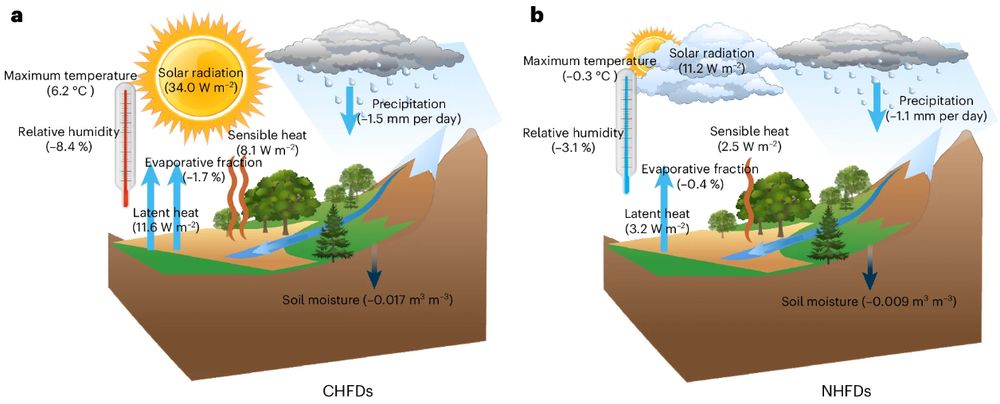
Schematic illustrations of the onset mechanisms of compound heat flash droughts and non-heat flash droughts
⚒️ Article: Flash droughts that are accompanied by extreme heat drive more severe and prolonged impacts on global ecosystems
@erichfischer.bsky.social @ethz.ch @louiseslater.bsky.social @sebastian-sippel.bsky.social @retoknutti.bsky.social
www.nature.com/articles/s41...

