I think about this everyday. It’s been a month but the scale of preventable suffering here continues to be unfathomable to me.
04.08.2025 21:23 — 👍 1 🔁 0 💬 0 📌 0I think about this everyday. It’s been a month but the scale of preventable suffering here continues to be unfathomable to me.
04.08.2025 21:23 — 👍 1 🔁 0 💬 0 📌 0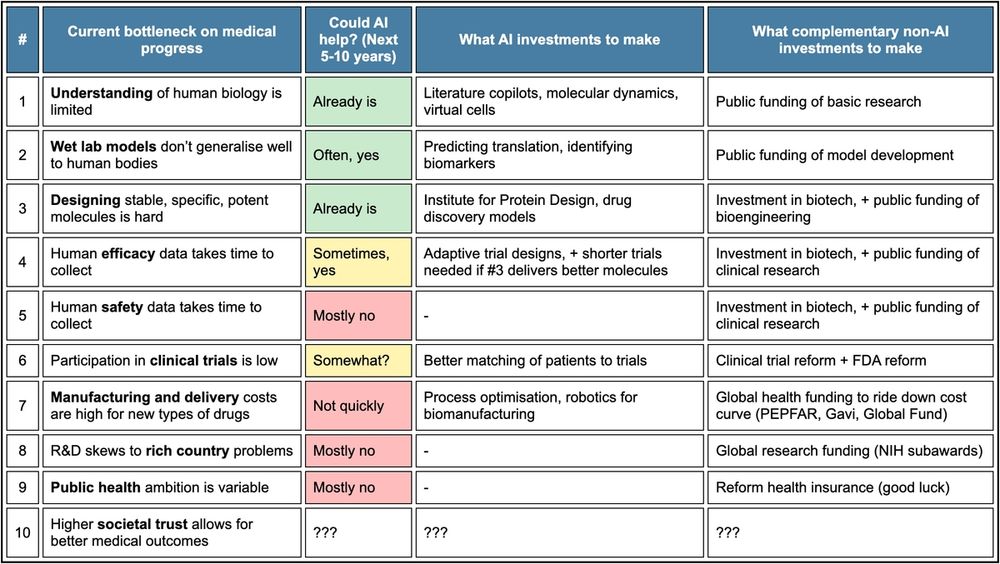
Look it's @jacobtref.bsky.social dropping three of the best blogposts of 2025.
“What does AI progress mean for medical progress?” gives a great overview.
Then it turns into a choose-your-own adventure to read about the bottlenecks AI won't solve *and* where it can still help.
Fascinating paper under fairly realistic conditions but the sample is fairly small. But never underestimate the ability of people to convince themselves the way to do something that feels easiest is actually best all things considered.
10.07.2025 22:57 — 👍 1 🔁 0 💬 0 📌 0
Here’s the underlying study which suggests that USAID saved the lives of nearly 92 million people from 2001-21.
Just in 2025 the cuts will cause the deaths of ~1.8 million, including nearly 700 thousand children under 5.

Ending USAID is a disaster on a scale I can barely comprehend.
For context 14 million people is more than the population of most countries today. It would be multiple times larger than the number of people who died in the Holomodor.
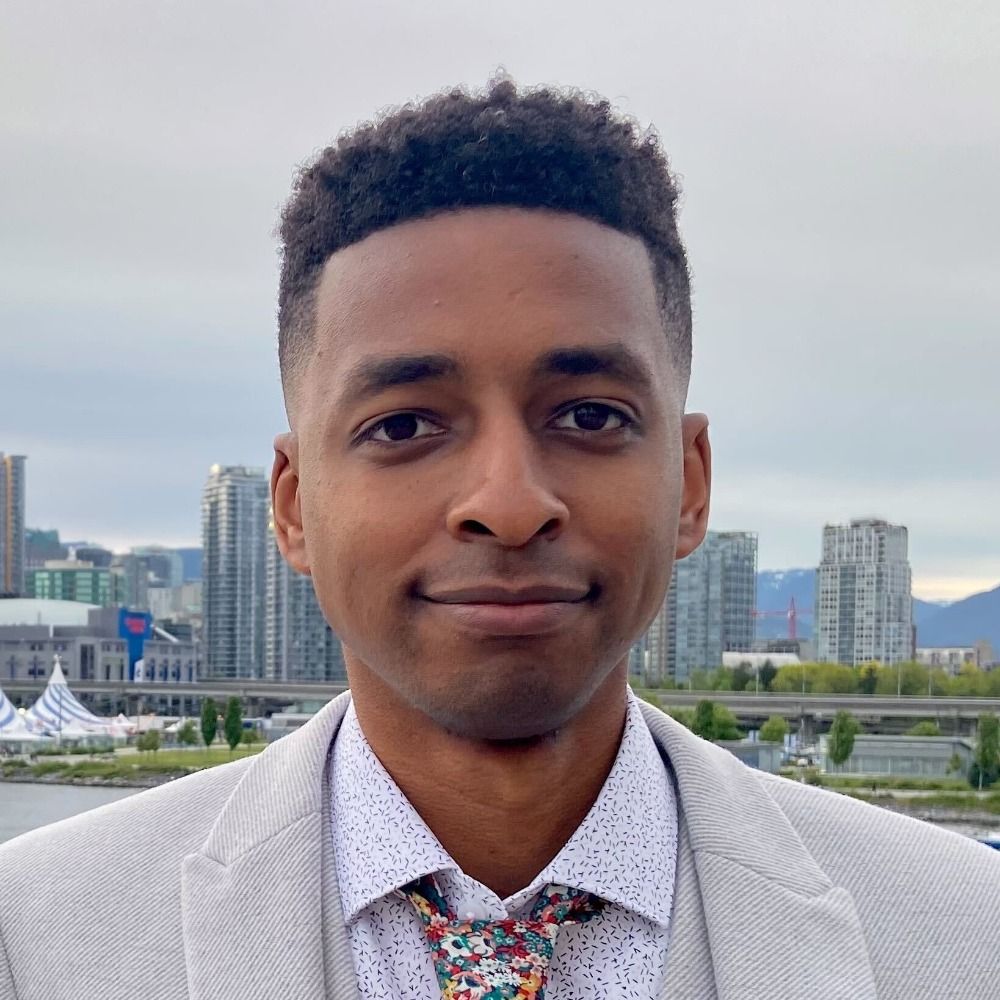
For context, this is kid me from the time I got tested for lead. He would want every kid to have a lead free future.
(He would also want some cake, what he's celebrating here. But who among us...)

Leading Rethink Priorities' work on lead exposure has been incredibly gratifying. I think that with more research, organizational capacity, and resources, we can achieve a lead-free future for our kids.
My full post on lead exposure, and efforts to end it: amarcusdavis.substack.com/p/how-my-chi...
This issue hits close to home for me. Chicago still has 400k+ lead pipes—the most of any US city. In my last apartment, from 2020-23, I spent $70/month on filtered water.
Around the world, millions face the same contamination, but aren't aware of the risks or can't afford protection.

Last year, major funders including @openphil.bsky.social, @gatesfoundation.bsky.social, and USAID launched the Lead Exposure Action Fund (LEAF), aiming to invest $100M+ by 2027—more than quintupling philanthropic resources dedicated to lead.
www.openphilanthropy.org/research/ann...
New organizations are stepping up to fix this. Lead Exposure Elimination Project's work in Malawi reduced "dangerously high" lead levels in paint from 50%+ to 33% in under 3 years. They've now expanded to 20 countries representing 45% of global infant births.
Inspiring work: leadelimination.org
But it's a problem we can solve. The global phase-out of leaded gasoline proved it's possible. However, only 43% of countries have legally binding restrictions on lead paint. In other words, more than half the world still allows manufacturers to sell toxic paint.
20.06.2025 13:30 — 👍 0 🔁 0 💬 0 📌 0Lead is everywhere: in batteries, paint, spices, water pipes, cosmetics, toys. Lead poisoning caused ~1.5M deaths in 2021 and costs low and middle-income countries $300-500 billion annually in reduced earnings from cognitive damage.
20.06.2025 13:30 — 👍 0 🔁 0 💬 2 📌 0
But globally? The picture is still devastating. 600-800 million children worldwide—1 in 3 kids on the planet—have blood lead levels of at least 5 mcg/dL. That's roughly the entire population of Europe. India alone has ~200 million affected children.
20.06.2025 13:29 — 👍 0 🔁 0 💬 1 📌 0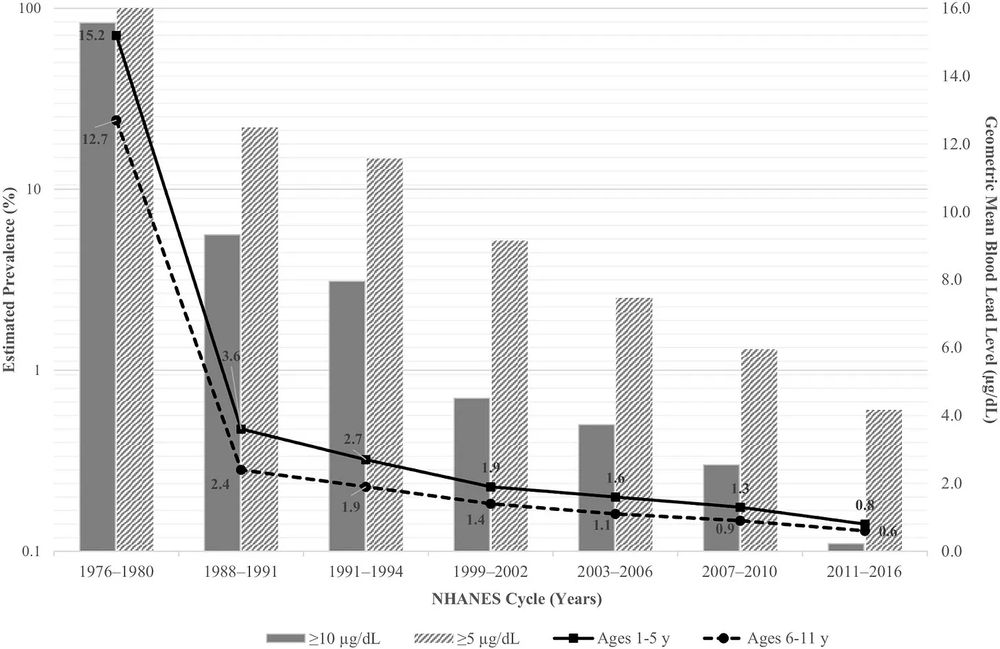
Progress in the US has been extraordinary. Mean blood lead levels in US kids dropped 95% from the late 1970s to 2016. Only 1% of kids under 11 now have levels above 5 mcg/dL (vs 99%+ in the late 70s). The CDC called it a top 10 public health achievement of the 21st century.
20.06.2025 13:29 — 👍 0 🔁 0 💬 1 📌 0Here's the thing about lead: there's NO safe level of exposure. As we learned more, the CDC kept lowering intervention thresholds—from 10 mcg/dL to 5 mcg/dL in 2012, then to 3.5 mcg/dL in 2021. Under today's standards, kid Marcus would have needed intervention.
20.06.2025 13:27 — 👍 0 🔁 0 💬 1 📌 0
Chicago was hit especially hard. Between 1993-1998, the city had to test 33-59% of kids under 7 EVERY YEAR. Chicago youth were 2-4x more likely to have severely elevated lead levels compared to the rest of Illinois.
20.06.2025 13:26 — 👍 0 🔁 0 💬 1 📌 0In the 1970s, *88%* of American children had blood lead levels over 10 mcg/dL. By the 90s (when I was tested), that figure had dropped to 9%—still alarming, but a massive improvement owed to interventions like the elimination of leaded gasoline.
20.06.2025 13:26 — 👍 0 🔁 0 💬 1 📌 0
I still remember getting my blood drawn for lead testing as an elementary schooler in Chicago. I was just under the intervention threshold of 10 mcg/dL. Many of my classmates weren't so lucky. Today, lead poisoning continues to afflict 800 million kids worldwide. 🧵
20.06.2025 13:25 — 👍 1 🔁 0 💬 1 📌 1
At a basic level, the ideas and arguments that guide our efforts to improve the world deserve scrutiny, whether they emerge from academic theory or hard-won experience.
Please join me in applying some of that scrutiny.
amarcusdavis.substack.com

Still, as much as others and I seek to improve the world, some people wish to undermine the values of equality, freedom, and opportunity that millions of people work every day to expand. So, having “charity for all” doesn’t mean being naive about those out to destroy you. After all, when Abraham Lincoln made that statement, he was in the middle of a civil war where hundreds of thousands of people had died, and his opponents wanted to impose a strict hierarchical, race-based slave society on the rest of the country.
I'm uncertain about how best to help improve the world, but I also know it would be naive to think everyone shares this vision.
After all, Lincoln originally proclaimed "charity for all" during the middle of a civil war!

Still this mandate is hard! I have real uncertainty about what to do.
At my day job, at Rethink Priorities, we've worked with a huge range of actors which includes GiveWell and Charity Navigator but also farm animal welfare, nuclear risk, and how to make decisions in the face of moral uncertainty.

This type of approach isn’t a panacea. I take each of these principles as guidelines, not dictates, and I have more than my share of quibbles with how particular people apply these principles in practice. I don’t want to just tease this, you will hear some of those quibbles and gripes in forthcoming posts as I think some of these are pretty substantive disagreements.
Broadly, I try to apply the principles of effective altruism, namely caring about the scope of how much good you can do, trying to be impartial, and explicitly recognizing there are tradeoffs to make as you can't support every cause. But this isn't a panacea.
These are guidelines, not dictates.

I'd add the moral constraint that when I seek to help, I want to help those who need it most, without regard to how much they resemble me or how close they are to my daily life. I don't think the accident of my birth in America should justify valuing Americans—explicitly or implicitly—as orders of magnitude more important than people from Bangladesh or Kenya. This means prioritizing based on need and impact rather than familiarity or convenience. To the extent I'm fortunate enough to be in a position to help others, I value charity for all.
That I work to do the same doesn't make me special. What I think does distinguish me a bit is how I approach doing good. I think we should seek to help improve the world as much as is viable.
This means not treating the accident of my birthplace as important. It means prioritizing based on need.

Millions of people get up every day and try to make the world a better place. This includes people from all walks of life. From people protesting governments, to those battling homelessness in wealthy countries, to those in low income countries working tirelessly to improve child nutrition.
17.06.2025 12:46 — 👍 0 🔁 0 💬 1 📌 0
I'm excited to announce I have a Substack: Charity for All. It's a blog about charity, the people in that space, and the broad political and philosophical landscape that shapes how we think about these topics.
substack.com/home/post/p-...
I feel like podcast episodes get longer as the show goes on, so someone should start a prediction market on how long the first 5 episodes will be on average. Non-zero chance episode 5 could be like 15 hours (of awesomeness).
12.06.2025 11:04 — 👍 2 🔁 1 💬 0 📌 0So exciting!
12.06.2025 11:01 — 👍 3 🔁 0 💬 0 📌 0I actually have a draft post on his insane defense of Richard Lynn from January but I can’t even get that out before this man argues that DEI is equivalent to firing people who watch the nukes and then having to hire them back.
02.03.2025 15:36 — 👍 1 🔁 0 💬 0 📌 0
I mean this man’s brain is cooked. This is caveating nonsense but he seems to think it is reasonable for some people to conclude that plane crashes could be linked to DEI
02.03.2025 15:30 — 👍 1 🔁 0 💬 1 📌 0