Adding this to my daily lexicon
07.01.2026 22:39 — 👍 0 🔁 0 💬 0 📌 0
@gllevine.bsky.social
Legal historian and fellow @policyintegrity, posting in a personal capacity gllevine.com
Adding this to my daily lexicon
07.01.2026 22:39 — 👍 0 🔁 0 💬 0 📌 0In most times and places, certainly in the U.S., the rule of politics has partly been a rule of law and vice versa. That doesn’t mean they’re conceptually, institutionally, or functionally identical.
07.01.2026 20:23 — 👍 0 🔁 0 💬 1 📌 0I can’t give a pithy answer — too much work to get on the same page about fundamentals. But query whether the “rule of politics” would simply replicate all the claimed virtues of the “rule of law.” Maybe the former is better on balance, but that doesn’t mean it strictly dominates in every respect.
07.01.2026 20:15 — 👍 0 🔁 0 💬 1 📌 0One needn’t have a dour view of politics; one need only think the functional separation between law and politics is useful, even if both have their virtues.
07.01.2026 19:57 — 👍 2 🔁 0 💬 1 📌 0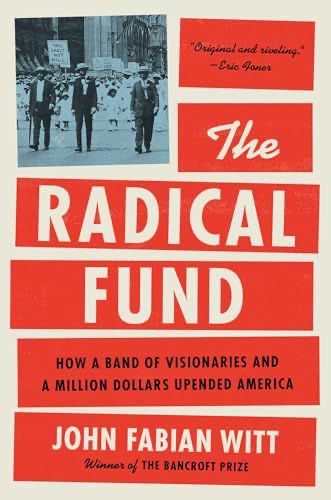
Starred review from @publisherswkly.bsky.social says The Radical Fund is “an immense and essential achievement” with an “exhilarating range of figures” and “stark parallels with the present.” www.publishersweekly.com/9781476765877
26.07.2025 12:22 — 👍 38 🔁 14 💬 1 📌 1Sure. There’s lots more to say, e.g., about whether Arendt got the history right, whether there’s an important theoretical break between totalitarianism and authoritarianism, whether her work is useful today, etc. I’m just trying to keep the various issues/concepts distinct.
11.03.2025 19:15 — 👍 0 🔁 0 💬 0 📌 0Of course, none of this amounts to a defense of Arendt’s account.
11.03.2025 18:46 — 👍 0 🔁 0 💬 0 📌 0That wasn’t clear to me from your initial post. The distinction matters because, for Arendt, totalitarianism was centrally defined by an all-encompassing ideology, which underwrote its claim to “natural law.” That’s potentially very different from an “arbitrary and capricious” authoritarianism.
11.03.2025 18:45 — 👍 0 🔁 0 💬 1 📌 0Not sure if you mean “totalitarian” rather than “authoritarian,” but if so, I don’t think this gets Arendt right. See, e.g., this post the1313.law.columbia.edu/2023/12/06/b... by @bernardharcourt.bsky.social
11.03.2025 18:11 — 👍 1 🔁 0 💬 0 📌 0
I’m very happy to see that my article, “Democratically Durable Regulation,” is now live at the American Journal of Law & Equality: direct.mit.edu/ajle/article...
I draw from dem theory, historical institutionalism, and adlaw to envision a new approach to regulatory review.
Hello! I am on the law teaching market this year. Looking forward to talking about the First Amendment and the conservative legal movement with anyone who'll listen.
31.07.2023 14:16 — 👍 19 🔁 4 💬 0 📌 0
I agree. And it is striking that many public-interest lawyers sought to defend litigation as democratic (with mixed success at best). You may enjoy my review of Sabin's book here: https://michiganlawreview.org/journal/beyond-big-government-toward-new-legal-histories-of-the-new-deal-orders-end/
07.07.2023 19:51 — 👍 1 🔁 0 💬 1 📌 0