Overlap and fragmentation in the global governance complex of sustainable finance, by Stefan Renckens & Christian Elliott
09.01.2026 15:51 — 👍 8 🔁 3 💬 0 📌 0
@sylvainmaechler.bsky.social
Postdoctoral researcher at the Geneva Graduate Institute PhD from University of Lausanne International political economy & Environmental politics Green accounting, Biodiversity govervance, Central banks http://sylvainmaechler.ch/
Overlap and fragmentation in the global governance complex of sustainable finance, by Stefan Renckens & Christian Elliott
09.01.2026 15:51 — 👍 8 🔁 3 💬 0 📌 0If you’re interested in green finance, accounting, or the politics of numbers, this one’s for you.
Many thanks to @mattkranke.bsky.social & Malcolm Campbell-Verduyn for putting together the special issue! 7/7
Our argument:
Green accounting works less as a solution than as a political economy of delay; a temporary socio-ecological fix. 6/7
This doesn’t mean green accounting is irrelevant. Its effects are real:
– producing urgency
– mobilising expertise
– creating new institutions
– sustaining the sense that economies are in the process of fixing themselves. 5/7
Despite these differences, they face a similar structural problem.
Across all three, green accounting struggles to wrestle with the conventional accounting infrastructure (GDP, financial reporting, valuation logics).
It circles the core infrastructure rather than transforming it. 4/7
We distinguish three major green accounting agendas:
1. Biophysical accounting since the 1980s
2. Natural capital accounting since the 1990s
3. Nature-related risk accounting since the 2010s
Different actors, different logics, different arenas. 3/7
In the past few yeaes, green accounting is repeatedly sold as revolutionary.
Yet novelty is often exaggerated. Green accounting has existed since the 1970s–80s, involving heterogeneous communities of actors with very different political projects and expectations. 2/7
New open-access paper out (with Valérie Boisvert) in @econsocjournal.bsky.social , as part of this great special issue!
Read it here: shorturl.at/L2Ui8
Core question: If conventional accounting is a growth infrastructure, then what exactly are the different forms of green accounting?
A short 🧵 1/7

Peaceful garden walkway with trees leading to a historic building.
'Failure-proof or failure-prone? The paradoxes of global biodiversity institutions' 🌳
Review of International Studies article & video abstract by Sylvain Maechler co-authored w/ Jacqueline Best 🎉
Read and watch here! 👉 https://ow.ly/2jmh50XBOSk
Environment and Climate Politics Working Group
@christianelliott.bsky.social @greenprofgreen.bsky.social @krdgnydn.bsky.social @matpaterson.bsky.social @vapunkt.bsky.social @pgolka.bsky.social @ryankatzrosene.bsky.social @rosiecollington.bsky.social @jvtk.bsky.social @greenfinanceobs.bsky.social @estherturnhout.bsky.social @kprodani.bsky.social
19.11.2025 06:42 — 👍 5 🔁 0 💬 1 📌 0Perhaps of interest to@lenseabrooke.bsky.social @monicadileo.bsky.social @jcgraz.bsky.social @stefanaykut.bsky.social @johnhoganmorris.bsky.social @nataschavanderzwan.bsky.social @vkluzik.bsky.social @pkashwan.bsky.social @james7jackson.bsky.social @amandine-orsini.bsky.social @jhollway.bsky.social
19.11.2025 06:42 — 👍 3 🔁 0 💬 1 📌 0Thanks to @uottawa.ca @cepi-cips.bsky.social for their support and providing open-access, and to @gvagrad-ggc.bsky.social
Thanks also to @etsingou.bsky.social @mattkranke.bsky.social @jhasselbalch.bsky.social for helpful comments on earlier version. 7/7
These strategies make institutions appear failure-proof, because they can always show progress: reports, conferences, new metrics, bigger networks.
But they also make them failure-prone, because they distract from the deeper failures of biodiversity governance. 6/7
Displacement happens when the work of creating biodiversity-related indicators and metrics becomes the main activity itself within these institutions. 5/7
19.11.2025 06:42 — 👍 1 🔁 0 💬 1 📌 0To cope with this discomfort, they rely on two strategies: diversion and displacement.
Diversion creates decoy activities that give the impression of progress — what we call governing by showing. 4/7
Drawing on the sociology of expertise, we show how they confront two forms of uncomfortable knowledge in biodiversity governance:
1️⃣ that three decades of efforts to “make biodiversity pay for itself” have largely failed, and
2️⃣ that biodiversity governance continues to fall short of its goals. 3/7
We examine two recent institutions:
1️⃣ the European Business and Nature Platform, which brings businesses together around “valuing nature”
2️⃣ the Network for Greening the Financial System, a coalition of central banks and financial supervisors measuring the financial risks of biodiversity loss 2/7
Why do global environmental institutions multiply and persist even when they seem unable to address biodiversity loss and environmental governance failures effectively?
Our new OA article with @jacquelinebest.bsky.social in @risjnl.bsky.social tries to answer this question. 1/7
cup.org/4hZNlcX

New report out now with @granthamlse.bsky.social CETEx: "A framework for central banks navigating political uncertainty in the transition"
cetex.org/publications...
Looking great!
Really excited for the panel I’m organising on biodiversity finance, featuring great papers by Klaudia Prodani @kprodani.bsky.social , Maud Borie, Roelien van der Wel, and co-authors like Natascha van der Zwan @nataschavanderzwan.bsky.social
After 1.5 fantastic years in Ottawa @cepi-cips.bsky.social with @jacquelinebest.bsky.social, I’m excited to continue my postdoc in Switzerland at @gvagrad-ggc.bsky.social, pursuing my research on the int. political economy of green finance & teaching global environmental politics!
shorturl.at/fMnIH
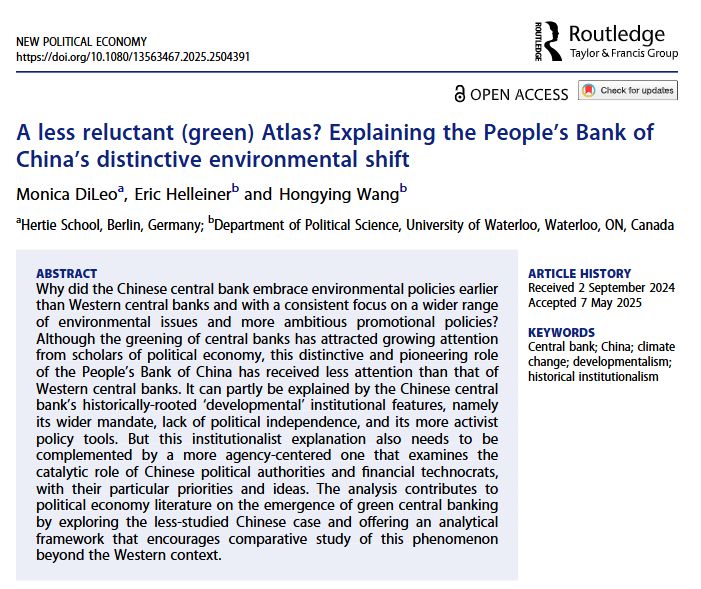
New (open access!) paper out now with Eric Helleiner and Hongying Wang in New Political Economy:
"A less reluctant (green) Atlas? Explaining the People’s Bank of China’s distinctive environmental shift"
1/ A brief thread 🧵
doi.org/10.1080/1356...
👇Same here👆
08.05.2025 07:52 — 👍 2 🔁 1 💬 0 📌 0Looking forward to participating and presenting our paper with @christianelliott.bsky.social on nature risk scenarios!
23.04.2025 18:13 — 👍 2 🔁 1 💬 1 📌 0
Authors: Jacqueline Best, Matthew Paterson, Ilias Alami, Daniel Bailey, Sarah Bracking, Jeremy Green, Eric Helleiner, James Jackson, Paul Langley, Sylvain Maechler, John Morris, Stine Quorning, Adrienne Roberts, Jens van’t Klooster, Robert Watt and Stanley Wilshire. Abstract: In this article, we survey the literature on central bank action on climate change, focusing particularly on how the combined crises of COVID-19, inflation, and Ukraine have affected this action. We argue that the current situation is a critical juncture in which recent crises have created a highly indeterminate situation regarding what central banks might do regarding climate change. To date, some central banks have used these crises as opportunities for expanding their role while others have succumbed to pressure to withdraw from climate action. We explore three dynamics that generate this openness to various potential trajectories for climate action...
New article!
This review surveys the state of knowledge regarding central bank activity on climate change, and argues that there is considerable indeterminacy in the trajectory of this activity & its potential to contribute to effective climate action.
doi.org/10.1080/0964...
I’m thrilled to see this article published with a fantastic group of scholars!
31.03.2025 11:20 — 👍 2 🔁 0 💬 0 📌 0Thank you very much Klaudia, it's super interesting and useful!
31.03.2025 11:16 — 👍 0 🔁 0 💬 0 📌 0Huzzah! My latest book is now published! It offers an introduction to the contemporary debate about the relationship between growth and environmental sustainability. I have a few free copies I can send students and ECRs - if you want to enter the draw, reply with 🙋🙋♀️🙋🏻♂️
elgaronline.com/view/book/97...
A quick summary 🧵 !
🌍🌍🌍 @kprodani.bsky.social and I make two new claims, provocatively stated: (i) Quantifying climate transition risk is easy, biodiversity is not (ii) The most recent regulatory strategies entirely escape the "risk-based approach" said to dominate prudential policy. /1


For early birds at the @isanet.bsky.social Chicago, come tomorrow morning for our presentation on Biodiversity Scenarios and Climate’s (Un)Learned Lessons with @christianelliott.bsky.social
Other great papers including from @krdgnydn.bsky.social