Long thought to have possessed a trunk, recent research indicates this wasn't the case. However, this "paleomeme" is still very common.
Haven't watched #PrehistoricPlanetIceAge (yet!), and I'm excited to see their depiction of this species without the classic trunk!
#Megafauna
#Iceage #fossil
05.12.2025 23:53 — 👍 2 🔁 0 💬 0 📌 0

Traveling through South America, I've seen many fossils big and small - so many that I should start my own #FossilFriday posts!
Macrauchenia, one of the last and largest of the litopterns, a South American lineage that is totally extinct. Apparently, Macrauchenia had a remarkable nose ->
05.12.2025 23:48 — 👍 14 🔁 3 💬 1 📌 0
And of course, many colleagues and friends have helped me in completing this project, but most of all my supervisors, Meirav Meiri and Nimrod Marom @nxmarom.bsky.social - who introduced me to this fantastic antelope, to their fields of research and supported me along the way 🙏🏼
03.12.2025 03:09 — 👍 1 🔁 0 💬 0 📌 0

Me with a skull of a (North African) Bubal hartebeest at the MNHN collections, 2023. The gannet did poke me in the head.
I've worked on this thesis (part time) for around 3 years, and it is very fulfilling to see it finally published for the world to see! And who knows, maybe even set the seeds for a new species reintroduction project in the Levant. 13/13
03.12.2025 01:35 — 👍 3 🔁 0 💬 0 📌 0
In the discussion we talk about the possibility of reintroducing hartebeest to the Levant, and some genetic and ecological benefits of such a project.
Today the species is mostly restricted to natural reserves and parks, and populations are more fragmented than ever
#rewilding #reintroduction 12/13
03.12.2025 01:33 — 👍 3 🔁 0 💬 1 📌 0

Figure 5 of the paper. A shows predictions of the ecological niche model to 21st century global climate model GFDL-ESM4, assuming both milds (ssp126) and severe (ssp585) climate change scenarios. B, boxplots showing iterations of the mean predicted climatic suitability in the southern Levant, concentrated on the same area as in A. Results for all combinations of climate models and shared socioeconomic pathways are shown.
We took it one step further and applied the ecological model to different climate change scenarios for the 21st century. All different scenarios, even extreme ones, predict a minor decline in suitable habitat. 11/13
03.12.2025 01:33 — 👍 3 🔁 0 💬 1 📌 0
This lends support to human pressures - not only hunting, but pastoralism and agriculture too - as the culprit behind the earliest case of hartebeest extinction. Many other hartebeest populations met the same fate at human hands, especially in the 19-20th century. 10/13
03.12.2025 01:31 — 👍 4 🔁 1 💬 1 📌 0

Figure 4 of the paper. A, boxplot graph showing spread of average climatic suitability for hartebeest in the Levant, over different time periods tested. In the right side is the O18 isotope data from the Soreq cave, indicator of precipitation.
B shows individual projections of the ecological niche model to different time periods in the Levant, with suitable habitat indicated by colours and threshold.
The climatic model shows that during the #Holocene (and even before) suitable habitat for hartebeest was present in the southern Levant, and is still present today. The most significant cooling and drying event occurred mid-Holocene, yet hartebeest were still around after that 9/13
03.12.2025 01:31 — 👍 4 🔁 1 💬 1 📌 0
To learn more about the cause of extirpation, I trained Ecological Niche Models based on present day distribution of hartebeest and bioclimatoc variables. This could reveal if a climatic shift during the Holocene was strong enough to affect hartbeest in any way.
#ecology #enms #modelling #R 8/13
03.12.2025 01:29 — 👍 3 🔁 0 💬 1 📌 0

Figure 3 of the paper. Two phylogenetic trees, tree A of different hartebeest subspecies, and tree B including other alcelaphines.
In our phylogenetic analysis the Levantine hartebeest is nested deep within the Bubal+western Hartebeest clade. In other words, we have genetic evidence confirming the hitherto null hypothesis, and no support for East African affinities. 7/13
03.12.2025 01:28 — 👍 7 🔁 2 💬 1 📌 0

Hartebeest skulls at the collections of the Musee National d'Histoire Naturelle, Paris.
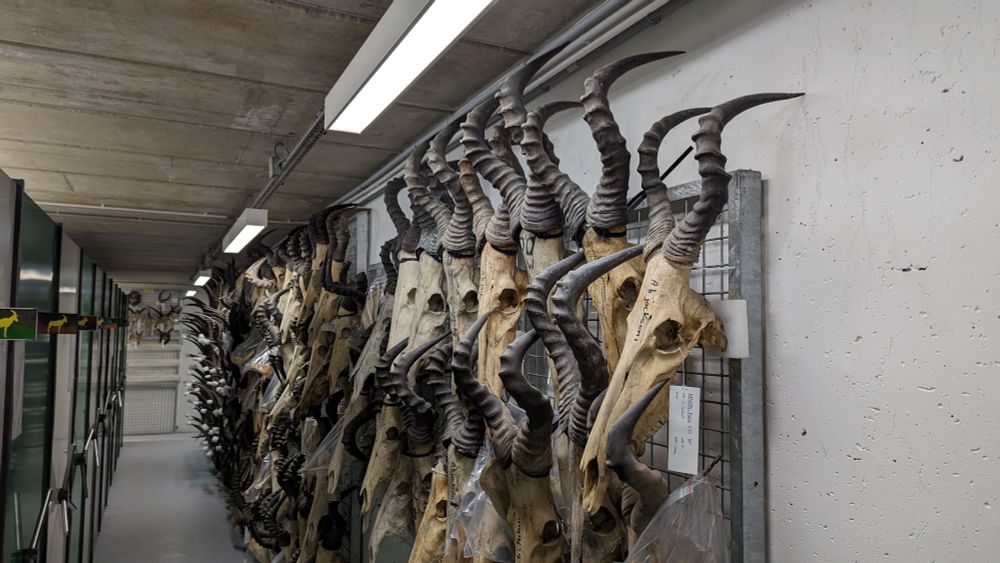
Hartebeest skulls at the collections of the Musee National d'Histoire Naturelle, Paris.
We extracted DNA from less sampled hartebeest populations, especially the Bubal and Tora hartebeest (the two geographically closest forms, too). Many thanks to the staff at the MNHN in Paris for access to their collections, as there are very few specimens of these taxa! 6/13
03.12.2025 01:27 — 👍 3 🔁 0 💬 1 📌 0

Figure 2 of the paper. A map of the southern Levant showing archaeological sites with reported hartebeest occurrence.
A real challenge was extracting DNA from archaeological Levantine remains. The Negev desert is not ideal for genetic materials! Luckily, after several attempts and using mammalian mtDNA capture, we obtained good coverage for two of the most recent samples (Nessana)
#archaeology 5/13
03.12.2025 01:24 — 👍 3 🔁 0 💬 1 📌 0
In the paper we extracted the #aDNA of the Levantine hartebeest and compared it to other ssp. - is it a Bubal, or something distinct?
We also tried to infer the cause of #extinction of this population, centuries earlier than any other. Are humans to blame, or a local climatic shift? 4/13
03.12.2025 01:23 — 👍 3 🔁 0 💬 1 📌 0

Illustration of the Bubal hartebeest (A.b. buselaphus). A tall, tan antelope with distinctive curved, swept back horns. Published in Sclater and Thomas (1894). Image in public domain.
The Levantine hartebeest was never thoroughly studied, and often assumed to be the same as the Bubal, hartebeest of North Africa, which became extinct c. 1920's. This is the first work evaluating the affinities and extinction of the levantine hartbeest in detail. 3/13
03.12.2025 01:21 — 👍 3 🔁 0 💬 1 📌 0

Figure 1 of the paper, a map of Africa and the Middle East with colour indexed historical ranges of different hartebeest subspecies.
It used to range all across the continent - and even ventured into the Levant, becoming the only alcelaphine to set foot out of Africa!
The Levant is also the earliest known local extinction of the species, with last confirmed records dating to the middle ages. 2/13
03.12.2025 01:19 — 👍 6 🔁 1 💬 1 📌 0

Red hartebeest (Alcelaphus buselaphus caama), photographed at Mokala National Park, South Africa. Red hartebeest are the most numerous population of the species in the 21st century. Very different from the Levantine hartebeest. ©️ Uri Wolkowski

Title of new publication, Wolkowski et al. 2025.
I'm glad to share my M.Sc thesis about the extinct Levantine #hartebeest , now published and #openaccess ! Link following 🧵
The hartebeest is a staple antelope of eastern and southern African savannahs. However, the species had a far wider past distribution 1/13
03.12.2025 01:18 — 👍 9 🔁 3 💬 2 📌 1


Plaza Huincul is far from being a classic tourist destination. This statue and the museum are about it.
But for 20 years I've dreamt of coming here, to see the remains of giants like Argentinosaurus, in the lands they used to roam. And I'm very lucky and glad I could make this dream come true 🦕
26.11.2025 18:44 — 👍 0 🔁 0 💬 0 📌 0


The new discoveries do illuminate what Argentinosaurus might have looked like - with 7 vertebrae and a few other bones, we can't know too much. The 2003 skeletal mount at the museum is now outdated, but still captures the absolute size of the animal.
Other replicas are on show, like Giganotosaurus
26.11.2025 18:37 — 👍 0 🔁 0 💬 1 📌 0

Despite the discovery of newer, more completely known giants like Patagotitan, the remains of Argentinosaurus still give it a leading edge for the title of largest land animal known (even if some other verts might have been a little longer, looking at BYU 9024 👀).
26.11.2025 18:32 — 👍 0 🔁 0 💬 1 📌 0

The figure used in my News & Views commentary. I generated the CT-based rendering of the holotype skull of Nanotyrannus lancensis (CMNH 7541), based on a recent scan. The lower image was done by the Nature art department.

Here's the free link to the print version that I'm permitted to share: https://rdcu.be/eNv94. You can't download it but you can screen-capture its two pages if you really need a copy.

Our casts of (bottom) the holotype of Nanotyrannus lancensis (CMNH 7541), (middle) the newly named holotype of N. lethaeus (BMRP 2002.4.1), and (top) T. rex (AMNH 5027). We published on CMNH 7541 in 2010 (http://bit.ly/3X5nCGm).
Today's bombshell in @nature.com by Lindsay Zanno & James Napoli @jgn-paleo.bsky.social (bit.ly/4qBE6ng) shows that putative juvvy T. rex fossils actually are Nanotyrannus. I reviewed the manuscript, so Nature invited me to write the News & Views commentary. Free link: rdcu.be/eNv94 🦖
30.10.2025 21:42 — 👍 136 🔁 47 💬 2 📌 1
Exciting to hear about another member of the tribe!
20.10.2025 17:05 — 👍 2 🔁 0 💬 1 📌 0
Noooo Jane Goodall died!
She was one of the best exemplars of something I believe to my very core: that empathy is often an essential ingredient in good science.
01.10.2025 19:01 — 👍 1097 🔁 105 💬 29 📌 3


Just came out of two hours of teaching early humans and primates to hear that Jane Goodall has sadly died. The legacy and impact of this human is beyond measure. She brought us closer to each other, closer to primates and face to face with our evolutionary inheritance.
01.10.2025 18:31 — 👍 283 🔁 52 💬 6 📌 2

Jane Goodall crouched down and reaching out as a baby chimp reached out to touch her
I hope people spend days and days talking about her (she is 10,000,000 times more important than Charlie Kirk) and the amazing work she did.
This photo will always be so powerful and as defining of who we all can be.
Be like Jane Goodall.
Photographer: Hugo van Lawick
01.10.2025 19:48 — 👍 230 🔁 65 💬 3 📌 1
I am filled with so much love and gratitude that I cannot grieve. Dr. Goodall worked tirelessly in her gentle, hopeful way for a better world for all life on Earth. She has laid down her field notebook for the last time; now it is for us to fill with wonder, joy, and connection, into infinity.
01.10.2025 19:59 — 👍 325 🔁 56 💬 4 📌 4

"WE'VE ARRANGED A society based on science and technology, in which nobody understands anything about science technology. And this combustible mixture of ignorance and power, sooner or later, is going to blow up in our faces. Who is running the science and technology in a democracy if the people don't know anything about it?"
"Science is more than a body of knowledge, it's a way of thinking. A way of skeptically interrogating the universe with a fine understanding of human fallibility. If we are not able to ask skeptical questions, to interrogate those who tell us that something is true, to be skeptical of those in authority, then we're up for grabs for the next charlatan, political or religious, who comes ambling along."
I think a lot about what Carl Sagan said in one of his final interviews.
04.05.2025 06:21 — 👍 18578 🔁 6324 💬 248 📌 279
NSF EAR Postdoctoral Fellow at the Field Museum of Natural History. Tetrapods in deep time: evolution, development, and paleontology. Also: mountains.
Zooarchaeology
Taphonomy
Prehistory
Nature
Postdoc at @uonclassarch.bsky.social
https://www.researchgate.net/profile/Meir-Orbach
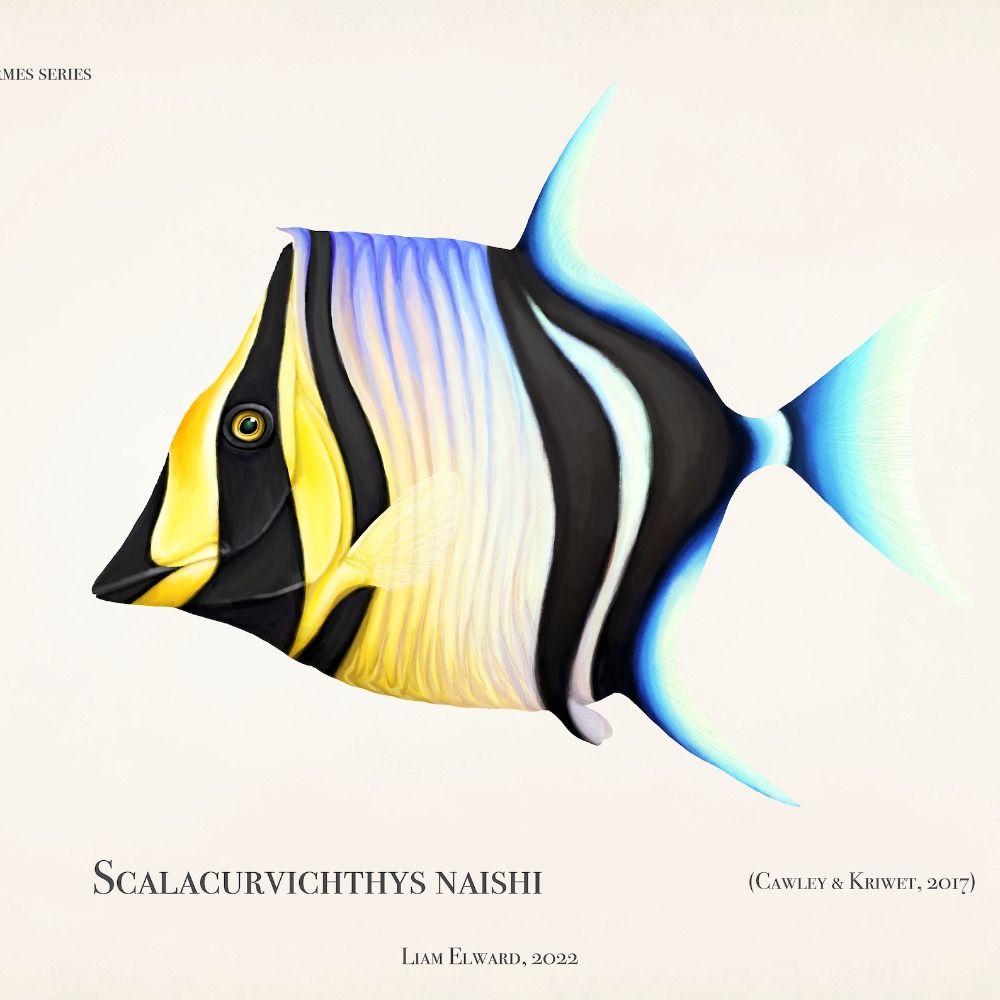
Chicago-based paleoartist. He/him. Email for commissions/inquiries at liam_elward@yahoo.com
Palaeoartist, palaeontologist, author, documentary consultant and creature designer. Affiliated with the University of Portsmouth, UK; views and opinions are my own.
More about me at markwitton.co.uk.
Support my work at www.patreon.com/markwitton
Editor in Chief, MeidasNews. Former Fed & State Prosecutor, Marine, Attorney. Switched parties from R to D in 2020. MeidasPlus.com/subscribe
Writer for Love in the Time of Chasmosaurs - Creator of the speculative evolution project "A New Age of Reptiles" - Natural History and Palaeontology Pop Culture - 27 - (she/her) -
Our mission: To provide tools and resources to foster a diverse, friendly, and inclusive community of data science learners and practitioners. Join us at https://dslc.io
A vaguely humanoid, ambiguously artistic, debatably humorous entity from the periphery of civilization. No longer able. Just here to fix shelves and feed the cats.
She/her ADHD LGBT+ 🏳️⚧️
Prof. Daniel Field's bird evolution and palaeontology lab at the University of Cambridge. We watch living birds and write papers about dead ones. Lab website: fieldpalaeo.com
Ancient DNA researcher at Centre of New Technologies, University of Warsaw, Poland
#aDNA, #paleogenomics, #domestication, #conservation, #BaBBe
Ancient DNA Lab at the Center for New Technologies, University of Warsaw. Working on 🦇🐿️🐀🦌🐻🫎🐐🐈⬛🧔♂️🦇🐎 and more!
http://adna.cent.uw.edu.pl/
Arthropod Evo-Devo biologists based at the Hebrew University. Interested in body-plan evolution (especially segments and tagmata), the evolution of complexity and the evolution of diversity.
Author of text-book: Organismic Animal Biology
Archaeologist, head of the Human Palaeosystems Group at the MPI-GEA, Reader at the University of Cologne, A/Prof at the University of Malta & NatGeo Explorer. Human evolution, niche expansion & the transition to human dominated landscapes.
Concept- & content developer new Natural History Museum UniZurich; Island biologist w. fetish for giant tortoises (Aldabrans!) & rewilding 🐢
Fond of Gessner (x2) & Scheuchzer; lover of old books, older fossils, history of science & music of metal
Author. Tigers Between Empires (2025). Owls of the Eastern Ice (2020, Best Book per NYT/WSJ, PEN America winner, Nat Book Award longlist). Work: Regional Director Temperate Asia @wcs.org. Home: Mpls https://linktr.ee/jslaght
Climate, extinction, and biodiversity scientist researching Earth’s past for a better future. Writing and podcasting for the planet. Chaotic good professor. Forever DM. Working to be a good ancestor. She/her. @makeaplanetpod.bsky.social
Researching why legless lizards and snakes don't have feet. (She/her) 😷
convergent evolution, paleontology, ADHD, disability rights, grants, whatever my hyperfixation is this week.
kkoeller3115.wixsite.com/kristakoeller
https://twitter.com/KristaLerista
Marine mammal paleontologist, artist, snorkeler, beachcomber, tidepool enthusiast. Blog: www.coastalpaleo.blogspot.com
Curator, fossil reptiles and amphibians, at Natural History Museum London UK. Honorary positions at UCL and University of Adelaide. #tuatara 🦎 #Cymraeg He/Him
Orcid: 0000-0002-0146-9623