#ICYMI We were joined by Dr. Elias Sotirchos to discuss vaccines in the setting of immunocompromised patients. www.youtube.com/watch?v=7VCE...
This program was made possible with support from Alexion Pharmaceuticals

@esotirchos.bsky.social
#ICYMI We were joined by Dr. Elias Sotirchos to discuss vaccines in the setting of immunocompromised patients. www.youtube.com/watch?v=7VCE...
This program was made possible with support from Alexion Pharmaceuticals
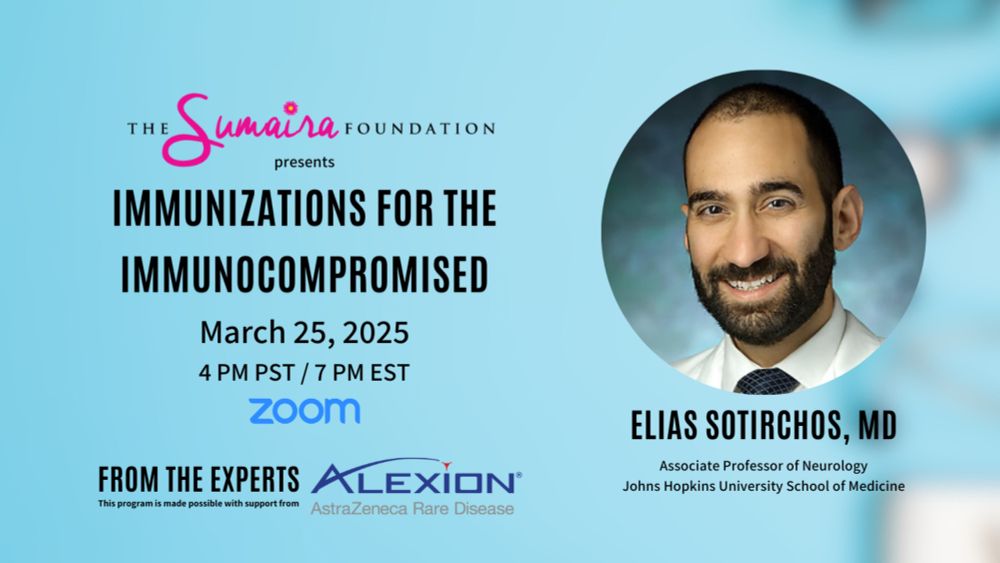
#MedSky Vaccines play a crucial role in protecting immunocompromised patients & help prevent the spread of diseases.
Join us on March 25th for a discussion led by Dr. @esotirchos.bsky.social
To register, visit us02web.zoom.us/webinar/regi...

#URGENT: #MultipleSclerosis research funding at risk: contact Congress today!
The Continuing Resolution to fund the government cuts funding by 57%
The #MS Society has an action alert urging Members of Congress to oppose these cuts here nmss.quorum.us/campaign/113...
Please take action and #share!
 10.03.2025 22:35 — 👍 9 🔁 5 💬 1 📌 2
Pleased to write this editorial with Larry Steinman about a potential novel antibody in MS
www.neurology.org/doi/10.1212/...
Original manuscript here:
www.neurology.org/doi/10.1212/...
In these situations, especially if live CBA is not available for follow-up testing in patients with high suspicion for MOGAD or AQP4+ NMOSD, clinical and imaging phenotypic characteristics need to be relied on more heavily to help guide appropriate management.
05.02.2025 20:54 — 👍 0 🔁 0 💬 0 📌 0We must recognize though that fixed CBAs may be the only assays readily accessible, especially in resource-limited settings.
05.02.2025 20:54 — 👍 0 🔁 0 💬 1 📌 0These results support that using exclusively fixed CBAs may miss many cases resulting in misdiagnosis and consequently suboptimal treatment, but also has significant implications for characterizing "double-seronegative" NMOSD.
05.02.2025 20:54 — 👍 0 🔁 0 💬 1 📌 0Live CBA had markedly better sensitivity, especially for MOG-IgG testing, with very good specificity for both live and fixed CBA (notably specificity was 100% for AQP4-IgG by both assays).
05.02.2025 20:54 — 👍 0 🔁 0 💬 1 📌 0
Excited to share out study (led by Yana Said and in collaboration with colleagues at the Mayo Clinic) reporting our real-world clinical experience with paired fixed and live CBA testing for MOG-IgG and AQP4-IgG.
onlinelibrary.wiley.com/doi/10.1002/...
A bill to break up UnitedHealth, CVS, Cigna and more has been introduced by a bipartisan group of U.S. senators and representatives.
The legislation would force insurers to sell their pharmacy businesses.
It aims to combat PBMs, pharma middlemen who drive up costs.
A multi-center, randomized-controlled, open-label, rater-blinded, pragmatic trial “Treatment of Inflammatory Myelitis and Optic Neuritis with Early vs Rescue Plasma Exchange” that is planned to commence in the United States in 2025.
04.12.2024 15:42 — 👍 1 🔁 0 💬 0 📌 0Regardless though, a randomized controlled clinical trial is needed to further inform the use and timing of PLEX for treatment of severe demyelinating attacks. This is why we are pursuing (together with co-PI
Dr. John Chen from Mayo), the TIMELY-PLEX trial:
Performing additional analyses, including a formal comparison of 1st-line PLEX recipients vs those who received only corticosteroids, accounting/matching for relevant variable such as demographics, attack severity etc can help provide further insight into these findings.
04.12.2024 15:42 — 👍 0 🔁 0 💬 1 📌 0So unless we think that PLEX actually worsens clinical outcomes (which seems unlikely), it should be fairly clear that this is likely driven by selection bias.
04.12.2024 15:42 — 👍 0 🔁 0 💬 1 📌 0Notably, in this study patients treated with only corticosteroids for their attacks had BETTER disability than those who received PLEX at the last follow-up, despite similar demographics and clinical characteristics.
04.12.2024 15:42 — 👍 0 🔁 0 💬 1 📌 0This is a huge selection bias that is present in all retrospective studies of PLEX in NMOSD and MOGAD, since the analysis is restricted only to those who received PLEX.
04.12.2024 15:42 — 👍 0 🔁 0 💬 1 📌 0PLEX is not done as a 2nd or 3rd-line therapy randomly, but because patients did not significantly improve or even worsened after 1st line therapy. Conversely, many of those who received PLEX as a first-line therapy may have improved with just corticosteroids.
04.12.2024 15:42 — 👍 0 🔁 0 💬 1 📌 0
jnnp.bmj.com/content/earl... This is an interesting study. Need to be careful though with potentially overinterpreting this and other retrospective observational studies purported to prove the effectiveness of early PLEX. My detailed rapid response to this article here: jnnp.bmj.com/content/earl...
04.12.2024 15:42 — 👍 6 🔁 2 💬 1 📌 0
Time to strike the label
“Lupus Myelitis” … Forever ✅
What say you, #MedSky #RheumSky #NeuroSky?
🧠🎙️ Neurology Podcast: Dr. @esotirchos.bsky.social discusses the underlying etiologies of myelitis in patients with rheumatologic disease.
Listen now: bit.ly/48VRPwC