FirstScope 76 affordable kids fun April 2025 - Science lovers, dive into the cosmos with the 3D Solar System Model Kit! A must-have for space geeks!--> https://amzn.to/3ErpC6l #Science #AmazonAffiliate #Share #Like
25.04.2025 20:00 — 👍 2 🔁 0 💬 0 📌 0
@sciencefeed.bsky.social
🔬🧬 | ScienceFeed | 🌍✨ Your daily dose of the latest discoveries, cutting-edge research, and thought-provoking discussions in science and tech. From space exploration to health breakthroughs—unlocking the mysteries of our universe, one post at a time.
FirstScope 76 affordable kids fun April 2025 - Science lovers, dive into the cosmos with the 3D Solar System Model Kit! A must-have for space geeks!--> https://amzn.to/3ErpC6l #Science #AmazonAffiliate #Share #Like
25.04.2025 20:00 — 👍 2 🔁 0 💬 0 📌 0
N79 spans 1630 ly in LMC - Science lovers, dive into the cosmos with the 3D Solar System Model Kit! A must-have for space geeks!--> https://amzn.to/3ErpC6l #Science #AmazonAffiliate #Share #Like
25.04.2025 19:58 — 👍 3 🔁 1 💬 0 📌 0
Cats Paw Nebula massive star clusters - Science lovers, dive into the cosmos with the 3D Solar System Model Kit! A must-have for space geeks!--> https://amzn.to/3ErpC6l #Science #AmazonAffiliate #Share #Like
25.04.2025 19:57 — 👍 2 🔁 1 💬 0 📌 0
IC 1623 compact center in Webb - Science lovers, dive into the cosmos with the 3D Solar System Model Kit! A must-have for space geeks!--> https://amzn.to/3ErpC6l #Science #AmazonAffiliate #Share #Like
25.04.2025 19:53 — 👍 3 🔁 1 💬 0 📌 0
Protons stay stable unlike free neutrons - Science lovers, dive into the cosmos with the 3D Solar System Model Kit! A must-have for space geeks!--> https://amzn.to/3ErpC6l #Science #AmazonAffiliate #Share #Like
25.04.2025 19:49 — 👍 1 🔁 0 💬 0 📌 0
"Negative time" observed in new quantum experiments, surprising scientists www.earth.com/news/negativ...
01.01.2025 18:08 — 👍 11 🔁 5 💬 0 📌 1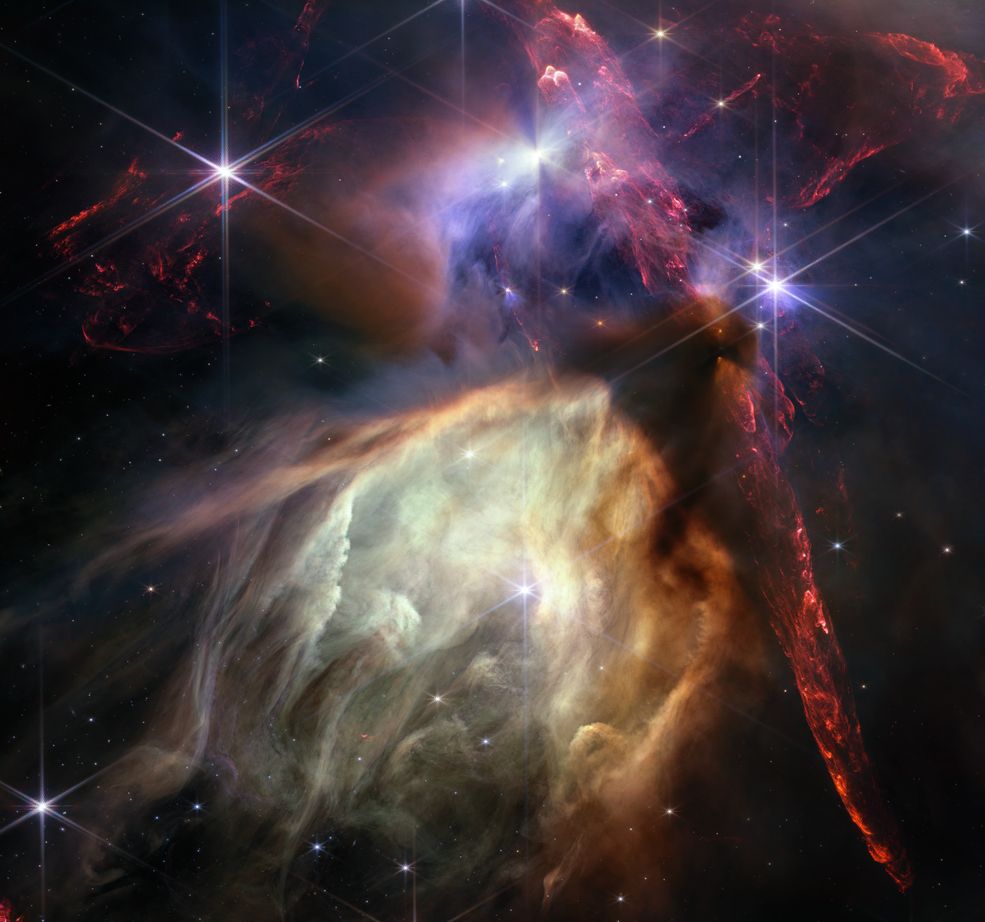
The James Webb Space Telescope's image of the Rho Ophiuchi cloud complex provides new clarity on a brief period in the stellar lifecycle by capturing the intricate details and processes involved in star birth. Here's how this image enhances our understanding of this phase: Detailed Visualization: The image taken by the James Webb Space Telescope reveals a close-up view of the Rho Ophiuchi cloud complex, which is a relatively small and quiet region of space where stars are being born. The telescope's high-resolution capabilities and advanced instruments allow us to see the intricate structures, illuminated gases, jets of hydrogen, and even dense cocoons of dust within the cloud complex. This level of detail provides us with unprecedented insights into the physical processes occurring during the formation of stars. Observation of Young Stars: The image showcases approximately 50 baby stars within the Rho Ophiuchi cloud complex. Scientists have determined that these stars are no bigger than our sun. This observation is significant because it offers a unique opportunity to study stars in their infancy and gain a better understanding of their formation and evolution. By examining the characteristics and properties of these young stars, astronomers can refine existing models and theories about stellar birth.
Mindblowing image from the James Webb Telescope Reveals Unprecedented Details of Star Birth in the Rho Ophiuchi Cloud Complex. Inspired to explore the cosmos with a telescope? Get your own telescope here 👉 amzn.to/49g9lvS #SpaceInspiration #AmazonAffiliate, save $200 with this offer bit.ly/3Pf3sWs
28.12.2024 15:30 — 👍 114 🔁 10 💬 0 📌 2
NASA’s Parker Solar Probe Reports Successful Closest Approach to Sun #NASA science.nasa.gov/science-rese... #SolarProbe
27.12.2024 19:15 — 👍 23 🔁 7 💬 0 📌 0
Biodiversity Alert: A new species of electric-blue tarantula has been discovered in Thailand. Its vibrant color serves as a warning to predators. 🐜🕷️ #NewSpecies #Biodiversity #Nature www.usatoday.com/story/news/w...
24.12.2024 15:31 — 👍 6 🔁 0 💬 0 📌 0Quantum Leap: Scientists have made a breakthrough in quantum computing, achieving the longest coherence time yet for a qubit! This could revolutionize how we process information. #QuantumComputing #TechBreakthrough
24.12.2024 15:27 — 👍 6 🔁 1 💬 0 📌 0Did you know? The Venusian day is longer than its year! It takes Venus 243 Earth days to rotate once on its axis but only 225 Earth days to orbit the Sun. 🌍🔄 #VenusFacts #SpaceScience
24.12.2024 15:26 — 👍 1 🔁 0 💬 0 📌 0What’s scarier: the vast emptiness of space or the fact that most of it is something we can’t see or understand? Dark energy, we’re looking at you! #ScienceQuestions
20.12.2024 03:32 — 👍 5 🔁 1 💬 1 📌 0What's your favorite Brian Cox Talk Show ? This guy is a genius! #BrianCoxTalks
19.12.2024 19:04 — 👍 9 🔁 2 💬 2 📌 0
Have aliens visited Earth? Watch as Brian Cox dives into the science, skepticism, and possibilities of extraterrestrial encounters.
👀 What’s your take? Let’s debate below!
#Aliens #Science #BrianCox www.youtube.com/watch?v=GVkF...

Is time travel possible? #BrianCoxTalks www.youtube.com/watch?v=GEFB... #Space #TimeTravel
17.12.2024 18:15 — 👍 7 🔁 2 💬 0 📌 1
Earth compared to all its water and air. From space, Earth looks like a water planet, with oceans covering more than 70 percent of its surface with an average depth of 14,000 feet (4267 meters). However, if every drop of water in the world was collected into a sphere, it would be just 869 miles (1400 km) across – barely big enough to cover Eastern Europe. The image also shows all the air in the atmosphere (5140 trillion tonnes of it) gathered into a ball at sea-level density. Illustration: Félix Pharand-Deschênes, Concept: Adam Nieman.
Earth compared to all its water and air. From space, Earth looks like a water planet, with oceans covering more than 70 percent at depth of 14,000 feet (4267 meters). However, if every drop of water in world was collected into a sphere, it would be just 869 miles (1400 km) across. #Earth #Air #Water
13.12.2024 17:10 — 👍 4 🔁 3 💬 0 📌 0
Brian Cox on how black holes could unlock the mysteries of our universe. www.youtube.com/watch?v=pGsb... #BrianCox #BlackHoles
11.12.2024 16:24 — 👍 29 🔁 4 💬 0 📌 0
Professor Brian Cox breaks down the mystery of the "God Particle"! Discover how the Higgs boson shaped our understanding of the universe and why it matters.
🎥 Watch now: www.youtube.com/watch?v=HLpK...
#BrianCox #GodParticle #Physics #HiggsBoson #ScienceExplained

The north polar region of Jupiters volcanic moon Io was captured by NASAs Juno during spacecrafts the 57th close pass of the gas giant on Dec. 30, 2023
Juno Captures North Polar Region of Io #Juno #Jupiter's #moon. Inspired to explore the cosmos with a telescope? Start your journey today and get your telescope here 👉 amzn.to/49g9lvS #SpaceInspiration #AmazonAffiliate
12.12.2024 19:43 — 👍 14 🔁 2 💬 0 📌 0Mind-blowing! The Higgs boson truly is the key to unlocking the universe's greatest secrets. Thanks for making complex science so accessible, Professor Cox! #ScienceIsAwesome #PhysicsRocks @sciencefeed.bsky.social
12.12.2024 19:36 — 👍 21 🔁 6 💬 1 📌 0Brian Cox on the Odds of Alien Life in the Universe #BrianCoxTalks #Space #Universe #AlienLife
12.12.2024 15:12 — 👍 18 🔁 4 💬 0 📌 0
James Webb Reveals Cosmic Cliffs, Glittering Landscape of Star Birth #JamesWebb #Space Do you agree Universe is mind-blowingly beautiful? Inspired to explore the cosmos with a telescope? Get yours now 👉 amzn.to/49g9lvS #SpaceInspiration #AmazonAffiliate
12.12.2024 15:17 — 👍 58 🔁 5 💬 1 📌 0
Capturing a glimpse of the Milky Way's dense core through the Near-Infrared Camera (NIRCam) instrument on NASA's James Webb Space Telescope, this image illuminates the Sagittarius C (Sgr C) region in a new perspective. The captivating scene showcases approximately 500,000 stars, accompanied by unidentified features. The cyan-colored expanse reveals a vast region of ionized hydrogen, characterized by intriguing needle-like structures with no discernible uniform orientation. Credits: NASA, ESA, CSA, STScI, and S. Crowe (University of Virginia).
This is the Heart of Milky Way galaxy - James Webb Telescope Unveils Sagittarius C in the Heart of the Milky Way
#JamesWebb #MilkyWay Inspired to explore the cosmos with a telescope? Start your journey today and get your own telescope here 👉 amzn.to/49g9lvS #SpaceInspiration #AmazonAffiliate

Brian Cox On The Most Terrifying Places In Our Solar System #BrianCoxTalks #Science #Space www.youtube.com/watch?v=cO87...
12.12.2024 03:24 — 👍 13 🔁 4 💬 0 📌 0For the first time ever, researchers have witnessed — in real time and at the molecular-scale — hydrogen and oxygen atoms merge to form tiny, nano-sized bubbles of water. #Discovery #breakthrough #sciencefeed news.northwestern.edu/stories/2024...
26.11.2024 11:52 — 👍 69 🔁 11 💬 4 📌 4
Google unveils 'mind-boggling' quantum computing chip which it claims takes five minutes to solve a problem that would currently take the world's fastest super computers ten septillion – or 10,000,000,000,000,000,000,000,000 years – to complete. #Google #Quantum www.bbc.com/news/article...
09.12.2024 20:21 — 👍 9 🔁 5 💬 1 📌 0
Google unveils 'mind-boggling' quantum computing chip which it claims takes five minutes to solve a problem that would currently take the world's fastest super computers ten septillion – or 10,000,000,000,000,000,000,000,000 years – to complete. #Google #Quantum www.bbc.com/news/article...
09.12.2024 20:21 — 👍 9 🔁 5 💬 1 📌 0
NASA’s Wide Field Infrared Survey Telescope (WFIRST) is now named the Nancy Grace Roman Space Telescope, after NASA’s first Chief of Astronomy.
The Nancy Grace Roman Telescope is the next big leap in space exploration! With a field of view 100x larger than Hubble, it will unlock the secrets of dark energy, exoplanets, and so much more. @nasaromantelescope.bsky.social
Stay tuned for amazing discoveries #RomanTelescope #SpaceExploration

Stephan's Quintet from Webb Telescope
More than 10,000 people bought this telescope last month. Start exploring the universe with this amazing telescope. Get yours now 👉 amzn.to/4gmsH4C #STEM
#Astronomy #SpaceExploration #AmazonAffiliate Stephan's Quintet from Webb Telescope!

The James Webb Space Telescope's recent capture of Cassiopeia A (Cas A) in near-infrared light offers astronomers valuable insights into the dynamic processes within the supernova remnant. The intricate details of the supernova's inner shell, depicted in vivid pink and orange hues, are composed of sulfur, oxygen, argon, and neon originating from the star itself. Notably, the bottom right corner reveals a sizable, striated formation known as Baby Cas A, representing one of the rare light echoes visible within NIRCam's field of view.
🎁 This holiday season, give a gift that keeps on giving—a telescope! 🔭✨ It’s not just a present; it’s a gateway to the stars, STEM, and a lifetime of wonder. 🌌 Inspire someone to explore the cosmos. 🚀💫 #STEM #Astronomy Grab yours 👉 amzn.to/49g9lvS #SpaceExploration #AmazonAffiliate #Ad
05.12.2024 11:14 — 👍 199 🔁 22 💬 4 📌 1