The Pink One saying "I,m so lovelys!"
29.12.2024 18:35 — 👍 2542 🔁 301 💬 10 📌 7
@imandromeda.bsky.social
lol what am i doing here (any pronouns)
The Pink One saying "I,m so lovelys!"
29.12.2024 18:35 — 👍 2542 🔁 301 💬 10 📌 7
The new year is even more important than we thought:
29.12.2024 23:59 — 👍 241 🔁 42 💬 5 📌 5
an image with a girl who is in the style of scene. the text says „i make sparkles and rainbows deadly“ and „i drink glitter glue“ and „all my scene bitchez in the club say rawr!“ there is a rainbow border and rainbow everything
happy almost 2008! x3 #art
29.12.2024 23:37 — 👍 991 🔁 219 💬 13 📌 3
📷 yin hao
Meteor Shower and Orion in Mongolia 🇲🇳
27.12.2024 10:23 — 👍 341 🔁 34 💬 7 📌 1
What do the following things have in common: a cone, the fur of a fox, and a Christmas tree? Answer: they all occur in the constellation of the Unicorn (Monoceros). Considered as a star forming region and cataloged as NGC 2264, the complex jumble of cosmic gas and dust is about 2,700 light-years distant and mixes reddish emission nebulae excited by energetic light from newborn stars with dark interstellar dust clouds. The featured image spans an angle larger than a full moon, covering over 50 light-years at the distance of NGC 2264. Its cast of cosmic characters includes the Fox Fur Nebula, whose convoluted pelt lies just to the left of the image center, bright variable star S Mon visible just to the right of the Fox Fur, and the Cone Nebula near the image top. With the Cone Nebula at the peak, the shape of the general glow of the region give it the nickname of the Christmas Tree Cluster, where stars are tree ornaments. Image Credit & Copyright: Tim White
The complex jumble of cosmic gas .
Image Credit & Copyright: Tim White

The bright light at the end of this country road is a close conjunction of two Venus and Jupiter from August 27, 2016. This vertical panorama shows the central Milky Way near zenith, posed on top of a pillar of zodiacal light along the ecliptic plane. Credit: Copyright Josh Calcino
Milky Way near zenith, posed on top of a pillar of zodiacal light along the ecliptic plane.
Credit: Copyright Josh Calcino

flug crying while smiling. waw.. so emotional..
28.12.2024 19:05 — 👍 2106 🔁 234 💬 8 📌 7
Week seems to be sick and laying in bed with their giant singular pillow, "yay im so excited to jab you with a syringe" said The Pink One with a little nurse hat on and said syringe
28.12.2024 19:21 — 👍 4451 🔁 556 💬 19 📌 22sigan a koreco o les parto las piernas 👁️
23.12.2024 22:47 — 👍 0 🔁 0 💬 0 📌 0
flug and The Pink One high fiving, awesome
23.12.2024 13:31 — 👍 2083 🔁 248 💬 7 📌 7
flug pressing a button with their disgustingly outstretched arm. "*button press*"

flug with a unicode flower on their head as they pressed the button that gives you ✿
23.12.2024 13:51 — 👍 3373 🔁 449 💬 27 📌 13 23.12.2024 17:13 — 👍 278 🔁 51 💬 9 📌 4
holi
23.12.2024 22:44 — 👍 0 🔁 0 💬 0 📌 0
Taking advantage of Mars's closest approach to Earth in eight years, astronomers using the Hubble telescope have taken the space-based observatory's sharpest views yet of the Red Planet. The telescope snapped these pictures between April 27 and May 6, 1999, when Mars was 87 million kilometres from Earth. From this distance the telescope could see Martian features as small as 19 kilometres wide. This view depicts the planet as it completes one quarter of its daily rotation. Below and to the left of Acidalia are the massive Martian canyon systems of Valles Marineris, some of which form long linear markings that were once thought by some to be canals. Early morning clouds can be seen along the left limb of the planet, and a large cyclonic storm composed of water ice is churning near the polar cap. The red colour of the martian surface is due to 'rusted' iron-composites. NASA/ESA Hubble Space Telescope snapped this portrait of Mars within minutes of the planet's closest approach to Earth in nearly 60,000 years. This image was made from a series of exposures taken between 5:35 a.m. and 6:20 a.m. EDT Aug. 27 with Hubble's Wide Field and Planetary Camera 2. In this picture, the red planet is 34,647,420 miles (55,757,930 km) from Earth. This sharp, natural-color view of Mars reveals several prominent Martian features, including the largest volcano in the solar system, Olympus Mons; a system of canyons called Valles Marineris; an immense dark marking called Solis Lacus; and the southern polar ice cap. Credit: NASA/ESA, J. Bell (Cornell U.) and M. Wolff (SSI)
Hubble's Closest View of Mars
07.12.2024 11:11 — 👍 515 🔁 39 💬 15 📌 4yo?
08.12.2024 15:52 — 👍 1 🔁 0 💬 1 📌 0pero sigue vivo el loco??? a éste paso va a ser como Mirtha Legrand
08.12.2024 15:51 — 👍 1 🔁 0 💬 0 📌 0
This beautiful, blushing nebula is unique amongst its counterparts. While many of the nebulae visible in the night sky are emission nebulae — clouds of dust and gas that are hot enough to emit their own radiation and light — Caldwell 4, otherwise known as the Iris Nebula or NGC 7023, is a reflection nebula. This means that its color comes from the scattered light of its central star, which lies nestled in the abundant star fields of the constellation Cepheus. Located some 1,400 light-years away from Earth, the Iris Nebula’s glowing gaseous petals stretch roughly 6 light-years across. The Iris Nebula was discovered by German-British astronomer Sir William Herschel on October 18, 1794. (Herschel has an impressive track record, having also discovered the planet Uranus and having been knighted in 1816.) His Iris Nebula has an apparent magnitude of 7. Located near the North Celestial Pole and the North Star (Polaris), Caldwell 4 is nearly impossible to see from the Southern Hemisphere. For best viewing in the Northern Hemisphere, use a telescope in early autumn to star hop from the two brightest stars in the constellation Cepheus. Since the Iris Nebula is faint and diffuse, dark skies away from city lights are recommended for viewing it. This nebula is of particular interest to scientists because of its colors. Reflection nebulae glow because they are made up of extremely tiny particles of solid matter, up to 10 or even 100 times smaller than dust particles on Earth. These particles diffuse the light around them, giving the nebula a second-hand glow that’s typically bluish (like our sky). While the Iris Nebula appears predominantly blue, it includes large filaments of deep red, indicating the presence of an unknown chemical compound likely based on hydrocarbons. Studying nebulae like this one helps astronomers learn more about the ingredients that combine to make stars.
Caldwell 4 also called the Iris Nebula, or NGC 7023
Credit: NASA & ESA

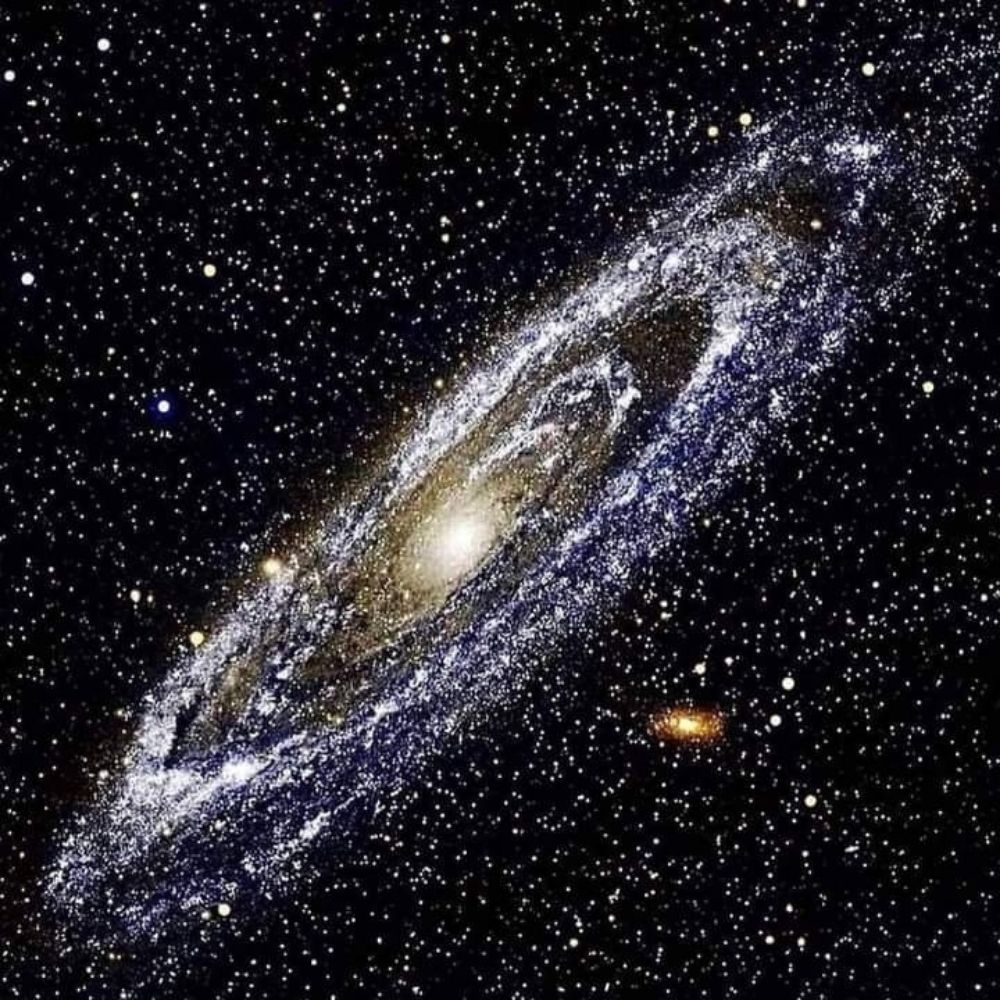
This artist's concept illustrates the Large Magellanic Cloud's (LMC's) encounter with the Milky Way galaxy's gaseous halo. In the top panel, at the middle of the right side, the LMC begins crashing through our galaxy's much more massive halo. The bright purple bow shock represents the leading edge of the LMC's halo, which is being compressed as the Milky Way's halo pushes back against the incoming LMC. In the middle panel, part of the halo is being stripped and blown back into a streaming tail of gas that eventually will rain into the Milky Way. The bottom panel shows the progression of this interaction, as the LMC's comet-like tail becomes more defined. A compact LMC halo remains. Because the LMC is just past its closest approach to the Milky Way and is moving outward into deep space again, scientists do not expect the residual halo will be lost.
The Large Magellanic Cloud's encounter with the Milky Way galaxy's gaseous halo.
Credit:Nasa

flug with a little wizard outfit on, they are holding a staff with a bunch of doodads and trinkets tied to it
07.12.2024 22:44 — 👍 3688 🔁 538 💬 24 📌 16
flug looking shocked with a "!" next to them

flug egg.

flug holding onto a soda labeled "soda purple" like those little candys that have the stuffed animal hanging onto them i dont know what they are called

flug laying dead on the ground (i make alot of these. partly because i get migraines alot lmao)
various flugs 2
07.12.2024 22:49 — 👍 2383 🔁 253 💬 15 📌 4
text reads: MEGROCKS ART RAFFLE, ty for 30k <3, follow/like/repost (dont quote post), comment your OC (optional), ends on december 25th image is of meg's OC, Wynona posing in a batkini. she has pale skin, split dyed hair thats black and white, red eyes, and pointy ears.
tysm for 30k here on booskee!!
this will be my first time doing an art raffle 🖤
ends on christmas so join nao!
#artraffle #art

Week with their eyes scribbled out, text in lunarian This is a reference to the artwork used for "Young girl A" by siinamota
08.12.2024 14:04 — 👍 2007 🔁 198 💬 20 📌 2
The Pink One in a monochrome world. This is a reference to the song "double lariat" by agoaniki-P
08.12.2024 14:23 — 👍 1436 🔁 146 💬 10 📌 4me olvidé de que tenía ésta app, perdón
08.12.2024 15:39 — 👍 1 🔁 0 💬 1 📌 0
Credit: Yin Hao
Meteor Shower and Orion in Mongolia 🇲🇳
07.12.2024 23:11 — 👍 14400 🔁 1162 💬 125 📌 47