We've just set up a Bluesky for @nu-mechanobiology.bsky.social - give it a follow if you're in the #mechanobiology space!
06.10.2025 20:44 — 👍 3 🔁 2 💬 0 📌 0We've just set up a Bluesky for @nu-mechanobiology.bsky.social - give it a follow if you're in the #mechanobiology space!
06.10.2025 20:44 — 👍 3 🔁 2 💬 0 📌 0
Benson, R.B.J., Walsh, S.A., Griffiths, E.F. et al. Mosaic anatomy in an early fossil squamate. Nature (2025). doi.org/10.1038/s415...
01.10.2025 16:46 — 👍 54 🔁 11 💬 0 📌 0
More recent Luke news: I made some music and you can listen to it!
https://lukejohns.online/blog/bits_peaces/
📸 4. Alligator 🐊 Rodney Cammauf, U.S. National Park Service, Public Domain, commons.wikimedia.org/w/index.php?...
📸 5. Trainer Lauralea Oliver 🚶♀️ with Vector 🐕🦺, Public Domain, commons.wikimedia.org/w/index.php?...
📸 2. Map 🗺️ NASA + Pfly, Public Domain, commons.wikimedia.org/w/index.php?...
📸 3. Snake 🐍 Rushen, Kaeng Krachan National Park, CC BY-SA 2.0, commons.wikimedia.org/w/index.php?...
📸 4. Deer 🦌 Ianaré Sévi, CC BY-SA 3.0, commons.wikimedia.org/w/index.php?...

#SourceOfTheScience - Doi.org/10.1007/s10530-010-9908-3
#SourceOfTheScience - doi.org/10.1073/pnas...
📸 1. Snake 🐍 LiCheng Shih, CC BY 2.0, commons.wikimedia.org/w/index.php?...
📸 2. Cormorant 🐦 DarkNight0917, CC BY-SA 4.0, commons.wikimedia.org/w/index.php?...
Removing a population of #InvasiveSpecies is difficult, and multiple methods will be needed.
If you live in Florida, what can you do if you spot a wild Burmese Python?
Note the location, take a photo and report it on: www.eddmaps.org/florida/
[6/9]

Right, trainer Lauralea Oliver, with Vector, a mottled black and tan Shepard dog (left). The dog holds a green crocodile plush toy in its mouth, and is wearing a red collar and a body sash which reads “Search Dog”. Lauralea Oliver is crouching down with her dog, and wears black fingerless gloves, a black sweater and a blue rucksack.
Burmese Pythons are secretive, and have no natural predators in the #Everglades. This is why human intervention is vital.
Camera technologies, drones, scent tracking dogs, & even other snakes are all techniques being assessed on how well these methods can recover pythons.
[5/9]

A white-tailed deer, facing to the right with the top part of its front legs and part of its body in the camera view. The deer has a light tan colour, with a white belly and occasional white streaks through its body. Its large, round brown eye has a white circle of fur around it. The deer’s nose is a darker brown, and its large oval ears are raised high, with slightly pointed tips.
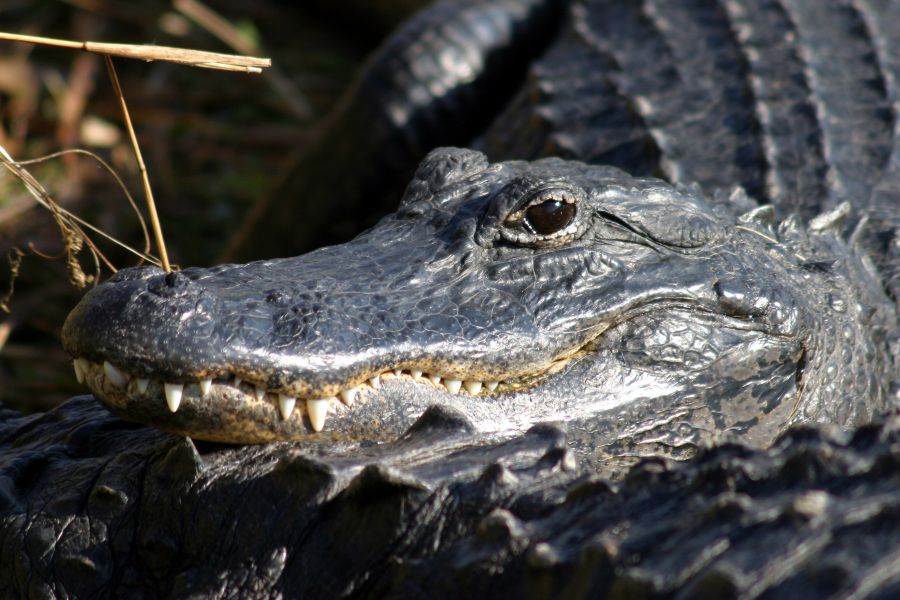
The face of an American Alligator, in side view, fills the image. The Alligator has grey-blue scales covering its body. The teeth in its upper jaw are white, and exposed in an overbite, so they hang over the closed lower jaw. The alligator rests its head on the irregularly spiked tail of another alligator, which follows into the direct foreground and out of frame.
The remains of white-tailed deer, alligators, 37 species of bird, & even bobcats have been found inside the stomachs of these hungry snakes.
So what is happening to prevent these snakes from causing irreversible damage?
[4/9]

Foreground: A mottled tan and dark brown patched Burmese Python (Python molurus bivittatus) twists into the foreground. Its head is raised showing a pale underbelly and a round, black eye.
Likely introduced through the exotic pet trade, the past 40 years have seen a dramatic increase in the number of invasive pythons spotted in the Everglades.
Alongside the rise in invasive pythons, the local mammal population has declined by over 90%.
[3/9]

A double crested cormorant is present in the foreground. It is a large bird with half oval shaped black feathers. It has an elongate, slightly hook-ended beak, which is coloured yellow. Its eye is a solid black circle. The bird is perched on the side of wooden decking and is facing towards one of the waterways in the everglades. The surface of the water is covered in heart-shaped green leaves. The background shows a blue sky with fluffy clouds, with thickly clustered green bushes on the horizon.

A satellite map image of the state of Florida. The southern most tip of Florida is highlighted by a yellow border, marking the boundary of the Everglades protected area. The Everglades take up approximately one quarter of the landmass.
But over in south Florida, these holiday-making #pythons have far overstayed their welcome. This has caused devastating environmental consequences in the #Everglades.
These pythons did not migrate to Florida on their own. This is a problem caused by humans.
[2/9]

A Burmese Python (Python bivittatus) coiled across the left and middle of the image. The snake is dark brown, with tan streaks and a pale underbelly. The head of the snake is lifted up, with a black forked tongue slightly protruding from its face.
It's the 9th of #ssSnaketember and it's a day for looking at #InvasiveAlienSpecies
Burmese Pythons are native to India & southeast Asia. In these areas the #snakes have a #conservation status of 'vulnerable' on the IUCN Red List.
[1/9]
#Herpetology #SciComm #snake

#SourceOfTheScience -
doi.org/10.1086/377052
#SourceOfTheScience - doi.org/10.1242/jeb.062539
📸3 Snake 🐍 Rushenb, CC BY-SA 2.0, commons.wikimedia.org/w/index.php?...
📸5 Snake 🐍 Darius Bauzys, CC BY 3.0, commons.wikimedia.org/w/index.php?...

The head of a black and yellow snake (Natix natrix) on a sandy surface. The snake sticks out its black forked tongue. The snake has a large black, round pupil in a dark coloured eye.
Snake hisses tend to be high pitched, around the top F# of a piano (3,000+ Hz). This means that snakes cannot hear their own hiss!
This could explain why snakes do not appear to communicate with each other using sound.
[5/6]
Most snakes can comfortably hear one octave above a piano “middle C” & two octaves below (80 - 600Hz).
This is a rather small range – young humans can hear sounds between 20 – 20,000Hz.
This small range means that, sadly, snakes are not big fans of modern music.
[4/6]

A coiled reticulated python. The snake’s head rests on one large coil, with two coils in the background. The snake’s head is yellow with black outlined scales. The neck and body of the snake has an undulating black stripe, outlined in yellow scales. A slight rainbow iridescence is present on some scales.
This contact allows the snake to "hear" the vibrations travelling through any surface that the snake lays its head on.
Snakes can also hear sounds that travel through the air - but they have a limited hearing range.
[3/6]

Humans, rabbits & other mammals (think fluffy critters) have 3 small ear bones that vibrate in response to sound.
Snakes have only one (the stapes/columella). Unlike in mammals, the ear bone in snakes is in contact with the jaw bones.
skfb.ly/6xGrP
[2/6]

In the style of a coloured pencil sketch: a green coiled snake bobs back and forward whilst leaning against a blue grand piano, with an open lid.
“Hearing” is #ssSnaketember the 8th’s theme!
Whilst #snakes do not have external "sticky out" ears, they can still hear. It is a myth that snakes are deaf, however they do have some quirks in relation to their methods of hearing.
[1/6]
#Herpetology #SciComm #Snake
📸3. Snakes🐍: Bjørn Christian Tørrissen, bjornfree.com/galleries.html, CC BY-SA 4.0, commons.wikimedia.org/w/index.php?...
📸4. Snake🐍:Dr. Raju Kasambe, CC BY-SA 3.0, commons.wikimedia.org/w/index.php?...
📸5. Snake🐍:Augustus Binu, CC BY-SA 3.0, commons.wikimedia.org/w/index.php?...
What’s Batesian Mimicry you cry? Check out an earlier #ssSnaketember post on the topic:
bsky.app/profile/dino...
🐍
#SourceOfTheScience - doi.org/10.1086/377052
📸1. Snake🐍: Vassil, CC0, commons.wikimedia.org/w/index.php?...
📸3. Snakes🐍: Rushenb, CC BY-SA 4.0, commons.wikimedia.org/w/index.php?...

Two Oriental Ratsnakes balancing on their bodies to raise their heads upright (as if "standing"). The left snake is grey with a lightly coloured underbelly. The right snake is a mustard yellow colour. Both snakes face to the right and are resting on grey rocks.
The Oriental Ratsnake lives in the same region as the King Cobra.
King Cobras are venomous but Oriental Ratsnakes are not.
It is possible that by growling, the Oriental Ratsnake is mimicking & pretending to appear like the cobra – an example of Batesian Mimicry.
[5/7]

The head and neck of an Oriental Ratsnake. The snake is light brown with a cream underbelly. Irregular black stripes fall across the snake's face and along its underbelly. The snake has an orange eye with a circular black pupil, and its black forked tongue sticks out. Snake is in front of an out of focus green forest background.
These pockets act as resonating chambers, removing the high-pitched sounds of the hiss & leaving a low pitched sound to be produced in the throat.
The Oriental Ratsnake has also been heard growling but it does not have throat pockets. Instead, it has to flatten its throat
[4/7]

A king cobra snake (Ophiophagus hannah) stands with its head raised and faces to the left. The rest of its body trails behind it into the distance and out of focus. The snake has light cream underbelly scales and light brown scales on its face. The scales on its face are bordered by dark brown detail.

A bright green snake (Red Tailed Racer snake) is coiled amongst a tree branch. The snake has triangular pointed scales, outlined in dark brown. The snake's head rests on one of its coils. The snake has a green eye with a large black, circular pupil.
In snakes, a growl is a special kind of hiss. Not all snakes have the physical requirements to growl.
Two snakes that do are the King Cobra & the Red Tailed Racer.
In these snakes, the throat is not just a straight tube - it is lined with pockets that extend into the body.
[3/7]

But let's set the record straight first - snakes rarely hiss. When they do, it is an entirely defensive move.
If a snake hisses around a human it's basically saying "here I am, don’t tread on me!"
They do not hiss when angry, nor to communicate with other snakes.
[2/7]

A king cobra snake (Ophiophagus hannah) coiled up. The snake has a light brown colour with its scales outlines in dark brown. Its head peeks over the top of a large coil. The snake rests on some fake moss on a tree trunk.
The 7th #ssSnaketember is a day for Growling!
Even though many humans have never encountered a "real" #snake, thanks to film and TV, you will have probably heard a snake hiss.
But did you know that some #snakes can growl too?
[1/7]
#Herpetology #SciComm
📸3. Snake🐍Shagil Kannur - Own work, CC BY-SA 3.0, commons.wikimedia.org/w/index.php?...
08.09.2025 22:03 — 👍 0 🔁 0 💬 0 📌 0
📸1. Snake🐍Rushen, CC BY-SA 2.0, commons.wikimedia.org/w/index.php?...
📸Mammals🐿️Emőke, CC BY-SA 4.0, commons.wikimedia.org/w/index.php?...
Matteo De Stefano/MUSE, CC BY-SA 3.0, commons.wikimedia.org/w/index.php?...
📸3. Snake🐍Gihan Jayaweera, CC BY-SA 3.0, commons.wikimedia.org/w/index.php?...

This means that when a snake jumps from a tree, it does not simply fall downwards (like a rock), but instead is able to glide a controlled horizontal distance away from its starting point (like a plane).
#SourceOfTheScience - doi.org/10.1038/s415...
[5/7]
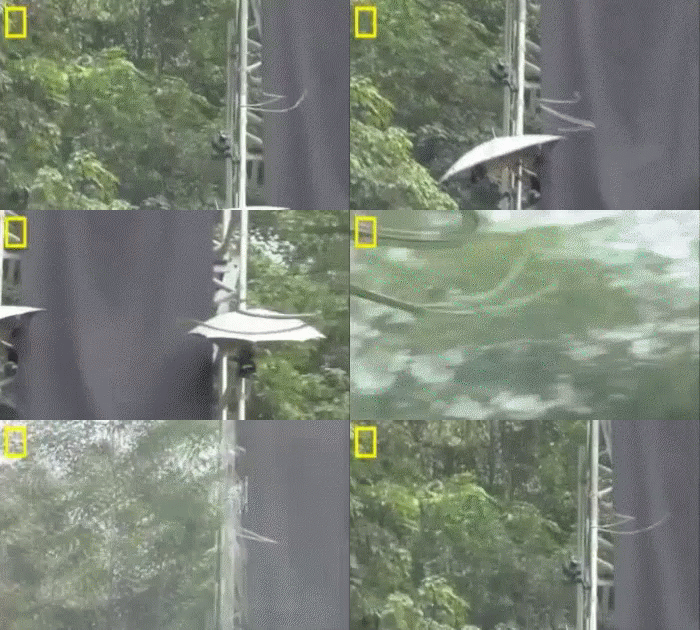
In the air, the snake will move its body in a distinct S-shaped curve.
Movement occurs in both side-to-side, and up & down directions.
These snakes are also able to flatten their bodies into a 3D shape that resembles an aeroplane wing (an aerofoil).
[4/7]

A grey-brown snake with black banding at regular intervals. The snake is coiled in an S shape curve.
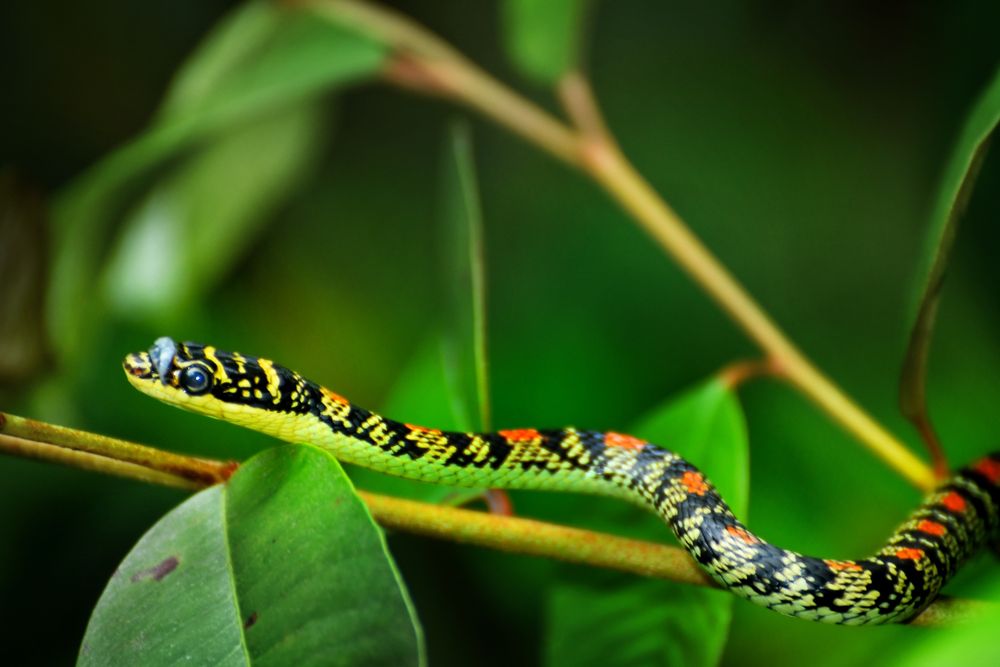
The head and neck of a black snake with a yellow underbelly. The snake has large red spots at regular intervals along its back. The snake rests on a green-red branch and is surrounded by green foliage.
So what do “flying snakes” (Chrysopelea) do?
On land a snake will wiggle its body side to side to propel itself along the ground.
Flying snakes will do a similar motion when in the air – but their “airborne wiggle” motion is different from their “ground wiggle” pattern.
[3/7]
