New publication with @ymeier.bsky.social!
Check out the threat below 👇🏼
14.11.2025 16:10 — 👍 5 🔁 0 💬 0 📌 0
Not unexpected, but still shocking…
12.11.2025 10:54 — 👍 4 🔁 0 💬 0 📌 0
Overall, our results differentiate norm inference from norm adoption and highlight behavioral prevalence as a stable normative driver. They also raise concerns about how visible peer behaviors may facilitate the diffusion of risky disclosure practices.
Link: osf.io/preprints/ps...
(9/end)
11.11.2025 12:26 — 👍 0 🔁 0 💬 0 📌 0
Reinforcement signals (likes and comments) showed no observable effect on norm formation or disclosure intentions. This challenges common assumptions about the centrality of engagement metrics in shaping behavior.
(8/9)
11.11.2025 12:26 — 👍 0 🔁 0 💬 1 📌 0

Similarity moderated these processes. Participants relied less on prevalence cues when evaluating similar others, yet similarity amplified the impact of norms once they were formed.
(7/9)
11.11.2025 12:26 — 👍 0 🔁 0 💬 1 📌 0
Written disclosure had a more limited role. It shifted norm perceptions modestly but did not meaningfully influence disclosure intentions, suggesting a modality-specific sensitivity to normative information.
(6/9)
11.11.2025 12:26 — 👍 0 🔁 0 💬 1 📌 0

The findings were quite consistent: prevalence was the dominant mechanism. Higher levels of visual disclosure among peers led to stronger descriptive and injunctive norms, which in turn increased participants’ own disclosure intentions.
(5/9)
11.11.2025 12:26 — 👍 0 🔁 0 💬 1 📌 0

We therefore developed a new platform called Travelgram, closely resembling Instagram. It simulated the full social media experience. Participants scrolled, posted, liked, commented and we manipulated what they saw.
(4/9)
11.11.2025 12:26 — 👍 2 🔁 0 💬 1 📌 0
Across two preregistered experiments (n=590; n=1337) using a ecologically valid, but simulated platform, we independently manipulated two elements: the prevalence of others’ disclosures and reinforcement via likes/comments. We further measured perceived similarity of other users.
(3/9)
11.11.2025 12:26 — 👍 0 🔁 0 💬 1 📌 0
Building on my previous work (doi.org/10.1371/jour...), we argue that platforms are saturated with signals about what others do, and these signals structure users' own decisions to share.
(2/9)
11.11.2025 12:26 — 👍 0 🔁 0 💬 1 📌 0

NEW PREPRINT 💡
Together with @dougaparry.bsky.social, I just published a new preprint experimentally examining how specific normative cues on social media shape self-disclosure using an innovative simulation approach.
Link: osf.io/preprints/ps...
Read on for more information (1/9) 👇
11.11.2025 12:26 — 👍 9 🔁 8 💬 1 📌 0
New special issue, "Comparative Approaches to Studying Privacy," edited by #CPRN is now published in Social Media + Society!
journals.sagepub.com/topic/collec...
w/ @lutzid.bsky.social, Lemi Baruh, Kelly Quinn, @masurphil.bsky.social, Carsten Wilhelm (comparativeprivacy.org)
07.08.2025 13:30 — 👍 14 🔁 8 💬 1 📌 2
Oh, this is old. I think I should revisit this. :D
11.07.2025 07:12 — 👍 2 🔁 0 💬 1 📌 0
Thanks, Cameron!
07.07.2025 07:27 — 👍 1 🔁 0 💬 0 📌 0
Thanks so much, Ye!
07.07.2025 07:27 — 👍 1 🔁 0 💬 0 📌 0
Using specification curve analyses, we show that this relationship is sensitive to analytical decisions, highlighting the importance of transparency and replication in survey-based privacy research.
(4/4)
04.07.2025 10:15 — 👍 1 🔁 0 💬 0 📌 0
Only 32.5% of the original effects replicated exactly, though 67.5% were significant and in the expected direction. Interestingly, the widely reported negative link between privacy concerns and self-disclosure did not replicate—in our data, it turned positive.
(3/4)
04.07.2025 10:15 — 👍 1 🔁 0 💬 1 📌 0
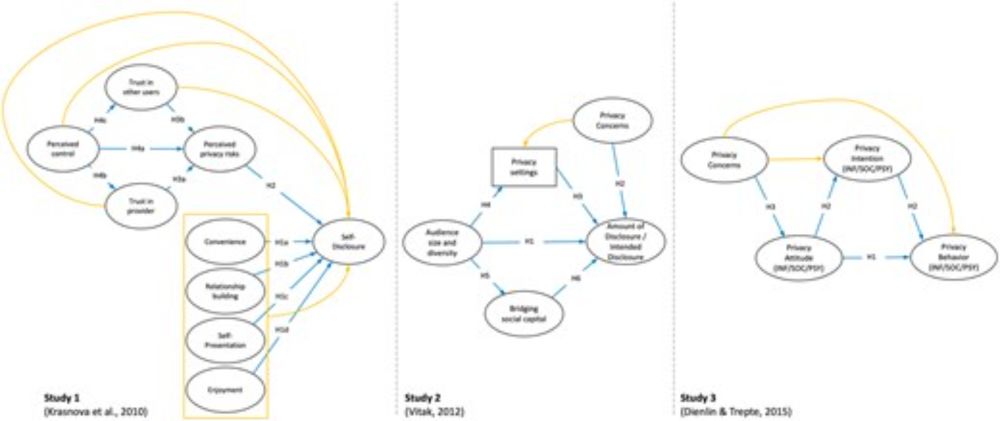
Together with Giulia Ranzini, we closely replicated three foundational studies in privacy research:
🔹 Krasnova et al. (2010) on the privacy calculus
🔹 Vitak (2012) on context collapse
🔹 Dienlin & Trepte (2015) on the privacy paradox
(2/4)
04.07.2025 10:15 — 👍 0 🔁 0 💬 1 📌 0

CAT Best Paper Award at #ica25: @masurphil.bsky.social with a study on norms on social media
13.06.2025 21:35 — 👍 17 🔁 1 💬 1 📌 0
😊😊😊 #ica25
15.04.2025 06:02 — 👍 12 🔁 0 💬 0 📌 0
Great PhD and PostDoc opportunity! Having worked with Tobias for years, I can only recommend applying!!! 👍👍👍
13.03.2025 07:05 — 👍 4 🔁 0 💬 1 📌 0

Picture of the WHAT-IF project consortium at the kick-off meeting in Amsterdam
Hello world! Meet our consortium—15 organizations, 10 countries—joining forces to rethink the digital political information space. 🚀
Last week, we kicked off our project WHAT-IF, setting the stage to build a digital twin that will help us test the impact of policy interventions.
More in the 🧵!
03.02.2025 13:13 — 👍 23 🔁 9 💬 1 📌 5
New PhD students: This is a great opportunity to get feedback on your project as well as meet other PhD buddies! 👇
28.01.2025 10:13 — 👍 2 🔁 0 💬 0 📌 0
Comparative Privacy Research Network
(4) analyzing how these units interact to shape privacy expectations, policies, and behaviors.
The paper resulted from discussion within the comparative privacy research network. For more info, check out: comparativeprivacy.org
28.01.2025 10:09 — 👍 1 🔁 0 💬 0 📌 0
...whether privacy concepts are truly comparable across different contexts, (3) identifying meaningful units of comparison beyond national boundaries—exploring cultural, social, political, technological and economic units of comparison—and ...
28.01.2025 10:09 — 👍 1 🔁 0 💬 1 📌 0
We propose the Comparative Privacy Research Framework (CPRF), which provides a systematic approach to studying privacy across contexts. The framework highlights four key principles: (1) critically examining researchers’ own epistemological biases and power positions, (2) assessing...
28.01.2025 10:09 — 👍 1 🔁 0 💬 1 📌 0
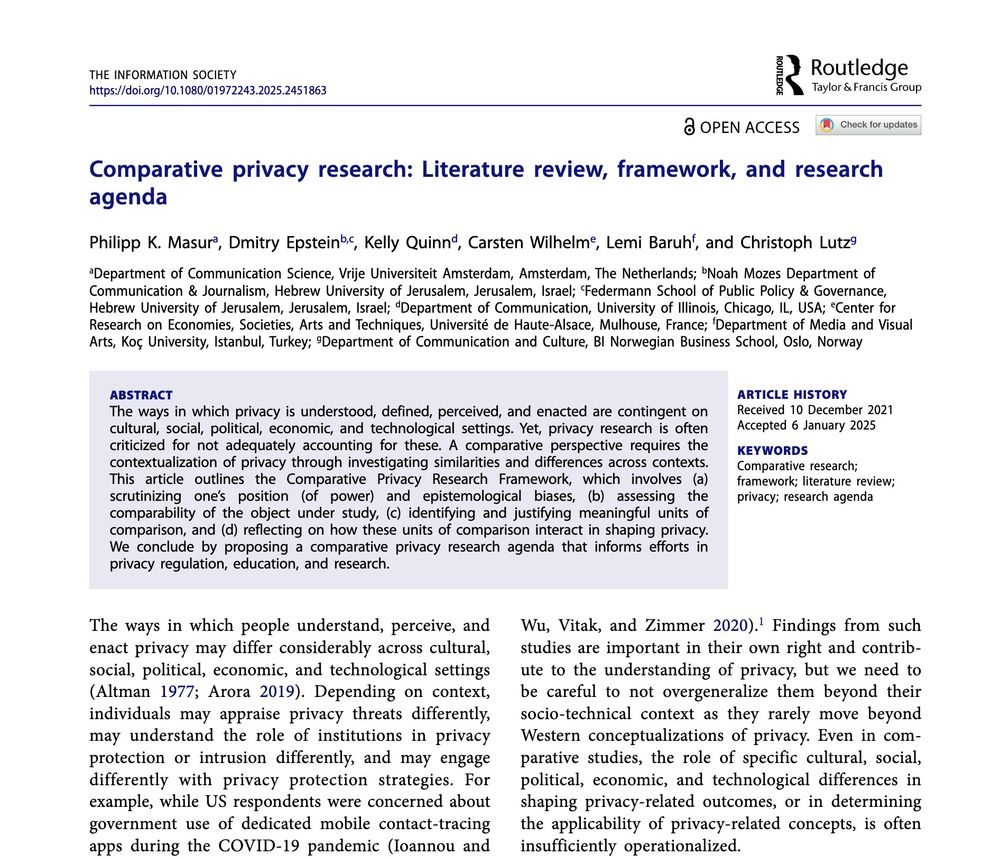
It offers a comprehensive literature review of privacy and comparative privacy research, thereupon develops a new framework and a research agenda for comparative privacy research.
28.01.2025 10:09 — 👍 1 🔁 0 💬 1 📌 0

Comparative privacy research: Literature review, framework, and research agenda
The ways in which privacy is understood, defined, perceived, and enacted are contingent on cultural, social, political, economic, and technological settings. Yet, privacy research is often criticiz...
🎆 New Publication on comparative privacy research!
After almost 5 years, we (that is @thinkmacro.bsky.social, Kelly Quinn, Carsten Wilhelm, Lemi Baruh, @lutzid.bsky.social and myself) are proud to have published this article:
www.tandfonline.com/doi/full/10....
28.01.2025 10:09 — 👍 12 🔁 3 💬 1 📌 1
Ph.D. Student in Communication at UC Santa Barbara
Researcher at the intersection of mass comm, media effects & social psych. I investigate how digital media affects social/group dynamics (influence, identity, intergroup relations) & online hate. 🤬🌐🤝🏾
Experimental psychologist. Interested in cognitive science, research rigour, and interesting interdisciplinary spaces.
Work: https://orcid.org/0000-0003-1183-5508
Enjoying the outdoors around the NW of England.
DMs disabled.
PhD student | University of Zurich | @ikmzmediachange.bsky.social
Research: dataveillance, digital society, user-centered research, mixed methods
Horizon Europe research project testing the impact of evidence-based policies for healthier political information environments
https://what-if-horizon.eu/
Professor for Social and Behavioral Data Science at the University of Konstanz. Also at CSH Vienna, ETH Zurich and TU Graz.
PhD candidate in computational communication science @newsflows.eu, VU Amsterdam, Assistant Editor @CCR. Interested in politics of big tech & journalism, social media cultures, recommender systems, flows and influence online.
Associate Professor of Political Communication and Computational Social Sciences at Royal Holloway University of London. Director of the London Social Media Observatory. UKRI Future Leader Fellow.
Institute for Information Law. Studying how we should regulate tech that makes and targets news & political speech.
Digital Journalism is an international, peer-reviewed, top-ranked journal that publishes cutting-edge research and concepts. Editor-in-Chief: Oscar Westlund.
https://www.tandfonline.com/journals/rdij20
The Journal of Communication (JoC) is the flagship journal of the International Communication Association.
COMPTEXT is an international community and forum for text/image/video as data scholars
interdisciplinary teaching & research institute @viadrina.bsky.social
www.europeannewschool.eu
Imprint: www.europa-uni.de/en/admin/impressum/index.html
Forschungsinstitut: Research for the Digital Age 🔎 | Gesellschaft und Digitalisierung 💻 | #TeamCAIS 👥| Bochum 🏙️| Willkommen beim #CAIS!
🌐 Website: https://www.cais-research.de/
📌 Impressum: https://www.cais-research.de/impressum/
I am married to an amazing woman.
Both of us are professors at Michigan State university.
Woke. Long time fighter for diversity.
And apparently I like editing journals and conducting what I hope is creative research.
No DMs unless I know you
Computational communication scientist at the University of Vienna & Complexity Science Hub | alumna UvA ASCoR
https://julaluehring.github.io/
Researching the intersections between digital technologies, privacy, and inequalities. Centre for Social Informatics at University of Ljubljana.
PhD Researcher at @hertieschool.bsky.social | War, social media, incivility, text-as-data | previously @ic3jm.bsky.social & University of Amsterdam | FirstGen 🇩🇰
Official account for the Communication & Technology Division of the International Communication Association, @katypearce
& @commfox & @anneohirsch at the wheel