Infant brain categorizes common objects by two months of age
Brain activity patterns in the ventral visual cortex appear to distinguish images across 12 categories, including birds and trees, fMRI scans suggest.
The Transmitter writes about @clionaod.bsky.social's work with
@ainedineen.bsky.social, @annatruzzi.bsky.social, Graham King, @lorinanaci.bsky.social, Keelin Harrison, Enna-Louise D'Arcy, Jessica White, @chiarac.bsky.social, Tamrin Holloway, Anna Kravchenko, @diedrichsenjorn.bsky.social!
24.02.2026 16:56 — 👍 25 🔁 10 💬 2 📌 0

Infant brain categorizes common objects by two months of age
Brain activity patterns in the ventral visual cortex appear to distinguish images across 12 categories, including birds and trees, fMRI scans suggest.
Functional MRI scans of more than 100 2-month-old infants suggest that they are capable of distinguishing among a variety of different objects. The findings challenge perceptions of cognitive development as a gradual process.
By @helenak.bsky.social
www.thetransmitter.org/cognitive-ne...
24.02.2026 15:44 — 👍 21 🔁 10 💬 1 📌 0

This is figure 2, which shows visual representations from infancy to adulthood.
Human babies may be able to visually categorize different objects earlier than previously thought, even at two months of age, according to research in Nature #Neuroscience. go.nature.com/4tcQOu3 🧪
02.02.2026 23:41 — 👍 24 🔁 5 💬 0 📌 1

Deep learning in fetal, infant, and toddler neuroimaging research
Artificial intelligence (AI) is increasingly being integrated into everyday tasks and work environments. However, its adoption in medical image analys…
This paper was an awesome collaborative effort of a @fitngin.bsky.social working group. It provides a detailed review of how DNNs can be used to support dev neuro research
@lauriebayet.bsky.social and I wrote the network modeling section about how DNNs can be used to test developmental theories 🧵
28.01.2026 15:08 — 👍 28 🔁 14 💬 2 📌 1

Functional Magnetic Resonance Imaging in Awake Infants: Insights From More Than 750 Scanning Sessions
Functional magnetic resonance imaging (fMRI) in awake infants has the potential to reveal how the early developing brain gives rise to cognition and behavior. However, awake infant fMRI poses signifi....
Awake infant fMRI offers a rare window into early brain and cognitive development. In a new paper out now in Infancy, we leverage data from hundreds of infant scans from the Saxe and Turk-Browne Labs to reveal what factors drive scanning success — and how future studies can maximize data retention!
31.01.2026 22:45 — 👍 46 🔁 18 💬 1 📌 0
Through the Foundcog project we scanned 100+ infants with awake fMRI. In this Nature Neuroscience paper led by clionaod.bsky.social, we show that, by 2-months, infants’ brains already encode rich representations of object category.
Congratulations Clíona on such beautiful results! 🧠✨
02.02.2026 19:46 — 👍 14 🔁 2 💬 0 📌 0
And thank you so much to all of our participants and their families!
02.02.2026 16:41 — 👍 11 🔁 3 💬 0 📌 0
1/7 Can infants recognise the world around them? 👶🧠 As part of the FOUNDCOG project, we scanned 134 awake infants using fMRI. Published today in Nature Neuroscience, our research reveals 2-month-old infants already possess complex visual representations in VVC that align with DNNs.
02.02.2026 16:00 — 👍 155 🔁 70 💬 4 📌 8


The FIT'NG Trainee Committee is excited to be recruiting new members!
It’s a great way to:
✨ Build your network
✨ Gain leadership experience
✨ Shape programming for trainees across the society
Interested? Fill out our form by September 23rd: tinyurl.com/TraineeCommi...
20.09.2025 22:23 — 👍 9 🔁 4 💬 0 📌 1

@mariesantillo.bsky.social shows that 2 month old infant show significant activity in the MD cortex which is different from 9 month olds and independent of visual complexity
07.09.2025 15:45 — 👍 8 🔁 2 💬 0 📌 0

Dr. Anna Truzzi shares her fascinating findings on how baby brains exhibit longer timescales using both MRI and EEG!
07.09.2025 16:25 — 👍 7 🔁 1 💬 0 📌 0

Cliona O'Doherty present pioneering work relating awake infant fMRI data to adults and computational models of vision, with strong correspondence at 2 months of age!
07.09.2025 16:48 — 👍 10 🔁 1 💬 0 📌 1
Exciting new preprint from the lab: “Adopting a human developmental visual diet yields robust, shape-based AI vision”. A most wonderful case where brain inspiration massively improved AI solutions.
Work with @zejinlu.bsky.social @sushrutthorat.bsky.social and Radek Cichy
arxiv.org/abs/2507.03168
08.07.2025 13:03 — 👍 140 🔁 59 💬 3 📌 11
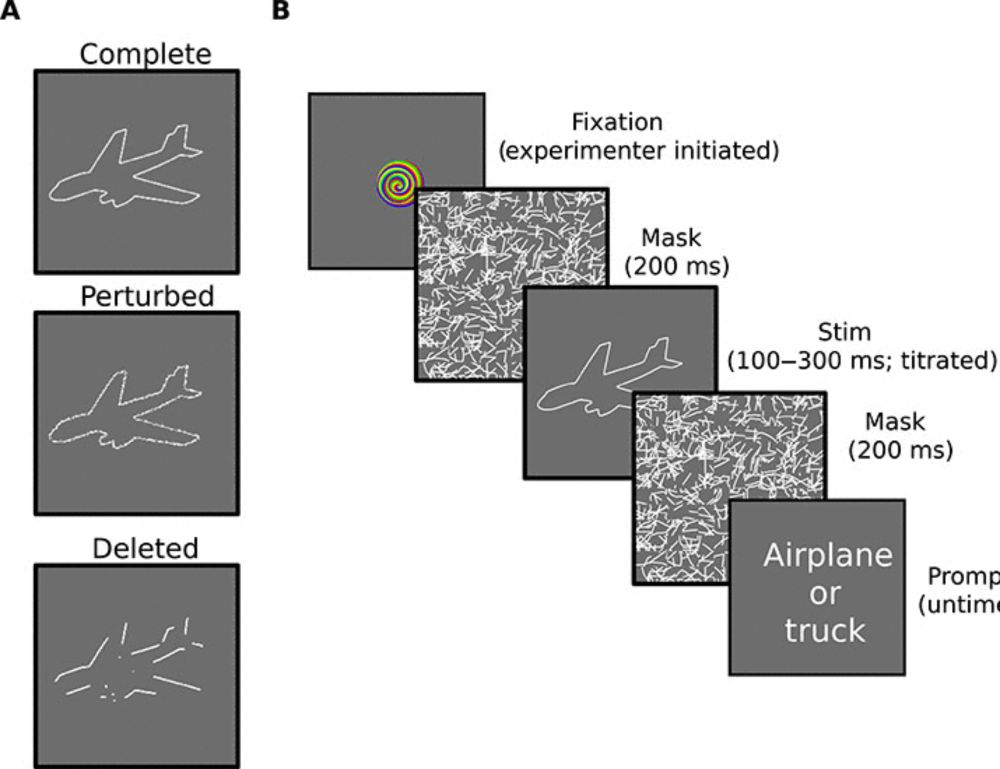
Fast and robust visual object recognition in young children
The visual recognition abilities of preschool children rival those of state-of-the-art artificial intelligence models.
My paper with @stellalourenco.bsky.social is now out in Science Advances!
We found that children have robust object recognition abilities that surpass many ANNs. Models only outperformed kids when their training far exceeded what a child could experience in their lifetime
doi.org/10.1126/scia...
02.07.2025 19:38 — 👍 111 🔁 36 💬 2 📌 2
First morning in Brisbane! Looking forward to exploring the city before #OHBM2025 kicks off! Excited to be here to share my research on early MD network engagement in infants. Come chat at poster #1029 🧠🌎
22.06.2025 22:17 — 👍 2 🔁 1 💬 1 📌 0
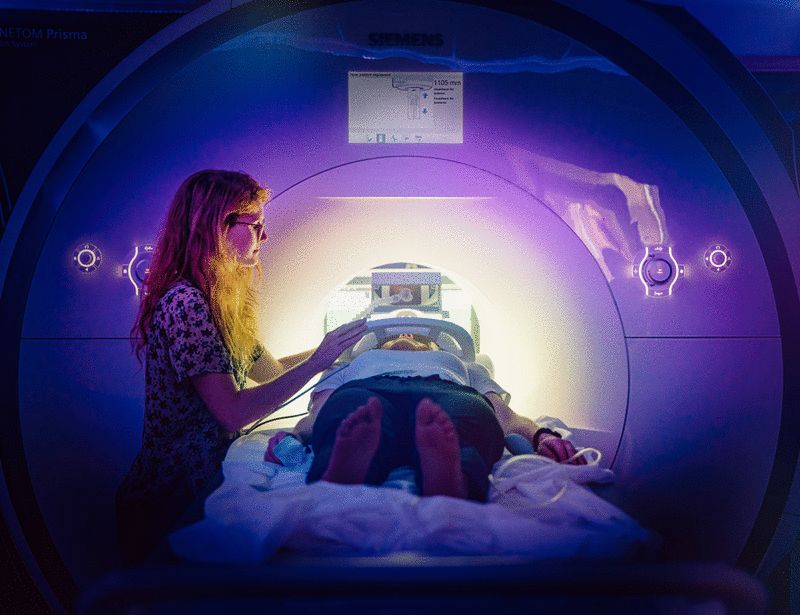
Hippocampal encoding of memories in human infants
Humans lack memories for specific events from the first few years of life. We investigated the mechanistic basis of this infantile amnesia by scanning the brains of awake infants with functional magne...
Why do we not remember being a baby? One idea is that the hippocampus, which is essential for episodic memory in adults, is too immature to form individual memories in infancy. We tested this using awake infant fMRI, new in @science.org #ScienceResearch www.science.org/doi/10.1126/...
20.03.2025 18:36 — 👍 482 🔁 165 💬 19 📌 22
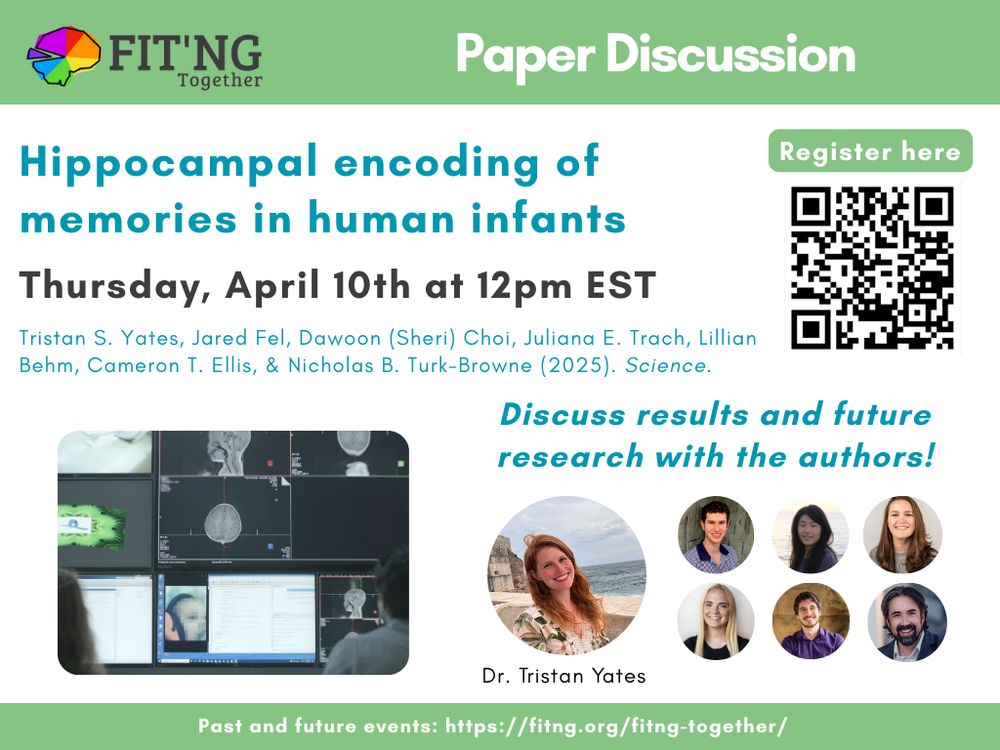
Don't miss our next FIT'NG Together event this Thursday, April 10th at 12pm EST where we will discuss a new paper on Hippocampal Encoding of Memories in Human Infants (DOI: 10.1126/science.adt7570) with @tristansyates.bsky.social and other authors!
Register for FREE at: tinyurl.com/fitngtogether
06.04.2025 16:36 — 👍 18 🔁 5 💬 0 📌 2

🥁FIT'NG 2024 submission site is now open!
🗓️The deadline to submit abstracts is May 15, 2024.
Click the 🔗 to get more info: fitng.org/submissions/
15.03.2024 19:01 — 👍 5 🔁 2 💬 0 📌 1
wondering how humans and computers learn and use language 👶🧠🗣️🖥️💬
the work is mysterious and important, see bbunzeck.github.io
phd at @clausebielefeld.bsky.social
PhD candidate in CogCompNeuro at JLU Giessen
Exploring brains, minds, and worlds 🧠💭🗺️
https://levandyck.github.io/
Fellow of the Royal Society of Canada. All comments are my own. Scientific Director of the Centre for Functional and Metabolic Mapping, 🇨🇦's national ultra high field MRI platform. cfmm.uwo.ca
https://orcid.org/0000-0002-7916-0263
Developmental cognitive scientist @carleton-cogsci.bsky.social studying how young kids develop mathematical thinking
Cognitive Neuroscientist | Assistant Prof at VU Amsterdam | Active vision, memory, imagery | Multi-task studies, fMRI, eye tracking | https://matthiasnau.com
Cognitive Neuroscience | Postdoc Schönauer Lab @ Uni Freiburg | PhD Schuck Lab @ MPIB/UHH
An independent nonprofit in San Francisco working to improve understanding, diagnosis, treatment, & rehabilitation of human visual disorders and blindness. RTs≠endorsements.
www.ski.org.
@SKERIResearch on Twitter/X.
Brains, Data and Science
Prof in Computational Neuroscience at Western University
Cerebellum and Motor Control
We are a research lab studying early learning & brain development! PI: @nataliebrito.bsky.social 🐘👶🏽🧠
Neuroscientist, former academic, freelancer and founder
https://www.phd-2b.com/
🧠Brains, 🧬biotech and 👩🏾💻alt ac
📱tech builder
Leading research publisher empowering researchers, educators, and health professionals with our trusted brands for 180+ years. #BePartOfProgress
https://group.springernature.com/gp/group
Site notice http://bit.ly/2oAyLi1
Assistant Professor at NYU Psychology 👩🔬 🧠 investigating the origins and development of abstract thought
Computational Neuroscientist at Trinity College Dublin and University of Oxford. PI of the Cognition, Anatomy & Neural Networks (CANN) lab.
Assistant Professor of Cognitive Science at Johns Hopkins. My lab studies human vision using cognitive neuroscience and machine learning. bonnerlab.org
Postdoctoral Fellow in the Infant Studies Centre, University of British Columbia, researching rhythm in early language development 👶🎶🧠
Recently received my PhD at McMaster University, in the Auditory Development Lab.
UCLA Associate Professor, PhD Researcher of brains 🧠 (development, stem cells, neuroinflammation, autism, sensory processing, brain injury & repair)
Teacher of Neuroanatomy, Neurophilosophy (consciousness, cognitive science), & Stem Cell Biology
CNS is committed to the development of mind and brain research aimed at investigating the psychological, computational, and neuroscientific bases of cognition. #CNS2026 in Vancouver, March 7-10!
4th-year PhD candidate in neuroAI @ Harvard with Talia Konkle and George Alvarez. Vision, DNNs, fMRI, behavior. Previously TarrLab @ CMU. NDSEG Fellow.
neuroscience phd student @WUSM in stl. super interested prenatal environments, biological mechanisms, and early brain development :)