
Last 3 days to apply!
25.02.2026 13:41 — 👍 0 🔁 1 💬 0 📌 0Last 3 days to apply!
25.02.2026 13:41 — 👍 0 🔁 1 💬 0 📌 0
10 days left to apply! 👇
Keynotes: Marcella Alsan (Stanford University) and Dmitry Taubinsky (UC Berkeley).

“CO2 was never a pollutant.”
Words Can Kill 101.
Gift article: www.nytimes.com/2026/02/12/c...
📣 Call for Papers | Riederau Workshop on People’s Understanding of and Support for Economic Policies
We are pleased to announce the Riederau Workshop on People’s Understanding of and Support for Economic Policies, taking place 8–10 September 2026 in Riederau am Ammersee (Germany).
Urgency everywhere, but there are also reasons for 🇪🇺 leaders to play the long game (react calmly) even though MAGA is criminal & dangerous.
1. maximum support for 🇺🇦, keeping 🇺🇸 on the team
2. buy time for military, tech, trade
3. AfD & Co can't score if people are more anti MAGA than gov't

If grovelling to Trump is meant to buy us time to end our dependency on the US, you’d expect feverish activity in Europe to rapidly become autonomous. So has Europe made good use of the time it has bought with self-humiliation? It has not. My blog:
open.substack.com/pub/sophiein...
"Europeans can be proud of their development model"
Indeed!
Time to decouple from the US and fly the flag of the liberal and welfare state our forefathers built after WWII.
🇪🇺 We can be a better beacon for the free world. 🇪🇺

📢Call for Applications: Munich Graduate School of Economics (MGSE) @lmumuenchen.bsky.social is inviting applications for fully funded doctoral positions starting October 2026!
❗ Deadline: Jan 31, 2026
Online application tool: lmy.de/SKRWv
More info: lmy.de/ZLXgm

How information campaigns can fall short even if they successfully correct beliefs: Our experiments show that correcting consumers' large underestimations of which products cause high emissions does not have an effect on their actual consumption decisions.
15.12.2025 12:00 — 👍 6 🔁 4 💬 1 📌 1
In 2025 this youthy conference was fantastic
👇🏼 for 2026
#Econsky

A table showing profit margins of major publishers. A snippet of text related to this table is below. 1. The four-fold drain 1.1 Money Currently, academic publishing is dominated by profit-oriented, multinational companies for whom scientific knowledge is a commodity to be sold back to the academic community who created it. The dominant four are Elsevier, Springer Nature, Wiley and Taylor & Francis, which collectively generated over US$7.1 billion in revenue from journal publishing in 2024 alone, and over US$12 billion in profits between 2019 and 2024 (Table 1A). Their profit margins have always been over 30% in the last five years, and for the largest publisher (Elsevier) always over 37%. Against many comparators, across many sectors, scientific publishing is one of the most consistently profitable industries (Table S1). These financial arrangements make a substantial difference to science budgets. In 2024, 46% of Elsevier revenues and 53% of Taylor & Francis revenues were generated in North America, meaning that North American researchers were charged over US$2.27 billion by just two for-profit publishers. The Canadian research councils and the US National Science Foundation were allocated US$9.3 billion in that year.

A figure detailing the drain on researcher time. 1. The four-fold drain 1.2 Time The number of papers published each year is growing faster than the scientific workforce, with the number of papers per researcher almost doubling between 1996 and 2022 (Figure 1A). This reflects the fact that publishers’ commercial desire to publish (sell) more material has aligned well with the competitive prestige culture in which publications help secure jobs, grants, promotions, and awards. To the extent that this growth is driven by a pressure for profit, rather than scholarly imperatives, it distorts the way researchers spend their time. The publishing system depends on unpaid reviewer labour, estimated to be over 130 million unpaid hours annually in 2020 alone (9). Researchers have complained about the demands of peer-review for decades, but the scale of the problem is now worse, with editors reporting widespread difficulties recruiting reviewers. The growth in publications involves not only the authors’ time, but that of academic editors and reviewers who are dealing with so many review demands. Even more seriously, the imperative to produce ever more articles reshapes the nature of scientific inquiry. Evidence across multiple fields shows that more papers result in ‘ossification’, not new ideas (10). It may seem paradoxical that more papers can slow progress until one considers how it affects researchers’ time. While rewards remain tied to volume, prestige, and impact of publications, researchers will be nudged away from riskier, local, interdisciplinary, and long-term work. The result is a treadmill of constant activity with limited progress whereas core scholarly practices – such as reading, reflecting and engaging with others’ contributions – is de-prioritized. What looks like productivity often masks intellectual exhaustion built on a demoralizing, narrowing scientific vision.

A table of profit margins across industries. The section of text related to this table is below: 1. The four-fold drain 1.1 Money Currently, academic publishing is dominated by profit-oriented, multinational companies for whom scientific knowledge is a commodity to be sold back to the academic community who created it. The dominant four are Elsevier, Springer Nature, Wiley and Taylor & Francis, which collectively generated over US$7.1 billion in revenue from journal publishing in 2024 alone, and over US$12 billion in profits between 2019 and 2024 (Table 1A). Their profit margins have always been over 30% in the last five years, and for the largest publisher (Elsevier) always over 37%. Against many comparators, across many sectors, scientific publishing is one of the most consistently profitable industries (Table S1). These financial arrangements make a substantial difference to science budgets. In 2024, 46% of Elsevier revenues and 53% of Taylor & Francis revenues were generated in North America, meaning that North American researchers were charged over US$2.27 billion by just two for-profit publishers. The Canadian research councils and the US National Science Foundation were allocated US$9.3 billion in that year.

The costs of inaction are plain: wasted public funds, lost researcher time, compromised scientific integrity and eroded public trust. Today, the system rewards commercial publishers first, and science second. Without bold action from the funders we risk continuing to pour resources into a system that prioritizes profit over the advancement of scientific knowledge.
We wrote the Strain on scientific publishing to highlight the problems of time & trust. With a fantastic group of co-authors, we present The Drain of Scientific Publishing:
a 🧵 1/n
Drain: arxiv.org/abs/2511.04820
Strain: direct.mit.edu/qss/article/...
Oligopoly: direct.mit.edu/qss/article/...

🚨 Call for Papers!
The 2026 EAYE Annual Meeting will take place at the University of the Basque Country 🇪🇸 on 18–20 May 2026
📅 Submit your paper or extended abstract by 1 Dec 2025 via CMT
#EAYE2026

🚨 New working paper alert 🚨
Missing summer — and the Tour de France? Don’t worry, we got you covered. 🚴♂️🚴♂️🚴♂️
In this paper, we show that being on the route of Tour de France reduces far-right voting. osf.io/preprints/so...
Thank you Ala for the quick clarification! This analysis indeed goes against the alternative interpretation.
Just puzzling that taking away TdF exposure further decreases votes for the FR (if I read it correctly). The effects are indeed small, but the are up to 33% and 50% of your main estimates.
Cool!!
Can you also exclude the following competing interpretation of the treatment effect? "The TdF increases perceived inequality between towns which leads people living in not visited towns to increase their support for the far-right?"
More technically, what does ensure that SUTVA holds?
Good luck, David!
05.09.2025 07:06 — 👍 2 🔁 0 💬 1 📌 0
If you think the attack on the Fed's Lisa Cook has nothing to do with you, you're wrong — any one of us may be next paulkrugman.substack.com/p/we-are-all...
25.08.2025 12:49 — 👍 2954 🔁 1035 💬 70 📌 60
If I could change one thing about #ScientificPublishing I'd ask funding bodies to stipulate all work they fund be published in non-profit journals.
The knock-on effects would alleviate most of the strain on #AcademicSky.
This isn't hard. It's big, but actually, it's pretty easy.
1/n

A few months ago, Nature published how-to guide for using ChatGPT to write your peer reviews in 30 minutes.
This is, of course, a horrible idea. Here’s my response with @jbakcoleman.bsky.social .
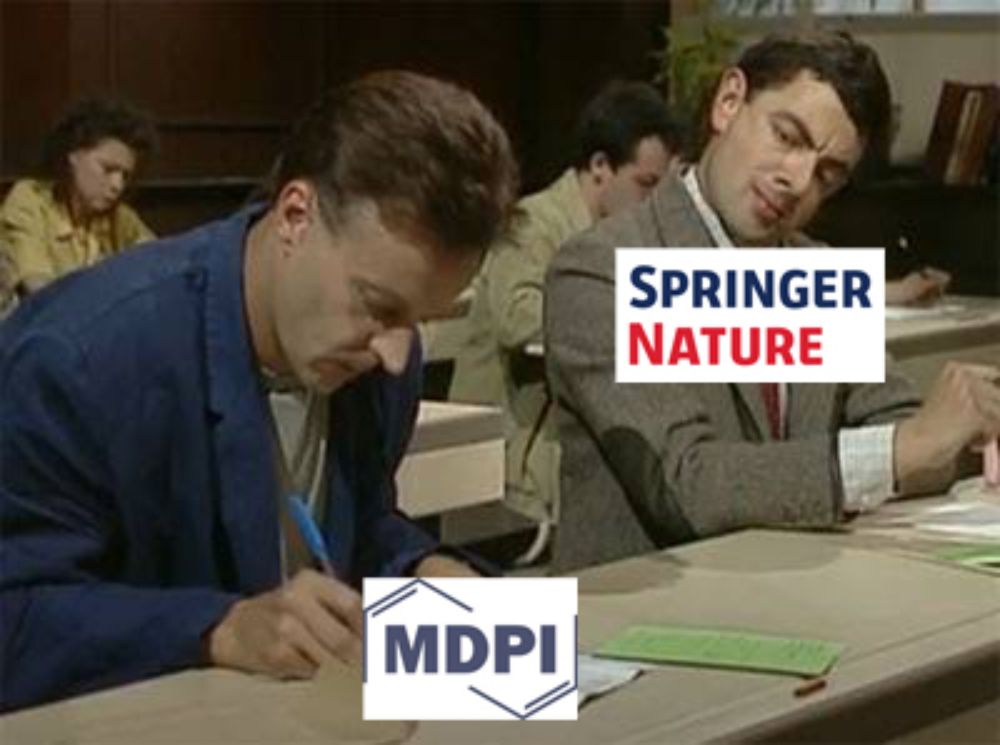
Springer-Nature launched a series of "Discover" journals that closely mimic MDPI titles -- sharing *identical* journal names, and likely similar business model.
What is going on, and why researcher will - as always - fall for it?
A 🧵
the-strain-on-scientific-publishing.github.io/website/post...
If you are a scientist in any field or just plainly a curious human being do subscribe to Andrea's substack. It contains and will keep delivering the most unexpected "oh! I didn't know that! Makes sense!" moments in your near future.
06.06.2025 11:56 — 👍 3 🔁 2 💬 0 📌 0
How do social interactions foster or hamper delusional beliefs?
This is the most pressing open question in the literature on motivated beliefs.
Great to see progress being made 👇
4️⃣ Both the public and experts are too pessimistic
about voters’ support for climate policies
5️⃣ Effective communication of the climate policy
details is key
3/3
2️⃣ Voters support green investments even when
the investments are funded via carbon taxes
3️⃣ A carbon tax plus a Climate Premium is another
promising policy. The Climate Premium is
an upfront transfer to all households
2/3
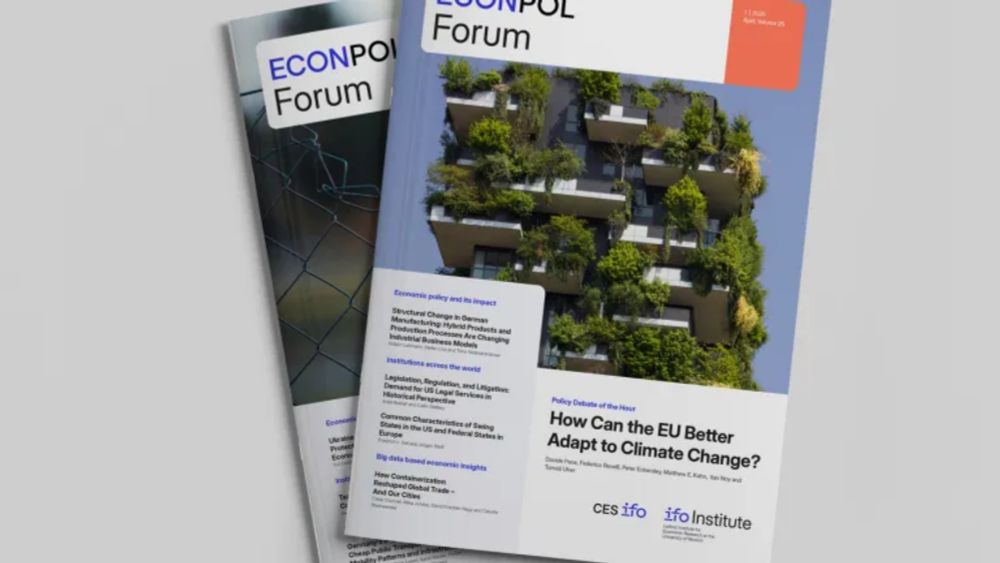
"Voters Like Climate Policies More Than You Think".
New policy piece for EconPol Forum based on recent research findings
www.ifo.de/en/econpol/p...
Key messages:
1️⃣ Voters are willing to make sacrifices for climate
change, and they endorse costly climate policies
#EconSky #ClimateChange
1/3
So sorry, Valeria... Crazy times...
21.04.2025 08:00 — 👍 2 🔁 0 💬 0 📌 0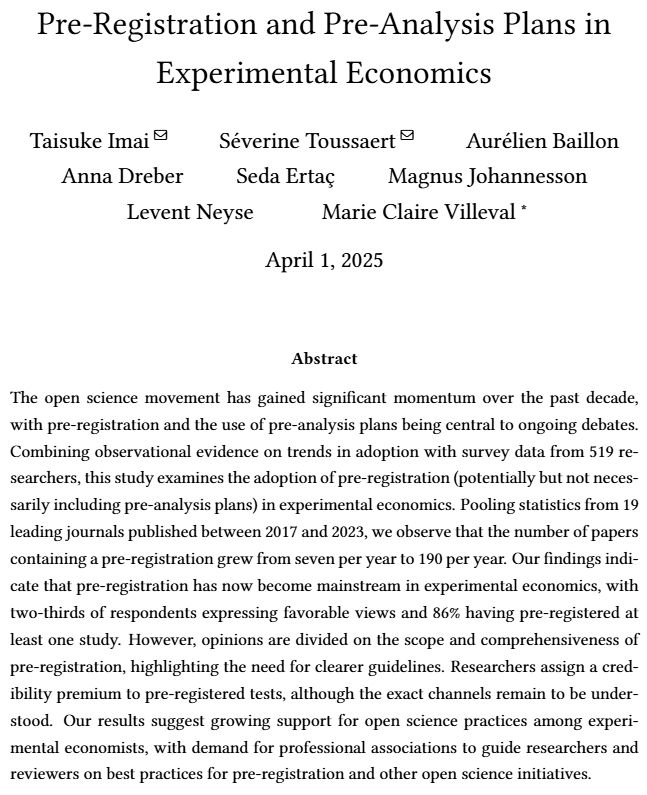
Abstract: The open science movement has gained significant momentum over the past decade, with pre-registration and the use of pre-analysis plans being central to ongoing debates. Combining observational evidence on trends in adoption with survey data from 519 re-searchers, this study examines the adoption of pre-registration (potentially but not necessarily including pre-analysis plans) in experimental economics. Pooling statistics from 19 leading journals published between 2017 and 2023, we observe that the number of papers containing a pre-registration grew from seven per year to 190 per year. Our findings indicate that pre-registration has now become mainstream in experimental economics, with two-thirds of respondents expressing favorable views and 86% having pre-registered at least one study. However, opinions are divided on the scope and comprehensiveness of pre-registration, highlighting the need for clearer guidelines. Researchers assign a credibility premium to pre-registered tests, although the exact channels remain to be understood. Our results suggest growing support for open science practices among experimental economists, with demand for professional associations to guide researchers and reviewers on best practices for pre-registration and other open science initiatives.
"pre-registration has now become mainstream in experimental economics"
New preprint by Taisuke Imai et al.: osf.io/preprints/me...
Why creating a fund only targeted to current US-based researchers? There are other (turning) illiberal countries with top scientists. Besides, competition is also about retaining talent.
It is a great moment to invest more on research, but what are the advantages of the geographical constraint?
🔔 Call for Participation 🔔
Lab² is inviting researchers to take part in a multi-analyst study on the effects of having daughters on various outcomes.
Join this metascience project as a co-author and gain the opportunity to work with SOEP data!
🤩🤩 Paper finally out in the AER!
With my co-authors (incl. @bluebery-planterose.com & @s-stantcheva.bsky.social) we surveyed climate attitudes in 20 countries covering 72% of global emissions.
In brief, people want ambitious, global, and fair climate policies. A 🧵⬇️
www.aeaweb.org/articles?id=...