Tadpole Nebula NGC 1893, Data from 2021.
Close crop. Processed in HOO
Esprit 100ED ASI294 MC Pro, L-eXtreme Filter
#astronomy #astrophotography

@erik7-64.bsky.social
I am an active 60yrs old , I am family oriented and I enjoy spending time with family and friends. I am from the Badger state .
Tadpole Nebula NGC 1893, Data from 2021.
Close crop. Processed in HOO
Esprit 100ED ASI294 MC Pro, L-eXtreme Filter
#astronomy #astrophotography

A barred spiral galaxy from the Galaxy Zoo: Hubble project, classified by 45 volunteers.
A barred spiral galaxy, observed with the Hubble Space Telescope in the COSMOS survey.
It is at redshift unknown (lookback time unknown) with coordinates (149.66757, 1.62720).
45 volunteers classified this galaxy in Galaxy Zoo: Hubble.
 30.01.2026 01:22 — 👍 6 🔁 2 💬 1 📌 0
Hi from Wisconsin.
24.01.2026 02:53 — 👍 1 🔁 0 💬 0 📌 0


@king-kogi.bsky.social so watching old videos I found the snuffmuffler urban dictionary and made these for you
23.01.2026 06:23 — 👍 3 🔁 1 💬 1 📌 0 24.01.2026 01:56 — 👍 2 🔁 1 💬 0 📌 0
This illustration represents half the disk of gas and dust surrounding the protostar EC 53: go.nasa.gov/4jTphJU
Illustration: NASA, ESA, CSA, Elizabeth Wheatley (STScI).
 20.01.2026 02:10 — 👍 5 🔁 1 💬 0 📌 0

I needed to look back to a simplier time. Who else has conversations over your fence?
#personalnarrative #reflection #neighbor #chat #friendship #friends #gardening #gardens #hope #pets #losses
swinginatree.blogspot.com/2026/01/over...
Scientists trained Hubble’s sharp vision on a starless, gas-rich, dark-matter cloud and identified a new type of astronomical object—a failed galaxy that never produced stars. Nicknamed Cloud-9, it is considered a fossil from the early universe: https://news.stsci.edu/4bdj2Ov #AAS247
05.01.2026 17:18 — 👍 78 🔁 29 💬 1 📌 1
A region of space is filled with stars and clumps of glowing orange and tan dust. A small portion of the sky at the center of the image is outlined with a white box. Lines extend from the corner of the box to the inset panel at the top right showing a magnified version of the outlined portion of the image. In the inset, there are smatterings of dim whitish-blueish stars and about seven glowing red orbs across the center in a line. Also across the center of the inset is a green glow. The background of the image is filled with stars and galaxies of various shapes and colors.
#NASAWebb researchers found iron-rich dust and complex carbon molecules in Sextans A, a nearby galaxy with similar properties to those in the early universe. Why the finding is surprising: https://news.stsci.edu/4st0ccz #AAS247 🔭
06.01.2026 18:00 — 👍 62 🔁 17 💬 1 📌 1
An illustration of the red supergiant star Betelgeuse, its companion star, and a dense wake. The disk of a red-orange star is in the center. It is surrounded by a diffuse orange cloud representing its extended atmosphere. Below it, about one stellar diameter away, is a yellow dot representing a smaller companion star. From the companion, a dark red cloud wraps around in a counterclockwise direction. It begins very narrow and expands as it gets further from the companion, finally disappearing at the outer edge of the diffuse orange cloud around 10 o’clock. The words “artist’s concept” are at lower right.
The varying brightness of red supergiant Betelgeuse could be explained by Hubble’s latest reveal: The bright star in Orion’s shoulder has an elusive companion star orbiting it in its extended atmosphere, leaving a “wake” of dense gas: https://news.stsci.edu/4sunaQH #AAS247 🔭
05.01.2026 21:16 — 👍 112 🔁 31 💬 1 📌 5
A spiral galaxy with large, open arms. A bar of yellow light, where old stars are gathered, crosses the middle of the disk. The very centre is a white point surrounded by a small, shining ring of star clusters. Thin lanes of dust swirl around this ring, reaching out to follow the spiral arms; also visible across the arms are red, glowing spots where stars are forming. To the right a star shines large and bright.
✨ NGC 6951: a starbusting spiral galaxy.
Nestled away at its core, NGC 6951 has another remarkable feature: a white-blue ring that encloses the very heart of the galaxy.
The dense gas in this starburst ring is the perfect environment to churn out an impressive number of stars.

Located only 8,000 light years away, the Wizard nebula, featured here, surrounds developing open star cluster NGC 7380. Visually, the interplay of stars, gas, and dust has created a shape that appears to some like a fictional medieval sorcerer. The active star-forming region spans 100 about light years, making it appear larger than the angular extent of the Moon. The Wizard Nebula can be located with a small telescope toward the constellation of the King of Aethiopia (Cepheus). Although the nebula may last only a few million years, some of the stars being formed may outlive our Sun.
#APOD Astronomy Picture of the Day
NGC 7380: The Wizard Nebula
Credit: Nevenka Blagovic Horvat & Miroslav Horvat
www.star.ucl.ac.uk/~apod/apod/a... 🧪🔭

Sagittarius B2, the most active star-forming region in the heart of our Milky Way, looks dramatically different depending on the light. The near-infrared light captured by #NASAWebb’s NIRCam shows thousands of colorful stars. Webb’s MIRI shows more of the region’s gas and dust structure. 🔭 🧪
07.10.2025 17:26 — 👍 59 🔁 11 💬 1 📌 0
A barred spiral galaxy, possibly merging from the Galaxy Zoo 2 project, classified by 42 volunteers.
A barred spiral galaxy, possibly merging, observed with the Apache Point 2.5m Telescope in the SDSS survey.
It is at redshift 0.008 (lookback time 114.4 million years) with coordinates (165.49580, 45.22805).
42 volunteers classified this galaxy in Galaxy Zoo 2.

Good Morning ☕️
#Photography

A galaxy seen face-on, with a slightly elliptical disc that appears to have a hole in the centre like a doughnut. In the hole, the core is a brightly glowing point that shines light out beyond the edge of the disc. Around the hole is an inner ring of dust, and at the galaxy’s edge is a thicker outer ring of dust, with a swirling web of dust strands in between. Blue stars and red nebulae are visible behind the dust.
Spiral, elliptical or neither? 🍩
Today’s NASA/ESA Hubble Space Telescope image features the galaxy NGC 2775.
NGC 2775 sports a smooth, featureless centre that is devoid of gas, resembling an elliptical galaxy. It also has a dusty ring with patchy star clusters, like a spiral galaxy.

A collage of four images showing a dusty nebula. Two-thirds of the collage is taken up by a single image of the nebula, while the remaining third shows three insets stacked on top of each other. In the largest image at left, there is an orange and yellow fang-like cloud of matter that cuts the image in two. The left side of the fang shows more clouds of a dark brown shade, while the right shows filaments of light brown. There are a number of bright blue and red points of light spread throughout, three of which are circled in white and labeled with a number from one to three. Circle 1 is located at about 12 o’clock in the middle of the fang-like cloud, while Circle 2 is at about 5 o’clock and Circle 3 is located at about 7 o’clock, toward the bottom left. Each circle magnifies an individual object, which is shown in each of the three squares to the right of the collage, labeled 1 to 3 from top to bottom. Each image contains a single, fuzzy point of light in the middle.
Spot the tiny scientific “puzzle pieces” in the Flame Nebula! In 2023, scientists used #NASAWebb’s infrared instruments to find several low-mass objects to better understand the lowest mass limit of brown dwarfs or “failed stars.” Credit: NASA, ESA, CSA, STScI. 🔭 🧪
15.09.2025 14:22 — 👍 63 🔁 11 💬 0 📌 0We’re seeing double: two interacting galaxies imaged by #Hubble and #NASAWebb. Hubble shows obscuring brown dust and blue star-filled regions, while Webb shows glowing cold dust as white material and pink stars still embedded in dust: https://bit.ly/3F72M4a 🔭 🧪
12.09.2025 15:01 — 👍 97 🔁 23 💬 1 📌 2
Gaseous yellow-orange filaments look like a rose seen from the side and tilted slightly from upper left to lower right, slightly higher than the center of the frame. Extending from the rose to upper left and lower right are gaseous outflows that appear as red lobes that have an overall shape of tall, narrow triangles with rounded tips. Each red triangle is made up of wavy, irregular lines. Dozens of stars are scattered across the field. One particularly bright white star with eight diffraction spikes is located at the top of the yellow rose. Another bright blue star with even more prominent diffraction spikes is to its lower left. The background of space is black.
Newly captured by #NASAWebb: a cosmic lightsaber! The gigantic, rare, eight-light-year-long jet erupting from a baby star 15,000 light-years away is reshaping our understanding of how massive stars form: https://bit.ly/4p6GbXF 🔭 🧪
10.09.2025 14:04 — 👍 138 🔁 32 💬 1 📌 5
Gaseous yellow-orange filaments look like a rose seen from the side and tilted slightly from upper left to lower right, slightly higher than the center of the frame. Extending from the rose to upper left and lower right are gaseous outflows that appear as red lobes that have an overall shape of tall, narrow triangles with rounded tips. Each red triangle is made up of wavy, irregular lines. Dozens of stars are scattered across the field. One particularly bright white star with eight diffraction spikes is located at the top of the yellow rose. Another bright blue star with even more prominent diffraction spikes is to its lower left. The background of space is black.
A stellar jet on the edge of our milky way 💥
These seething twin jets of hot gasses, captured by NASA/ESA/CSA James #Webb Space Telescope, are blazing across 8 light-years – twice the distance between our Sun and the nearest star system, Alpha Centauri.

Bluish clouds of gas have winding red lanes and filaments of dust. The clouds contain cavities filled with stars. Many more stars are both visible in the background and scattered throughout the clouds. The clouds are concentrated in the upper right and the lower middle. Tiny background galaxies are also sprinkled throughout the image. The background of space is black.
Observatories, assemble! Hubble and #NASAWebb combined forces, producing this amazing view of star clusters NGC 460 and NGC 456. Hubble captures glowing, ionized gas in blue, while Webb highlights clumps and delicate filamentary dust in red. Credit: NASA, ESA. 🔭 🧪
28.08.2025 14:08 — 👍 73 🔁 27 💬 0 📌 0
A spiral galaxy. The galaxy has a bright, white core surrounded by a glowing disk that is thick with swirling patterns of dark dust, and a faint halo around the disk. It is set on the black background of space and there are some small, distant galaxies and some foreground stars strewn throughout. A few stars along the left side appear particularly large and bright, with Hubble’s four-pronged diffraction pattern.
This spiral galaxy, IC 4709, hosts an active supermassive black hole that is gathering matter at its core, also known as an active galactic nucleus. This process causes the core to glow in many different wavelengths of light.
Credit: ESA, NASA, M. Koss, A. Barth. 🔭 🧪
This may be my favorite JWST image so far 🤩
🔭🧪

The Taffy Galaxies, UGC 12914 and UGC 12915. They experienced a head on collision 25 million years ago which created a bridge of turbulent gas spanning the gap between them.
(International Gemini Observatory/NOIRLab/NSF/AURA)
#space #galaxies #cosmos #stars #astrophysics

A blue and black sky filled with brilliant stars covers the upper two-thirds of the vertical image. The stars are different sizes and shades of white, beige, yellow, and pale orange. Across the bottom third of the scene is a craggy, mountain-like vista of dust and gas with spire-like peaks and deep, misty valleys. The peaks appear in varying shades of orange, yellow, and brown. Above their soaring spires is a wispy, ethereal white cloud that stretches horizontally across the scene. What looks like steam appears to rise from the mountaintops and joins this cloud. At the top right corner, a swath of orange and brown structure cuts diagonally across the sky.
What appears to be a craggy, starlit mountaintop kissed by wispy clouds is actually a cosmic dust-scape being eaten away by the blistering winds and ultraviolet light of nearby, massive, infant stars. What else did #NASAWebb find in Pismis 24? https://bit.ly/4mr3cmt
04.09.2025 14:12 — 👍 177 🔁 76 💬 1 📌 6Two takes on the Eagle Nebula by Hubble and #NASAWebb. Hubble shows dark brown pillars of gas and dust in visible light, while Webb’s infrared view is able to see through the dust to reveal many still-forming stars: https://bit.ly/43ra9N0 🔭 🧪
05.09.2025 14:50 — 👍 107 🔁 23 💬 0 📌 3
This scientific visualization takes viewers on a journey to a glittering young star cluster called Pismis 24. #NASAWebb captured this fantastical scene in the heart of the Lobster Nebula, approximately 5,500 light-years from Earth. 🔭 🧪
05.09.2025 18:58 — 👍 48 🔁 10 💬 1 📌 0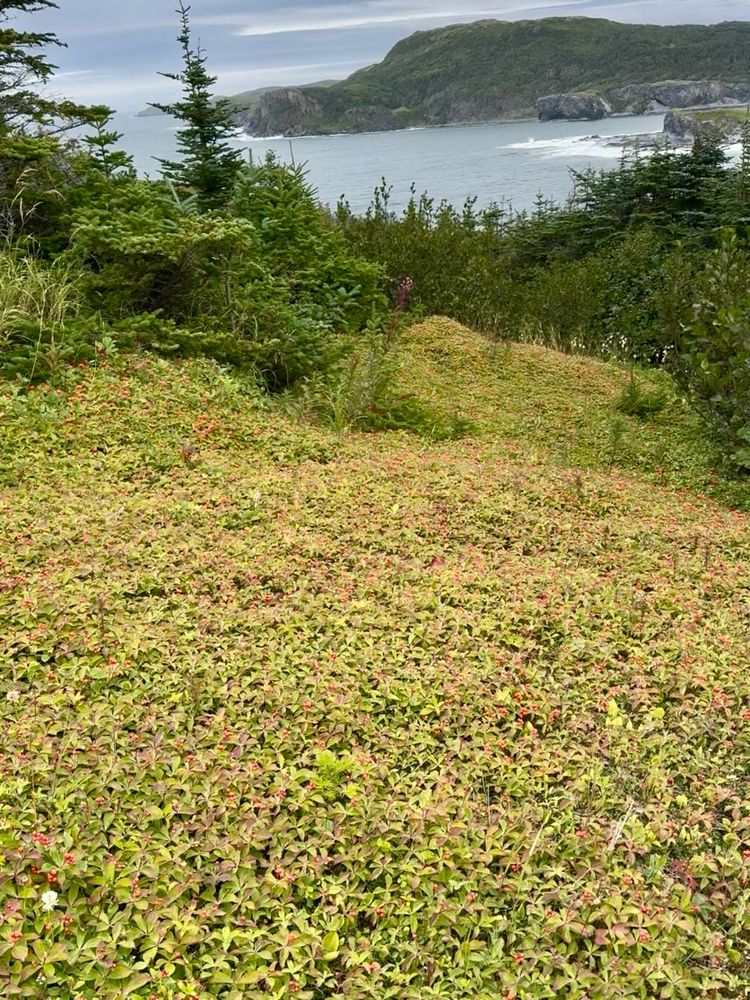
Great carpet!
In Noddy Bay, Newfoundland, Canada.
#newfoundland #canada