I have heard the same joke about my surname like thousand times during my life.
Get a new one!
28.11.2025 21:11 — 👍 2 🔁 0 💬 0 📌 0
We sincerely thank our funders for trusting in our research ideas and for enabling us to carry out this challenging work. Their support helped us pushing forward the study of ancient #RNA molecules in extinct species.
@vetenskapsradet.bsky.social
@villumfonden.bsky.social
@erc.europa.eu
14.11.2025 16:08 — 👍 2 🔁 0 💬 1 📌 0
These are the oldest ancient #RNAs ever sequenced, obtained from the extinct woolly #mammoth 🦣🦣
Many thanks to all the people that contributed to make this groundbreaking work possible.
@cpgsthlm.bsky.social @scilifelab.se @stockholm-uni.bsky.social @ucph.bsky.social @uitnorgesarktiske.bsky.social
14.11.2025 16:08 — 👍 4 🔁 1 💬 1 📌 0

a close up of a dog with a blue collar and tag
ALT: a close up of a dog with a blue collar and tag
Intriguingly enough, some of these #RNAs indicated that Yuka might have died under quite stressful conditions.
Indeed, claw marks in its skin could indicate that Yuka was attacked by cave lions before its death!! ☠️
14.11.2025 16:08 — 👍 2 🔁 0 💬 1 📌 0

Yuka was thought to be a female ♀️ mammoth, based on previous external examination. Surprisingly, we found evidence at both #RNA and #DNA levels revealing that Yuka was in fact a male! ♂️
14.11.2025 16:08 — 👍 1 🔁 0 💬 1 📌 0

The ancient #RNA sequences from Yuka showed increased chemical damage, as expected for such old molecules.
14.11.2025 16:08 — 👍 1 🔁 0 💬 1 📌 0

The best performing sample was mammoth 1, also known as #Yuka, a 5-year-old juvenile woolly mammoth that died nearly 40,000 years ago and that is one of the best preserved specimens ever found.
14.11.2025 16:08 — 👍 2 🔁 1 💬 1 📌 0


Only 3 out of the 10 mammoths had #RNA and #DNA of good quality, and the ancient RNA molecules were strongly concentrated in exonic regions.
14.11.2025 16:08 — 👍 1 🔁 0 💬 1 📌 0

We extracted both ancient #RNA and #DNA from soft tissues that have been preserved in the Siberian permafrost for thousands of years.
Did we find any mammoth-like molecules? Yes ✅, both in the RNA and DNA fraction, but not for all the mammoths we analyzed.
14.11.2025 16:08 — 👍 1 🔁 0 💬 1 📌 0

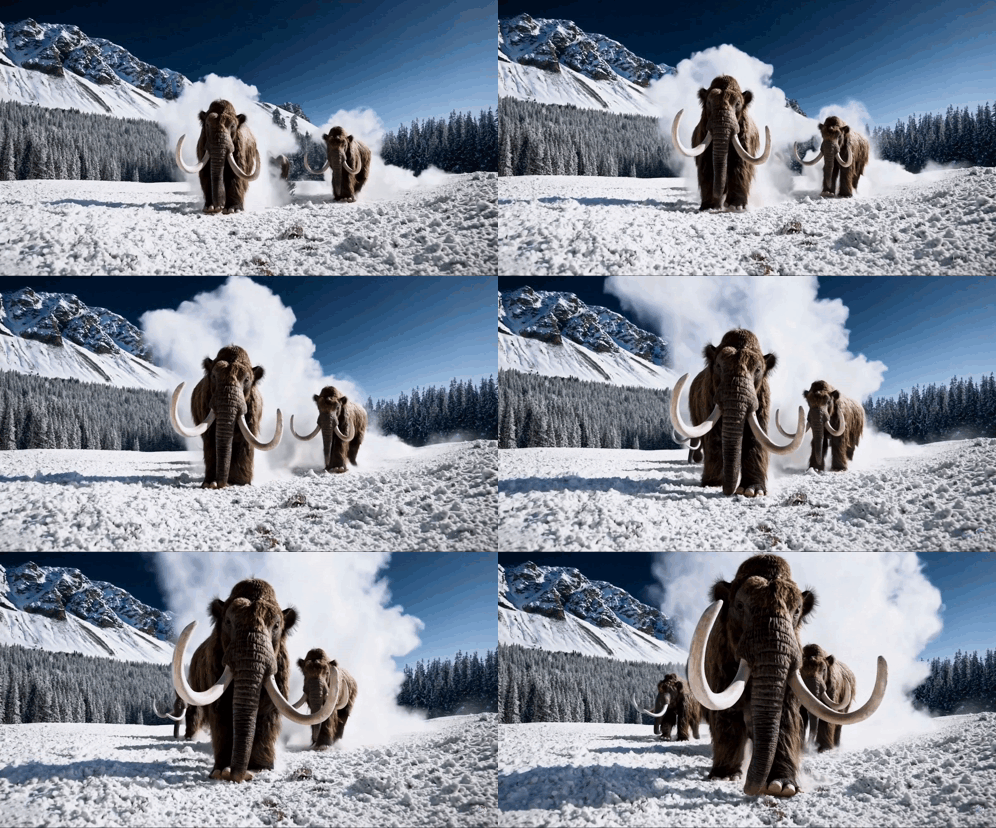
two mammoths are walking through a snowy field in the mountains
ALT: two mammoths are walking through a snowy field in the mountains
We sought to challenge this, and decided to double down the bet to look for ancient #RNA molecules in the extinct woolly mammoth.
We analyzed 10 samples from #mammoths that lived between 10,000 and 50,000 years ago in the Northern region of Siberia during the last Ice Age🥶
14.11.2025 16:08 — 👍 2 🔁 0 💬 1 📌 0

a cartoon cat is crying while sitting on a wooden platform
ALT: a cartoon cat is crying while sitting on a wooden platform
So far, isolating, sequencing, and analyzing #RNA molecules from old remains was considered such a difficult task full of past failures and only a handful of successes, that researchers seemed to have just lost hope.
14.11.2025 16:08 — 👍 1 🔁 0 💬 1 📌 0

a cartoon of homer simpson holding his finger to his lips with the word interesting behind him
ALT: a cartoon of homer simpson holding his finger to his lips with the word interesting behind him
So why should we bother about #RNA?
Contrary to #DNA:
📌RNA tells which genes are "turned on".
📌 We can detect tissue-specific gene expression and metabolic changes (stress, infections...)
📌Novel active genes can be found.
📌We can decipher regulatory mechanisms.
14.11.2025 16:08 — 👍 2 🔁 0 💬 1 📌 0

a cartoon of a monkey laying on the ground with his arms outstretched
ALT: a cartoon of a monkey laying on the ground with his arms outstretched
During past years, research focused on ancient #DNA has gained a lot of interest, with dozens of papers being routinely published each year📃
But what about ancient #RNA?
The common preconception is that these molecules, as opposed to DNA, do not last long after cell death.
14.11.2025 16:08 — 👍 3 🔁 0 💬 1 📌 0
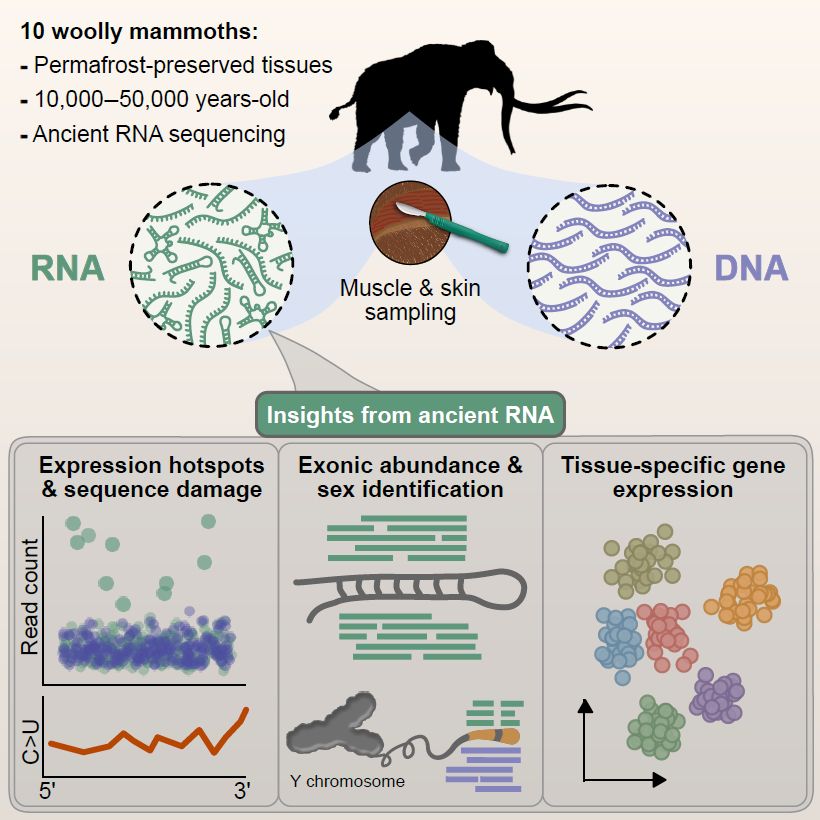
🦣🧬🦣🤯💥We are pleased to share our new paper about ancient RNA expression profiles from the Woolly Mammoth, now published in Cell @cellpress.bsky.social
www.cell.com/cell/fulltex...
If you want to know more, read the 🧵 below:
14.11.2025 16:08 — 👍 109 🔁 41 💬 1 📌 6
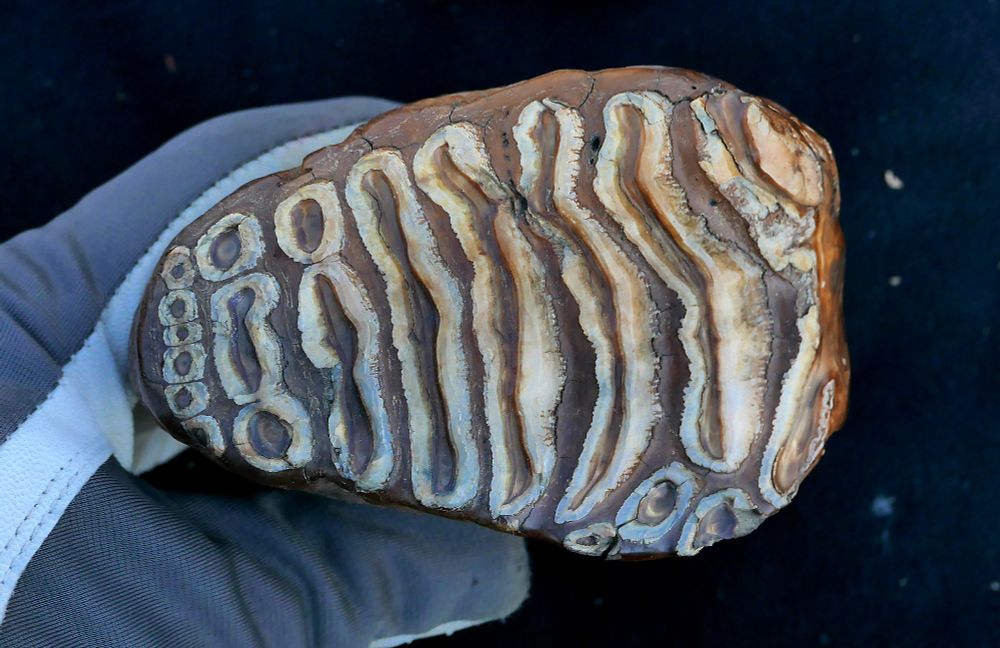
The world's oldest bacterial DNA found in a million-year-old mammoth!
New results from researchers at #CpgSthlm published in Cell!
Paper:
www.cell.com/cell/abstrac...
02.09.2025 20:52 — 👍 78 🔁 29 💬 3 📌 3
Interview to our July AaRCTikTalks speaker Pascale Lubbe · AaRC
Have a look at our new 2025 Blog entry from @aarc-community.bsky.social where we interviewed Dr. Pascale Lubbe (@plubbe.bsky.social) about the research project she presented in July 2025 #AaRCTikTalks
www.animal-adna.org/blog/2025/08...
01.08.2025 10:43 — 👍 8 🔁 3 💬 0 📌 0
I am starting a computational lab at LIOS, Riga, Latvia, and going to recruit a few people. Please DM if you are interested in a postdoc or PhD position in my Metabolic Research Group within the TARGETWISE project. I can highly recommend Riga, it is a beautiful city with very good living conditions.
18.07.2025 09:03 — 👍 36 🔁 30 💬 0 📌 7
Interview to our March AaRCTikTalks speaker Lydia Hildebrand Furness · AaRC
Have a look at our new 2025 Blog entry from
@aarc-community.bsky.social where we interviewed PhD Fellow Lydia Hildebrand Furness about the research project she presented in March 2025 #AaRCTikTalks
animal-adna.org/blog/2025/05...
#aDNA #Dugong #conservation
19.05.2025 17:29 — 👍 5 🔁 2 💬 0 📌 0
Interview to our February AaRCTikTalks speaker Alexander Salis · AaRC
Have a look at our new 2025 Blog entry from
@AaRC_Community where we interviewed Dr. Alexander Salis and Dr. Anna Penna (@apenna.bsky.social) about the research project he presented in February 2025 #AaRCTikTalks.
animal-adna.org/blog/2025/05...
animal-adna.org/blog/2025/05...
#aDNA #museomics
18.05.2025 10:44 — 👍 6 🔁 3 💬 0 📌 0
Interview to our January AaRCTikTalks speaker Jesse Morin · AaRC
Have a look at our second 2025 Blog entry from @aarc-community.bsky.social where we interviewed Jesse Morin about the research project he presented in January 2025 #AaRCTikTalks.
www.animal-adna.org/blog/2025/03...
#ancientDNA #aDNA #salmon #Tsleil_Waututh
18.03.2025 07:16 — 👍 7 🔁 4 💬 0 📌 0
Postdoc at Oxford University researching paleovirology, virus evolution and the global virome 🇦🇺 🇬🇧
Doctoral student researching megafauna evolution in North America 🫎 🦣🐴
Centre for Palaeogenetics at Stockholm University 🇸🇪 @cpgsthlm.bsky.social @stockholm-uni.bsky.social
University of Guelph Alumnus 🇨🇦 @uofguelph.bsky.social
Executive Publisher at T&F. Publish journals. Walk dogs. ❤️ doughnuts & ice cream. #scicomm #physicalsciences #mathematics #statistics #datascience #history #science #STS
Population genetics of humans and other mammals through ancient DNA analysis.
Interested in World War II history, geopolitics, progressive rock and metal.
Postdoctoral researcher, Department of Human Origins, Max Planck Institute for Evolutionary Anthropology
Paleoanthropology 💀 Bone growth 🦴
Scientific Officer (Biodiversity Genomics) @ Research Centre for Ecosystem Resilience, Botanic Gardens of Sydney 🌱.
Palaeogenomics | Population Genomics
Currently in 🇦🇺, previously in 🇳🇿🇸🇪
Biologist specialising in archaeogenetics, Ancient Near East enjoyer
🧬🏺🦴🦠
📍 Universität Tübingen
⬅️ Universitat de Barcelona
The first edition of the International Conference on Palaeogenomics (ICP2026) will be in Stockholm, 23–26 June 2026.
Conference info 👉 https://icp2026.palaeogenomics.org/
Researcher @cpgsthlm.bsky.social and Archaeology Dept. @stockholmuni.bsky.social | #ancientDNA #humans #kinship #popgen #archaeogenomics
ANSOC is creating a new vision of the Bronze Age with animals as active participants in past social worlds
https://ansoc.net
Funded by the ERC Advanced Grant scheme, led by Professor Joanna Brück in the School of Archaeology at University College Dublin
100% plebs urbana.
CIVIS3i-MSCA Researcher, funded by the EU H2020.
Sapienza University & Centre for Palaeogenetics/Stockholm University
https://sites.google.com/view/gonzalooteogarcia/home
Palaeoproteomics Researcher at CENIEH
🧪👩🔬🦴🦷🌏
Building a brand new #palaeoproteomics laboratory here in Burgos, Spain. Exciting new things on the horizon!
#archaeology #evolution #palaeolithic #ZooMS #proteins
Animal aDNA MSc, University of Tübingen // gnc
PhD student in aDNA @cpgsthlm.bsky.social
Ancient DNA Lab at the Center for New Technologies, University of Warsaw. Working on 🦇🐿️🐀🦌🐻🫎🐐🐈⬛🧔♂️🦇🐎 and more!
http://adna.cent.uw.edu.pl/
𝐒𝐨𝐦𝐞𝐭𝐢𝐦𝐞𝐬 𝐝𝐨𝐢𝐧𝐠 𝐬𝐜𝐢𝐞𝐧𝐜𝐞 🧬, 𝐬𝐨𝐦𝐞𝐭𝐢𝐦𝐞𝐬 𝐭𝐚𝐥𝐤𝐢𝐧𝐠 𝐚𝐛𝐨𝐮𝐭 𝐰𝐨𝐦𝐞𝐧 𝐢𝐧 @𝒄𝒍𝒐𝒕𝒊𝒔𝒑𝒆𝒅𝒊𝒂 (𝐈𝐧𝐬𝐭𝐚𝐠𝐫𝐚𝐦)
PhD student at MPI-EVA | ancient DNA, sediments ⏳🧬