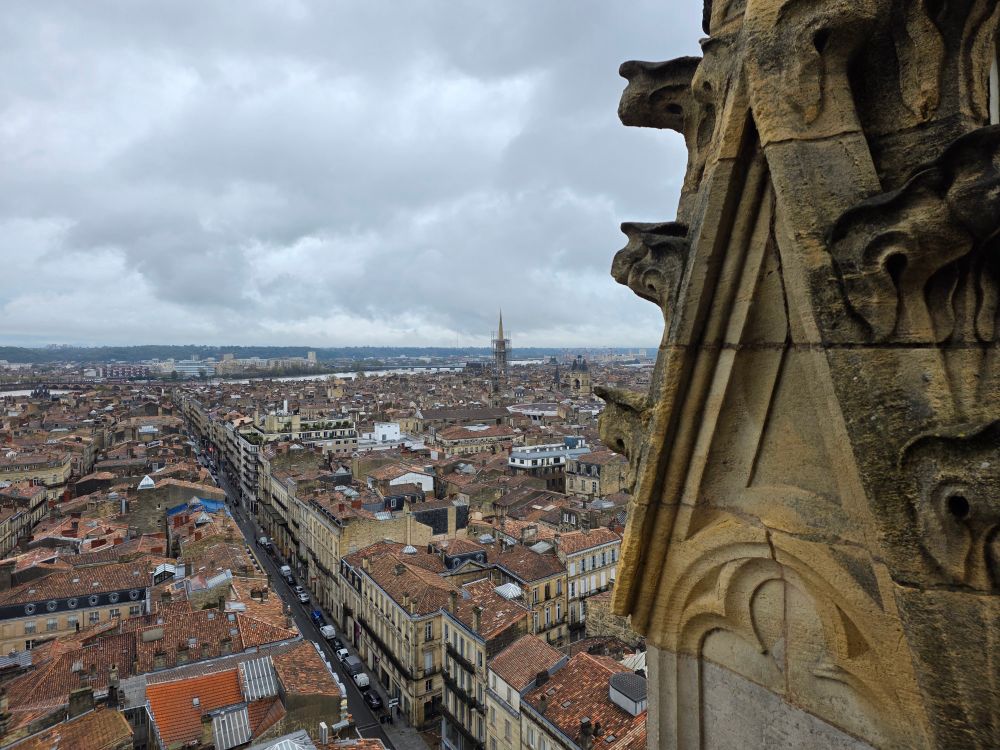
Escaping the laboratory by climbing to the top of one of Bordeaux's bell towers. Constructed in 1440 by the founder of Bordeaux University, Pey Berland.
24.11.2025 14:00 — 👍 2 🔁 0 💬 1 📌 0
@drsamneil.bsky.social
Uses biomolecular science to study human biological and social evolution: ancient DNA, stable isotopes and radiocarbon dating. Research Fellow @pacea.bsky.social University of Bordeaux and @unioxarchaeology.bsky.social University of Oxford
Escaping the laboratory by climbing to the top of one of Bordeaux's bell towers. Constructed in 1440 by the founder of Bordeaux University, Pey Berland.
24.11.2025 14:00 — 👍 2 🔁 0 💬 1 📌 0
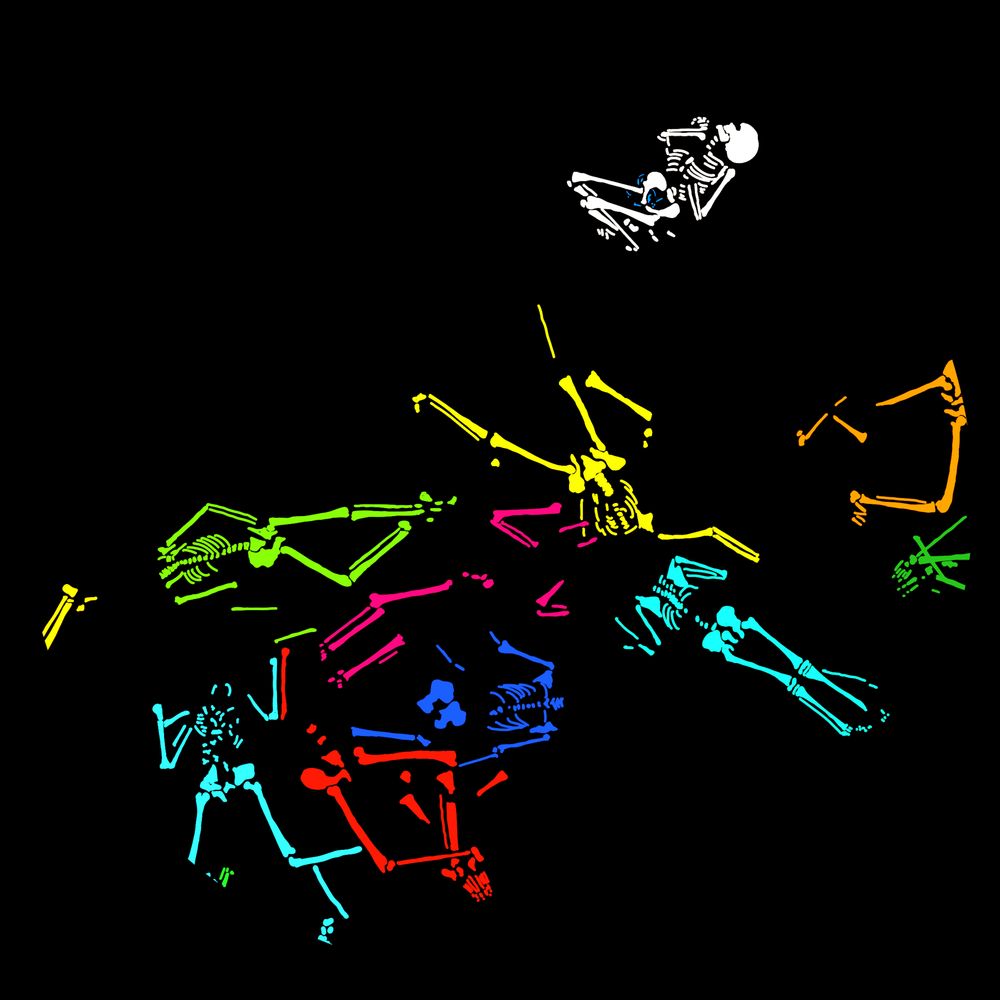
Did Neandertals choose their prey when practicing cannibalism?🍖
Check out our new study, just published in Scientific Reports - @natureportfolio.nature.com!
We provide the strongest evidence to date for a highly selective cannibalism at the end of Neandertal lineage, 41-45.000 years ago.
1/7

🦴🧬🦴🧬🦴
Abstract submission is now open for the 1st International Conference on Palaeogenomics!
June 23–26 2026, in Stockholm.
Join researchers from across the field for 4 days and >100 talks (+ poster sessions)!
Submit abstracts here 👉
icp2026.palaeogenomics.org/abstracts/
Deadline: Nov 30th


Amazing presentations at the meeting on Ancient Genomes: perspectives on human biology and medicine at the Royal Society today
14.11.2025 10:56 — 👍 0 🔁 0 💬 0 📌 0
🚨 New paper alert 🚨
Our research, published today in Science, reveals remarkable concordance between human and dog genomes through time, highlighting how deeply intertwined our evolutionary histories have been over the past 11,000 years.
🔗 Read the full paper here: www.science.org/doi/10.1126/...


Currently writing up the results of new radiocarbon dating from this amazing Neolithic monument, Le Déhus, on the Channel Islands. With thanks to @isotopesuk.bsky.social and @oxradiocarbon.bsky.social for funding radiocarbon dating.
12.11.2025 14:29 — 👍 4 🔁 1 💬 0 📌 0
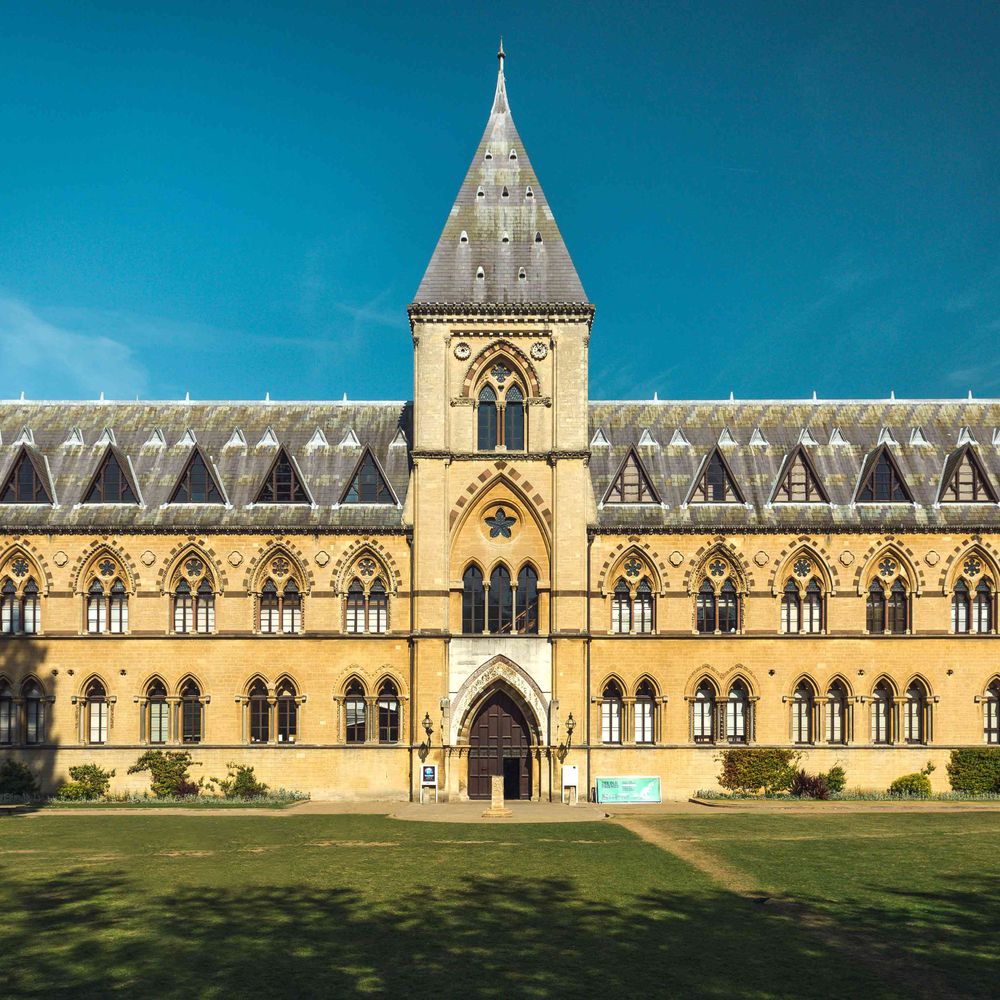
is back at one of my favourite places in the whole world, The Oxford University Museum of Natural History @morethanadodo.bsky.social
07.11.2025 14:50 — 👍 22 🔁 2 💬 0 📌 0
Is all alone early a very quiet radiocarbon lab, freeze drying things..hey, who put the sign in the pie oven...no Frey Bentos in here
06.11.2025 09:12 — 👍 1 🔁 0 💬 0 📌 0
Interesting new paper on radiocarbon dating methods: Application of microsublimation for sample purification in compound-specific radiocarbon analysis.
link.springer.com/article/10.1...
Just to say thanks so much for your efforts in organizing today Kenny along with Seren. It was a really great series of talks and a fascinating day!
03.11.2025 18:27 — 👍 4 🔁 0 💬 0 📌 0
royalsocietypublishing.org/doi/10.1098/...
Probably posted a preprint version of this before but good to see some formal testing of different hypotheses of descent/residence in prehistoric cemeteries of Europe, rather than just eyeballing the trends.


At the Treasure exhibition, Museum of Liverpool
30.10.2025 16:17 — 👍 0 🔁 0 💬 0 📌 0
Optimizing ancient DNA recovery from archaeological plant seeds
www.nature.com/articles/s41...

A new high-coverage #Denisovan genome, chock-full of fascinating new information. Must-read study by @stephanepeyregne.bsky.social @janetk.bsky.social and colleagues
On @biorxivpreprint.bsky.social: 🧪🧬
www.biorxiv.org/content/10.1...

Hand bones from a human relative, found in Kenya, reveal features similar to those of living gorillas, complicating the evolutionary history of hand and tool manipulation
go.nature.com/4nQn3ff
👋 Hello, Bluesky! We’re Radiocarbon, an international peer-reviewed journal (since 1959) dedicated to advancing radiocarbon research, from calibration and chronology to applications across archaeology, geology, environmental science, and more. We’re glad to be here. #Radiocarbon #Geochronology
03.10.2025 17:10 — 👍 43 🔁 18 💬 2 📌 0


🚨SAVE THE DATE for two 14C conferences happening in Santiago, Chile 🇨🇱, next year:
4th 14C & Diet: 6-8 July
3rd Latin American 14C: 8-10 July
Plus, the 11th 14C & Archaeology will be in Brazil just before on 30 June-3 July 🇧🇷
Details for 🇨🇱 below👇 Please share widely!
@fransantanas.bsky.social

Useful new paper on use of isotopes in biomolecular archaeology www.sciencedirect.com/science/arti...
27.09.2025 11:51 — 👍 0 🔁 0 💬 0 📌 0 13.09.2025 11:33 — 👍 1 🔁 0 💬 0 📌 0

Has just emerged from below ground in central Bordeaux looking at some beautifully carved 4th-6th century sarcophagi
13.09.2025 11:28 — 👍 2 🔁 0 💬 1 📌 0
Made it from Oxford to Bordeaux... just before the transport chaos started here in France
10.09.2025 12:45 — 👍 0 🔁 0 💬 0 📌 0
Busy in the labs working on isotope samples to link these to our palaeogenomic data. Better linking these datasets will help us directly study changes in population diet, mobility and genomics over time.
05.09.2025 13:29 — 👍 2 🔁 0 💬 0 📌 0
Promotional illustration for the Royal Society of Chemistry's Sustainable Laboratories Grant 2025. The scene depicts several individuals engaged in various scientific activities in a lab setting, with emphasis on recycling and sustainability. A quote from Martyn Towner about the benefits of the recycling project is also featured.
Your project can create positive change – by helping the environment, your project can also support your own growth and success.
Make your ideal project a reality and share sustainable research practices with your community.
Find out more: rsc.li/sustainable-labs-grant

Nice piece by @mathiesoniain.bsky.social on polygenic prediction of human complex traits using ancient DNA (h/t @evobioclio.bsky.social ) 🧪🧬
www.sciencedirect.com/science/arti...

Disagree with this paper, it is too early to tell...very many sites have not been sampled, or had data published yet... www.nature.com/articles/s41...
26.08.2025 15:17 — 👍 0 🔁 0 💬 0 📌 0
Attending #ESEB2025 has been an amazing experience!
If you are interested in more ancient DNA and museomics, please consider joining us in Stockholm for the first International Conference on Palaeogenomics (June 23-26 2026)!
Follow @palaeogenomics.bsky.social
👉icp2026.palaeogenomics.org
Just to note on this article: systemmatic use of micro-CT scanning is no longer recommended. It has been shown that it causes radiation damage, impacting collagen preservation. This can be significant and
may prevent radiocarbon dating & stable isotope analysis:
www.cambridge.org/core/journal...

Escaped the DNA lab for a day to climb Europe's largest sand dune
26.07.2025 11:06 — 👍 3 🔁 0 💬 0 📌 0
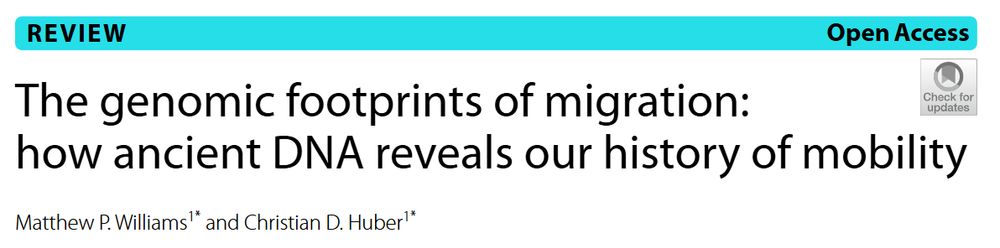
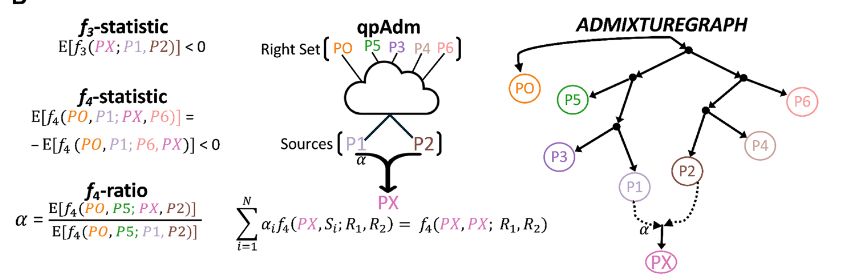
Two useful new reviews on ancestry inference in population genetics:
onlinelibrary.wiley.com/doi/10.1111/...
genomebiology.biomedcentral.com/articles/10....
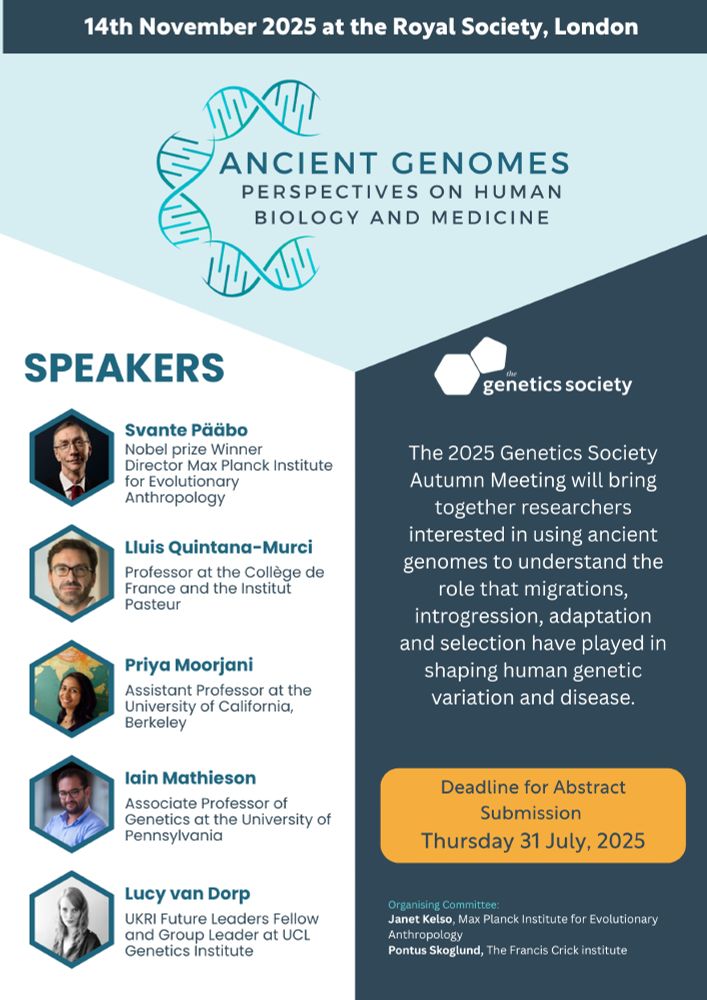
We have an exciting line-up of speakers already confirmed for our Ancient Genomes meeting in November. If you want to be one of the speakers or present a poster, submit your abstract by 31 July!
genetics.org.uk/events/ancie...