
Do you have to create a scientific poster? 🧪 I have created a basic Figma template for it. Hope it helps 👐:
github.com/osvalB/figma...
Do you have to create a scientific poster? 🧪 I have created a basic Figma template for it. Hope it helps 👐:
github.com/osvalB/figma...

New protocol out now! 📕🖊️🔍
A practical workflow for analyzing CD thermal unfolding of short RNAs — from SVD decomposition to two-state fitting to extract melting temp and enthalpy with ChiraKit.
A must-see if you’re working with RNA structure and CD data.
DOI: 10.1007/978-1-0716-5084-4_12 
@mpimarinemicrobio.bsky.social @cssbhamburg.bsky.social
17.09.2025 11:38 — 👍 0 🔁 1 💬 0 📌 0
We’re looking for a GL!
Join us at EMBL Hamburg! 🧫🦠🧬
The position will be based at CSSB @cssbhamburg.bsky.social , an interdisciplinary research centre focused on infection biology, and will be integrated into EMBL's research programme. @embl.org
Find out more and apply here: lnkd.in/dJU9pee7

EMBL-EBI ARISE fellow @melanieschneider.bsky.social & EMBL Grenoble’s Marquez team developed EnsembleFlex 🖥️! It can analyse flexibility, identify protein states, and show drug binding, providing new insights into protein dynamics!
doi.org/10.1016/j.st...

Simulated mass photometry results showing count distributions at a constant concentration of A (150 kDa) and seven different concentrations of B (30 kDa). B free is under the limit of detection (40 kDa). A and B interact with an equilibrium dissociation constant (Kd) of 1 nM.

Screenshot of the pyPhotoMol package repository (https://github.com/osvalB/pyphotomol)
Do you want to analyze mass photometry (MP) count data with Python scripts? Try pyPhotoMol, a package to process, fit, and visualize the MP data 👨💻
github.com/osvalB/pypho...
pyPhotoMol is derived from PhotoMol, our web tool for MP:
spc.embl-hamburg.de/app/photoMol
#massphotometry #Python #code
Happy to present the next tool under development. KinGenie, for binding kinetics. It already supports biolayer interferometry input files. Try it here: spc.embl-hamburg.de
🎉🎉🧪🧪
ChiraKit, our tool for circular dichroism, has been published in NAR 🎉🎉👨🔬👨🔬. @narjournal.bsky.social
28.04.2025 10:53 — 👍 5 🔁 0 💬 0 📌 0
Just want to say thanks to @spcembl.bsky.social for developing ChiraKit and allowing quick and informative analysis of CD data - more here www.biorxiv.org/content/10.1...
best news of the day today as we were stuck with beautiful but hard to analyze data 🙂 #scienceisawesome

Interested in antimicrobial resistance and drug discovery? Attend the talk of my colleague and partner Tania Szal 😊
Monday 17th at 8:30. Platform: protein-small molecule interactions I
#BPS2025
espc poster details

BPS conference banner
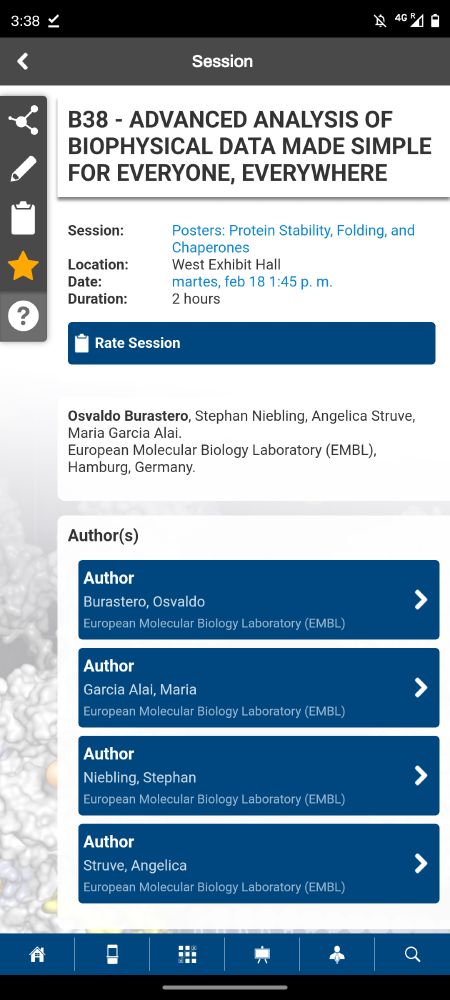
Looking forward to making new connections at #BPS2025👨 Meet me at poster B38 on Tuesday 18 Feb 13:45. Session "protein stability folding and chaperones"
14.02.2025 14:41 — 👍 3 🔁 1 💬 0 📌 1
Poster template done in Figma
Just finished a science poster (in Figma) and wanted to share the template I used! 🎨 Hope it's useful: github.com/osvalB/figma...
11.02.2025 11:51 — 👍 2 🔁 0 💬 0 📌 0
A cup of yerba mate on a wooden surface and some dried yerba mate next to it.
Scientists at University of Buenos Aires, EMBL Hamburg, and others mapped yerba mate’s genome, providing surprising facts about its biochemistry and evolution of caffeine biosynthesis. 🧉🧬🧪
Find out more: www.embl.org/news/science...
@spcembl.bsky.social
Curious fact: many researchers normalise the CD signal using the number of residues. Others, use the number of peptide bonds. Still, everyone calls it 'mean residue molar ellipticity/extinction'. The cromophore unit is the peptide bond, so use that. For short peptides, it matters. 👍
31.01.2025 10:57 — 👍 2 🔁 0 💬 0 📌 0After many months of gathering user feedback and improving our software, we think it's time to share it with the community. Enjoy our latest tool 🥳 , and stay tuned for the next one 😉
31.01.2025 10:35 — 👍 10 🔁 4 💬 1 📌 0
Points: measured MST signal. Line: Fitted curved based on the estimated Kd of 1.3 micromolar.
The estimated Kd (micromolar) is 1.3, and we also provide the asymmetric confidence interval: [0.5 - 3.1] (link.springer.com/article/10.1...)
The reported Kd by the authors was 1.2.
6. Extra: I scaled the plot to start around 0.

Screenshot of ThermoAffinity showing that the Kd upper bound (for the fitting) is 5 micromolar.
4. Go to the '2. Fitting' section. Inside the 'Advanced settings', set the Kd max value to 5 micromolar (to help the fitting algorithm 😄😬 ).
5. Press on 'Run fitting' and voila!

Screenshot of ThermoAffinity showing that the selected units are 'Nanomolar', and that the hot region interval goes from 14 to 20 seconds.

Microscale thermophoresis traces of the entry https://mbdb-data.org/mst/5s81t-w6s49
2. Import the file into our tool ThermoAffinity (spc.embl-hamburg.de/app/thermoAf...)
3. Set the units to 'Nanomolar' and the hot region between 14 - 20 seconds (based on what the authors reported)
Hope this makes it easier to reproduce published analyses. A short example (circa 10 minutes):
1. Downloaded the microscale thermophoresis raw data Lys VHH B09 25 nM Lys100uM max_MSTTraceRawData.xlsx, available at
mbdb-data.org/mst/5s81t-w6...
Our colleagues in Prague have released a database for molecular biophysics data - mbdb-data.org! 🌍📊 A great step forwards FAIR data in biophysics. 🙌✨ @mosbri.bsky.social
31.01.2025 10:24 — 👍 15 🔁 6 💬 1 📌 1
Instruct now has two R&D calls open - aimed at growing and advancing the global structural biology toolkit!
- The pilot award is open to Early Career Researchers, with up to €15,000 available for any topic
- The TechDev call in AI research awards up to €30,000
instruct-eric.org/rd-project-a...

An abstract representation of what happens during a circular dichroism measurement. Left- and right-circularly polarized light passes through the sample. One of the components is more absorbed.
Are you working with circular dichroism (CD)? Check out the latest update to our ChiraKit tool, now with 10 tutorials to get you started! 🚀 Try it here: spc.embl-hamburg.de/app/chirakit
29.01.2025 16:00 — 👍 2 🔁 0 💬 0 📌 0
The Sondermann group and collaborators @univofmaryland.bsky.social have identified a new family of bacterial enzymes termed diDNases. The research received a Breakthrough Article designation from Nucleic Acids Research.
Find out more: t1p.de/i07ua
Journalist friend: you pay to publish your work? 😶
Me: yes, and we also review for free, and pay to read
Friend: are scientists okay?
Idk 😅
Apply now to learn about binding kinetics at the Institut Pasteur (April 2025) 🧪😁
06.12.2024 11:39 — 👍 1 🔁 0 💬 0 📌 0
So many people added to pack 1 this weekend we had to make pack 2. Makes sure you refresh for followers on pack one to see them all!
🧶🧬
go.bsky.app/DDetSBp
Look who's here
@pnas.org ✔️
@science.org ✔️
@naturecellbiology.bsky.social ✔️
@natrevgenet.bsky.social ✔️
@naturebiotech.bsky.social ✔️
@naturemicrobiol.bsky.social ✔️
@naturechemistry.bsky.social ✔️
@genesdev.bsky.social ✔️
@cellchembiol.bsky.social ✔️
@genomeresearch.bsky.social ✔️
@jcellbiol.bsky.social ✔️
Anyone looking for a postdoc position? Apply to join our group in EMBL Hamburg 😊🧪
22.11.2024 20:56 — 👍 0 🔁 0 💬 0 📌 0We've developed some tools to analyse dsf data. Please check them out and don't doubt to contact us 😁 spc.embl-hamburg.de
20.11.2024 16:40 — 👍 3 🔁 0 💬 1 📌 0