PhD Workshop
Next Edition:
2nd PhD Workshop in Labor and Behavioral Economics
June 8/9, 2026
Center for Economic Behavior and Inequality (CEBI)
University of Copenhagen
Submission Deadline: January 31, 2026
📢 PhD Workshop in Labor and Behavioral Economics 2026 📢
The next edition will take place at CEBI, University of Copenhagen (June 8–9, 2026).
Keynote speakers: Ingar Haaland (NHH) & Benjamin Schoefer (UC Berkeley).
Call for Papers: sites.google.com/view/behavio...
Deadline: Jan 31, 2026
01.12.2025 09:15 — 👍 6 🔁 7 💬 3 📌 2
@economist.com @spiegel.de @faznet.bsky.social @szde.bsky.social @derstandard.at @diepressecom.bsky.social
24.11.2025 20:50 — 👍 0 🔁 0 💬 0 📌 0
@ihs.ac.at @rwi.bsky.social
24.11.2025 20:50 — 👍 0 🔁 0 💬 1 📌 0
Not properly captured in our paper, but: broader lesson for GenAI era❓
👉 gains depend not only on what AI can do (automation), but especially if workers can step into expanded task spaces that create new work (augmentation)
👉 People need to build and update skills that 🤝 with AI
12/12
24.11.2025 20:47 — 👍 0 🔁 0 💬 1 📌 0
Key takeaways:
How does AI skill demand affect workers’ earnings and employment stability?
• No broad earnings and employment responses
• Gains mostly modest and concentrated among expert workers
• Certain inequality concerns, but also job-augmenting potential
11/12
24.11.2025 20:47 — 👍 0 🔁 0 💬 1 📌 0

Results suggest: high-skilled benefit, lesser-skilled not so much ➡️ Implications for Inequality?
Estimates vary sharply across earnings distribution:
• Bottom deciles: -8 days, earnings −3.9%
• Top decile: +5 days, earnings +2.5%
👉 Suggestive evidence: AI could widen existing inequalities
10/N
24.11.2025 20:46 — 👍 2 🔁 0 💬 1 📌 0

AI exposure expands analytic + interactive tasks, and reduces manual ones.
These task expansions translate into measurable earnings gains, especially through analytic work.
👉 Early AI technologies seem to induce task shifts, consistent with reinstatement effects.
9/N
24.11.2025 20:46 — 👍 0 🔁 0 💬 1 📌 0

Clear pattern: expert workers gain modestly, others not.
• Experts: +0.7% earnings (~400€), small gains in days worked in response to doubling in local AI demand
• Lesser-skilled workers: small declines
👉 Job-specific expertise matters (more than formal education or other skill proxies).
8/N
24.11.2025 20:45 — 👍 0 🔁 0 💬 1 📌 0
On average, rising AI demand does not change workers’ employment stability or annual earnings.
👉 Early AI neither caused broad job loss nor generated large productivity gains.
👉 But: these zero results mask considerable skill heterogeneity...
7/N
24.11.2025 20:45 — 👍 1 🔁 0 💬 1 📌 0
Identification Strategy:
OLS likely biased
👉 We use a leave-one-out instrument: national AI demand within occupations (excluding worker’s own region).
This approach helps to isolate broad tech shifts from local conditions (see paper for technical details).
6/N
24.11.2025 20:45 — 👍 0 🔁 0 💬 1 📌 0

AI Exposure rises with skill levels:
👉 Experts face more AI vacancies than helpers, professionals, or specialists
👉 Similar insights by formal education and occupational task structures
Sets the stage for distinct insights by skill groups (more on that later).
5/N
24.11.2025 20:45 — 👍 0 🔁 0 💬 1 📌 0

AI demand across local labor markets: occupations × regions
Most local labor markets show little AI skill demand, others experienced notable increases.
(e.g.: in 2017 only 9% of local labor markets displayed AI demand, by 2023 ca. 16%)
👉 Key variation: changes in AI skill demand over time.
4/N
24.11.2025 20:44 — 👍 0 🔁 0 💬 1 📌 0

Stylized Facts on AI Skill Demand (2017–23, Germany)
• Modest in aggregate terms, fluctuates between 1 – 1.5% of all job postings.
• Most demand on unspecified AI skills, #machinelearning, and other technologies popularized prior to the emergence of #GenAI.
3/N
24.11.2025 20:44 — 👍 2 🔁 0 💬 1 📌 0

How does AI skill demand affect individual workers?
#AI can:
1. displace tasks
2. boost productivity
3. create new tasks
👉 Explore channels in context of longer-term dynamics of the early AI wave (2017-2023).
Data: Online Job Postings + German worker-level admin data (@iabnews.bsky.social)
2/N
24.11.2025 20:43 — 👍 1 🔁 0 💬 1 📌 0
📢New WP - AI in Demand: How Expertise Shapes its (Early) Impact on Workers
In a nutshell:
• No broad impact on earnings & employment
• Gains concentrated among expert workers
• Inequality concerns, but also job-augmenting potential
Paper: irihs.ihs.ac.at/id/eprint/73...
Below a short 🧵 #EconSky
24.11.2025 20:42 — 👍 5 🔁 1 💬 1 📌 1
#econsky ;)
24.11.2025 20:39 — 👍 0 🔁 0 💬 0 📌 0
@economist.com @spiegel.de @faznet.bsky.social @szde.bsky.social @zeit.de @derstandard.at @diepressecom.bsky.social
24.11.2025 20:21 — 👍 0 🔁 0 💬 0 📌 0
@ihs.ac.at @rwi.bsky.social
24.11.2025 20:18 — 👍 0 🔁 0 💬 1 📌 0
Key takeaways:
How does AI skill demand affect workers’ earnings and employment stability?
• No broad earnings and employment responses
• Gains mostly modest and concentrated among expert workers
• Certain inequality concerns, but also job-augmenting potential
11/12
24.11.2025 20:11 — 👍 0 🔁 0 💬 0 📌 0
Identification Strategy:
OLS likely biased
👉 We use a leave-one-out instrument: national AI demand within occupations (excluding worker’s own region).
This approach helps to isolate broad tech shifts from local conditions (see paper for technical details).
6/N
24.11.2025 20:03 — 👍 0 🔁 0 💬 0 📌 0
PS: No teaching load, lots of freedom for your own projects, and an interdisciplinary team that values both rigor and collegiality - and all of that in the heart of one of the most liveable cities worldwide.
12.11.2025 17:30 — 👍 1 🔁 0 💬 0 📌 0
EJM - Econ Job Market
🏛️ Join us in vidid Vienna! 🏛️
We at @ihs.ac.at are hiring Postdocs in Econ, with a focus on #LaborEcon #EducationEcon #PublicFinance #SurveyResearch.
🕐 Apply via #EconJobMarket by Dec 2.
Feel free to share this post - or just come join us yourself!
👉 Link: econjobmarket.org/positions/12...
12.11.2025 17:28 — 👍 2 🔁 2 💬 1 📌 0
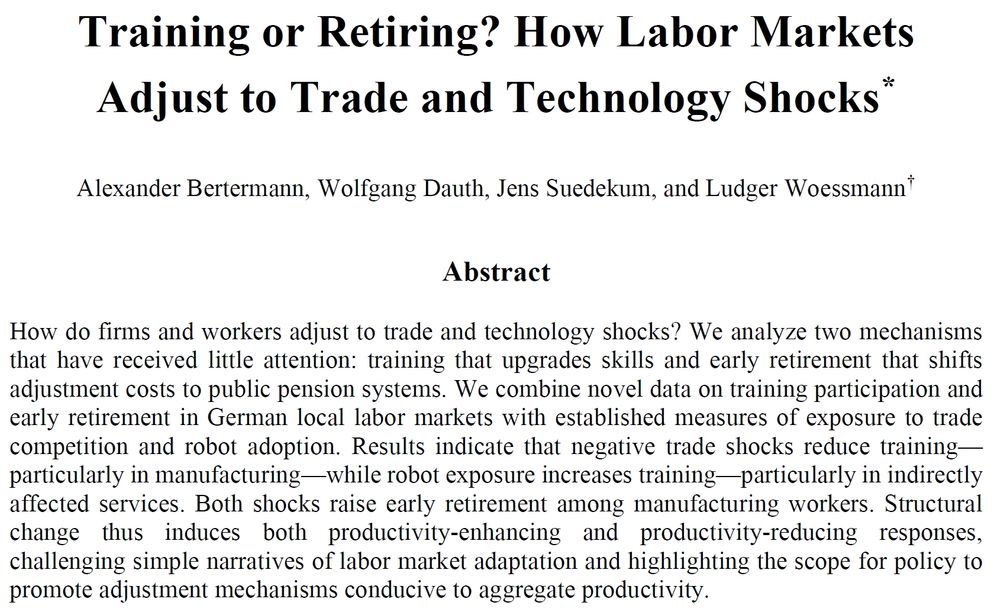
🆕Working Paper🚨
Training or Retiring? How Labor Markets Adjust to Trade and Technology Shocks📒
w/ A.Bertermann, @dauthecon.bsky.social & @suedekum.bsky.social
🤖 Robots ➡️ ⬆️training & ⬆️early retirement
🌏 Imports ➡️ ⬇️training & ⬆️early r.
🌎 Exports ➡️ ⬆️training & ⬇️e.r.
www.ifo.de/DocDL/cesifo...
🧵1/9
11.11.2025 05:59 — 👍 30 🔁 13 💬 1 📌 1

It was a pleasure to host Oliver Schlenker (ifo & @iabnews.bsky.social ) today @ihs.ac.at Vienna.
Oliver presented "The Deadly Consequences of Labor Scarcity: Evidence from Hospitals".
Setting: DE–CH border region, but w/ many lessons beyond. Very timely paper!
👉 Check it out: lnkd.in/eNyxXHNS
30.10.2025 18:41 — 👍 4 🔁 1 💬 0 📌 0
German Reunification Day invites both gratitude and reflection.
Gratitude, because the peaceful revolution of 1989 was nothing short of a miracle — a bloodless dismantling of a repressive regime.
Reflection, because the wounds of the transition still mark the country —and because
03.10.2025 15:09 — 👍 56 🔁 21 💬 4 📌 6
Link to paper: www.nber.org/system/files...
Link to non-technical summary: openai.com/index/how-pe...
03.10.2025 06:46 — 👍 0 🔁 0 💬 0 📌 0
But: the consultant role (“how can I do this?”) tends to produce higher-quality output. Note: [educated] users in high-paying jobs lean more on the ChatGPT-as-consultant role, esp. for decision support.
👉 It’s not just if you use ChatGPT, but HOW you use it that shapes the value you get from it.
03.10.2025 06:45 — 👍 0 🔁 0 💬 1 📌 0
1️⃣ ChatGPT is increasingly used for personal tasks – not just for work.
2️⃣ By July 2025, 56% of users employ ChatGPT as a “personal assistant” (e.g. “please edit this text”).
03.10.2025 06:44 — 👍 0 🔁 0 💬 1 📌 0

How do people use ChatGPT?
A new NBER WP by researchers from OpenAI, Harvard & Duke analyzes millions of ChatGPT conversations since its launch, showing how usage patterns have shifted across work & personal contexts.
There are many interesting insights in here, but two findings stood out to me:
03.10.2025 06:43 — 👍 3 🔁 0 💬 1 📌 0
War mit eine Freude ein paar Einschätzungen zum Artikel beitragen zu dürfen, insb. zum Spannungsfeld zwischen österreichischen und globalen Trends.
29.09.2025 21:29 — 👍 2 🔁 0 💬 0 📌 0
Health Economist @ihs.ac.at
Professor at NHH Norwegian School of Economics @NHHnor, interests incl.: labour markets, family and equality policies, gender and organisations.
BA, PPE @warwickuni / MPhil, Comparative Government @UniofOxford / DPhil student in Politics @NuffieldCollege & @Politics_Oxford
Link to my blog “Often wrong, but sometimes useful”: https://jacobedenhofer.substack.com/
Offizieller Account der österreichischen Tageszeitung DER STANDARD. https://derstandard.at
Wir sind eine der größten Ökonomenvereinigungen Europas und wollen die Wirtschaftswissenschaften stärker in den Fokus der öffentlichen Wahrnehmung rücken.
noun | a reference source containing words alphabetically arranged along with information about their forms, pronunciations, functions, and etymologies
· Economist @univlorraine.bsky.social, en français and in English
· I study how humans influence each other in organizations, at work, in scientific communities, and online #Rstats
· He/Him 🏳️🌈
🌐 https://o.simardcasanova.net
📍 Nancy, Lorraine, France 🇪🇺
PhD @ ROA, Maastricht University | Amateur Footballer and Sport Lover | Sikh
PhD candidate at @ROAMaastricht || AI, tech. change and labour markets
https://roa.nl/p70078329
PhD candidate at the Luxembourg Institute for Socio-Economic Research (LISER) @liserinlux.bsky.social
Postdoc at Microsoft Research, incoming AP at MIT in Economics and Computer Science
lindseyrraymond.com
PhD student @unibern, impact of digitalization on labor markets & education, @econ_uzh MA, prev. @kofeth. my private views.
Associate Professor, Economics, YorkU | Inequality, Technological Change, Occupations, Skill Investments | 🇨🇷 🇨🇦 🏳️🌈
Professor of sociology (social stratification and inequality) at the University of Amsterdam || Schrijft een boek bij Das Mag || Co-chair of the annual AISSR Popquiz
Research based at @liser.lu on #digitalisation, labour relations, #FutureOfWork, #migration, unemployment, #AI, skills, employability, cross-border work, etc.
Familienvater, Hobbyfotograf, DJ Labour MC. Hauptberuflich CEO vom AMS.
Pro-democracy conservatives Republicans fighting Trump & Trumpism.
https://www.instagram.com/republicansagainsttrump/profilecard/?igsh=MXM4OGZ0cHRiOGdmMg==
#AUSSDA – The Austrian Social Science Data Archive
We make social science data accessible and reusable.
Find research data at data.aussda.at
https://aussda.at/