
CBCS is proud to introduce a brand new initiative... Friends of Biodiversity! 🦜
The initiative offers events, citizen science and volunteer opportunities, plus lifelong learning through talks, workshops and articles.
Interested in joining? Register your interest here: ems.gs/3iGO0ledsts

COLLECTION | To coincide with our first anniversary, Nature Reviews Biodiversity has launched a collection of our content relating to the Kunming-Montreal Global Biodiversity Framework Targets: go.nature.com/4pV2cI1
(1/7)

‘Current approaches and future opportunities for climate-smart protected areas’ by Buenafe et al.
Available here: go.nature.com/4pSxFul
(4/7)
Good to show what’s possible when you really apply yourself
(This is a game I play with myself to incentivise applications! Getting to 10 for the year means I get a Little Treat. And occasionally some of the things aren’t rejected which is nice too.)

Very pleased to announce (after failing by one last year) that I have reached my 2025 goal of 10 rejections (jobs & grants)! Cheers to all the hardworking HR departments getting “we regret to inform you” emails out on Christmas Eve.
Incredibly grateful for this support for our work in the Southern Great Barrier Reef!
Google at its peak was basically the best information retrieval system in human history and they and every competitor decided going from there to “you didn’t want answers you wanted half-assed auto-complete 80%-wrong hallucinations” in a few years was the right idea


Fab talk from @megcevans.bsky.social about government trying to use capitalism (for profit model) to attempt to solve problems created by capitalism (environmental damage and biodiversity loss).
But $2bn to solve biodiversity crisis isn't much compared to many other publicly funded things.
#esa2025
Proud of the many colleagues named on this list, and of the many more I know who agree.
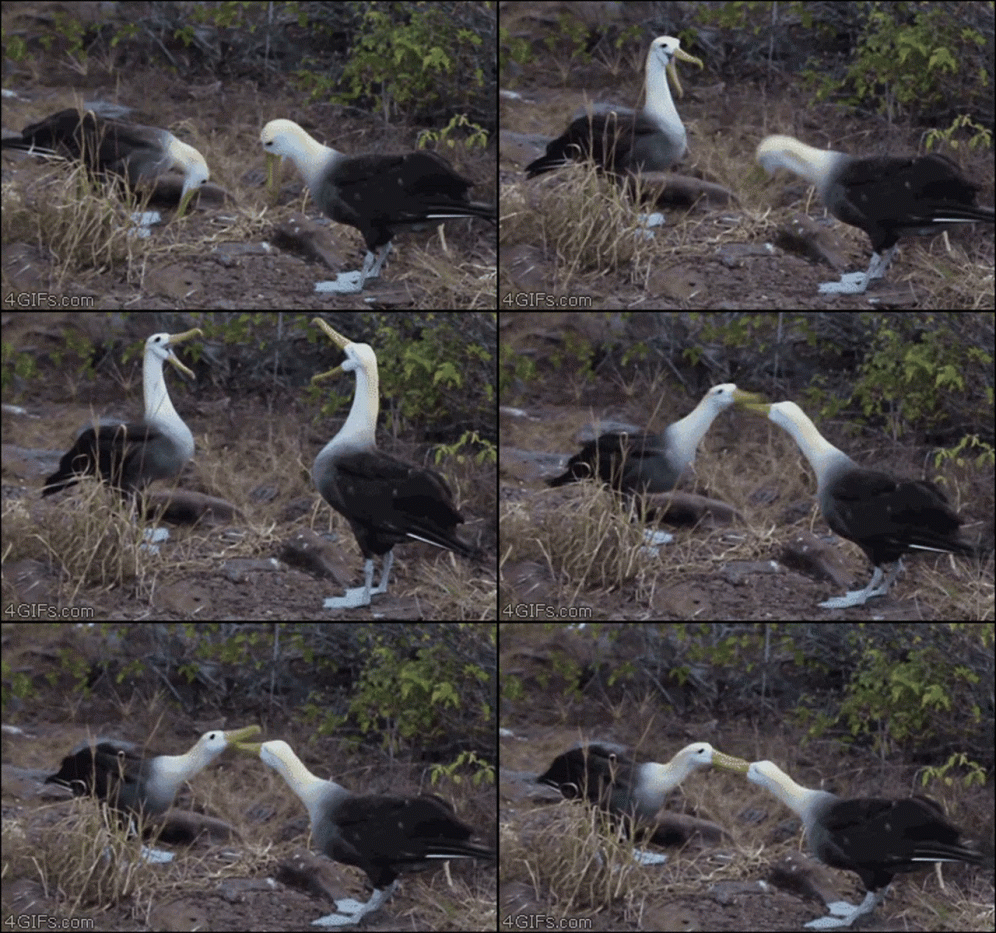
The birds always get a whirl!

Phenomenal Welcome to Kaurna Country @ecolsocaus.bsky.social #ESA2025 from Katrina Karlapina Power.
Incredible Indigenous and feminist energy, both a wake up call and call to action, to connect with the land our Mother.
"Curiosity and Courage!"

At #ESAus2025 & interested in movement ecology? Come to our three sessions today in Riverbank Room 8 organised by @scottwilliamf.bsky.social. At 11.45am I'll talk connectivity of megavertebrates in the global ocean, PLUS call on Australian movement ecologists to join geobon.org/move-bon/ 🌏🎉 #ESA2025
Super excited to be in Adelaide for #ESA2025! Come and say hi to chat about movement ecology, seabirds, marine conservation policy, or... honestly whatever.

#Wisdom is back!
The world’s oldest known living banded bird, Mōlī (Laysan albatross) queen, has returned to Kuailhelani (Midway Atoll). #Birds
Hey you probably don’t remember our brief email exchange in like 2019, but it was genuinely helpful and I still think about your advice. I’m really sorry for your loss. Amongst… *gestures* everything, I hope you’re doing ok.

new paper by Sean Westwood:
With current technology, it is impossible to tell whether survey respondents are real or bots. Among other things, makes it easy for bad actors to manipulate outcomes. No good news here for the future of online-based survey research
New work out today! 🌏 We identify geographic and taxonomic gaps in EBSA descriptions, trends in the levels of protection observed, and ways forward to improve the uptake and appropriate use of the outputs of this singular intergovernmental process.

What is an ecologically or biologically significant area?
How do we prioritise one seagrass bed over another, or a seagrass bed over a seamount?
www.nature.com/articles/s44...

Animal migrations are extensive and crucial for ecosystem health but are in decline. A study in Nature Communications identifies 1,787 sites and links among them for 109 marine species, providing policymakers with essential knowledge for effective conservation. 🌊 🧪

Really nice piece on our recent work on @mongabay.com
news.mongabay.com/2025/05/new-... 🌏🦈🐋🌊
Read the article here: 🧪
www.nature.com/articles/s41...

🦋 Join henrylnorth.bsky.social (@girtoncollege.bsky.social @camzoology.bsky.social) as he shows how we’re monitoring moths in Cambridge to better understand local biodiversity.
Big insights from small wings.
#BiodiversityDay #MothMonitoring #CambridgeScience
Animal migrations are extensive and crucial for ecosystem health but are in decline. A study in Nature Communications identifies 1,787 sites and links among them for 109 marine species, providing policymakers with essential knowledge for effective conservation. 🌊 🧪

Happy Belated 99th Birthday to Sir David. Even as someone who, in theory, understood the ecological impact of bottom trawling the footage from his latest film was truly horrifying. Hoping the wider community is inspired to speak up for the ocean, too, so our kids can see it healthier than before.

Thanks to The Conversation for the chance to share some thoughts about our new paper!
We need to continue our progress towards understanding marine connections with the valuable data we collect! Glad to be a part of this initiative - Great job team MiCO & thank you to all of the collaborators and @gobisecretariat.bsky.social for your support! 👏🌐🌊

Happy 99th birthday to the man who gave voice to the wild. 🎉
Sir David Attenborough, thank you for a lifetime dedicated to the natural world, and for sharing its story with wisdom, wonder, and grace.
You've inspired generations to fall in love with nature.
🙏Particular thanks to anchor author Daniel Dunn @marinebiogeo.bsky.social for his leadership and unwavering support, both on this work and in general. Thanks also to the Global Ocean Biodiversity Initiative @gobisecretariat.bsky.social for supporting this work.
I want to acknowledge and thank folks who have worked on this project for much longer than I have, including coauthors Dina Nisthar, Ei Fujioka, Corrie Curtice, Sarah DeLand, Ben Donnelly, Autumn-Lynn Harrison, Ellie Heywood, Connie Kot, Guillermo Ortuño Crespo, Ph.D., Sarah Poulin, and Pat Halpin.
👀 The gaps in the data we found are as informative as the the data themselves – checking our biases, filling in strategic gaps, and incorporating more recent work into the system will all help us bring the picture into even clearer focus.
