Handwritten note saying: "But I am very poorly today & very stupid & hate everybody & everything."
Let's celebrate #DarwinDay by reminding ourselves that everyone has moments when they feel worse for wear.
Darwin wrote to Charles Lyell in 1861:
"But I am very poorly today & very stupid & hate everybody & everything."
www.darwinproject.ac.uk/letter/DCP-L...
So, hang in there, #academicsky!
🧪🌏🐵
12.02.2026 09:48 — 👍 107 🔁 45 💬 1 📌 7
Do you know the origin of the colour-ringed individual?
11.02.2026 12:46 — 👍 0 🔁 0 💬 1 📌 0

New (competition funded) PhD opportunity with me,
@iaciac.bsky.social and @dralgernon.bsky.social
www.findaphd.com/phds/project...
Higher-order networks and animal communication. Suited to someone keen on network science theory/computational modeling and keen to adapt this to ecology & evolution.
09.02.2026 14:41 — 👍 28 🔁 39 💬 1 📌 1
Delighted to see our paper featured on the cover of the Journal of Animal Ecology @animalecology.bsky.social @britishecologicalsociety.org
Thanks Pam Hurkens for the lovely image of a heavily pregnant meerkat being weighed at our field site.
05.02.2026 13:02 — 👍 24 🔁 10 💬 0 📌 0
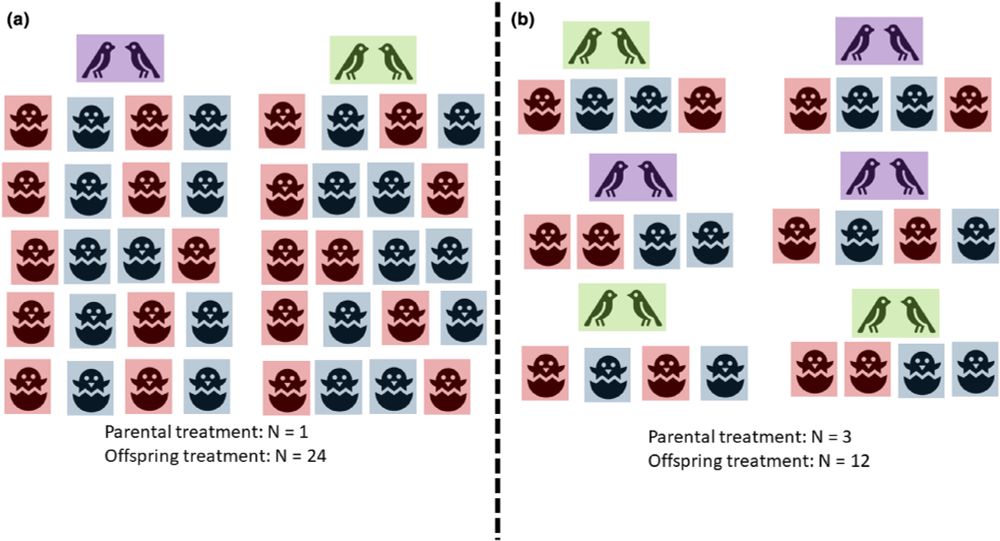
Principles of experimental design for ecology and evolution
Here I argue that we do not discuss experimental design, often until it is too late. This editorial seeks to begin a conversation about how and where to replicate appropriately.
The principles of experimental design in ecology and evolution has 20k downloads, but unfortunately I still have to reject ~20% of papers without review because they lack replication at the right level. More discussion among mentors and mentees please.
onlinelibrary.wiley.com/doi/full/10....
07.02.2026 04:57 — 👍 35 🔁 14 💬 1 📌 0
Found it! Apologies to Schiller, it was Kluver in the 30s. Worth a few minutes of anyone's time: www.sciencedirect.com/science/arti...
22.01.2026 18:46 — 👍 1 🔁 0 💬 0 📌 0
Help me out. I'm looking for a paper I think I saw on bluesky from ~1950s about experiments where chimps were given rats on strings to use as living tools to access out of reach food. I think it might have been Schiller but I can't find it anywhere! Have I gone mad?
22.01.2026 16:02 — 👍 0 🔁 1 💬 0 📌 1

Simulation examples. Scenarios A–D above correspond to agent behaviour sequences in rows A–D below. The sequences indicate 12 time steps, one per box, which proceed horizontally (i.e. the leftmost box is t1, the rightmost box is t12). In the lower rows, beak direction is depicted with a triangle such that head rotations are visible (e.g. in row B, there is a head rotation each time step). The circular area connected to the triangle represents a top view of the scrub-jay head (filled circle with unfilled sectors). Circles with two unfilled sectors show the default foveal position bilaterally, and circles with four unfilled sectors show further foveation during a fixed head position. Unfilled row squares indicate that the scrub-jay has high uncertainty about whether a hawk is present due to lack of sensory evidence (no hawk shape is visible and no hawk call is audible). Filled row squares that progress from dark (orange) to light (yellow) represent the strength of the belief that a hawk is present, beginning with low uncertainty during three time steps when the hawk shape is visible and an increasing belief that the hawk is no longer present once the shape is no longer visible. Upper half: the filled circle indicates the scrub-jay’s proximal surroundings. In the top left (A), a single hawk suggests low background predation risk, which elicits a head rotation every two time steps (row A). (Dotted lines indicate possible but not actual approaches.) Three hawks are shown in B, indicating high background predation risk, which elicits a head rotation every time step (row B). Rectangular cover in C presents a skewed distribution of possible hawk approaches. This leads to a head rotation pattern that proportionately increases the time monitoring exposed areas (row C). In the upper right (D), two actual hawk approaches are shown (solid lines extended by dotted lines). The dark orange solid segment corresponds to the dark orange boxes in row D, when the hawk shape is visible.
Paper out today on @royalsocietypublishing.org:
"Alerting and orienting attention in anti-predator vigilance: neurocognitive modelling and behavioural evidence"
royalsocietypublishing.org/rsif/article...
🧪🌎🪶 #corvids #OpenAccess
21.01.2026 09:18 — 👍 18 🔁 9 💬 0 📌 2
I was always intrigued in how cultural conformity forms and erodes, so much so I would get up before sunrise to dye cheese different colours. This fab new paper shows how competition and ease of learning can produce a spectrum of conformist outcomes in the same system: www.pnas.org/doi/abs/10.1...
21.01.2026 09:15 — 👍 4 🔁 0 💬 0 📌 0
To add to this, if you are down towards Donana anyway then popping into El Rocio is very worthwhile, even just to have a look around. I would also second Trujillo as a gorgeous place to be based for general birding things
20.01.2026 12:24 — 👍 1 🔁 0 💬 1 📌 0

A u shaped structure made out of sticks called a bower, built under a small tree. In front of the bower is a pile of grey, white and green objects that make up the display court. The whole scene is in dappled sunlight and shade created by the tree above.
New bowerbird paper out, we asked whether male great bowerbirds care about the light environment around the bower where they display to females. Short answer: not really. What they do care about is having a display arena with strong visual contrast on the ground. 🐦 tinyurl.com/2v7rycdz
15.01.2026 15:13 — 👍 48 🔁 19 💬 0 📌 0

Internships are now available with the Cornish Jackdaw Project! 🐦⬛
Duties will include assisting with nest monitoring, bird ringing, data entry, and the potential to help with ongoing research projects.
15.01.2026 08:27 — 👍 42 🔁 44 💬 2 📌 0
Paper alert ⚠️⚠️⚠️. Check out our last preprint on bird gestures. Great work By Mylene and collegue and my first empirical paper on non-primates :-). Not only do we confirm that the "after-you" gesture is indeed symbolic in tits but we also found that nestlings use this gesture for another function.
09.01.2026 20:41 — 👍 9 🔁 3 💬 1 📌 0

Simulation-based inference with deep learning suggests speed climbers combine innovation and copying to improve performance
Abstract. In the Olympic sport of speed climbing, athletes compete to reach the top of a 15 m wall as quickly as possible. Since the standardization of the
Proc B with @sampassmore.bsky.social! We used simulations to explore the innovation strategies of speed climbers 🧗♀️ Innovation is higher among slower athletes and lower when the population size is larger, and the overall balance of innovation and copying appears to be suboptimal 🔗 bit.ly/499QjZM
08.01.2026 14:00 — 👍 42 🔁 18 💬 3 📌 4

a,b Average sleep time during 36 h under LD in C. andromeda (a) and N. vectensis (b). White, black, and red horizontal bars represent light, dark, and SD periods, respectively (C. andromeda: ZT17-23, N. vectensis: ZT20-ZT4). c, d Sleep time accumulation of the previous 12 h (sliding average) in C. andromeda (c) and N. vectensis (d) during 36 h under LD. Black arrowheads indicate sampling time for the DNA damage assay presented in (i–l). e Confocal z-projection of a C. andromeda rhopalium and adjacent peri-rhopalial tissue. White squares mark representative single nucleus in the mesoglea. Red asterisk indicates rhopalium. Scale bar 150 μm. f Confocal z-projection showing the mOrange-positive endodermal nervous system in tg(-2.4NvElav1b:mOrangeCAAX) N. vectensis. White squares mark representative single neurons. Scale bar 100 μm. g Representative images of cells in the peri-rhopalial tissue of C. andromeda sampled at ZT11, ZT23, and the following day (Day2 ZT11). Nucleus stained by DAPI (gray), and γH2AX foci (magenta) are stained using immunohistochemistry. Scale bar 4 μm. h Representative images of γH2AX staining (magenta) in mOrange-positive neurons (green) of tg(-2.4NvElav1b:mOrangeCAAX) N. vectensis sampled at ZT17, ZT8, and the following night (Night2 ZT17). Nucleus stained by DAPI (gray). Scale bar 2 μm. i, k Normalized number of γH2AX foci per nucleus of control and sleep-deprived C. andromeda under LD. i Control: Day1 (n = 24, 1.00 ± 0.64), Night (n = 22, 0.55 ± 0.55), Day2 (n = 26, 1.31 ± 0.63). k Sleep-deprived: Day1 (n = 27, 1.00 ± 1.09), Night (n = 31, 2.11 ± 1.13), Day2 (n = 28, 1.42 ± 1.12). Values are mean ± s.d. (n=rhopalia from 8-10 animals per time point).
Jellyfish sleep, which is already bizarre given they have no brains. DNA damage accumulates in their neurons when jellyfish are awake, and it gets repaired when they sleep. This might be something fundamental, evolutionarily, to the role of sleep. 🧪🌊
Link: nature.com/articles/s41...
08.01.2026 06:54 — 👍 116 🔁 39 💬 0 📌 2

📢📢PhD opportunity!
We are looking for enthusiastic researchers to develop a project looking at the ontogeny of migratory behaviour!
Deadline for expression of interest: 8 February 2026
👉Check details here: drive.google.com/file/d/1wow2...
#migration #ornithology #GPStracking
06.01.2026 11:31 — 👍 60 🔁 46 💬 0 📌 4

Winter means.. communal roosts! 🦅🐦🦜
But why do birds form such roosts? In red kites, young single males are the most frequent visitors. Once paired, birds roost more solitarily, often together as a pair.
📢 Now online: tinyurl.tools/98e9279e
@animalecology.bsky.social
@vogelwarte.bsky.social
11.12.2025 09:57 — 👍 20 🔁 11 💬 0 📌 0

Multiple anthropogenic stressors can negatively impact species but can a single stressor also have multiple, concurrent impacts? Here we show that light pollution creates several simultaneous impacts to the nocturnal movement ecology of a moth and a spider: tinyurl.com/5eku5bff (1/5)
17.12.2025 20:15 — 👍 80 🔁 38 💬 4 📌 7

ASAB spring conference 2026 logo with gorilla
If you’re sad #ASABWinter2025 is over, have no fear! #ASABSpring2025 🌼 is coming soon, from March 23-25 at Bristol University. It’s an especially fantastic meeting for students and ECRs 🤠
Don’t forget travel grants are due Feb 1!
www.asab.org/conferences-...
16.12.2025 17:08 — 👍 32 🔁 18 💬 0 📌 1
Beyond proud to be recognised for my poster. Huge thanks to the organisers for such an interesting and inspiring event!
17.12.2025 00:21 — 👍 10 🔁 2 💬 0 📌 0

Helena, Joey and James holding poster prizes

Jolyon shaking Jonah’s hand
Congratulations to #ASABWinter2025 best talk winner Jonah Walker (“Multimodal signalling and mate choice across peacock spider species“) and poster winners Helena Norman, Joey Baxter and James Robertshaw 🙌🎨🏆
16.12.2025 16:48 — 👍 35 🔁 4 💬 0 📌 3

Delighted to have presented my work on meerkat inter-group conflict at my first conference! If you didn’t get the chance today, come and say hi tomorrow 👋 #ASABWinter2025
15.12.2025 22:46 — 👍 21 🔁 2 💬 0 📌 1

Very happy to have presented my poster today on vocal regulation of cooperation in meerkats at #ASABWinter2025 come chat to me tomorrow if you’re interested! 🤓
15.12.2025 22:23 — 👍 17 🔁 4 💬 0 📌 1
Sad to be missing the #ASABWinter2025
@asab-meetings.bsky.social conference this week, but two postdocs that may interest ASAB members:
15.12.2025 08:21 — 👍 10 🔁 11 💬 0 📌 1
Andy has been such a fantastic mentor to so many this is the least recognition he deserves. I can’t put into words the transformative effect Andy’s guidance has had on how I conduct both my science and myself. Get yourself a mentor like Andy.
14.12.2025 17:56 — 👍 7 🔁 1 💬 1 📌 0
Very grateful for such a warm, fun research group made up of some truly brilliant scientists!
04.12.2025 14:03 — 👍 3 🔁 2 💬 0 📌 0
Ecologist at the University of East Anglia | Macroecology, animal movement, global change
Research Fellow in the Institute of Ecology and Evolution at University of Edinburgh. Social networks, behaviour, disease, demography and some wildlife photos.
Interested in animal behaviour, biodiversity, ecology, evolution, conservation and physiology; studying sex roles and evolutionary ecology of coucals and conservation of grassland birds such as whinchats; based at the Max Planck Institute in Seewiesen
Ecologist with broad interests studying gulls, pathogens, and microbiomes. Love and teach R. Dangerously close to becoming microbiologist. Gulls Eating Stuff citizen science project. https://linktr.ee/alice_risely
The International Biogeography Society. Fostering collaboration, awareness of & education in biogeography, for the study & conservation of the world's biota.
https://www.biogeography.org/
We investigate and protect what we are passionate about.
Birder | Research Associate at Swiss Ornithological Institute @vogelwarte.bsky.social
Interested in the evolution of bird movements and how they can influence evolutionary processes
https://pauldufour80.notion.site/pdu
Birder, ringer, moth(er) and mother. Head of Surveys at BTO, BB Editorial Panel, BB Director, BBRC, Chair RBBP. EBCC Board. Views my own. She/her.
BirdsPlus Index. American Bird Conservancy. Dad. Natural history. Ecology and evolution, conservation, acoustics, and occasionally politics.
Masters student, interested in behaviour and ecology of social mammals
We are interested in how animals (including humans) respond(ed) and adapt(ed) to changing environments.
Department of Zoology, Cambridge, UK.
PI: Prof. Andrea Manica (he/him)
Website: https://evolecolgroup.github.io/website/
PhD student at ANU (Ecology and Evolution) studying social behaviour of superb fairy-wrens
MSc in Biogeosciences, BSc in Natural Sciences @LaStatale, Milano
#birds #animalbehaviour #sociality
https://scholar.google.it/citations?user=jgsCs8kAAAAJ&hl=it
PhD student at University of Exeter, Cornwall
'Ecological and welfare implications of social connections in the wild'
🖤 Jackdaws 🩶
PhD Candidate at the Australian National University, working on innovativeness, cognitive ecology and social learning in sulphur-crested cockatoos 🦜
Behavioural ecologist studying cognition, social behaviour, gut microbiota & urbanisation | R enthusiast | Assistant Prof. at Université de Rennes #NewPI | She/her
http://camilletroisi.weebly.com
Behavioural ecology and coevolution. I like cuckoos. He/Him
Assistant Professor at Wageningen University | Evolutionary Biology, Genomics and Ornithology | Blogging at Avian Hybrids
Birding Grafham Water from Aug 1997 (236 for the patch) | WeBS counter | Cambs List 302 (233 self-found) | Former County Recorder | terrible photographer