Immigrants often arrive with better health than natives of their host country, a phenomenon known as the ‘healthy immigrant effect.’ This advantage diminishes over time, one reason being unequal healthcare access. Our study examines whether communication barriers contribute to these inequalities in a healthcare system that rarely accommodates an increasingly diverse and multilingual population. We expect that limited French proficiency restricts equitable access to care. Using the Trajectoires et Origines 2 survey conducted in 2019 in France among over 27,000 individuals---oversampling immigrant-origin populations---we investigate how language shapes healthcare use. France provides a relevant case, as immigrants come from diverse origins, including former colonies where French is an official language, generating substantial variation in proficiency. Findings show significant language-related disparities in medical visits, except for generalist practitioners. To address possible endogeneity bias in the relationship between language and healthcare uptake, we construct an instrument combining age at arrival in France and linguistic distance between French and the mother tongue. This method reveals a significant language effect only for visits to psychologists or psychiatrists. Theoretically, we propose a quantitative strategy to assess language barriers’ effects on immigrants’ healthcare access. Practically, we highlight the need for linguistically inclusive health services.


NEW PREPRINT by CREST Sociology's Julia Nicolas: "Language Barriers and Healthcare Uptake. Causal Evidence From Immigrants in France"
AVAILABLE at @socarxiv.bsky.social: doi.org/10.31235/osf...
03.12.2025 11:59 — 👍 5 🔁 3 💬 0 📌 0
TOMORROW, 12 noon Paris time at the CREST Sociology seminar: @oms279.bsky.social talking about "Coordinating futures in organizational communication"
Join us in person (Room 3049) or on Zoom! zoom.us/j/9779502445...
26.11.2025 11:18 — 👍 2 🔁 0 💬 0 📌 0


NEW PREPRINT by CREST Sociology's @abelaussant.bsky.social at @socarxiv.bsky.social: "What Do Culture Vouchers Really Buy? Evidence from France's ‘Pass Culture’ Policy Effects"
LINK: doi.org/10.31235/osf...
28.10.2025 11:40 — 👍 6 🔁 2 💬 1 📌 0
The ENSAE-CREST is hiring a computational sociologist -- Assistant or Associate Professor.
Date of appointment: September 2026.
Details here : www.css.cnrs.fr/assistant-or...
24.10.2025 23:48 — 👍 16 🔁 13 💬 0 📌 0
Assistant or Associate Professor in Computational Sociology at CREST in Paris
The position is open to computational sociologists regardless of their research area. Deadline for applications: January 31, 2026. All details here: www.shorturl.at/E57le
24.10.2025 10:04 — 👍 5 🔁 9 💬 0 📌 0


✨CREST Sociology is hiring ✨
Assistant or Associate Professor in Computational Sociology
Details here: www.shorturl.at/E57le
22.10.2025 10:03 — 👍 26 🔁 24 💬 0 📌 1

🇫🇷 We are hiring 🇫🇷
Assistant or Associate Professor Position in Computational Sociology @crestsociology.bsky.social @ipparis.bsky.social
Details here (please RT)
www.shorturl.at/E57le
20.10.2025 14:40 — 👍 33 🔁 27 💬 0 📌 0


THIS THURSDAY, 12 noon Paris time: Katia Begall's seminar "A Dyadic Approach to the Intergenerational Transmission of Household Work" in person at ENSAE or on-line at Zoom: zoom.us/j/9148878841...
20.10.2025 09:07 — 👍 2 🔁 0 💬 0 📌 1

The image showcases the paper title and its abstract. You can read it in PDF format here: https://osf.io/preprints/socarxiv/pmdvy_v1

The image report regression model results. It shows the net effect of ‘pass Culture’ grant spending on 12-month participation likelihood of several cultural practices. For a full description of the results, read section 7.2.2 in the linked article.
I'm excited to share my new paper: "What Do Culture Vouchers Really Buy? Evidence from France's ‘pass Culture’ Policy Effects" now published on SocArxiv. This research dives into a major cultural policy experiment.
doi.org/10.31235/osf...
#sociology #culturalpolicy #culturalconsumption
15.10.2025 14:12 — 👍 20 🔁 9 💬 2 📌 2
Zoom link: zoom.us/j/9825748840...
See you in an hour!
02.10.2025 09:01 — 👍 1 🔁 1 💬 0 📌 0


TOMORROW 12 NOON Paris time: CREST Sociology seminar by @sungju.bsky.social: "The Paradox of Place: How Emotional Connections Shape Community Responses to Flood Risks"
In person at ENSAE or on-line on Zoom!
01.10.2025 10:54 — 👍 8 🔁 2 💬 0 📌 1

NEW ARTICLE by CREST Sociology's Vitalina Dragun in Émulations: ‘’Pauvres riches’’ : la précarité relative des milliardaires russes en mobilité internationale
OPEN ACCESS: doi.org/10.4000/14o5i
18.09.2025 10:58 — 👍 5 🔁 2 💬 0 📌 0

Right now at the CREST Sociology seminar: Ashley Mears!
18.09.2025 10:20 — 👍 2 🔁 1 💬 0 📌 0

Actes de la recherche en sciences sociales (@actesrss.bsky.social) a 50 ans. Pour l’occasion, nous publions un numéro spécial. Anniversaire oblige, ce numéro double comporte aussi des surprises. Un 🧵:
shs.cairn.info/revue-actes-...
17.09.2025 14:21 — 👍 36 🔁 20 💬 1 📌 0
Due to the planned 💪 strike 💪 tomorrow the seminar will be on-line only!
17.09.2025 08:48 — 👍 3 🔁 2 💬 0 📌 0


THIS THURSDAY 12 NOON Paris time: Ashley Mears at the CREST Sociology seminar, talking about "Learning to Like the Likes and the Hate: The Labor of Internet Fame in the New Attention Economy"
In person at ENSAE and on-line: zoom.us/j/9730867636...
Come and join us!
16.09.2025 09:09 — 👍 7 🔁 3 💬 0 📌 1


The @crestumr.bsky.social AI & Social Sciences seminar resumes.
Wednesday 17th at 5pm (CET), we will receive Pr. @emilymbender.bsky.social . She will talk about her latest book, *The AI Con*, co-authored with Dr. @alexhanna.bsky.social.
Join us for what will certainly be a lively conversation.
09.09.2025 11:13 — 👍 31 🔁 17 💬 2 📌 0

Sociology seminar announcement poster featuring the CREST (Center for Economics and Statistics) logo at the top with a modern glass building in the background. The poster displays four upcoming seminars, each with a portrait photo of the speaker on the left and event details on the right:
September 18, 2025, 12:00-13:15: Ashley Mears (University of Amsterdam) presenting "Learning to Like the Likes and the Hate: The Labor of Internet Fame in the New Attention Economy" - shown with a professional headshot of a woman with shoulder-length dark hair wearing a black top with knit vest.
October 23, 2025, 12:00-13:15: Katia Begall (Radboud University) presenting "Of Apples and Trees: A Dyadic Approach to the Intergenerational Transmission of Household Work" - featured with a photo of a woman with glasses and hair in a bun, wearing a light blue shirt while presenting.
November 27, 2025, 12:00-13:15: Oscar Stuhler (Northwestern University) presenting "Agency Expressions in Organizational Communication" - accompanied by a headshot of a young man with dark wavy hair and wire-rimmed glasses wearing a dark sweater.
December 11, 2025, 12:00-13:15: Mads Meier Jæger (University of Copenhagen) presenting "Breath, Depth, or Consecration? Omnivorousness Tastes in Music and Perceptions of Status and Competence" - shown with a photo of a man with reddish hair and round glasses in an office setting with bookshelves.
All seminars are noted as "in person and on-line" events.
Check out the CREST Sociology seminar program for the rest of the year: Ashley Mears, Katia Begall, @oms279.bsky.social, and Mads Meier Jæger! All in person or on-line! Starting next week with Ashley Mears!
08.09.2025 11:56 — 👍 18 🔁 8 💬 0 📌 1
I am thrilled to share with you my first publication in a peer-reviewed journal! Thank you for everything @scoavoux.bsky.social
05.09.2025 08:44 — 👍 13 🔁 3 💬 1 📌 0
NEW: Samuel Coavoux, Abel Aussant, "Streaming Platforms, Filter Bubbles, and Cultural Inequalities. How Online Services Increase Consumption Diversity" sociologicalscience.com/streaming-pl...
04.09.2025 16:31 — 👍 10 🔁 4 💬 0 📌 1

Screenshot of the title and abstract of the article. the title is
Streaming Platforms, Filter Bubbles, and Cultural Inequalities. How Online Services Increase Consumption Diversity. The abstract reads: Do digital technologies affect diversity in cultural tastes? Digital sociologists have warned of “filter bubbles,” whereas sociologists of culture have shown that diversity in consumption is valued as a marker of upper-middle-class status. We estimate the effect of using streaming platforms on the diversity of cultural consumption using a matching technique applied to 2018 survey data from France. We find a statistically significant positive effect of using streaming platforms on the diversity of cultural consumption as well as on cosmopolitanism, on three domains, music, movies, and TV shows. The magnitude of this effect is much higher for TV shows. The study brings new evidence against the filter bubble thesis; it shows that platforms do reinforce cultural inequalities by increasing the social gap in consumption diversity. It further suggests that the effect of technology on cultural consumption might mainly operate through its impact on cultural markets rather than changes in cultural experience.

Main figure of the article. Difference in number of genres consumed, liked, and disliked between streaming users and non-users. Streaming users consume more genres than non-users after controlling for confounders. The difference is small for music (0.1 sd), moderate for movies (0.2 sd), and high for TV shows (0.46 sd). However, differences
in number of genres liked or disliked are small or not significant. SMD before (light) and after (dark)
adjustment through matching, with error bars indicating 95 percent confidence interva
Do streaming platforms trap us in cultural filter bubbles? We like to think so but the evidence says otherwise. In a new paper @abelaussant.bsky.social and I find the use of streaming platform to be associated with an increase in consumption diversity. sociologicalscience.com/articles-v12...
05.09.2025 08:40 — 👍 66 🔁 30 💬 5 📌 6
Look this way for some great analysis on how journalists frame the far right!
27.08.2025 15:10 — 👍 1 🔁 1 💬 0 📌 0
With also Julien Boelaert, who initiated the idea with @eollion.bsky.social & the contributions of many
> More information here www.css.cnrs.fr/active-tigger/
23.08.2025 16:11 — 👍 5 🔁 2 💬 0 📌 0

Ariane Bertogg, @ppraeg.bsky.social, and @klararaiber.bsky.social show that caregiving improves cognitive functioning for both men and women in later life. Read this open access article here: www.sciencedirect.com/science/arti...
18.08.2025 19:39 — 👍 12 🔁 6 💬 0 📌 0
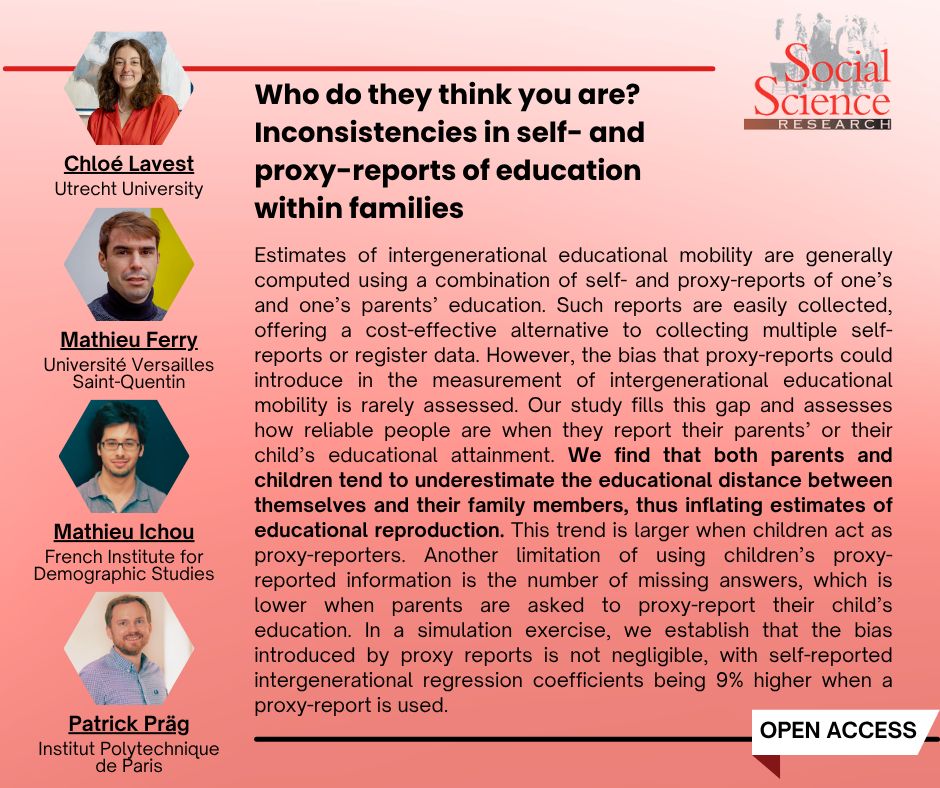
@chlolv.bsky.social and colleagues show that both parents and children tend to underestimate the educational distance between themselves and their family members. Read the full article here: www.sciencedirect.com/science/arti...
31.07.2025 17:59 — 👍 10 🔁 5 💬 0 📌 0
Special issue of SMR on generative AI -- featuring two articles from CREST!
01.08.2025 18:54 — 👍 5 🔁 0 💬 0 📌 0
Postdoc investigating people & places at risk. [she/her] @UFZ.de
Doctorant entre le @cris-sciencespo.bsky.social, le @crestsociology.bsky.social et la Cour des comptes.
Sociologie de la culture et du numérique.
Assoc Prof Pop Data Science/Sociology at CLScohorts/UCL/PurdueSociology | NuffieldCollege | PI of FINDME | book: http://shorturl.at/imP58
interested in sociology, computational social sciences, criminology, causal inference, spatial analysis and more | #rstats | he/him
PhD Student in Politics @Princeton
redatamtam.com
Assistant professor of work and organization studies at MIT Sloan School of Management. I’m a sociologists and computational social scientist studying culture, identity, intergroup conflict, and other things I find interesting or important.
Professor @milanlp.bsky.social for #NLProc, compsocsci, #ML
Also at http://dirkhovy.com/
Media scholar | Assistant Professor of Political Science @Columbia | Author of The American Mirage (PUP 2025) | Host of Media Effects Empricial Workshop (MEEW)
Journalism & politics, NLP & CSS. PhD candidate at
@crestsociology.bsky.social and @medialab-scpo.bsky.social. Before, Sociology @sciencespo.bsky.social, PoliSci at Sant'Anna.
Associate Prof. in Social Demography | Fertility, Family, Education & Inequality | PI of ERC StG DIVREP | University of Oxford
www.ewabatyra.com
Geographer @ercgrantees.bsky.social
Professor of Sociology @ University of Oslo | Editor @ European Societies | Researching social stratification, health inequalities, and political sociology
org sociologist, social innovation prof
@EMLYON, fellow @StanfordPACS, @CIFAR_News
organization of cities, civil society & sustainability
pro dumplings, salsa picante, 🦜🦜
https://www.christofbrandtner.org/
Harvard social scientist, author of #SeeingOthers #GettingRespect #DignityofWorkingMen and more.
Curious mind, mother, friend, mentor, professor, sociologist
www.michelelamont.org
Ph.D. candidate in Sociology at CREST (Paris). My research investigates the rise in union dissolution and the growing class inequality in union dissolution rates, examining both cultural and economic drivers. Website: https://sofianelatifi.github.io/
PhD candidate at CREST (Ecole Polytechnique, ENSAE) | Research affiliate at Institut des Politiques Publiques (IPP) | Director, founder and editor in chief of Oeconomicus
Website: pierrerousseaux.com
Journal: oeconomicus.fr
The Sciences Po médialab is a research center dedicated to connecting the social sciences with new digital tools.
Microeconomist. Associate Prof. at CREST-ENSAI. Family, Labor, Disability, Education.
Assistant professor of economics at CREST - Ecole Polytechnique. Labor, technological change, migration, innovation.
Personal website: https://sites.google.com/view/sarasignorelli/home