Issue 6 of the PAGES PO2 newsletter is out! 🎉
Featuring a Marine Oxygen Loss special issue, PO2 workshop, job opportunities, Data Stewardship updates, conference reports, events & recent publications.
Read here 👉 pastglobalchanges.org/news/138771
@pastoxygen.bsky.social
02.12.2025 10:46 —
👍 4
🔁 3
💬 0
📌 0

Abstract submission is open for #EGU26 (3 - 8 May 2026) 🚨
Are you working with #microfossils and have a story to tell about the #paleoenvironment and/or #paleoclimate? Then join our session to put a focus lens on these amazing micropaleontological proxies!
11.11.2025 21:36 —
👍 9
🔁 6
💬 2
📌 0

The theme of the #UNESCO celebration for this year is Trust, Transformation, and Tomorrow: The Science We Need for 2050. We deserve a world at peace, and science is the key to making it happen! Would you join the change?
10.11.2025 21:47 —
👍 2
🔁 0
💬 0
📌 0


Today’s a special day. it’s World Science Day for Peace and Development! 🌍✨It’s all about boosting public awareness, sharing knowledge, and teaming up across borders. Because when nations unite through science, we get closer to figuring out how to live in a peaceful, sustainable world, together! 🔬🤝💚
10.11.2025 21:47 —
👍 4
🔁 2
💬 1
📌 0
Agglutinated forams (forams that make their shells by adding or agglutinating sorrounding stuff) make their shells by gluing things they find around them: sand, minerals, and skeletons of other organisms! This includes other forams, sponge spicules, even radiolaria! 😱😱
01.11.2025 10:57 —
👍 9
🔁 4
💬 1
📌 0

The ocean has different layers with different temperatures & salt content that result in density differences that drive the thermohaline circulation and the Atlantic Meridional Overturning Circulation (AMOC), a global circulation system that absorbs carbon and heat from the atmosphere & distributes it.
This happens in the deep ocean, and in the shallower ocean, other factors like winds also drive circulation, and supply, among other things, oxygen!
In the deep ocean, density differences drive thermohaline circulation as ocean layers have different temperature & salt content. In the shallower ocean, winds also drive circulation & supply oxygen! Today, areas with little oxygen (Oxygen Minimum Zones-OMZ) form where subsurface circulation is slow
04.11.2025 14:16 —
👍 3
🔁 1
💬 1
📌 0
Very proud to see our own @sofigerina.bsky.social shine! 🤩🌟💙
05.11.2025 13:04 —
👍 3
🔁 1
💬 0
📌 0
PAGES announces 2026 Early-Career Award recipient: Dr. Sofía Barragán-Montilla | PAGES
🏆 Congratulations to Dr. Sofía Barragán-Montilla, recipient of the 2026 PAGES Early-Career Award (ECA)
Sofía uses tiny fossils, foraminifera, to uncover big stories about our oceans’ past. 🌊Thank you for your inspiring contributions to #paleoceanography
👉https://pastglobalchanges.org/news/138727
04.11.2025 16:06 —
👍 14
🔁 5
💬 2
📌 2

Did you learn something new or have questions? Comment below! Follow us on LinekdIn and Instagram and share Past Ocean Oxygen Knowledge!
In summary, we infer that a weak AMOC-driven heat transport decrease led to a strong temperature gradient between the tropical & NAtlantic, that accelerated subsurface circulation, bringing more oxygen to the OMZ we studied. Did you learn something new? Follow us and share! 🌊🐚🔬🤔
04.11.2025 14:16 —
👍 0
🔁 0
💬 1
📌 0

In the last 27.000 years, AMOC has slowed on 2 occasions. Our oxygen reconstruction shows that in those times, there was more oxygen, meaning the subsurface circulation was accelerated and brought more oxygen to the OMZ 🧐Since winds' strength depends on temperature and air pressure changes, we compared the differences between the tropical and northermost Atlantic sea surface temperatures and found that these are larger with a slow AMOC 😱
Findings: with a slow AMOC there was + oxygen, suggesting a stronger subsurface circulation that brought + oxygen to the OMZ🧐Since winds' strength depends on temperature & air pressure, we calculated the sea surface temperature diff. between tropical & NAtlantic: they were larger with a slow AMOC 😱
04.11.2025 14:16 —
👍 0
🔁 0
💬 1
📌 0
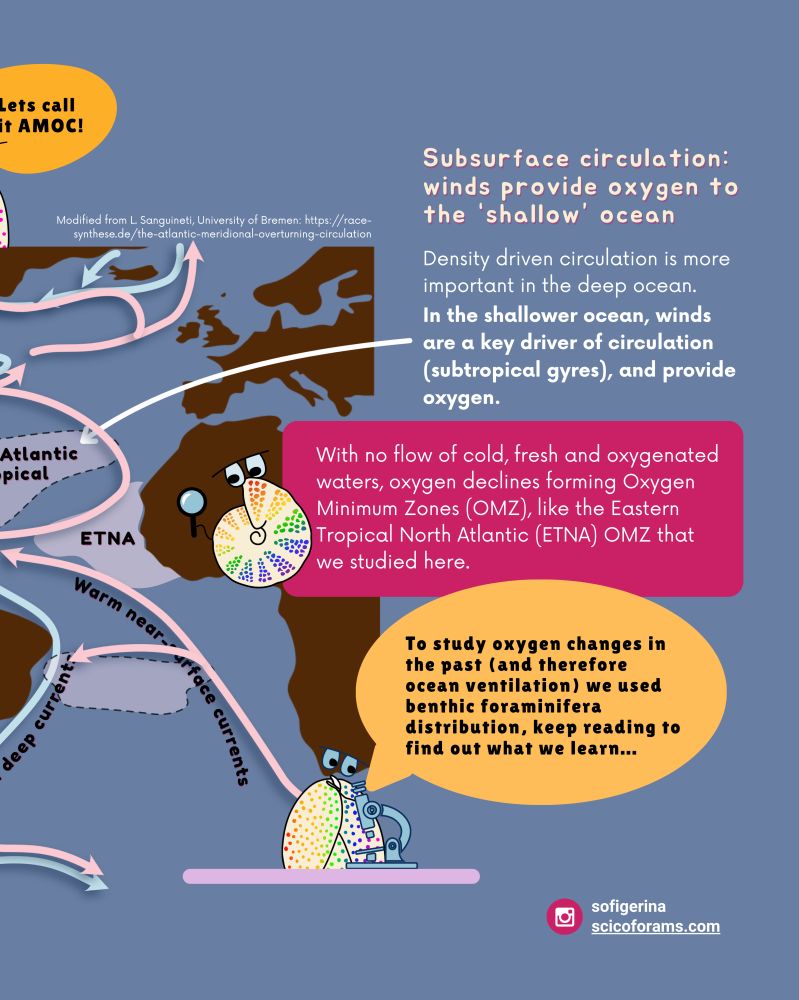
Today, areas with little oxygen occur where subsurface circulation is lower: "Oxygen Minimum Zones or OMZs"
Here, we used a seafloor archive of the eastern tropical Atlantic OMZ, next to Senegal. We reconstruct oxygen changes in the last 27.000 years with benthic forams (seafloor microscopic organisms that produce a shell that fossilizes) distribution that is sensitive to oxygen changes
AMOC slowed 2 times in the last 27k years, and to understand what happens to subsurface circulation with this slowdown, the authors reconstructed oxygen changes using benthic forams distribution in the OMZ off the Senegal coast.
04.11.2025 14:16 —
👍 0
🔁 0
💬 1
📌 0
The ocean has different layers with different temperatures & salt content that result in density differences that drive the thermohaline circulation and the Atlantic Meridional Overturning Circulation (AMOC), a global circulation system that absorbs carbon and heat from the atmosphere & distributes it.
This happens in the deep ocean, and in the shallower ocean, other factors like winds also drive circulation, and supply, among other things, oxygen!
In the deep ocean, density differences drive thermohaline circulation as ocean layers have different temperature & salt content. In the shallower ocean, winds also drive circulation & supply oxygen! Today, areas with little oxygen (Oxygen Minimum Zones-OMZ) form where subsurface circulation is slow
04.11.2025 14:16 —
👍 3
🔁 1
💬 1
📌 0
@pages-ipo.bsky.social @pages-ecn.bsky.social @cecior.bsky.social @sofigerina.bsky.social @geolatinas.bsky.social
01.11.2025 10:58 —
👍 0
🔁 0
💬 0
📌 0
01.11.2025 10:57 —
👍 1
🔁 1
💬 0
📌 0
Ok.. maybe nor skeletons, but they definetly use fossil remains of dead organisms to make their shell or is it ... their House of Horrors! 😱😱😱🤣 and you? You have any Science horror story?
01.11.2025 10:57 —
👍 0
🔁 0
💬 1
📌 0
Agglutinated forams (forams that make their shells by adding or agglutinating sorrounding stuff) make their shells by gluing things they find around them: sand, minerals, and skeletons of other organisms! This includes other forams, sponge spicules, even radiolaria! 😱😱
01.11.2025 10:57 —
👍 9
🔁 4
💬 1
📌 0
Forams are super cute, but some of them are just spooky 🎃Did you know some forams make their shells gluing “skeletons” of other fossils?
01.11.2025 10:57 —
👍 9
🔁 5
💬 2
📌 1

📣Don’t miss out! You can still register for the PO2 Second Workshop!🌊 We invite the #ocean#oxygen community to our #PO2workshop. Announced Past Global Changes, Past Ocean Oxygenation and NC Museum of Natural Sciences.
Scan the QR for details on our #registration. @pages-ecn.bsky.social
26.09.2025 13:27 —
👍 5
🔁 2
💬 1
📌 0

Pretty cool, right? Can you think of other shell features or clues that could serve as proxies? Share your ideas in the comments!
Post by @sofigerina.bsky.social @dharmarx.bsky.social sebastiangarrido
#pastoceanoxygenation #scicomm #paleoclimate #proxies #foraminifera #timemachines
29.08.2025 11:12 —
👍 1
🔁 0
💬 0
📌 0
Scientists study how micro-organisms such as foraminifera respond to today’s ocean conditions, then use those patterns to infer what oceans were like thousands or even millions of years ago. By comparing past and present, they can reconstruct Earth’s climate history.
29.08.2025 11:12 —
👍 1
🔁 0
💬 1
📌 0
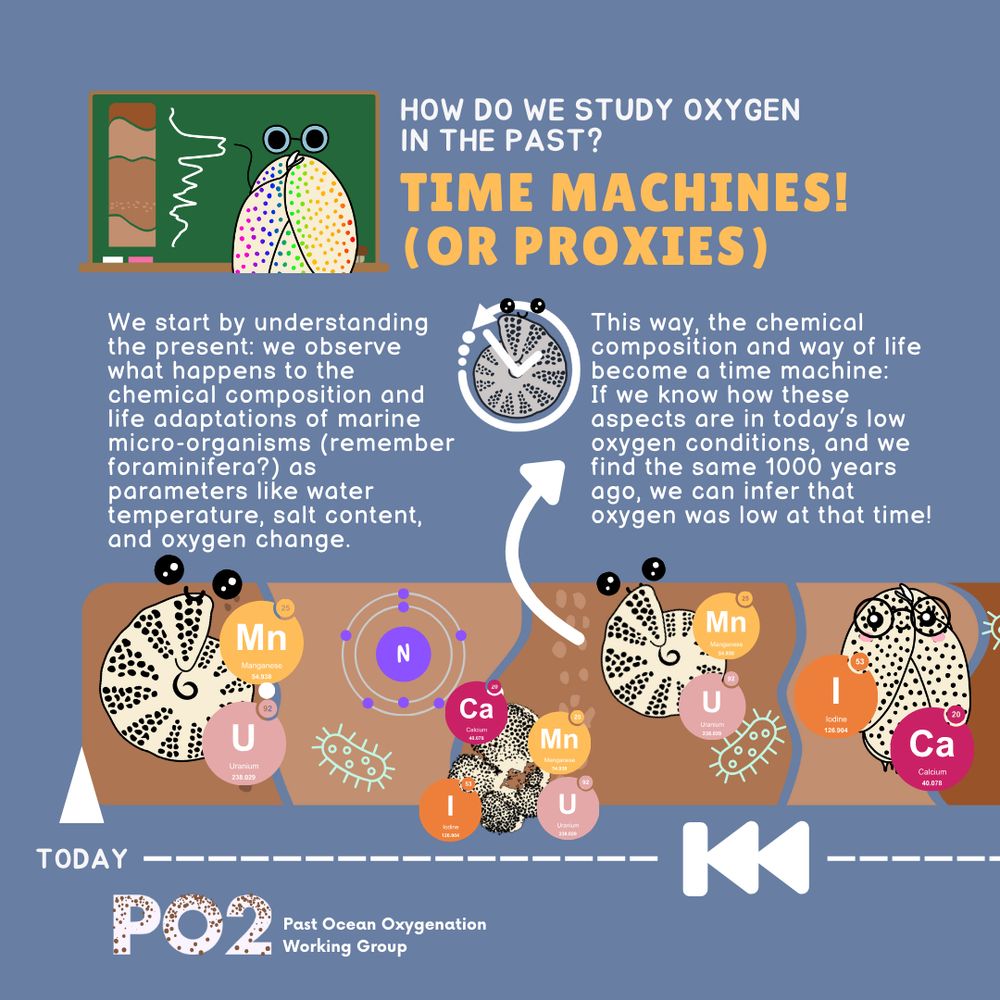

Hi again, Oxyguys!!🤓🌍🌊“Proxies: Windows into the Past” Did you know scientists can uncover past climates using proxies? These are measurable clues preserved in marine sediments—like tiny “time machines” recording signals of temperature, oxygen, or salt. @pages-ipo.bsky.social @pages-ecn.bsky.social
29.08.2025 11:12 —
👍 6
🔁 5
💬 1
📌 0
¿Aprendiste algo nuevo o tienes preguntas? déjala en los comentarios! Ilustración y textos por María Yolanda Nuñez; textos y edición por Sofía Barragán Montilla @sofigerina.bsky.social
#pastoceanoxygen #scicomm #bilingual #paleoecology #oxygen #marinescience #paleoscience #darkoxygen #paperalert
14.08.2025 14:51 —
👍 0
🔁 0
💬 0
📌 0

Estos hallazgos podrían cambiar lo que sabemos sobre la vida marina y cómo el océano abisal se mantiene oxigenado. Impresionante, ¿verdad?
14.08.2025 14:51 —
👍 0
🔁 0
💬 1
📌 0

El estudio se hizo en una zona cubierta de nódulos polimetálicos, por lo que los autores plantean que el alto voltaje de los nódulos dio lugar a la electrólisis, un proceso por el cual se descomponen las moléculas de agua en oxígeno e hidrógeno.
14.08.2025 14:51 —
👍 0
🔁 0
💬 1
📌 0

Investigadores instalaron cámaras bentónicas en el fondo marino abisal del Océano Pacífico para cuantificar el oxígeno en un periodo de tiempo y ¡los datos muestran más oxígeno del esperado! lo que sugiere que en las profundidades del océano también se produce O₂
14.08.2025 14:51 —
👍 0
🔁 0
💬 1
📌 0

📑🔬¿Sabes qué es el oxígeno oscuro? Un estudio publicado en Nature Geoscience muestra un descubrimiento sorprendente: más oxígeno del esperado en el océano profundo. Aquí, el oxígeno proviene de la ventilación de aguas menos profundas y es consumido por organismos para respirar y oxidar materia.
14.08.2025 14:51 —
👍 3
🔁 2
💬 1
📌 1

Impressive right? If you learned something new or have other questions leave it in the comments, we will do our best to reply. This is a post Maria Yolanda Nuñez (Illustration and texts) and @sofigerina.bsky.social (text and edits).
12.08.2025 15:40 —
👍 1
🔁 0
💬 0
📌 0

Since the chambers were located in a polymetallic nodule-covered zone. Their hypothesis: high voltage of nodules enabled electrolysis to break down water molecules into oxygen & hydrogen. The findings could change what we know about ocean life, chemistry & how the abyssal ocean remains oxygenated.
12.08.2025 15:40 —
👍 1
🔁 0
💬 1
📌 0

The researchers installed benthic chambers in the Pacific Ocean abyssal seafloor to quantify oxygen over a period of time. The data shows more oxygen than expected, suggesting additional O2 was being produced!
12.08.2025 15:40 —
👍 1
🔁 0
💬 1
📌 0