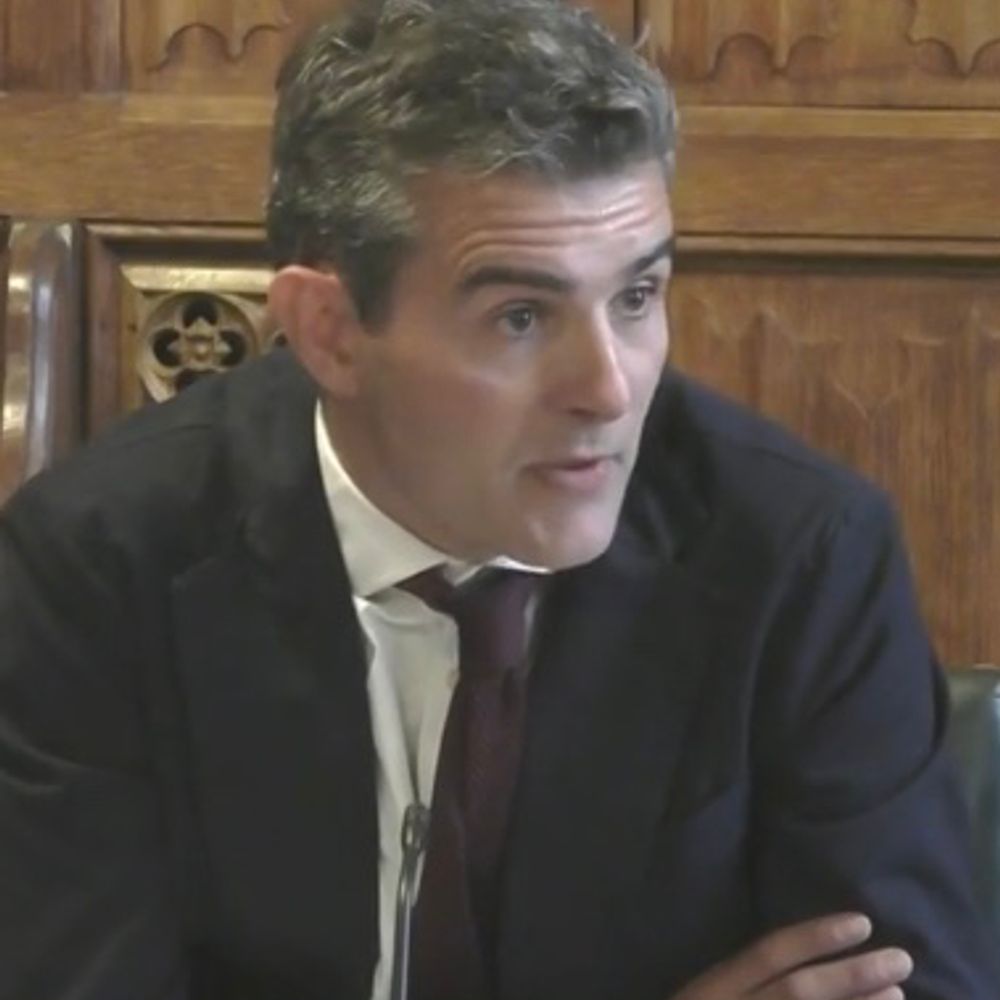
We get a few (excellent) West Point / Annapolis students in our summer school where I teach them such woke topics as optimal currency areas and monopsonistic labour markets
14.02.2026 09:00 — 👍 4 🔁 0 💬 2 📌 0

Europe lags the United States because of a structural deficit in first-mover innovation. This paper diagnoses the institutional roots of that deficit and outlines a coordinated political-economy pathway to address it.
🔴 zurl.co/1uhUW
11.02.2026 14:25 — 👍 1 🔁 1 💬 0 📌 0
terrible pub, great company
11.02.2026 20:21 — 👍 1 🔁 0 💬 0 📌 0
Great times
11.02.2026 20:05 — 👍 1 🔁 0 💬 1 📌 0
Going to @ucl.ac.uk changed my life & gave me the best friends a person could ask for.
It helped me think, write and argue. (Looking at you @jowolff.bsky.social @timcrane.bsky.social & others not on here)
Happy 200th UCL. Keep breaking the tradition.
11.02.2026 19:56 — 👍 31 🔁 5 💬 3 📌 0
Just found about it now, so no! I'd actually done another urgent one that morning - it's a bind because you don't want to be the reason a former student doesn't get a job
02.02.2026 08:47 — 👍 2 🔁 0 💬 1 📌 0
Had a reference request at 9.47pm on Saturday night asking for the reference 'ideally' by midnight
02.02.2026 08:44 — 👍 7 🔁 1 💬 2 📌 0
Quick science policy thread 1
Changes in the governance of UK science since the mid 1980s make it extremely hard to be strategic (that was the point), in terms of both process (dropped) and capability (hollowed out).
01.02.2026 17:21 — 👍 18 🔁 20 💬 2 📌 3
Rock climbing and the economics of innovation (revisited) – Soft Machines, by Richard Jones
"All around us – in our homes, in everyday life, in our hobbies and pastimes – we can see, if we care to look, the products of all kinds of technological innovation in products & the materials that make them, that collectively lead to overall economic growth"
softmachines.org?p=3249
01.02.2026 09:35 — 👍 3 🔁 1 💬 0 📌 0
Rock-climber Alex Honnold is in the news again, for climbing solo a Taipei skyscraper - an excuse to recycle this old post of mine about the importance of technological innovation in climbing, (contrary to the claims of a well-known economist).
01.02.2026 09:35 — 👍 5 🔁 2 💬 2 📌 0
Ha! I'm not sure - I will try and check later but I think your resident point is a good one...
29.01.2026 14:03 — 👍 0 🔁 0 💬 0 📌 0
Huge caveats on the data but GVA per head in Cambridgeshire and Oxfordshire actually fell relative to the national average between 1998 - 2023
29.01.2026 14:02 — 👍 1 🔁 0 💬 0 📌 0
Smartphones have reduced crime but made everyone unhappy. So maybe we actually liked crime?
29.01.2026 11:36 — 👍 0 🔁 0 💬 0 📌 0

🧵 1/4 Yesterday I sat down with the @livingstandardsc.bsky.social, the @coopparty.party.coop, and several colleagues and experts to discuss how we can deliver growth felt by communities.
29.01.2026 10:36 — 👍 7 🔁 2 💬 1 📌 0
confidence intervals: 1.1 in Greater Manchester, 0.7 in London so I think any errors broader than that
29.01.2026 10:33 — 👍 1 🔁 0 💬 1 📌 0
Actually let me do confidence intervals and report back
29.01.2026 10:12 — 👍 0 🔁 0 💬 1 📌 0
There is a nice paper on sampling error in Ashe which I think may be similar to the issues in the GVA (under sampling small firms), but I think a little more reliable because easier to attribute wage data than output
I should have done confidence intervals but I think 2-5%
29.01.2026 10:12 — 👍 2 🔁 0 💬 1 📌 0

My contribution to the 'is Manchester growing' debate
GVA data looks fishy, but ASHE data on wages seem to show some convergence (with caveats)
(Source: ASHE, resident analysis)
28.01.2026 17:02 — 👍 6 🔁 1 💬 3 📌 0
We need a Southern Powerhouse to rebalance the economy
28.01.2026 17:03 — 👍 0 🔁 0 💬 0 📌 0
My contribution to the 'is Manchester growing' debate
GVA data looks fishy, but ASHE data on wages seem to show some convergence (with caveats)
(Source: ASHE, resident analysis)
28.01.2026 17:02 — 👍 6 🔁 1 💬 3 📌 0
Research Associate in Creative Industries (Quantitative)
Research Associate in Creative Industries (Quantitative)
work with me and @drdaveobrien.bsky.social as part of @creativepec.bsky.social! we're recruiting a postdoc to work on the arts, culture and heritage sectors using quantitative methods. please share, please feel free to email me directly with any Qs! jobsite.sheffield.ac.uk/job/Sheffiel...
23.01.2026 10:25 — 👍 9 🔁 24 💬 0 📌 5

Markets and Mobility: How Employers Structure Economic Opportunity

Intergenerational mobility, measuring the ability to achieve economic success regardless of family background, is a critical reflection of a society’s commitment to equality of opportunity. Rising income inequality has raised concerns about the potential erosion of upward mobility. While education has traditionally been viewed as the path to mobility, its transformative power is facing challenges in a rapidly evolving job market. This project reorients the focus of intergenerational mobility research by highlighting the labor market as an arena for the reproduction of advantage. It employs a comparative approach, using administrative data from four countries: Sweden, Austria, England, and the United States. It also incorporates evidence from a broader set of nations through cross-national surveys, longitudinal household surveys, labor force surveys, secondary data, and digital trace data. The project employs cutting-edge empirical methods, including quasi- experimental designs, event studies, within-family comparisons, decomposition analyses, counterfactual simulations, and diagnostic checks to rigorously assess the extent of inequalities in the labor market. The research investigates how family background influences the sorting of individuals to employers and workplaces, accounting for education and occupation, and explores variations in career progression within and between employers. It comprehensively catalogues and assesses mechanisms shaping workplace inequality, contributing to the development of social closure theory. Additionally, the project evaluates intervention strategies, encompassing both employer practices and government actions, to promote fair opportunity in the labor market.
JOB! I'm hiring a postdoc for 2 years on my ERC MaMo project.
Looking for someone with strong quant methods, ongoing work close to the project's aims, and a desire to publish in sociology. Start flexible in the next 12 months.
Formal call out shortly, but contact me first.
21.01.2026 12:32 — 👍 101 🔁 109 💬 0 📌 6

📣 Call for Papers:
🗓️ 23-24 April 2026 at LSE
Submit full papers: forms.office.com/e/9qVWeNTK0p
Please share with colleagues & early-career researchers!
20.01.2026 12:31 — 👍 33 🔁 34 💬 0 📌 2

Will you be in #Madrid in late #February? Join @neillee.bsky.social & I to decode the #geography of #discontent and the structural rise of #populism. We map the territorial revolt in this @fundacionareces.bsky.social & #LSE masterclass.
Applications: 9 February
www.fundacionareces.es/fundacionare...
19.01.2026 08:51 — 👍 3 🔁 1 💬 0 📌 0
A lot of the analysis seems to be about falling shares of low income households in neighbourhoods, which in many cases (such as Woodberry Down) is probably driven by building large amounts of market rate housing. But other research suggests that will tend to lower rents and gentrification pressures.
18.01.2026 11:42 — 👍 2 🔁 1 💬 1 📌 0
well exactly. the revenge of mixed neighbourhood policy!
18.01.2026 11:50 — 👍 1 🔁 1 💬 0 📌 0
maybe Boris Johnson’s masterplan for levelling up was tanking London?
18.01.2026 10:43 — 👍 0 🔁 0 💬 0 📌 0

Head to the Trust for London website for the nasty background: incomes in London barely shifted from 2012-2020
18.01.2026 10:36 — 👍 2 🔁 1 💬 1 📌 0
Prof Urban Studies + Associate Dean (Impact & Innovation) KCL | Author Debt Trap Nation: Family Homelessness in a Failing State (2025) | Housing/Home/Law | UK & Cambodia | Editor TIBG | Views own | https://www.debt-trap-nation.org/book
Postdoctoral Fellow at LSE’s School of Public Policy. PhD in Politics, University of Oxford. Mainly social science research, big picture stuff, and songs.
Political scientist. Thinking about democracy, rural-urban divide, inequality.
Associate professor and Head of Department of European Studies at Poznań University of Economics and Business: Regional Studies Association Board Member: RSA Europe Board Member; Coordinator of Jean Monnet Centre of Excellence "Transform EU"
Father to three, Husband to one | PhD from Univ. Of Stavanger | Economic Geography | Senior Researcher in Innovation & Industry with NORCE | 🇳🇴 🇮🇪
Political economist @ LSE | Finance, central banking & more | benjaminbraun.org
PhD student @LSEGovernment. Political economy of climate policy. Prev. @OECD_Social, @EU_Competition, & @TheWilsonCenter. he/him
https://pwyckoff.github.io/
PhD @LSE Government,
Graduate Student in Social
Data Science @LSE Methodology, formerly Social Science @HumboldtUni
Interested in places, neighborhoods and political behavior.
charlottekuberka.github.io
At the crossroads of urban policies and data-
keep out of direct light and store in a cool, dry place
urbanotters.github.io
Departmental Lecturer in Comparative European Politics at University of Oxford.
Researching Migration and Political Behavior.
🌐 simonecremaschi.com
A centre of international academic excellence in economic and urban geography, urban planning, environmental social science and climate change.
Ranked 2nd globally in the QS World Subject Rankings 2025 🏆
Currently celebrating our 130th birthday! 🎉
Senior editor at Research Professional News, mainly editing European research, innovation and higher education policy news
Head of Policy and Public Affairs, BCS | former Labour HQ | #AVFC | https://danhowl.substack.com | www.linkedin.com/in/dan-howl/
Ursine Plenipotentiary. Defrocked astrophysicist. Aire échta for hire.
Official sponsor of the 🐻 emoji
“O fish, are you constant to the old covenant?”
Was @marxculture on Twitter
Professor of Spatial Planning. Geographer-Planner based in London. Cities, housing, environment, government. Enjoys travel, hiking, cycling and lots more.
Associate Professor at @tcddublin.bsky.social | Acting Head of @tcdsociology.bsky.social | child wellbeing, education, mental health, poverty, inequality | Formerly UNICEF, Nuffield College, University of York | Member of @learnineq.bsky.social
Economist PhDing @oxfordecondept.bsky.social & researching @harvardrte.bsky.social. Labour, energy, innovation, history & 🇨🇦
sites.google.com/view/jacobgreenspon
We study local labor market, industrial, & economic transformation policies, combined with practitioner insight | Based at the Harvard Kennedy School
Economist at the IFS. Interested in inequality, labour markets and economic geography. Views my own.
MIT professor, Brookings senior fellow, series editor at Cornell Press ⎮ Foreign policy, military operations, civil-military relations, nuclear weapons, authoritarianism ⎮ Views are my own ⎮ Book: The Dictator's Army
https://www.caitlintalmadge.com/