They can, and they do! There’s research to suggest that some flies drink alcohol (naturally-fermented fruits usually but also our hard stuff) to become more attractive to mates, and also to drown their sorrows when they can’t find a mate.
19.07.2025 22:31 — 👍 25 🔁 0 💬 2 📌 0
Thank you Andrea!
19.03.2025 19:13 — 👍 2 🔁 0 💬 0 📌 0
It is! Nice to finally have a starting point for folks to work on and compare their finds against, both for expanding records and for building towards population monitoring. Long, long ways to go, but we’re moving in the right direction.
07.03.2025 19:13 — 👍 1 🔁 0 💬 0 📌 0
The checklist also serves as a provincial checklist as every species’ known distribution is broken down, as well as an up-to-date catalog of species-level taxonomy and synonyms for all included species.
07.03.2025 14:57 — 👍 10 🔁 0 💬 0 📌 0
Rémi Hébert of Environment and Climate Change Canada was the major driving force behind this work as part of the WILD Species project in Canada assessing the status of our natural heritage. We still have lots of work to do building up baseline data for populations, but this is a huge first step!
07.03.2025 14:55 — 👍 7 🔁 0 💬 0 📌 0
In Canada, we can now say with confidence that we share our home with 9,777 species of flies. Other estimates suggest this is only about half of the true diversity however, so we have lots more work to document and study them all!
07.03.2025 14:52 — 👍 12 🔁 1 💬 1 📌 0
For the first time in over 100 years we have an up-to-date checklist of Canadian Diptera. Really proud to have been a part of this effort!
07.03.2025 14:46 — 👍 111 🔁 27 💬 6 📌 1
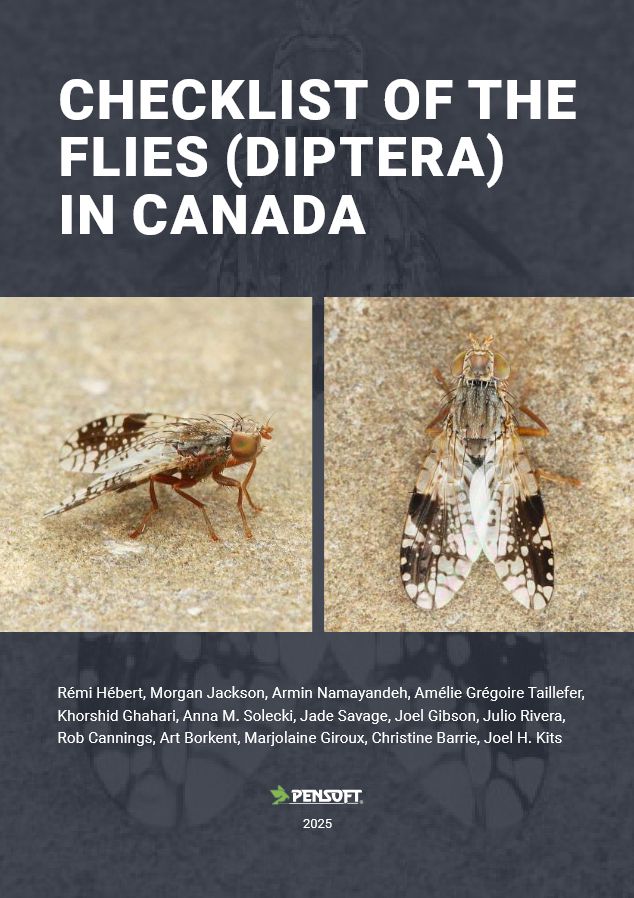
Cover of "Checklist of the Flies (Diptera) in Canada" featuring two fly images, with contributors and publisher details below.
New book: A checklist to identify all known species of flies in Canada! doi.org/10.3897/ab.e...
"This checklist is a fundamental piece of work that will guide the assessment of the conservation status of those species."
@bioinfocus.bsky.social
07.03.2025 14:29 — 👍 42 🔁 19 💬 0 📌 4
Hi! :) And thanks!
04.03.2025 16:54 — 👍 1 🔁 0 💬 0 📌 0
Thanks Donna!
04.03.2025 16:54 — 👍 1 🔁 0 💬 0 📌 0
Thanks Andrea!
04.03.2025 16:54 — 👍 0 🔁 0 💬 0 📌 0
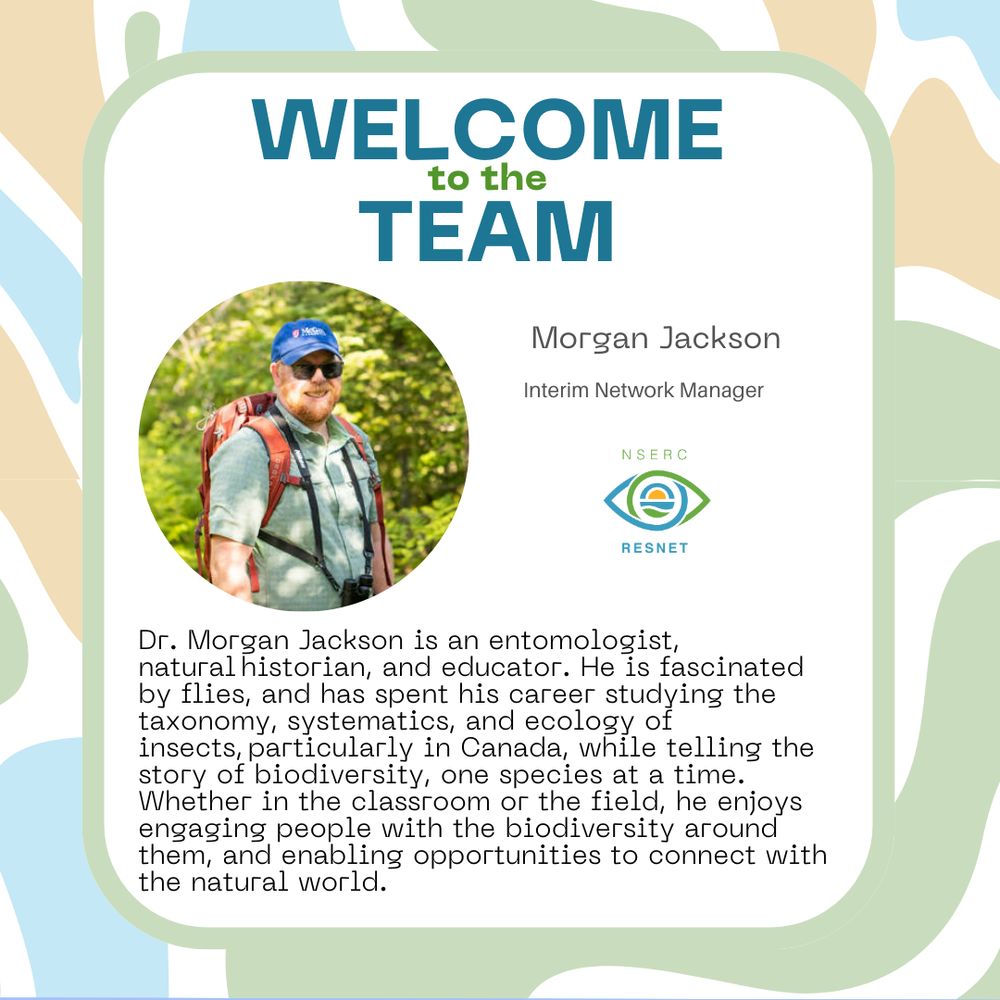
A very warm welcome to ResNet's Interim Network Manager: Dr. Morgan Jackson (you can follow him @bioinfocus.bsky.social)! He will be responsible for overseeing ResNet’s daily operations while our permanent Network Manager Nicole Middlemiss is on leave.
04.03.2025 12:38 — 👍 14 🔁 4 💬 4 📌 0
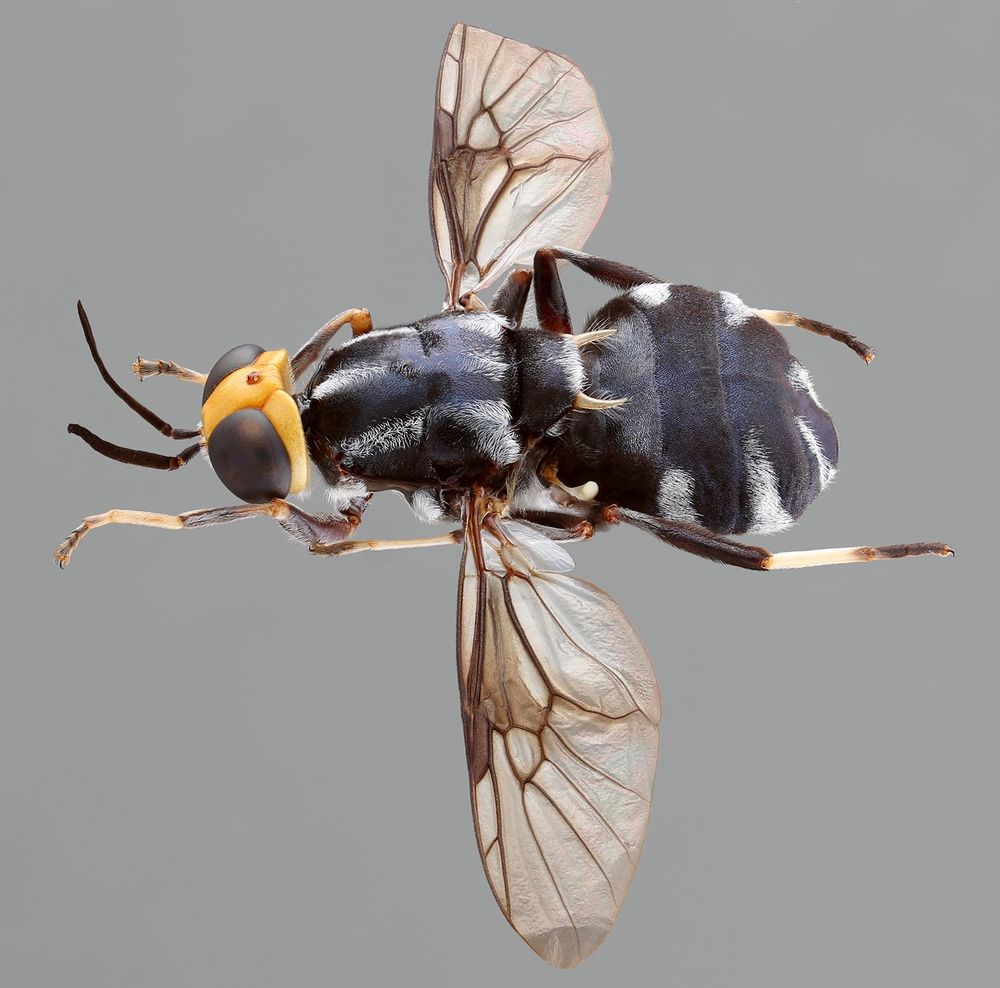
Upper left lateral view of a soldier fly (Stratiomyidae) against a grey background. The head is yellow, the large oval eyes are dark and the dark antennae are quite long (for a fly). The thorax and abdomen are black, slight metallic, white white maculations formed by areas of white, appressed setae. There are two horn-like projections extending back from the posterolateral corners of the scutellum. They curve inward and are slightly tapered, so they really look like horns.
Soldier on.
#NaturalHistoryCollections
#Macrophotography
#FocusStacking
#FlyDayFriday
#FlyFriday
#FlyDay
24.01.2025 15:15 — 👍 59 🔁 4 💬 2 📌 1
Arboreal brittle stars! Get Nature on the line, quick lol
24.01.2025 13:43 — 👍 3 🔁 0 💬 0 📌 0
Red Squirrel (<i>Tamiasciurus hudsonicus</i>) feeding on Balsam Poplar (<i>Populus balsamifera</i>) galls induced by aphids
| The Canadian Field-Naturalist
Last year, my fantastic co-author @bioinfocus.bsky.social and I published this note observing squirrels foraging insect galls in the Yukon: www.canadianfieldnaturalist.ca/index.php/cf... #SquirrelAppreciationDay
21.01.2025 21:38 — 👍 5 🔁 5 💬 1 📌 0
Do you have any favourite evolutionary biology resources that are not textbooks? E.g. podcast/youtube series or episodes, blogs, websites, news articles.. I am trying to diversify the resources I recommend to the students in the courses I teach 🤓
20.01.2025 20:57 — 👍 20 🔁 11 💬 10 📌 1

Hyperlinked list of resources to create a gender inclusive environment, advocate for name changes, improve information accessibility, and consider daily language and use. The full text document and the links can be accessed on this linktree: https://linktr.ee/trans_inclusion
Coming out, transitioning, and being trans is HARD. Fortunately, there's a lot we can all do, whether cis or trans, to help our colleagues and strengthen our departments. In addition to all the actions we can take, we've also gathered a list of resources.
16.01.2025 07:20 — 👍 27 🔁 11 💬 1 📌 1
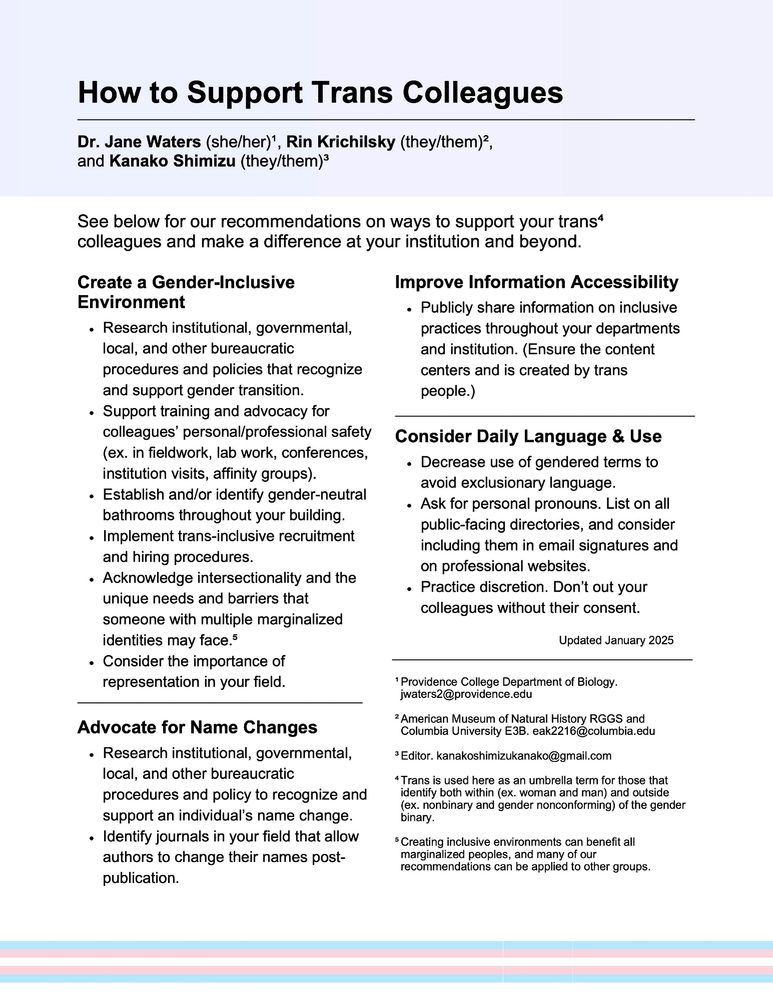
How to Support Trans Colleagues
Create a Gender-Inclusive Environment
Research institutional, governmental, local, and other bureaucratic procedures and policies that recognize and support gender transition.
Support training and advocacy for colleagues’ personal/professional safety (ex. in fieldwork, lab work, conferences, institution visits, affinity groups).
Establish and/or identify gender-neutral bathrooms throughout your building. Implement trans-inclusive recruitment and hiring procedures.
Acknowledge intersectionality and the unique needs and barriers that someone with multiple marginalized identities may face.
Consider the importance of representation in your field.
Advocate for Name Changes
Research institutional, governmental, local, and other bureaucratic procedures and policy to recognize and support an individual’s name change.
Identify journals in your field that allow authors to change their names post- publication.
Improve Information Accessibility
Publicly share information on inclusive practices throughout your departments and institution. (Ensure the content centers and is created by trans people.)
Consider Daily Language & Use
Decrease use of gendered terms to avoid exclusionary language.
Ask for personal pronouns.
List on all public-facing directories, and consider including them in email signatures and on professional websites.
Practice discretion. Don’t out your colleagues without their consent.
Collaborating with @rin-krichilsky.bsky.social and Kanako Shimizu, we put together what's basically a top-ten list of ways to help foster trans inclusivity and awareness within our scientific and academic communities and would love if you could help share the guide!
16.01.2025 07:20 — 👍 68 🔁 51 💬 1 📌 1
Transgender Inclusion | Linktree
Resources for transgender inclusion in STEM and beyond.
Want to know how to support trans and gender nonconforming colleagues things you can literally do right now to help?
Check out the first link here for a new two-page handout to share widely! linktr.ee/trans_inclus...
16.01.2025 07:20 — 👍 49 🔁 36 💬 2 📌 2
Holy cow, this is incredible! Congratulations on the big reveal and thank you for putting so much work into developing such a great resource!
15.01.2025 19:24 — 👍 1 🔁 0 💬 1 📌 0
A tricky #SpotTheInsect!
12.01.2025 16:47 — 👍 13 🔁 1 💬 0 📌 0

Globular springtail doodle using colored pencil and ink
Little globular springtail doodle in colored pencil and ink. Inspired by @the_forest_tin on IG, one of my fav macro photographers. 💚
#SciArt 🎨🕷️🐡🐞🌱
11.01.2025 16:59 — 👍 806 🔁 66 💬 13 📌 5

Large horsefly with an orange booty, caught in flight with his wings motion-blurred
Horsefly boy in flight, very buzzy 🤎
10.01.2025 01:42 — 👍 1177 🔁 85 💬 50 📌 4
Rob is an author yes, but Dick is the first author, along with another expert who keyed in on the identity via iNaturalist
10.01.2025 04:43 — 👍 1 🔁 0 💬 0 📌 0
Oh yes, he has a research and conservation biology background! He’s from a family of significant naturalists and has contributed lots of time and energy before going into politics to studying and protecting biodiversity in Canada
09.01.2025 16:55 — 👍 3 🔁 0 💬 2 📌 0
Chaetoleon pusillus (Neuroptera: Myrmeleontidae: Brachynemurini), a new genus and species of antlion for Canada
| Journal of the Entomological Society of British Columbia
Canadian Member of Parliament Richard Cannings found an unusual antlion in his backyard, posted it to iNaturalist, and just published it as being a new genus record for Canada in a regional society journal journal.entsocbc.ca/index.php/jo... Can't ask for much more in an elected representative TBH!
09.01.2025 15:57 — 👍 128 🔁 19 💬 4 📌 0
The Biodiversity Heritage Library provides free & #OpenAccess to 63+ million pages of #biodiversity literature online. 🔗 biodiversitylibrary.org
M.Sc. Renewable Resources - McGill U
Board member - Les Amis du Champ des Possibles
Passionate about improving the ways humans interact with the environment!
Post-doc | Freshwater ecologist💧| Conservation policy enthusiast🍃| Offsetting and mitigation banking♻️| Ecosystem service management🏞️| Favorite species - Percopsis omiscomaycus 🐟| Fantasy and SciFi connoisseur💍🧙♂️
PhD candidate at McGill interested in social-ecological systems and relationships between trees and people
she/her. researching the intersection of #caribou, #conservation, #restoration and #renewable #energy.
🇨🇦🇬🇾
professional sciencer, expert book lover, amateur baker. talk to me about greek myths, cool science, or the big jc (julius caesar).
Curator Emeritus of Entomology, Royal British Columbia Museum, Victoria, BC, Canada. Biologist, naturalist, writer. Broad insect interests but focuses on Odonata, Asilidae. Biodiversity. Conservation.
The Entomological Society of British Columbia serves professional entomologists, amateurs, educators all those with interest in entomology in BC and elsewhere.
Website: https://www.entsocbc.ca/
Assistant Professor of Vector Ecology and Infectious Disease at the University of Georgia | Mosquito-Plant Interactions | Chemical Ecology | Vector Ecology | #mosquitoes | Opinions are my own
Wildlife biologist 🦟 | Soccer referee, coach, and volunteer ⚽ | Dad | Slowly designing a board game about raptors 🎲 | Grower of 1 pawpaw tree 🌳 | falconry 🦅 | music 🪗 | bike infrastructure 🚲
Peterborough, ON #Ptbo
An NSERC/CRSNG Strategic Network to learn how to monitor, model, and manage Canada's working landscapes and all the #ecosystemsservices they provide.
Behavioral ecologist studying how animals cope with environmental changes. Researcher @INRAE_ECOSYS. Opinions my own.
PhD student & syrph larv wrangler (she/her) 🐛🔬
Australian-Canadian: entomology, evolution, sexual selection,behaviour, taxonomy, systematics. Also bikes, surfing, running, open-water swimming, photography, illustration, breathing, food, sleep...
linktr.ee/ethanashleymoon
Vancouverite 🇨🇦 (Musqueam, Squamish and Tsleil-Waututh Nations), bird nerd 🦆, forager of secondhand book stores 📚.
If you have questions about my app, feel free to contact me.
Dipterist and professional nitpicker
British Entomological and Natural History Society
www.benhs.org.uk
Senior Curator (Entomology) @ LKCNHM, Singapore. Research interests in Dark-, Largescale-, Cyber- and AI-taxonomy. Passionate on Sepsidae. Creator of Sepsidnet. Occasionally posting on the fly!
Fly School is a two week course for those who want to gain a more comprehensive understanding of Diptera. The next Fly School will be July-August 2026.
dipterists.org/fly_school.html
Our mission is to advance the scientific study, understanding, and appreciation of the insect order Diptera, or true flies.
dipterists.org