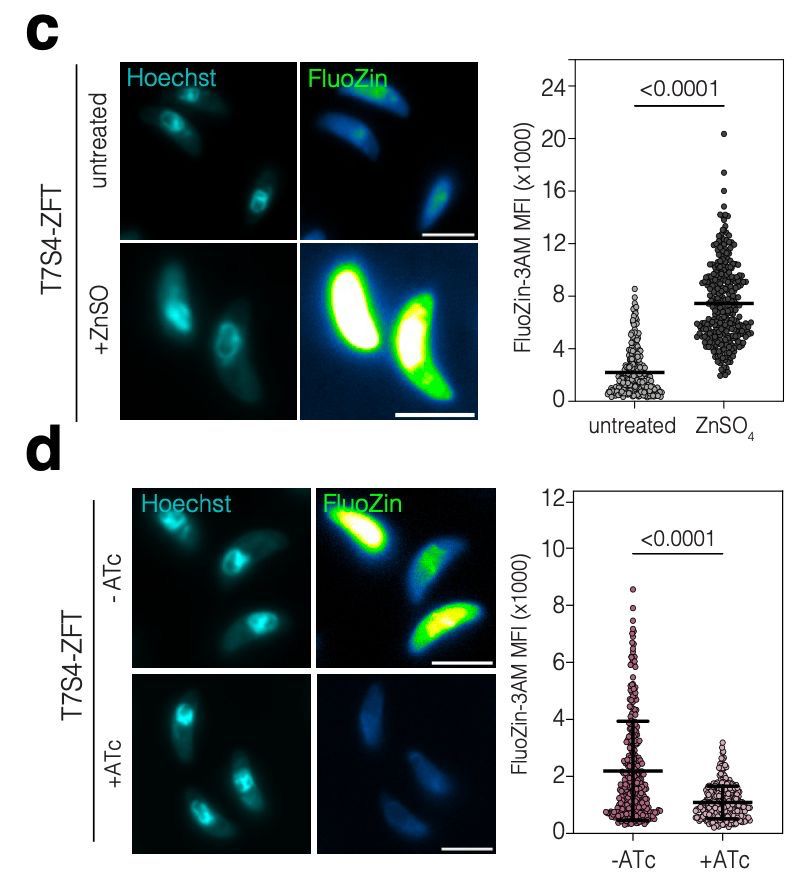
12/ In summary, we identified and characterised the first metal uptake transporter in Toxoplasma gondii. ZFT is indispensable, highlighting the importance of both iron and zinc uptake for the parasites
22.04.2025 10:09 — 👍 0 🔁 0 💬 0 📌 0


6/ We show parasites overexpressing ZFT form fewer and smaller plaques, confirming that overexpression of ZFT inhibits parasite replication. We also find that parasites overexpressing ZFT are more sensitive to excess iron, and ZFT overexpression provides a protective effect against iron chelation
22.04.2025 10:09 — 👍 0 🔁 0 💬 1 📌 0


5/ We demonstrate ZFT abundance is also dependent on iron availability. At 24 h post treatment, we find ZFT expression is reduced to ~40% of the untreated. We confirmed loss of ZFT expression in high iron conditions by IFA, demonstrating that ZFT expression is significantly reduced under excess iron
22.04.2025 10:09 — 👍 0 🔁 0 💬 1 📌 0
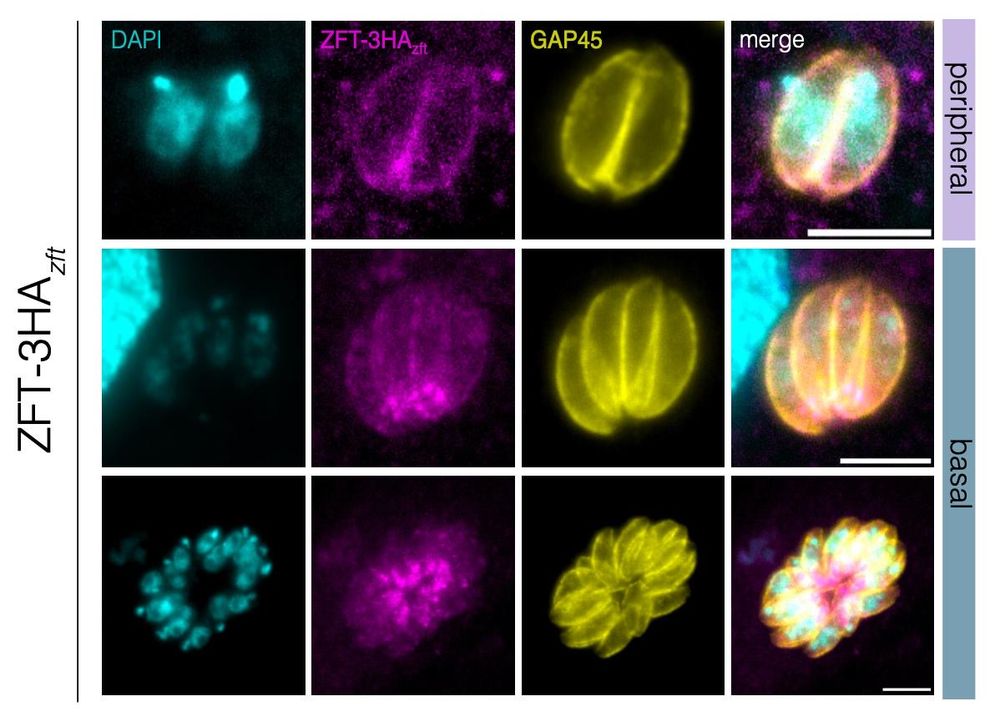

4/ We show ZFT localisation is dynamic, localising to the periphery of the parasite with a second foci at the basal pole. Interestingly, we find this localisation is highly dependent on the number of parasites per vacuole, and that the MFI of ZFT/parasite is higher in vacuoles with fewer parasites
22.04.2025 10:09 — 👍 0 🔁 0 💬 1 📌 0
3/ Toxoplasma encodes four ZIP domain containing proteins. Previosuly, we showed that Zn and Fe Transporter (ZFT) mRNA was stabilised under low iron, and loss of this regulation inhibited parasite survival under low iron (Sloan et al., 2025). Here, we characterise ZFT protein function in more detail
22.04.2025 10:09 — 👍 0 🔁 0 💬 1 📌 0
2/ Mammalian, plant and fungal cells use ZIP (Zrt-/Irt-like protein)- domain containing proteins to mediate iron and zinc uptake. ZIP domain containing proteins have also been identified in eukaryotic parasites such as Leishmania and Plasmodium
22.04.2025 10:09 — 👍 0 🔁 0 💬 1 📌 0
1/ Iron and zinc are essential for Toxoplasma gondii, and their intracellular levels are tightly regulated. As metals cannot diffuse across membranes, the parasite requires special mechanisms for iron and zinc uptake. However, these have not yet been established in Toxoplasma gondii
22.04.2025 10:09 — 👍 0 🔁 0 💬 1 📌 0
Thank you to all authors involved for all the hard work, including Cecilia Gallego Rubio, Miguel Cortijo Martinez, Augustin Pouzache, Erin J. Gibson, Lucas Pagura and @clarehardinglab.bsky.social
22.04.2025 10:09 — 👍 0 🔁 0 💬 1 📌 0
Excited to start my lab at the University of Edinburgh studying sulfur metabolism in apicomplexan parasites. Kindly supported by an MRC Career Development Award.
Watch this space for job opportunities!
04.03.2025 11:45 — 👍 34 🔁 6 💬 3 📌 4
Remember learning that ribosomes are made of 1 large subunit RNA + 1 small subunit RNA?
Well, some cells defy this rule, and the most extreme case is Toxoplasma which makes its mitoribosome from >50 RNA pieces!
Wanna know how? Read below
20.01.2025 15:08 — 👍 26 🔁 7 💬 14 📌 3

Megan opening champagne!
Excellent start to the year with @sloanmegan.bsky.social paper being accepted! Watch this space......
07.01.2025 13:49 — 👍 20 🔁 2 💬 1 📌 0
Postdoctoral researcher
Sheiner lab
Centre of Parasitology, University of Glasgow
The Marine Biological Laboratory (MBL), founded in 1888, is an international center for research & education in biology & ecology in Woods Hole, MA. An affiliate of the University of Chicago. www.mbl.edu
Principal Investigator, Sir Henry Dale Fellow, new mom. My lab studies #Cryptosporidium biochemistry and drug discovery at the University of Dundee. She/Her
The ESRF, the European Synchrotron, located in Grenoble, France, is an international research infrastructure. Its bright X-rays are used to decipher the secrets of matter. www.esrf.fr
Post doc in the Maizels lab @ University of Glasgow
Postdoctoral researcher at the University of Glasgow, specialising in genetic manipulation, glycosylation and biochemistry. Basic weegie scumbag currently developing RNAi in parasitic helminths of livestock.
🔬Head of lab at GIMM, Lisbon. Studying host-trypanosome interactions.
Trying to understand how wicked parasites get on with their lives, in order to fight them.
The Faria Lab is based at University of York and studies nuclear architecture, genome organisation and biomolecular condensates in the context of gene expression regulation in trypanosomatids
OEB PhD student in the Extavour lab @Harvard 🪰🦗🦠🌱 He/Him🇲🇽🏳️🌈 and interested in all things evolution!
Scientist @InstitutPasteur; previously @ImperialCollegeLondon, @IMM. Malaria biology.
Group Leader at EMBL Barcelona. Malaria, bioengineered vascular models, blood-brain barrier
Senior Program Officer - Global Health R&D @coeff_giving (previously openphil) | views my own. Malaria researcher | vaccine developer | R21 inventor
Researcher and Lecturer at the University of Glasgow. Trypanosoma brucei; human genetics; Doonhamer; European.
Studying #mosquito to fight #malaria
Reader @sbohvm.gla.ac.uk
Visiting Scientist at #IfakaraHealthInstitute
Researcher at #VectorsGlasgow
https://www.gla.ac.uk/schools/bohvm/staff/francescobaldini/
https://francescobaldini.wordpress.com/
Immunologist interested in T cells, B cells, antibodies, vaccines & global health. #StrepA #malaria Lab Head @MonashImmunol @MonashUni She/Her
https://research.monash.edu/en/persons/danika-hill