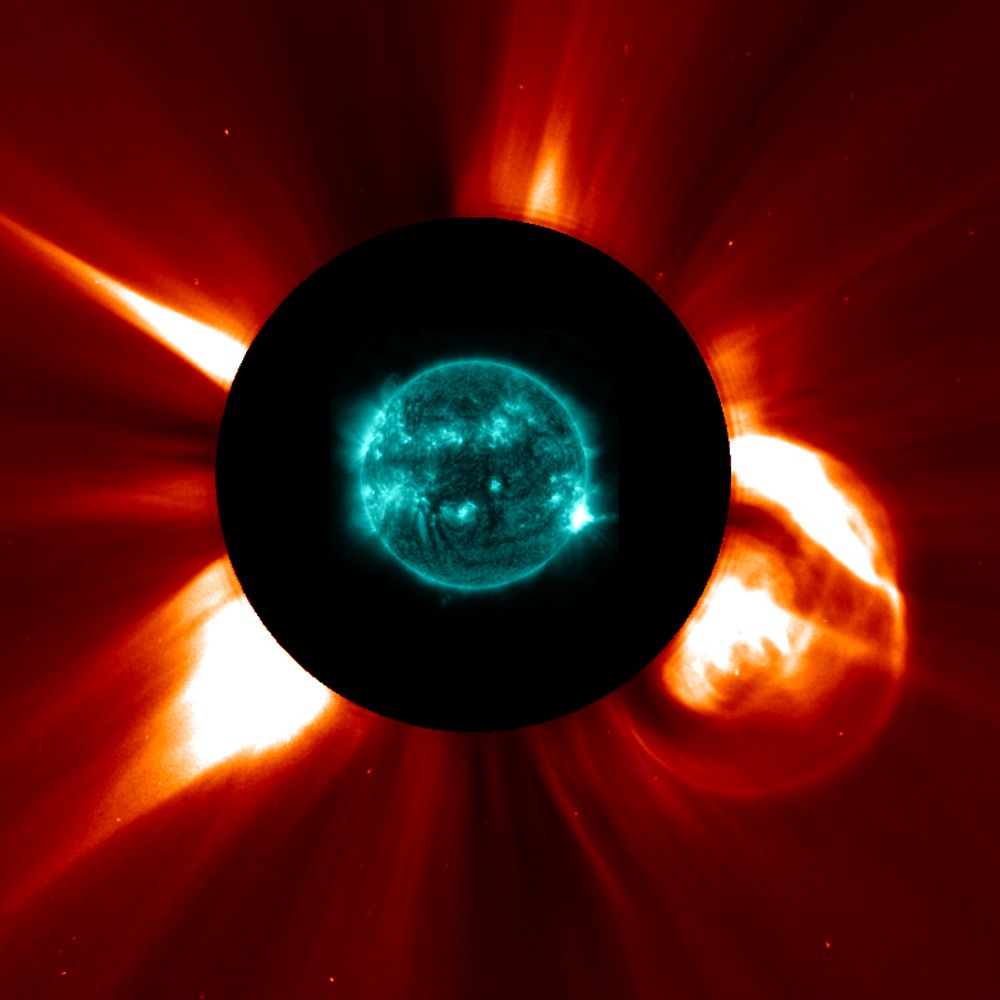
A closer look at the coronal mass ejection produced by last night’s major solar flare. Some models are predicting that the eruption may have a minor Earth-directed component! #spaceweather
02.12.2025 02:10 — 👍 27 🔁 2 💬 0 📌 0
Was going through my old laptop and found this animation of comet Kudo-Fujikawa transiting the SOHO/LASCO C2 FOV! The images are from January 2003. Enjoy! ☄️
#CometWatch #ESA #NASA
20.11.2025 15:04 — 👍 3 🔁 1 💬 0 📌 0

A look at big sunspot region 4294 as it rotates into view on Saturday. The region is currently producing occasional M-Flares and is likely a threat for an isolated strong X-Flare. SolarHam.com
29.11.2025 12:30 — 👍 11 🔁 5 💬 0 📌 1

A closeup of a comet's head with three apparent fragments in the inner coma. The comet has a white, dusty tail towards the upper right. In the background star trails are visible.
The at least three fragments of comet C/2025 K1 (ATLAS) imaged by Michael Jäger on Nov 18, 2025, at 3:17 UT, 42x7 sec, f= 1200 mm.
☄️🔭
18.11.2025 18:40 — 👍 23 🔁 3 💬 1 📌 1

Let's see if @kat-astro-bot.bsky.social can recognise anything.✨
19.11.2025 08:46 — 👍 1 🔁 1 💬 1 📌 0
Voll schön das Bild mit den Lichtern und dem Bodennebel! 🙃
15.11.2025 15:51 — 👍 1 🔁 0 💬 0 📌 0

Bei meinem gestrigen Post zu den #Polarlichtern handelt es sich leider um Lichtverschmutzung. Die Werte sahen ja gestern auch nicht so gut aus. Vielleicht auch ein Effekt durch den Saharastaub in der Atmosphäre?
Ich habe den Post deshalb auch mal wieder entfernt. Schön ausgesehen hat es dennoch. 🥲
15.11.2025 13:32 — 👍 2 🔁 0 💬 0 📌 0
Die Bilder sind voll schön! 😃 Das Wochenende, wo man die sehen konnte, war einfach episch! ✨🌈
13.11.2025 22:12 — 👍 2 🔁 0 💬 0 📌 0
That looks epic!
13.11.2025 20:34 — 👍 0 🔁 0 💬 0 📌 0
Hey Alice, hast du es denn auch gesehen? 🙃
13.11.2025 19:36 — 👍 0 🔁 0 💬 1 📌 0

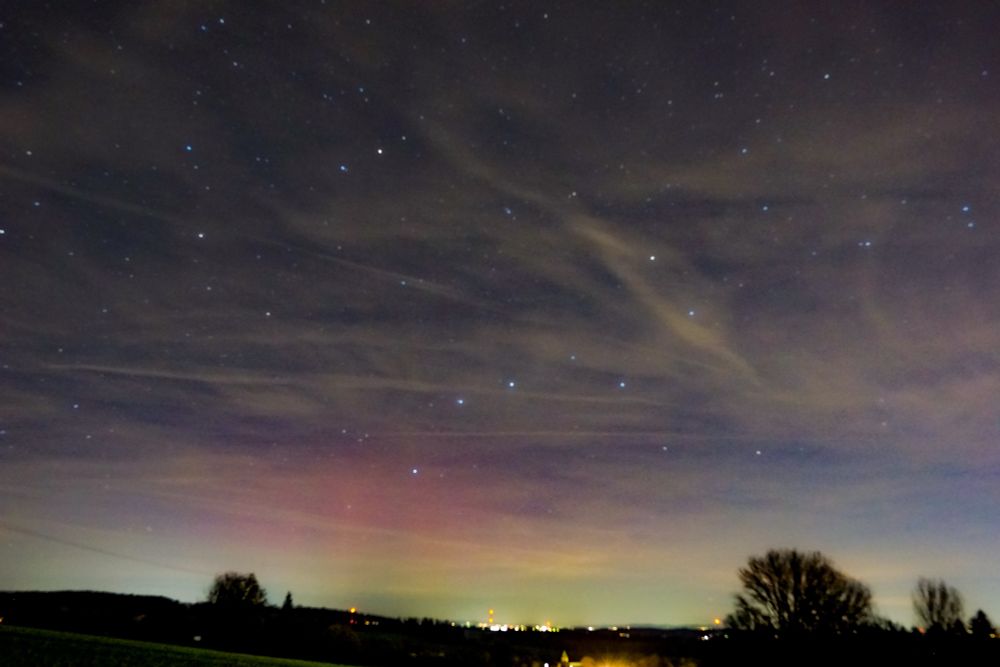
Photographic red Aurora borealis from last night near Bielefeld (Germany).
Date: 12 November 2025
Time: Around 23:00 (CET)
#northernlights #Polarlichter #auroraborealis
13.11.2025 15:01 — 👍 6 🔁 0 💬 1 📌 0
The pictures are amazing!
12.11.2025 11:32 — 👍 0 🔁 0 💬 0 📌 0
The SOHO LASCO instrument is drowned in solar energetic particles due to the X5 flare earlier today Nov 11. A bit west of the disk center the particles are magnetically well connected to Earth. A massive #solarstorm was produced which we will model once initial conditions are available.
11.11.2025 15:36 — 👍 13 🔁 3 💬 0 📌 0


We just got an X5 flare from the same active region that launched the 2 #solarstorms earlier this week, at around 20 degrees north and west of disk center. We will again need to see whether a storm was launched with coronagraphs and then evaluate its potential arrival at Earth in the upcoming days.
11.11.2025 10:58 — 👍 24 🔁 6 💬 1 📌 1
A #solarstorm with an initial speed of ~730 km/s is on its way toward Earth! It’s associated with an X1.7-class flare that peaked today around 07:35 UTC.
The CME is expected to arrive Tuesday, 11 November, around 20:00 UTC (21:00 CET).
Let’s hope for a better aurora show than on Friday🤞🌌
09.11.2025 17:12 — 👍 32 🔁 10 💬 0 📌 2
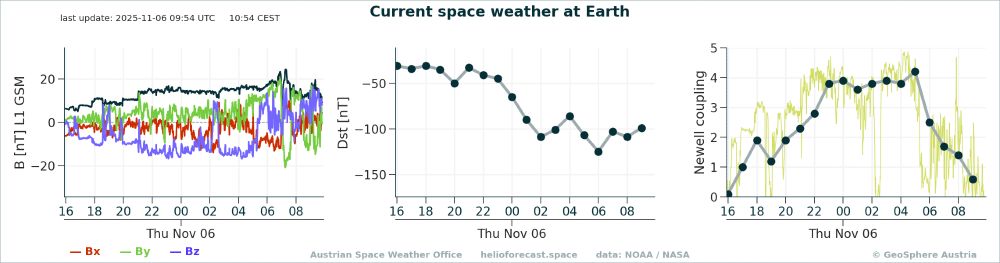
Three plots showing current space weather conditions at Earth. The left-most plot shows the magentic field conditions, with a currently positive Bz component that was previously negative. The middle plot shows the Dst index, which currently sits at around -110 nT. The right-most plot shows the Newell coupling, which is currently at close to 0, but has peaked around 4.
☀️ Earth is currently experiencing a class G3 geomagnetic storm (likely caused by a #solarstorm flank hit), with Dst values going as low as -136 nT in the last 12 hours. Bz magnetic field component is currently positive, Dst values remain around -110 nT
06.11.2025 10:18 — 👍 17 🔁 5 💬 1 📌 2
From a crewmember on yesterday's Teal 74 mission into now-Category 5 Hurricane #Melissa. As clear of an eye as you will see in the Atlantic basin.
27.10.2025 16:11 — 👍 2798 🔁 1052 💬 53 📌 126
You might’ve heard the news: SpaceX just passed 10,000 Starlink satellites launched. And that number is already old news, as there’s now a new Starlink batch launched every other day. Here’s what that looks like in a short animation of Comet A6 Lemmon courtesy of Michael Jaeger:
28.10.2025 17:44 — 👍 103 🔁 57 💬 7 📌 16

A starfield with many small and colorful stars is dominated by comet Lemmon which is oriented diagonally in the frame.
The comet has a greenish coma and a diffuse yellowish dust tail is pointing up from the nucleus. Layered with the dust tail is the blueish ion-tail which is much narrower and longer, stretching beyond the top of the image. The ion tail shows some slight undulations from changes in the comets activity over time.
#Comet C/2025 A6 #Lemmon in the constellation Boötes, on the evening of October 24th. Captured from the light polluted outskirts of Munich.
16 minutes integration time with my Fujifilm X-S10 and 135mm f4.5 lens (untracked).
#astrophotography 🔭
26.10.2025 09:38 — 👍 332 🔁 93 💬 9 📌 3
INTERNATIONAL #ROSETTA MISSION
Target: 67P/CHURYUMOV-GERASIMENKO 1 (1969 R1)
Date: 12 aug 2015 21:21:11 utc
Distance to Target: 329 km
Camera: OSINAC Orange filter
rosetta-osiris.eu/image/NAC_20...
ESA/Rosetta/MPS for OSIRIS Team MPS/UPD/LAM/IAA/SSO/INTA/UPM/DASP/IDA/j. Roger
27.10.2025 20:23 — 👍 90 🔁 23 💬 1 📌 1
It's amazing how high-resolution the images from CCOR-1 are.
26.10.2025 10:45 — 👍 0 🔁 0 💬 1 📌 0

Comet ATLAS vs CCOR-1
This is cool. While Interstellar Comet 3I/ATLAS is currently 2.35 AU from Earth on the farside of the Sun, it is visible in the CCOR-1 coronagraph aboard NOAA’s GOES-19 satellite. Worachate Boonplod found the +11th magnitude comet in recent images, and traced out its path through CCOR-1’s imager:
24.10.2025 13:57 — 👍 7 🔁 5 💬 3 📌 0
Very exciting, I was wondering which comet had passed through the field of view of the C3.
24.10.2025 19:57 — 👍 1 🔁 0 💬 0 📌 0
Here is another longer animation of #comet #3I/ATLAS in CCOR-1.
Date: 24 October 2025
Time span: 06:30-15:45
Animation by me.
FITS data source: GOES-19 / CCOR-1 / NOAA
24.10.2025 17:21 — 👍 1 🔁 0 💬 0 📌 0
#Comet 3I/ATLAS will soon leave the field of view of CCOR-1.
Date: 24 October 2025
Time span: 06:30-10:45
Animation by me.
FITS data source: GOES-19 / CCOR-1 / NOAA
#CometWatch #3I/ATLAS
24.10.2025 12:31 — 👍 1 🔁 0 💬 0 📌 0
space cowgirl (UTAustin Astronomy grad student) & investigator of Galactic origins🔎💫🔭🧘♀️🤠🪩 UF alum🫶🏼 zoehackshaw.github.io
UMN astro phd candidate modeling radio galaxies w/ mhd + ML
astrobiter
she/her
Astronomer
erinkara.space
astronomy phd student at harvard, previously at ohio state (they/she)
i like binary stars
NASA science writer, freelance environmental writer, mom of three 💙💙🩷
Too many interests, too little time!
Watercolour landscape painting 🖼
Astrophotography with the Seestar S50
Archery
Zentangle art
🛰️🪐 Space voyager processing space images 📡💻
🎞️ HD Photostream: https://www.flickr.com/photos/192271236@N03/
🎋Other places: https://linktr.ee/andrealuck
🌍Glasgow, Scotland 🌱 (He/Him)
ERC SYNERGY grant
Alteration induced volcanic hazards 🌋
Mike Heap @rocklabstrasbourg.bsky.social, Claire Harnett @claireharnett.bsky.social, Val Troll, Thomas Walter @trwalter.bsky.social
Website: http://rottnrock.eu
PostDoc volcanologist on the ROTTnROCK project at University of Strasbourg (France) | Field & Experimental Volcanology | 🌋 monitoring & disaster risk reduction
Maintained by ESA's Space Weather Coordination Centre providing information on the ESA Space Weather Network. No services provided via this account.
#Astrophysics PhD Candidate, solar science, CME watcher. This is not a pure science account. Leftist, anti-fascist. #astrophotography #photography. He/him. Modern Luddite. Former Nagoya-ite. I love filling my feed with art. Absolutely no genAI.
writer, union hottie, biblically accurate alma. one half of NYC's Picnic Magazine
DiRAC fellow @ UW, PhD from Penn. Discoverer of minor planets and C/2014 UN271, Brazilian, coffee dependent, geek. He/him/ele, pt-br/en
GW astrophysicist • Postdoc • LIGO • LISA
CERN is the European laboratory for particle physics, home to the Large Hadron Collider.
linktr.ee/CERN_official
Official account of the LIGO Scientific Collaboration. We detect gravitational waves!
Email: questions@ligo.org
Astronomer here! I’m a Hungarian-American radio astronomer, alias /r/Andromeda321 on Reddit. Assistant professor at the University of Oregon
Official Mirroring APOD BOT for Bluesky.
https://apod.nasa.gov/apod/lib/about_apod.html
Src:
https://apod.nasa.gov/apod/astropix.html
http://star.ucl.ac.uk/~apod/apod/astropix.html
Maintained by @shinyakato.dev
Astrophysics PhD candidate at University of Queensland | UC Berkeley '21 | Exoplanets and Stars | @astrosoundbites.bsky.social co-host | Astrophotographer
shashankdholakia.github.io