Thanks to all the authors in Chris Howe's, @biophotoelectro.bsky.social and other labs who contributed over the years. Also to the fantastic (and super quick) editors and reviewers whose comments greatly improved the manuscript, as well as the BBSRC and others for funding. (10/10)
21.07.2025 11:05 — 👍 0 🔁 0 💬 0 📌 0

This technique (native membrane electrochemistry) combines the interpretability of protein electrochemistry with the complexity of microbial electrochemistry. We envision applications in investigating #bioenergetics, as well as #bioelectricity and #biocatalysis. (9/10)
21.07.2025 11:05 — 👍 0 🔁 0 💬 1 📌 0

We also identified how wiring membranes to electrodes has inherent advantages in #biohybrid devices for energy conversion. Here we obtain photocurrents at -600 mV vs SHE; ~1V more negative (much higher energy electrons) than is achievable with isolated proteins. (8/10)
21.07.2025 11:05 — 👍 0 🔁 0 💬 1 📌 0

We also showed how these electrochemical measurements can be coupled to spectroscopy, with parameters from each showing agreement with one another. (7/10)
21.07.2025 11:05 — 👍 0 🔁 0 💬 1 📌 0

This alone demonstrates that electrochemistry can interrogate complex biological systems, but what can we actually use it for? Here we use the Spike Charge to measure respiratory reduction and oxidation of the #quinone pool (↑Spike Charge = ↑quinone reduction). (6/10)
21.07.2025 11:05 — 👍 2 🔁 0 💬 1 📌 0

Through many experiments (different inhibitors, mutants, experimental conditions) we could disentangle the different electron transfer pathways within the membranes. This enabled us to create a detailed model of electron transfer between the membranes and the electrode. (5/10)
21.07.2025 11:05 — 👍 1 🔁 0 💬 1 📌 0

These parameters were dependent on different interfacial electron transfer pathways, shown here by the different effects of photosynthetic inhibitors. This suggested analysis of photocurrents could provide information on different membrane electron transfer pathways! (4/10)
21.07.2025 11:05 — 👍 0 🔁 0 💬 1 📌 0

These specialised electrodes enabled sensitive measurements of photocurrents, revealing a distinct profile (not observed in previous studies) which was quantified as two parameters: the Spike Charge and the Steady State Photocurrent. (3/10)
21.07.2025 11:05 — 👍 0 🔁 0 💬 1 📌 0
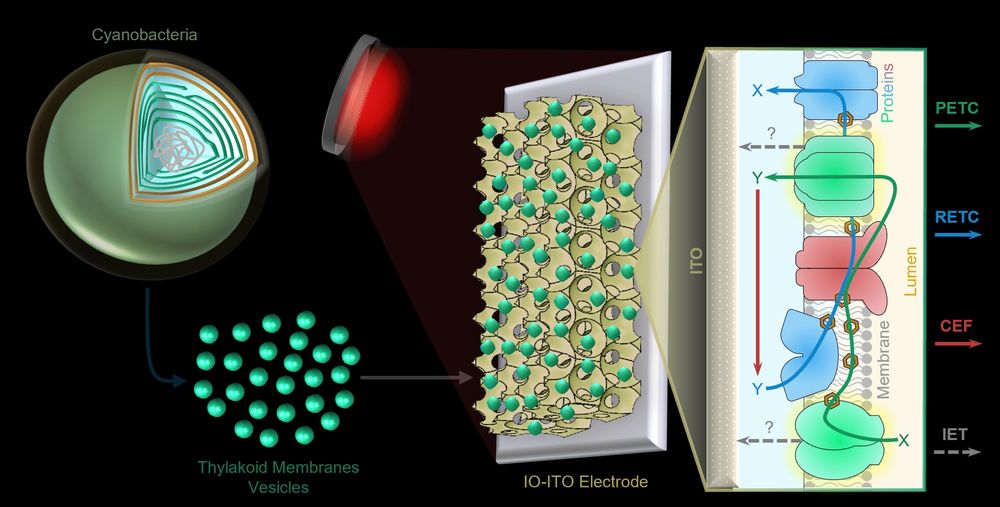
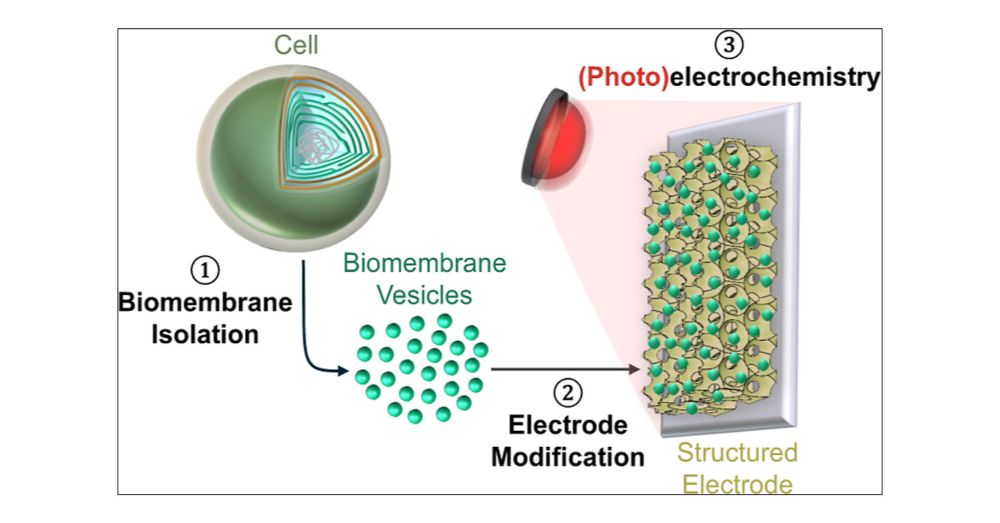
To analyse bioelectrical pathways, we interfaced thylakoid membranes isolated from #cyanobacteria with structured #electrodes. These #membranes contain a highly complex network of electron transfer, including electron transport chains for #photosynthesis and #respiration. (2/10)
21.07.2025 11:05 — 👍 2 🔁 1 💬 1 📌 0
Was great to be part of this study headed up by @scaralbi.bsky.social. We are very excited by the finding that chromosomal polyploidy could be an important driver in the #evolution of #cyanobacteria and other prokaryotes. 🧬🦠
25.03.2025 15:05 — 👍 4 🔁 1 💬 0 📌 0
This work wouldn't have been possible without my fantastic colleagues in the Zhang lab (@biophotoelectro.bsky.social), Howe lab, and further afield. Also my funders @ukri.org, Leathersellers' foundation and Trinity Hall, who have supported this work which has bridged my PhD and fellowship. 15/15
19.03.2025 16:41 — 👍 0 🔁 0 💬 0 📌 0
Because cyanobacterial thylakoid membranes have some of the most complex electron transport pathways known to nature, the technique should be readily transferrable to any biological membrane. We foresee its use in characterising bioenergetic pathways and biohybrid systems. 14/15
19.03.2025 16:41 — 👍 0 🔁 0 💬 1 📌 0
We think natural membrane electrochemistry sits nicely between protein electrochemistry and microbial electrochemistry in terms of data complexity and interpretibility, making it a perfect system for studying biological electron transport at a systems-level. 13/15
19.03.2025 16:41 — 👍 0 🔁 0 💬 1 📌 0
This thread is a very high-level look at the manuscript which, like biolectrochemistry data, is very information-dense. All comments and questions are welcome! 12/15
19.03.2025 16:41 — 👍 0 🔁 0 💬 1 📌 0

We also developed a spectroelectrochemistry set-up, which we used to prove that these changes in the Spike Charge matched biophysical measurements of plastoquinone pool reduction. 11/15
19.03.2025 16:41 — 👍 0 🔁 0 💬 1 📌 0
In this graph we can see that the magnitude of the feature depends on the dark time (during which quinone reduction occurs), the addition of substrates for dehydrogenase enzymes which reduce the quinone pool, or the deletion of oxidase enzymes which oxidise the quinone pool. 10/15
19.03.2025 16:41 — 👍 2 🔁 0 💬 1 📌 0
But how is this useful? To demonstrate the power of this technique, we used the Spike Charge feature to provide a direct electrochemical readout of plastoquinone pool reduction. 9/15
19.03.2025 16:41 — 👍 0 🔁 0 💬 1 📌 0

To cut a (very long) story short, from these experiments we were able to build a model of the electron transfer processes happening within the isolated thylakoid membranes, and between them and the electrode. 8/15
19.03.2025 16:41 — 👍 0 🔁 0 💬 1 📌 0

In addition to testing experimental conditions and mutants, the beauty of electrochemistry is that just by changing our electrode potential we could control which cofactors could transfer electrons to the electrode; as demonstrated in stepped chronoamperometry experiments like this one. 7/15
19.03.2025 16:41 — 👍 0 🔁 0 💬 1 📌 0
We were were able to show how these two electrochemical parameters related to different thylakoid membrane electron transport pathways, including components of the photosynthetic and respiratory electron transport chains. Disentangling signals from these overlapping pathways is very difficult! 6/15
19.03.2025 16:41 — 👍 0 🔁 0 💬 1 📌 0
When recording photocurrents (change in current over a photoperiod) using these electrodes, we observed a unique profile which could be analysed using two electrochemical parameters: the Steady State Photocurrent and the Spike Charge. 5/15
19.03.2025 16:41 — 👍 0 🔁 0 💬 1 📌 0

Here, we use highly structured electrodes to perform sensitive electrochemical measurements of the thylakoid membranes of our favourite organisms, #cyanobacteria. These contain very complex electron transport pathways, with #photosynthesis and #respiration occuring in the same membranes. 4/15
19.03.2025 16:41 — 👍 0 🔁 0 💬 1 📌 0
There has been some spectacular research in recent years on interfacing membranes and cell biofilms with electrodes (check the references for some of these). But the low sensitivity and high complexity of these analytes have hindered analysis of electron transport in these complex systems. 3/15
19.03.2025 16:41 — 👍 0 🔁 0 💬 1 📌 0
Electrochemistry enables information-rich analysis of redox proteins and enzymes, both soluble and membrane-bound. However, its reliance on protein purification limits it to just one or a few proteins/complexes, which differs from the complexity of electron transport in living cells. 2/15
19.03.2025 16:41 — 👍 0 🔁 0 💬 1 📌 0
Thanks to @cenmag.bsky.social for this great article about our efforts to create music with algae 🎶🦠
12.03.2025 22:16 — 👍 6 🔁 3 💬 1 📌 0

Algae at the interface
Explore the article collection: Algae at the interface. Published in Applied Phycology.
For more papers of this ilk, check out the special issue on 'algae at the interface', which this publication is part of. 12/12
www.tandfonline.com/journals/tap...
10.12.2024 17:26 — 👍 0 🔁 0 💬 0 📌 0
A big thank you to Juliet Brodie, as well as the rest of the Applied Phycology editorial team and our peer reviewers for helping us with this (rather unorthodox) paper. 11/12
10.12.2024 17:26 — 👍 0 🔁 0 💬 1 📌 0
We look forward to showing more of this work as it progresses. It's all been made possible through the collaboration of a highly interdisciplinary team of scientists, artists and designers: Alberto Scarampi, Emma Albertini, Paolo Bombelli, Chris Howe, Lucia Giron and Lena Kuzmich. 10/12
10.12.2024 17:26 — 👍 4 🔁 0 💬 2 📌 0
(Bio)chemistry PhD student @ Uni of York, UK
Bioinspired materials, Bioelectronics, Assoc. Prof.(Tohoku Univ., JP)
The official account of the Bioelectrochemical Society 🧪🥼
Follow us for regular updates on the society activities and bioelectrochemistry news! 🦠 ⚡
Assistant Professor @UniBa 🇮🇹 #Bioelectrochemistry #SemiartificialPhotosynthesis #Biomaterials | Previous @MinteerLab.bsky.social PD 🇺🇸 | Motorcycle and Travel enthusiast
Research, news, and information from the Journal of the American Chemical Society: pubs.acs.org/JACS
Nanyang Assistant Professor at NTU Singapore. #solarfuels, artificial leaves, #scalability ☀️
scientist (and hopeful science communicator) in training, lover of moss, maker of ancient board games | they/them 🏳️🌈🏳️⚧️
PhD student @ Chem Cambridge
Name currently under review, I might be Robin Horton elsewhere
Department of Biochemistry, University of Cambridge
“We are the first generation to feel the sting of climate change, and we are the last generation that can do something about it.” Jay Inslee
Postdoctoral Research Fellow in Orkun Soyer’s Lab, University of Warwick.
Interested in Cyanobacteria, microbial systems ecology, redox gradients and spatial structures
Postdoc in the Burlacot lab at Carnegie Science
Stanford Energy Postdoctoral Fellow
Interested in all things photosynthetic 🧪💚
Marseillais Brittanique and 🌿plant biologist interested in chloroplasts. Also @Ben_Field@mas.to
CryoEM, Bioenergetics, V-ATPases (especially in synaptic vesicles and lysosomes), OxPhos (especially in mycobacteria as a TB drug target)
Scientist, The Hospital for Sick Children
Professor, U of Toronto
👨👩👧🔬🚲
rubinsteinlab.org
COI: structura.bio
Marie Curie Fellow at Center for Electromicrobiology, Aarhus University
Electrochemist, Royal Society Research Fellow and PI @ Chemistry, University of Cambridge, UK.
https://www.ch.cam.ac.uk/group/zhang
Synthetic Biology. Designer cells and organelles. Space plants and microbes. Antifungal. Antimicrobials. Optimization of DNA delivery: conjugation, cell fusion. Western University, Canada.
Postdoc in plant epigenetics at University of Oxford, UK in the Mosher lab
Interested in epigenetics 🧬 plant reproduction 🌱 photosynthesis 🌿
Lino print enthusiast 🎨
Research scientist turned Climate and Nature communicator & activist.
abiperrin.com