👥 @ahlfeldt.bsky.social, @humboldtuni.bsky.social, @utoronto.ca, @unidue.bsky.social
19.02.2026 14:48 — 👍 0 🔁 0 💬 0 📌 0

The Price of Productivity
by Gabriel M. Ahlfeldt, Stephan Heblich, Tobias Seidel, and Fan Yin

Focus and Research Question
The study asks whether the productivity advantages of cities – known as agglomeration effects – are reflected not only in higher wages but also in higher commercial rents. It examines whether focusing on wages alone understates the true economic benefits of large cities.

Data and Measurement
The researchers build a new commercial rent index for Germany using five million property listings from 2007 to 2024. They measure rents at a fine geographic level and identify central business districts (CBDs) as areas with unusually high economic density.

Methodological Approach
They estimate how commercial rents decline with distance from the CBD and how CBD rents increase with city size. To identify causal effects, they use historical population as an instrument for current city size.
🏙️ Do big cities boost productivity more than we think?
A study shows the benefits of urban density are reflected not only in higher wages, but also in higher commercial rents. Ignoring rent effects may underestimate the true economic gains of large cities.
berlinschoolofeconomics.de/about-us/new...
19.02.2026 14:47 — 👍 2 🔁 1 💬 1 📌 0
📰 In a guest commentary for @taz.de, Dirk Engelmann (@humboldtuni.bsky.social & @bsoeberlin.bsky.social) examines inheritance taxation.
He argues that taxing inheritances as personal income could reduce inequities in wealth transmission and strengthen horizontal equity within the tax system.
18.02.2026 16:35 — 👍 3 🔁 0 💬 0 📌 0
🔁 @humboldtuni.bsky.social
18.02.2026 12:39 — 👍 0 🔁 0 💬 0 📌 0

Chinesische Kaffeekette startet mit Dumpingpreisen
Billig, schnell, per App: Mit "Cotti Coffee" startet eine chinesische Kaffeekette in Berlin. Der erste Standort an der Friedrichstraße setzt auf Niedrigpreise und hohe Frequenz. Die Branche fragt sich...
📺 On @rbb24.de, @ahlfeldt.bsky.social discussed the entry of low-price coffee chains.
☕ He argued market-wide price declines are unlikely, as cafés compete beyond price. Current pricing may not be sustainable, though part of productivity gains reaches consumers.
👉 www.rbb-online.de/abendschau/v...
18.02.2026 11:53 — 👍 2 🔁 1 💬 1 📌 0
👥 @ahlfeldt.bsky.social @humboldtuni.bsky.social @unidue.bsky.social
16.02.2026 07:53 — 👍 1 🔁 0 💬 0 📌 0

Berlin School of Economics INSIGHTS pieces
"The Price of Productivity"
by Gabriel Ahlfeldt, Stephan Heblich, Tobias Seidel, Fan Yin
📊 A new INSIGHTS piece shows that urban agglomeration is capitalised into commercial rents–not just wages.
🏙️ Using a new micro-geographic rent index for Germany the researchers find wage-based estimates understate total effects, especially in large cities.
berlinschoolofeconomics.de/insight/the-...
16.02.2026 07:50 — 👍 1 🔁 0 💬 1 📌 0

The agglomeration elasticity may be larger than widely believed (if we account for capitalization in commercial floor space prices). And the first micro-geographic commercial rent index for Germany!!! 😎 @bsoeberlin.bsky.social DP: opus4.kobv.de/opus4-hsog/f... Data: github.com/Ahlfeldt/AHS...
12.02.2026 13:32 — 👍 10 🔁 4 💬 1 📌 0
👥 @smaxand.bsky.social @viadrina.eu @franziskaedorn.bsky.social @unidue.bsky.social @ifso.bsky.social
11.02.2026 12:43 — 👍 0 🔁 0 💬 0 📌 0

Time-use and Income: A Trivariate Relative Poverty Surface
by Franziska Dorn, Kim Sarah Meier, and Simone Maxand

Focus and Research Question:
The paper asks how poverty measurement changes when we include not only income, but also time use – especially unpaid work (care, housework) and leisure. It argues that income-only measures can miss important forms of deprivation and develops non-parametric methods to estimate multidimensional poverty thresholds.

Core Idea:
Living standards depend on a bundle of money and time: households can sometimes compensate low income with more unpaid work, or compensate time scarcity with spending. The study, therefore, treats poverty as a problem of constrained income–time combinations, not just low income.

Data:
The authors use Mexico’s nationally representative 2018 ENIGH survey, which includes income, unpaid work time, and self-reported leisure time. This allows both household-level and individual-level poverty analysis.
📊 Is income alone enough to measure poverty?
New research introduces a trivariate method combining income, unpaid work, and leisure – revealing “hidden” poverty missed by standard measures, especially among women.
🔗 berlinschoolofeconomics.de/about-us/new...
#PovertyMeasurement #TimeUse
11.02.2026 12:37 — 👍 8 🔁 5 💬 1 📌 1
👥 @maltesandner.bsky.social @iabnews.bsky.social @iza.org @unipotsdam.bsky.social
04.02.2026 08:53 — 👍 0 🔁 0 💬 0 📌 0

Online Tutoring, School Performance, and School-to-Work Transitions: Evidence from a Randomized Controlled Trial
by Silke Anger, Bernhard Christoph, Agata Galkiewicz, Shushanik Margaryan, Malte Sandner, and Thomas Siedler (with photos of the researchers)
Logo Deutsche Forschungsgemeinschaft (DFG) - German Research Foundation, logo Labor Market Transformation - DFG Research Unit

Focus and Research Question
The study examines whether online tutoring for low-performing secondary school students improves not only grades, but also their transition from school into vocational training or work.

Why This Matters
While tutoring is known to raise short-term academic performance, it is unclear whether these gains translate into better early career outcomes, which are crucial for long-term employment prospects.

Data and Methodology
The researchers ran a randomized controlled trial with 839 students in Germany, randomly offering access to one-on-one online tutoring to identify causal effects.
💻 ⬆️ Can online tutoring do more than improve grades?
📑 How one-on-one online tutoring helps low-performing students expecially at the critical moment of moving into vocational training or work
🔗 berlinschoolofeconomics.de/about-us/new...
04.02.2026 08:51 — 👍 4 🔁 3 💬 1 📌 0

Screenshot of the title page of the Discussion Paper
"Time-use and Income: A Trivariate Relative Poverty Surface" –
new @bsoeberlin.bsky.social Discussion Paper by @franziskaedorn.bsky.social , Kim Sarah Meier & @smaxand.bsky.social just published:
opus4.kobv.de/opus4-hsog/f...
03.02.2026 12:53 — 👍 6 🔁 3 💬 0 📌 0
👥 @boschrosa.bsky.social, @mvbulutay.bsky.social & Bernhard Kassner
02.02.2026 08:21 — 👍 0 🔁 0 💬 0 📌 0

When Confidence Limits Attention: New Evidence on Belief Updating
by Ciril Bosch-Rosa, Muhammed Bulutay, and Bernhard Kassner

Focus and Research Question
Overprecision—overestimating the accuracy of one’s own beliefs—may shape how people allocate attention to information. This matters because, in an information-rich world, ignoring additional evidence is often framed as rational. However, what seems rational may instead be partially driven by biased confidence in one’s existing views.

Theory and Approach
The authors extend a standard model of rational inattention (choosing how much information to process when it is costly) to include overprecision. They predict that overconfident people will update their beliefs less and pay less attention.

Data and Experiment
They run a pre-registered online experiment with a representative German sample. Participants estimate average ages in photos, report how uncertain they are, and then update their beliefs after seeing some information.
🎯 Do people ignore information because it’s costly – or because they’re too confident in what they already know?
📊 A new study shows that overconfidence in one’s own beliefs can reduce attention to new information.
Read more 👉 berlinschoolofeconomics.de/about-us/new...
02.02.2026 08:20 — 👍 3 🔁 2 💬 1 📌 0

📣 Call for Papers opens Feb 1, 2026!
Submit your research for the open part of the VfS Annual Meeting and join us in beautiful Innsbruck. 🏔️
We’re looking forward to your submissions – and to seeing you in the Alps! 🏔️
express.converia.de/frontend/ind...
#VfSConf_26 #BehavioralEconomics
29.01.2026 10:27 — 👍 3 🔁 3 💬 0 📌 0

How Architecture Creates Economic Value Beyond Buildings
by Gabriel M. Ahlfeldt, Elisabetta Pietrostefani, and Ailin Zhang

Focus and Research Question
The paper asks how much “good architecture” is worth economically, and whether markets deliver too little of it. The key issue is that design benefits can extend beyond the building itself.

Why markets may underprovide design
High-quality design can create spillovers — benefits to neighbors and the wider area that the developer cannot fully charge for. This can lead to less investment in design than is socially desirable.

Evidence base and data
The authors synthesise evidence from many empirical studies linking architectural design to property prices and rents. They distinguish between effects on the designed building itself and effects on nearby buildings.
🏙️ Is “good #architecture” just aesthetics – or real #economic value?
👥 A new #paper by @ahlfeldt.bsky.social, E. Pietrostefani, and A. Zhang shows how distinctive design can raise prices not only for one building, but also for its neighbourhood.
📑 berlinschoolofeconomics.de/about-us/new...
29.01.2026 09:32 — 👍 3 🔁 3 💬 0 📌 1
📊 Using administrative data on 69,000+ refugees in Germany, the paper shows how later moves and correlated local conditions can distort results, even under random assignment.
🔍 A reminder that randomness alone is not a shortcut to causal certainty.
27.01.2026 12:29 — 👍 1 🔁 0 💬 0 📌 0

When Random Assignment Is Not Enough for Causal Evidence
by Marco Schmandt, Constantin Tielkes, and Felix Weinhardt

Focus and Research Question
The paper examines whether studies that rely on random placement — the random assignment of people to places or groups — can still produce biased results when estimating the effects of local conditions or group characteristics. This matters because random placement is often treated as a gold standard for causal evidence in economics.

Core Idea
The authors show that random placement alone does not guarantee unbiased estimates of local factors, because people are assigned to places, not to specific local characteristics like unemployment or social attitudes. As a result, estimates can mix causal effects with hidden biases.

Data and Setting
The framework is tested using administrative data on more than 69,000 refugees in Germany, who were initially assigned to counties under a random dispersal policy. The data track individuals over time and capture all later moves, which is crucial for studying mobility bias.
🎯 Does random assignment really guarantee unbiased results?
👥 A new study by @marcodavis94.bsky.social, Constantin Tielkes, and Felix Weinhardt shows why this common assumption can be misleading.
Read more 📑 berlinschoolofeconomics.de/about-us/new...
#economicresearch #evidencebasedpolicy
27.01.2026 12:28 — 👍 6 🔁 3 💬 1 📌 0

📣 Call for Papers - EXTENSION OF DEADLINE
Join us for the 2nd Berlin PhD Conference in Economics in July.
🗓 July 6-8, 2026
⏰ Application deadline: 30 January 2026
🔗 Learn more & apply: berlinschoolofeconomics.de/event-detail...
#phdconference #callforpapers @rationalitycrc.bsky.social
23.01.2026 09:12 — 👍 4 🔁 4 💬 0 📌 0
The workshop is organized by Stefano Carattini, @phaan.bsky.social, Davide Pace, @schmacker.bsky.social, and @georgweizsaecker.bsky.social, and is supported by @lmumuenchen.bsky.social, @rationalitycrc.bsky.social, and the @dfg.de (RU “Labor market transformation”).
22.01.2026 09:31 — 👍 2 🔁 0 💬 0 📌 0

Workshop on People’s Understanding of and Support for Economic Policies
September 8-10, 2026
Riederau Ammersee
The workshop is supported by Ludwig-Maximilians-Universität München, CRC Rationality and Competition, and the Deutsche Forschungsgemeinschaft (DFG) - German Research Foundation (RU “Labor market transformation”).

Keynote Speakers
Marcella Alsan (Stanford University)
Dmitry Taubinsky (University of California, Berkeley)

Call for Papers
Submission deadline: February 28, 2026
Submissions: Full papers; pre-analysis plans, pre-registered reports, and extended abstracts are also welcome.
Logistics & Support: The workshop will be held at Seminarzentrum Riederau; accommodation for two nights will be covered, and limited travel support is available upon request (details in the call).
📑🗣️ Call for Papers – Riederau Workshop on People’s Understanding of and Support for Economic Policies
📅 September 8–10, 2026, Riederau am Ammersee
👤 Keynotes: @marcellaalsan.bsky.social, Dmitry Taubinsky
⏰ Submission deadline: Feb 28, 2026
👉 econexperiments.eu/RiederauWork...
#callforpapers
22.01.2026 09:24 — 👍 5 🔁 1 💬 1 📌 2

Berlin School of Economics | INSIGHTS pieces (with INSIGHTS logo)
title: The Economics of Architecture
pictures of the authors Gabriel Ahlfedlt, Elisabetta Pietrostefani, Ailin Zhang
background: city skyline merges with financial data, reflecting economic growth and urban development
🏙️ The #Economics of #Architecture
@ahlfeldt.bsky.social, Elisabetta Pietrostefani & Ailin Zhang bring architectural quality into urban & welfare economics, documenting spillovers, heterogeneous preferences & a coordination problem in design investment.
👇
berlinschoolofeconomics.de/insight/the-...
21.01.2026 10:20 — 👍 5 🔁 3 💬 0 📌 0

Nobel Prize Lecture 2025: The lecture by Prof. Chi Hyun Kim (in the picture) and Prof. Ben Schumann (in the picture) explored key kontributions of the 2025 Nobel Laureates Joel Mokyr, Philippe Aghion and Peter Howitt.
Also in the picture: Prof. Daniel Klapper, Dean of the School of Business and Economics, Humboldt-Universität zu Berlin.
Also in the picture: clapping guests/audience
🏗️ From the Industrial Revolution to artificial intelligence – what drives economic growth, and at what cost?
Yesterday, the Nobel Prize Lecture 2025 took place at the School of Business and Economics at @humboldtuni.bsky.social
Discover more 📑 berlinschoolofeconomics.de/about-us/new...
15.01.2026 15:55 — 👍 2 🔁 1 💬 0 📌 0

Good architecture is a posterchild public good: non-rival and non-excludable. Had great fun using the economics toolbox to study why developments look rather underwhelming and simulate what policies could lead to more beautiful cities. @bsoeberlin.bsky.social github.com/Ahlfeldt/DPs...
12.01.2026 20:48 — 👍 18 🔁 5 💬 1 📌 0
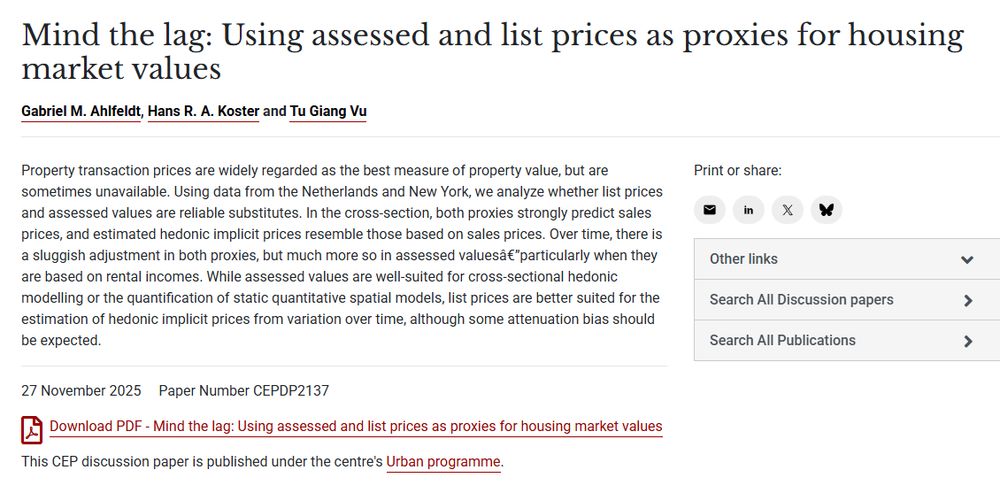
Assessed values are good for quantification of QSMs. List prices better for hedonic valuation using panel identification. Evidence and replication studies from the NL and NYC in our @cep-lse.bsky.social DP! cep.lse.ac.uk/_NEW/PUBLICA...
05.12.2025 20:25 — 👍 5 🔁 1 💬 0 📌 0

Nobel Prize Lecture 2025
Title: Economics Growth through Technological Progress and Creative Destruction
This event is supported by the WWG.
⏰ Reminder: Nobel Prize Lecture 2025
Join us on January 14, 2026 at @humboldtuni.bsky.social.
Chi Hyun Kim and Ben Schumann discuss the ideas of the 2025 Nobel Laureates in Economic Sciences, followed by a New Year’s Reception.
🔗 More info: www.wiwi.hu-berlin.de/de/Events/no...
06.01.2026 09:02 — 👍 6 🔁 3 💬 0 📌 0
📊 The authors use nationwide administrative data from 2005–2015, covering all nursing homes, ambulatory care services, and beneficiaries in Germany. Their approach follows the same facilities over time and links local unemployment rates to changes in care prices.
05.01.2026 09:04 — 👍 1 🔁 0 💬 0 📌 0