Postdoctoral position in Forest Genetics at @uni-freiburg.de with a focus on local adaptation and/or stress reaction of trees. The position combines research and teaching (4 SWS), and offers the opportunity to develop an independent research profile (4+ years).
19.02.2026 15:01 — 👍 29 🔁 37 💬 1 📌 0
How does the strength of genetic drift evolve over long times?
New preprint out 👇
www.biorxiv.org/content/10.6...
27.01.2026 23:20 — 👍 23 🔁 14 💬 0 📌 0

Asymmetric gene flow maintains range edges in a marine invertebrate | The American Naturalist: Vol 0, No ja
Three years since I collected the first amphipod for this paper and it is finally published! Feels like the end of an era.
We show that biased dispersal towards the range center maintains distinct edges in a beach amphipod.
www.journals.uchicago.edu/doi/10.1086/...
18.02.2026 20:59 — 👍 4 🔁 1 💬 0 📌 0
2-Year Postdoctoral Fellowship
We are pleased to invite applications for a
Eawag 2-year postdoc fellowship in Switzerland. Funding for Independent projects hosted in one of the research departments… come join us in Switzerland 🇨🇭! apply.refline.ch/673277/1335/...
13.02.2026 19:12 — 👍 25 🔁 22 💬 0 📌 0

'Modeling evolutionary rescue' doi.org/10.32942/X25...
10.02.2026 17:31 — 👍 20 🔁 9 💬 0 📌 2

Schematic representation of fitness landscapes. (A) Orange lines show maximum (dashed) and average (dotted) fitness of a population on a narrower peak (yellow circles), blue lines show the same for a wider peak (blue circles). (B) Trajectory of a population in a periodically changing environment with respect to a given fitness landscape (solid arrow) and with respect to an unseen other fitness landscape (dashed arrow). (C) Hypothetical “trapping” of the population in variable environments.
One of the most-viewed PNAS articles in the last week is “The variability of evolvability: Properties of dynamic fitness landscapes determine how phenotypic variability evolves.” Explore now: https://ow.ly/XouU50XWiiV
For more trending articles, visit https://ow.ly/AiXL50XWi81.
13.01.2026 22:00 — 👍 18 🔁 7 💬 0 📌 1
This story is absolutely wild. Did you know that avocados change sex over the course of a day? And that it's controlled by a single ancient balanced polymorphism? This is flat our crazy
25.12.2025 06:33 — 👍 212 🔁 78 💬 5 📌 9
Empseb is simply the best. If you're a PhD student of evolutionary biology, do go there!
12.12.2025 08:19 — 👍 13 🔁 13 💬 1 📌 0

Photo of a large number of scarlet monkeyflower plants growing in southern California (photo by MC Moazed).
Excited to share the first two publications from our PERSIST (Predicting Evolutionary Rescue of a Species in Space and Time) project. Thanks to NSF-DEB for supporting this work! (1/3)
22.12.2025 18:13 — 👍 40 🔁 18 💬 2 📌 0
Rapid adaptation follows experimental assisted gene flow in subset of annual monkeyflower populations https://www.biorxiv.org/content/10.64898/2025.12.02.689336v1
04.12.2025 06:32 — 👍 5 🔁 5 💬 0 📌 1
RegEvol: detection of directional selection in regulatory sequences through phenotypic predictions and phenotype-to-fitness functions https://www.biorxiv.org/content/10.1101/2025.11.26.690685v1
30.11.2025 01:31 — 👍 6 🔁 5 💬 0 📌 0
A lot has happened since our first announcement of #ExE2026, an evolutionary ecology conference hosted by @uniexecec.bsky.social in #Cornwall from June 29 to July 3 2026.
Have a look at our new website to see our confirmed plenary speakers, the mid-conference excursions, and more.
👉 evoxeco.uk 👈
21.11.2025 16:49 — 👍 18 🔁 22 💬 1 📌 0
Exciting!!
21.11.2025 13:59 — 👍 2 🔁 0 💬 0 📌 0
Most of the internet is down because of this one issue... this includes most academic journal websites!
Plos, Nature journals and biorxiv still seem to be up... for now. Made the mistake of closing many of the tabs I had open... sigh
18.11.2025 13:13 — 👍 2 🔁 0 💬 0 📌 0
ping @masahitotsuboi.bsky.social
07.11.2025 08:59 — 👍 0 🔁 0 💬 0 📌 0

📣CALL FOR PAPERS!
Upcoming SPECIAL ISSUE: Evolution at species range edges
Guest Edited by Shengman Liu, John Pannell and Sophie Karrenberg
More information here: academic.oup.com/jeb/pages/ca...
08.10.2025 14:53 — 👍 25 🔁 13 💬 0 📌 0
Out “in print”!
21.10.2025 15:43 — 👍 3 🔁 0 💬 0 📌 0

Cuts to science are happening everywhere, along with more and more austerity cuts. #SaveSwissResearch #SaveSwissTeaching
22.09.2025 09:34 — 👍 1 🔁 0 💬 0 📌 0

Hybridization and introgression are major evolutionary processes. Since the 1940s, the prevailing view has been that they shape plants far more than animals. In our new study (www.science.org/doi/10.1126/...
), we find the opposite: animals exchange genes more, and for longer, than plants
12.09.2025 07:54 — 👍 203 🔁 121 💬 3 📌 3

Illustration of projected changes in leaves. Three possible scenarios are shown as green shoots of different lengths with different densities of projected leaves.
Changes to a leaf trait due to adaptive evolution and plasticity can rescue subalpine populations from the detrimental effects of climate change
doi.org/10.1093/evle...
Now in @evolletters.bsky.social by Diane R Campbell, @jellyturtle.bsky.social, and Justin Kipness
Illustration by J. Francis
11.09.2025 14:56 — 👍 16 🔁 6 💬 0 📌 1
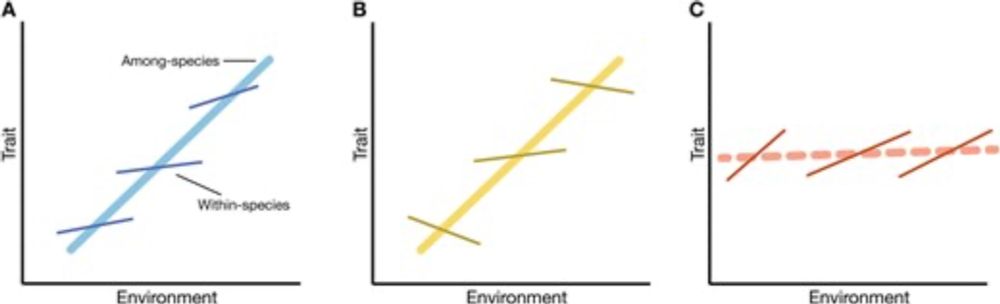
Alignment across taxonomic levels in strategies rather than in traits along elevational gradients
Abstract. Trait variation along environmental gradients can indicate the different strategies that organisms have evolved in response to environmental hete
A bit late, but really happy to see my first PhD paper out!
We studied trait-elevation relationships in multiple traits spanning growth, size (both above and belowground) and leaf economics to understand whether these align at within- and among-species scales.
academic.oup.com/evlett/advan...
03.09.2025 14:13 — 👍 24 🔁 9 💬 3 📌 0
More from my PhD to follow in the next months! Give it a read if you're into alpine plants or elevational ranges! academic.oup.com/evlett/advan...
03.09.2025 14:22 — 👍 0 🔁 0 💬 0 📌 0
We sought to uncover the extent of alignment across scales by sampling the elevational ranges of seven Brassicaceae species. Additionally, we also tried understand which traits (or trait syndromes) are putatively involved in adaptation, based on parallel clines and alignment across taxonomic scales
03.09.2025 14:20 — 👍 2 🔁 0 💬 1 📌 0
PhD Candidate in Theoretical Evolutionary Ecology
Evolutionary biology | Behavioural ecology | Sexual selection
@CNRS, CEFE, Montpellier
Postdoc @ Harvard with Michael Desai | Evolutionary dynamics & genotype-phenotype maps
ocf.berkeley.edu/~joaoascensao
Evolutionary biologist. Assistant Professor CCLCM/CWRU.
The Gene's-Eye View of Evolution (OUP 2021) and The Paradox of the Organism (HUP 2025).
www.arvidagren.com
Postdoc at Université de Lausanne (Switzerland) with Nicolas Salamin.
Population genetics and phylogenetics, confronting or integrating them.
https://thibaultlatrille.github.io/
Molecular evolution and publication ethics at ISEM (CNRS Montpellier)
Associate Professor Senckenberg and Goethe
Conservation biologist and genomicist.
Dyslexic so please forgive spelling mistakes!
She/her
🌳🐐🪶🐧
Director, Environmental Bioinformatics Group at SIB Swiss Institute of Bioinformatics @sib.swiss. Chair, European Reference Genome Atlas (ERGA, @ergabiodiv.bsky.social). #biodiversity #genomics www.rmwaterhouse.org
Evolutionary biologist interested sexual selection, sexual conflict and mating systems.
I am the managing editor of Journal of Forestry Research (JCR IF=4.6, 6/92; Scopus Citescore of 8.9). You can get all via journal web: https://www.springer.com/journal/11676
Professor of Interdisciplinary Stuff @ Department of Social and Behavioral Sciences, Toulouse School of Economics (TSE), and Institute for Advanced Study in Toulouse (IAST).
Mathematical models of cooperation and conflict.
https://jorgeapenas.github.io
SMBE fosters communication among molecular evolutionists and advances the field.
🔗 smbe.org
💬 smbe2026.org • smbeperu.github.io/SMBEperu-esp
👥 @smbe-idea.bsky.social
📙 @molbioevol.bsky.social • @genomebiolevol.bsky.social
Assistant professor, Department of Ecology and Evolution, University of Lausanne.
Interested in how behaviors are learned during early life, in the context of the environment 🪺🦅
PhD candidate at the University of Edinburgh interested in evolutionary biology and quantitative genetics 🌱🧬
Evolutionary biologist, speciation genetics, PMPZ, pollen-pistil interactions. Postdoc at Yale 🇨🇴
Cell biologist excited about autophagy, quality control, evolution, and membrane trafficking. Reads and thinks about academic mentoring, equality & diversity. https://www.cos.uni-heidelberg.de/en/evolutionary-cell-biology
Mathematical biologist studying evolution. Professor of Mathematics at Emmanuel College, MA. Queer, nonbinary (they/them). For social and ecological justice. Jewish as in Free Palestine. https://www.emmanuel.edu/emmanuel-mathematical-biology-research-embr
Evolutionary biologist at https://www.umontpellier.fr/ and https://isem-evolution.fr/ .
Molecular-evolution and PopGen
Insects; orthoptera; hymenoptera; diptera
Birds & mammals
OpenScience
Teacher at https://biologie-ecologie.com/departement/
Assistant Professor @UniFr studying evolution of circuits and behaviors in drosophilids. Co-Director @TReNDinAfrica - strengthening education capacity.
Evolutionary genomics 🧬, Molecular ecology, 🦋🦋🦋 biology, Assistant Professor, EEB, Tulane University
https://chaturvedi-lab.wp.tulane.edu/