How can we... Use LLMs to understand whether disease research happens where it's most needed? Read the blog post by Hongyu Zhou on the Accelerate Programme website. Image shows a photo of Hongyu with his quote.
📢 New blog! @zhou-hy.bsky.social used LLMs to investigate whether disease research happens where it's most needed.
Analysing 300k papers revealed stark disparities in global health research distribution - 43% of clinical trials occur in low/middle-income countries.
Find out more: bit.ly/47RyL2L
11.11.2025 09:55 — 👍 1 🔁 2 💬 0 📌 0

10/🧵
📈 The result: health shocks trigger rapid, durable rises in research attention — both domestic & global.
Responses are strongest for high-lethality threats, showing how the system mobilizes when risks are greatest.
01.10.2025 13:08 — 👍 2 🔁 2 💬 1 📌 0

9/🧵
🦠 What about sudden shocks — like Ebola?
Do countries ramp up research when health emergencies hit?
To test this, we use 3,134 WHO Disease Outbreak News alerts as quasi-random shocks to disease burden. 📢
01.10.2025 13:08 — 👍 2 🔁 0 💬 1 📌 0

8/🧵
📊 Responsiveness in low-income countries depends heavily on these actors.
Without philanthropy, responsiveness growth would shrink by 38%.
Without government support, by 32%.
01.10.2025 13:08 — 👍 2 🔁 0 💬 1 📌 0
7/🧵
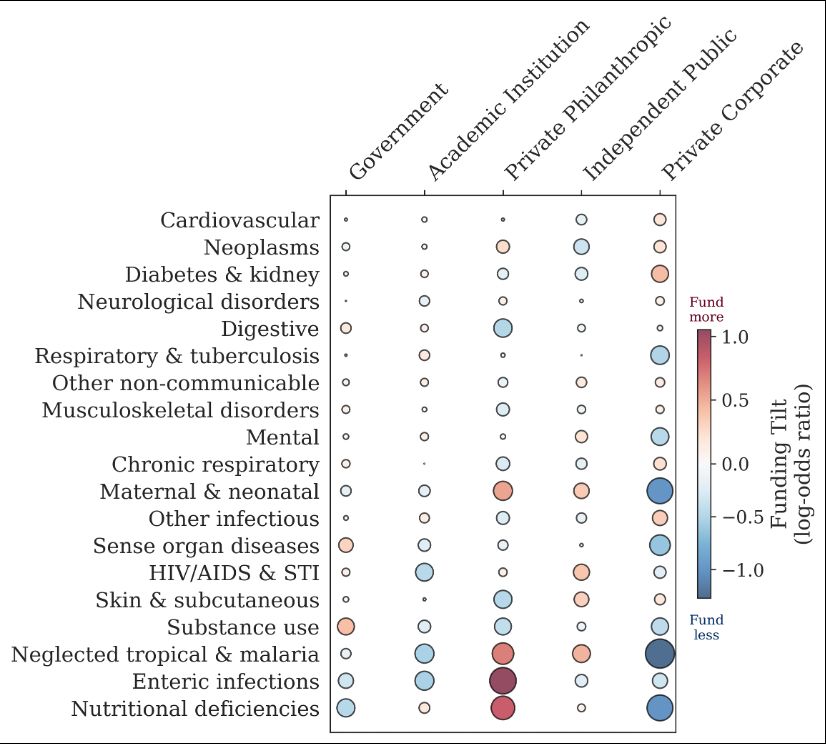
💰 Funders fund differently.
🔹 Philanthropies → target neglected burdens
🔹 Corporations → profitable chronic diseases
🔹 Governments → somewhere in between
01.10.2025 13:08 — 👍 1 🔁 1 💬 1 📌 0

6/🧵
🔹 Responsiveness has grown since 1990
🔹 Strongest growth in upper-middle-income countries
🔹 Rises modestly with GDP per capita — but varies widely among the wealthiest
01.10.2025 13:08 — 👍 4 🔁 0 💬 1 📌 2
5/🧵
📊 Is research becoming more responsive to health needs?
We modeled publications vs. disease burden (DALYs) to test how output shifts with a 1% rise in burden.
Answer: yes — but unevenly. 👇
01.10.2025 13:08 — 👍 1 🔁 0 💬 1 📌 0
4/🧵
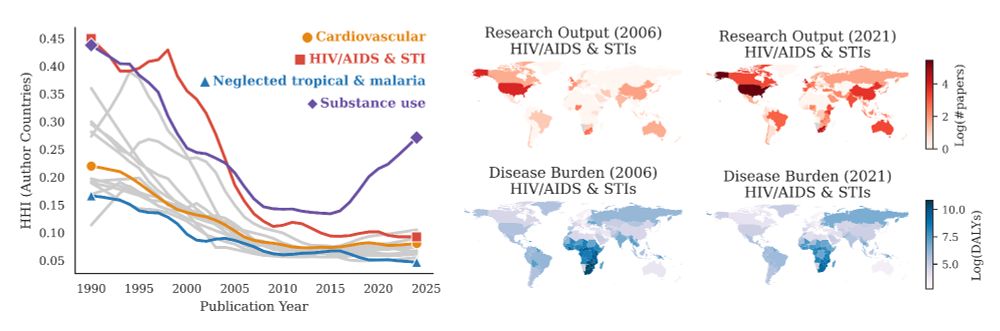
📈 Promisingly, we see diversification of global research output across almost all disease areas.
Over time, regions with the heaviest burdens have also emerged as research leaders, e.g. in HIV/AIDS & STIs, where African institutions gained visibility as key contributors.
01.10.2025 13:08 — 👍 4 🔁 1 💬 1 📌 0

3/🧵
🌍 Some regions are often studied but less often authored.
For neglected tropical diseases & malaria, Africa is the context in 32% of research — but just 14% of authorship.
01.10.2025 13:08 — 👍 3 🔁 0 💬 1 📌 0

2/🧵
Findings:
Most research centers on NCDs in wealthier settings (cardiovascular, neoplasms).
But neglected tropical diseases, maternal & neonatal health remain less-studied despite heavy burdens.
01.10.2025 13:08 — 👍 4 🔁 0 💬 1 📌 1
1/🧵
We analyzed 300k+ research articles from top medical journals (1990–2021).
Using LLMs + crosswalks, we linked:
🌍 Countries’ research output
🦠 Disease burden (via DALYs)
⚡ WHO health shocks
01.10.2025 13:08 — 👍 2 🔁 0 💬 1 📌 0

🚨Thrilled to share our paper🚨
Does science focus on the diseases that hurt people the most?
When deadly outbreaks hit, how does research respond?
Our work with:
@prashantgarg.bsky.social
@trfetzer.com
shows how medical research worldwide responds to both endemic burdens and emergencies.
🧵👇
01.10.2025 13:08 — 👍 15 🔁 6 💬 1 📌 2
7/🧵
💰 Funders fund differently.
🔹 Philanthropies → target neglected burdens
🔹 Corporations → profitable chronic diseases
🔹 Governments → somewhere in between
01.10.2025 12:53 — 👍 0 🔁 0 💬 0 📌 0
6/🧵
🔹 Responsiveness has grown since 1990
🔹 Strongest growth in upper-middle-income countries
🔹 Rises modestly with GDP per capita — but varies widely among the wealthiest
01.10.2025 12:53 — 👍 0 🔁 0 💬 1 📌 0
5/🧵
📊 Is research becoming more responsive to health needs?
We modeled publications vs. disease burden (DALYs) to test how output shifts with a 1% rise in burden.
Answer: yes — but unevenly. 👇
01.10.2025 12:53 — 👍 0 🔁 0 💬 1 📌 0

4/🧵
📈 Promisingly, we see diversification of global research output across almost all disease areas.
Over time, regions with the heaviest burdens have also emerged as research leaders, e.g. in HIV/AIDS & STIs, where African institutions gained visibility as key contributors.
01.10.2025 12:53 — 👍 0 🔁 0 💬 1 📌 0
3/🧵
🌍 Some regions are often studied but less often authored.
For neglected tropical diseases & malaria, Africa is the context in 32% of research — but just 14% of authorship.
01.10.2025 12:53 — 👍 0 🔁 0 💬 1 📌 0
2/🧵
Findings:
Most research centers on NCDs in wealthier settings (cardiovascular, neoplasms).
But neglected tropical , maternal & neonatal health remain less-studied despite heavy burdens.
01.10.2025 12:53 — 👍 0 🔁 0 💬 1 📌 0
1/🧵
We analyzed 300k+ research articles from top medical journals (1990–2021).
Using LLMs + crosswalks, we linked:
🌍 Countries’ research output
🦠 Disease burden (via DALYs)
⚡ WHO health shocks
01.10.2025 12:53 — 👍 0 🔁 0 💬 1 📌 0
🚨Thrilled to share our Paper🚨
Does science focus on the diseases that hurt people the most?
When deadly outbreaks hit, how does research respond?
Our work with
@prashantgarg.bsky.social
@trfetzer.com
shows how medical research worldwide responds to both endemic burdens and emergencies.
🧵👇
01.10.2025 12:53 — 👍 1 🔁 0 💬 1 📌 0