Great to see our paper -- with @trfetzer.com and @prashantgarg.bsky.social -- on local decline in the UK featured in this Guardian piece.
www.theguardian.com/business/202...

@prashantgarg.bsky.social
Econ PhD @imperial. Visiting researcher at Cambridge. AI and networks in economics. www.prashantgarg.org
Great to see our paper -- with @trfetzer.com and @prashantgarg.bsky.social -- on local decline in the UK featured in this Guardian piece.
www.theguardian.com/business/202...
🔗 Read the full preprint: www.researchsquare.com/article/rs-8...
Note: this replaces our earlier pre-print "The Changing Geography of Medical Research"

10/ Yes: outbreaks trigger rapid *and durable* rises in research attention.
Responses are much stronger in the 2010s than before and biggest for high-salience threats.
Capacity matters too: internet penetration, population structure, and research strength predict bigger mobilization.

9/ What about sudden shocks: Ebola, Zika, COVID?
Do countries ramp up research when health emergencies hit?
We test this using 3,134 WHO Disease Outbreak News alerts as quasi-random shocks to disease salience.

8/ In low-income countries, responsiveness growth depends heavily on these actors.
Without philanthropy, responsiveness growth would shrink by ~38%.
Without government support, by ~32%.
(And similar patterns show up in lower-middle-income settings.)

7/ Funders fund differently.
🔹 Philanthropies → neglected burdens (HIV/NTDs/nutrition)
🔹 Corporations → profitable chronic diseases (cardio, cancer, diabetes/kidney)
🔹 Governments/public → somewhere in between

6/ Even after conditioning on burden, some topics are consistently over-/under-studied:
Over: cardiovascular (+16.5%), digestive (+14.1%)
Under: nutritional deficiencies (−14.4%), maternal & neonatal (−12.4%)
So need ≠ attention (yet).

5/ The bad news: participation is still lopsided.
The Global South often appears more as a research setting than a research author.
Example: for neglected tropical diseases & malaria, Africa is 33% of research context, but only 14% of authorship.

4/ Research is getting less geographically concentrated over time, and “endemic responsiveness”
(elasticity of publications to domestic DALYs) has more than doubled since 1990.

3/ Cardio + cancer dominate papers, while respiratory infections/TB + maternal–neonatal + nutrition + many infectious diseases carry *much* higher burden than their paper ranks suggest.
but there's good news....
2/ We link a million papers (524 journals) to (i) diseases + (ii) geographic study context using LLM + (iii) author countries.
We find that the mismatch is real...

Does science follow where people are sick and does it mobilize when outbreaks hit?
@zhou-hy.bsky.social, @trfetzer.com and I answer just that in our revised paper.
1/ A short thread for highlights 👇
Thanks. Yes very related
03.12.2025 12:36 — 👍 5 🔁 0 💬 0 📌 0“When researchers randomly displayed these flood risk estimates to 18M people browsing Redfin, those who saw the feature were more likely to search for homes w/ low flood risk, according to a working paper published in the Nat’l Bureau of Economic Research last Nov*.”🧪
* www.nber.org/papers/w33119
Thanks!
27.11.2025 21:00 — 👍 3 🔁 0 💬 0 📌 0


Cool new data set from @reubenhurst.bsky.social and coauthors: politicsatwork.org
Associated papers:
-Political segregation in the US workplace papers.ssrn.com/sol3/papers....
-VRscores: A New Measure and Dataset of Workforce Politics Using Voter Registrations
papers.ssrn.com/sol3/papers....

TOMORROW (12 November): AYEW Big Data/Machine Learning Workshop!
Join us at 9pm AEDT (10am GMT) to @prashantgarg.bsky.social (@imperialcollegeldn.bsky.social), Zhenkai (Cambridge), Saani (University of Cincinnati), Luka (@ucsandiego.bsky.social )
Sign up for Zoom link: monash.edu/business/imp...

Can AI tell us anything meaningful about Bob Dylan’s songs? Delighted to share a new essay in @aeon.co breaking down an artists' evolution using AI extracted idea graphs.
aeon.co/essays/can-a...

we're hiring assistant professor in computational social science, applications close 26/10/2025
Not long left to apply for our Assistant Professor in Computational Social Science vacancy❗
📚 jobs.lse.ac.uk/Vacancies/W/...
Apply before 26 October and join an internationally outstanding group of social science methodologists 🌎
Delighted to share this new work. Check this thread by @zhou-hy.bsky.social. We use LLMs to analyse medical research to see whether it responds to local disease burdens.
06.10.2025 18:58 — 👍 3 🔁 0 💬 0 📌 0New paper on where medical research happens vs where disease burden is.
01.10.2025 13:24 — 👍 4 🔁 0 💬 0 📌 0any reviews?
12.09.2025 11:00 — 👍 0 🔁 0 💬 1 📌 0WE ARE HIRING! 2 Lecturers in Quantitative Social Science. Want a friendly interdisciplinary department in one of the world's most vibrant cities? This just might be for you.
Apply by: 10 Oct
www.ucl.ac.uk/work-at-ucl/...
Happy to share this paper. Full thread coming soon!
02.06.2025 11:45 — 👍 183 🔁 56 💬 8 📌 15🚨 Tariffs on inputs = tax on downstream products.🚨
Here’s cement’s granular production network. A 50% duty on key inputs propagates costs through roads, buildings, data-centres, and renewable infrastructure.
Public data, method & our paper in thread 🧵 0/8
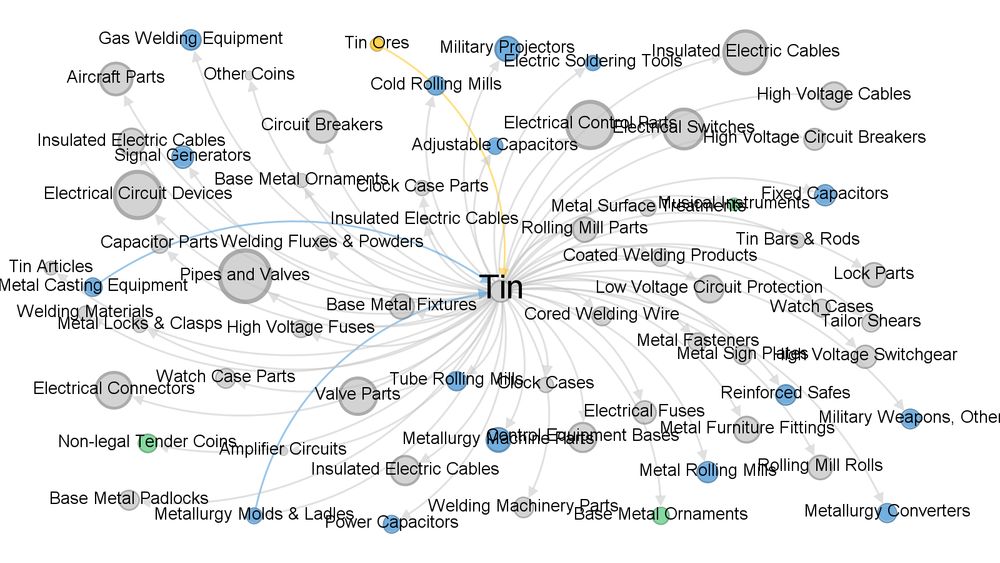
8/8 Explore the data, methods and paper at aipnet.io. Bonus: Here's input/output links for another related product, Tin.
24.07.2025 13:31 — 👍 6 🔁 1 💬 0 📌 0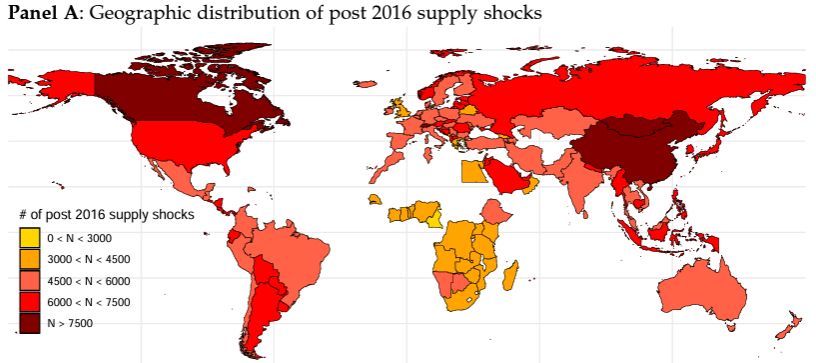
7/ Our paper finds that global supply shocks on internationally traded goods have become more prevalent since 2016, particularly affecting consumer goods and processed intermediates. Here's a map of these supply shocks. Post 2024 map, when data updates, will likely be worse...
24.07.2025 13:31 — 👍 4 🔁 0 💬 1 📌 0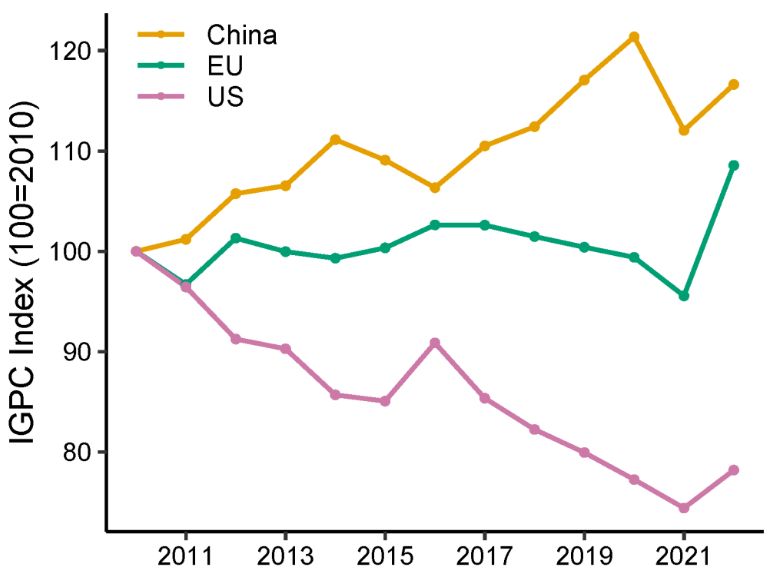
6/ Diverging strategies of U.S. vs. China in global trade. China: Importing more upstream products like Cement to build advanced domestic industries. US: Importing more downstream goods, relying on global supply chains.
24.07.2025 13:31 — 👍 4 🔁 0 💬 1 📌 0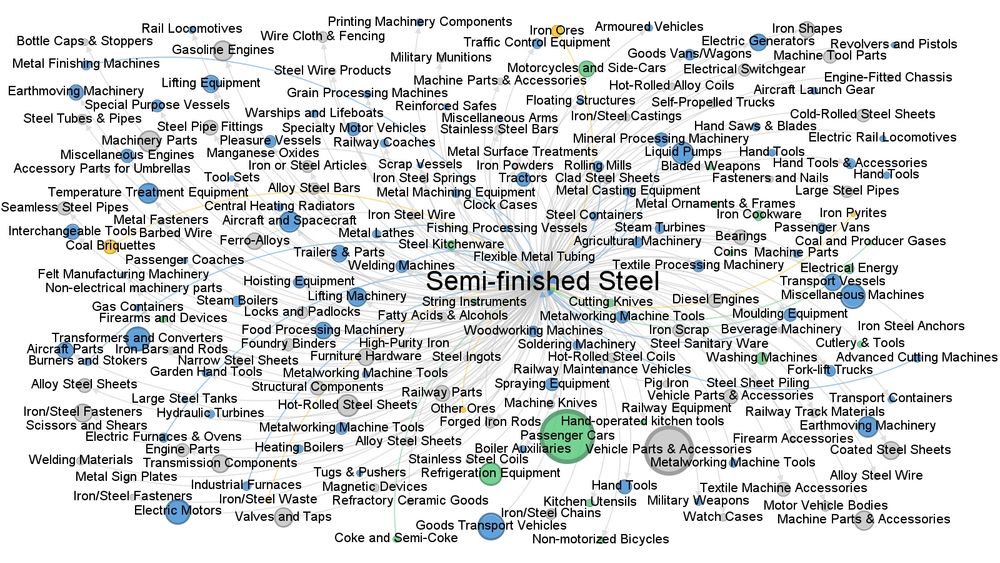
5/ The pending 15% baseline tariff agreement between the US and EU may impact 12 million tonnes of transatlantic clinker, reshaping supply chains, alongside ongoing 50% US steel duties
24.07.2025 13:31 — 👍 5 🔁 1 💬 1 📌 0