
Category selectivity vs. behavioral relevance in visual cortex? 👁️🧠
@levandyck.bsky.social and I really enjoyed diving into this piece and appreciated the authors’ thoughtful response. We're curious to see how the field moves forward from here! ➡️
Category selectivity vs. behavioral relevance in visual cortex? 👁️🧠
@levandyck.bsky.social and I really enjoyed diving into this piece and appreciated the authors’ thoughtful response. We're curious to see how the field moves forward from here! ➡️
We talk a lot about faces and bodies in cog neuro, but a person is both.
So how segregated are face and body representations in human visual cortex? When, and why, do they get integrated?
Check out Lenny’s new preprint using DNNs and fMRI encoding models to tackle exactly that question 👇
#NeuroAI

📢 Workshop announcement.
We are super excited to announce the workshop Perceptual Inferences, from philosophy to neuroscience, organized by Alexander Schütz and Daniel Kaiser.
📍 Rauischholzhausen Castle, near Marburg, Germany
🗓️ June 8 to 10, 2026.
1/4
I have a PhD opening for my #VIDI BrainShorts project 📽️🧠🤖! Are you or do you know an ambitious, recent (or almost) MSc graduate with a background in NeuroAI and interest in large-scale data collection and video perception? Check out our vacancy! (deadline Feb 15).
werkenbij.uva.nl/en/vacancies...

Dimensionality reduction may be the wrong approach to understanding neural representations. Our new paper shows that across human visual cortex, dimensionality is unbounded and scales with dataset size—we show this across nearly four orders of magnitude. journals.plos.org/ploscompbiol...
11.12.2025 15:32 — 👍 224 🔁 64 💬 7 📌 10
I’m excited to share the first preprint from my PhD project!
Together with Daniel Kaiser (@dkaiserlab.bsky.social), we investigated how internal models shape inter-individual differences in the perception and neural processing of natural scenes.
Preprint: osf.io/preprints/ps...
1/n
Very excited to be part of the new graduate training program "PIMON" by @dfg.de alongside a fantastic team! 🥳 We're looking forward to training a new generation of scientists in perception, cognition and (inter)action! 🧠🤖👀 Stay tuned for upcoming positions! #PIMON #neurojobs #NeuroAI #vision
03.12.2025 15:18 — 👍 12 🔁 1 💬 0 📌 0
Investigating individual-specific topographic organization has traditionally been a resource-intensive and time-consuming process. But what if we could map visual cortex organization in thousands of brains? Here we offer the community with a toolbox that can do just that! tinyurl.com/deepretinotopy
01.12.2025 11:26 — 👍 82 🔁 40 💬 4 📌 1
View from your office onto Giessen and surrounding villages.
Please repost! I am looking for a PhD candidate in the area of Computational Cognitive Neuroscience to start in early 2026.
The position is funded as part of the Excellence Cluster "The Adaptive Mind" at @jlugiessen.bsky.social.
Please apply here until Nov 25:
www.uni-giessen.de/de/ueber-uns...
A little late to the party, but huge congrats, Mona! 🥳
03.10.2025 19:38 — 👍 2 🔁 0 💬 0 📌 0Fantastic news! Congratulations, Mariya 🥳
04.09.2025 16:49 — 👍 1 🔁 0 💬 0 📌 0Find me at the poster session tomorrow! I’ll be standing in for Saskia who unfortunately couldn’t make it. Will presenting joint work with @kathadobs.bsky.social on MEG decoding during object permanence #CCN2025
11.08.2025 22:23 — 👍 6 🔁 1 💬 0 📌 0
Really looking forward to #CCN2025!
On Tuesday, I'm presenting new work with @kathadobs.bsky.social on segregated vs. integrated face & body processing in visual cortex 😊🧍🧠
Using DNNs & fMRI, we test competing hypotheses, finding both distinct & shared selectivity.
Come by Poster A64 for more.
Find them at their posters and chat about these or any other #NeuroAI topics. They’re all excited to hear your feedback! 🧠🤖
11.08.2025 19:51 — 👍 0 🔁 0 💬 0 📌 0
Wednesday (1:00–4:00 pm)
• Anastasia (B50): selectivity metrics in DNNs
Friday (2:00–5:00 pm)
• Zhengqing "John” (C149): resilience of functional specialization in DNNs
Tuesday (1:30–4:30 pm)
- Elah (A60): holistic face processing in humans & DNNs
- @levandyck.bsky.social (A64): face–body integration in DNNs & brains
- Sule (A63): top-down effects on neural face representations
- Saskia & @apurvaratan.bsky.social: neural decoding during object permanence
So sad (and definitely feeling the FOMO) that I can’t attend #CCN2025 this year 😢, but very proud that our lab will present 6 projects! 🥳 Here's a quick rundown:
11.08.2025 19:51 — 👍 10 🔁 0 💬 1 📌 0
In this world on fire, with misinformation, science and democracy under threat, how can scientists be a force for social good?
This Monday in Amsterdam, join @weijima.bsky.social @tsonj.bsky.social Ili Ma + me for an interactive workshop as part of #CCN2025
anneurai.net/2025/05/05/c...
Congrats, Lu! 🥳
26.06.2025 19:13 — 👍 0 🔁 0 💬 0 📌 0
Ever wondered whether it's categorical specialization or distributed representation in the human visual cortex?
Check out how the brilliant @levandyck.bsky.social tackles this long-standing question in his first PhD project. Spoiler alert: no need to choose anymore! 🤝🔄🧠
Thanks for the shout-out! 😊 I loved this result too, especially since we didn’t expect such strong differences. That the object-only trained network didn’t show this at all was quite striking!
05.06.2025 15:44 — 👍 1 🔁 0 💬 0 📌 0
Sounds like a fantastic PhD opportunity at the intersection of visual neuroscience, AI and developmental psychology! 🧠👁️🤖👶
'lees meer' here 👇
Looks like a super cool summer school and a great way to enhance your coding skills! 👩💻🐍😎
26.05.2025 15:36 — 👍 2 🔁 0 💬 0 📌 0So excited that our excellence cluster 'The Adaptive Mind' got funded! 🥳 Looking forward to lots of great science and projects! #TheAdaptiveMind #ExcellenceInitiative 👁️🧠🤖
22.05.2025 18:53 — 👍 48 🔁 7 💬 2 📌 0Congrats, Ko! 🥳 And so well deserved!
22.05.2025 14:08 — 👍 1 🔁 0 💬 1 📌 0Thank you so much, Haemy! There are no right or wrong words, just hearing from you means a lot. 💛 I really appreciate the support. I'm also trying to raise awareness of how much we owe to science, a message that seems to be forgotten by some these days. 🧠✨
07.05.2025 10:07 — 👍 1 🔁 0 💬 0 📌 0
Good morning, Bsky'ers! Some people have asked for a life update, here it is: I finished my last chemotherapy yesterday! 🥳 It’s been a long ride, but I’m feeling happy, relieved, and incredibly grateful. I sort of always knew, but now more than ever: #cancersucks #sciencematters #sciencesaveslives
07.05.2025 06:43 — 👍 68 🔁 1 💬 7 📌 2
Top-down feedback is ubiquitous in the brain and computationally distinct, but rarely modeled in deep neural networks. What happens when a DNN has biologically-inspired top-down feedback? 🧠📈
Our new paper explores this: elifesciences.org/reviewed-pre...
I am so happy—this is the first 1st author paper I have written, since the cancer diagnosis of my late wife seven years ago.
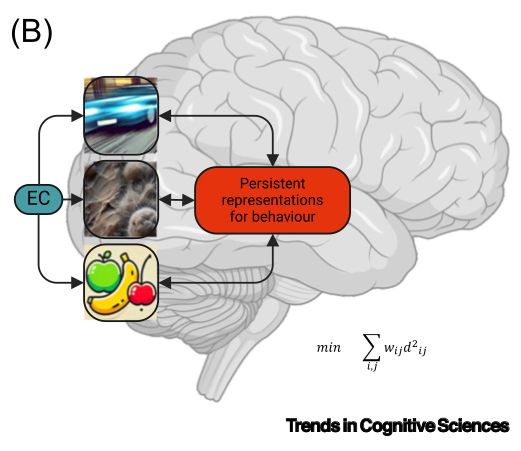
📑 PAPER ALERT: "Beyond binding: from modular to natural vision" in Trends in Cognitive Sciences (2025) sciencedirect.com/science/arti...
