11/
If you're interested in aging, navigation, attractor networks, and computational neuroscience, we’d love your feedback!
Thanks to Jonathan Shine, @wolberslab.bsky.social & @andrejbicanski.bsky.social for the supervision and collaboration.
Preprint: www.biorxiv.org/content/10.1...
01.12.2025 10:49 — 👍 2 🔁 0 💬 0 📌 0
10/
Why this matters:
The HD system may be an early marker of navigational decline and potentially of neurodegenerative change.
Understanding how aging affects HD attractor dynamics opens new avenues for translational work—from rodent aging studies to clinical interventions.
01.12.2025 10:49 — 👍 1 🔁 0 💬 1 📌 0
9/
This framework offers:
- Direct human evidence that the HD system is impacted by aging
- A mechanistic account of directional drift
- Support for attractor models that withstand perturbations
- Implications for memory, decision-making, and other attractor-based functions.
01.12.2025 10:49 — 👍 2 🔁 0 💬 1 📌 0
8/
The key insight:
Synaptic changes + vestibular noise + modest neuron loss best reproduce the behavioral drift we see in older adults.
These factors create shallow attractor basins → the HD bump becomes less stable → orientation estimates drift, especially with time delays.
01.12.2025 10:49 — 👍 1 🔁 0 💬 1 📌 0
7/
We then introduced aging-like perturbations:
- Synaptic degradation
- Increased noise in vestibular signals
- Neuron deletion
Each produces distinct signatures in HD stability, letting us test mechanistic hypotheses.
01.12.2025 10:49 — 👍 1 🔁 0 💬 1 📌 0
6/
Behavior alone can’t reveal why this drift occurs.
So we built a biologically realistic attractor-network model of the HD system that removes direct recurrence, uses persistent vestibular drive, and stays stable under perturbations—a long-standing challenge in attractor theory.
01.12.2025 10:49 — 👍 3 🔁 0 💬 1 📌 0
5/
Key findings: Performance drops when delay is added, but older adults show a much larger decline with systematic drift in orientation estimates. Errors build over time.
This is the first direct evidence that HD computations degrade with age in humans.
01.12.2025 10:49 — 👍 1 🔁 0 💬 1 📌 0
4/
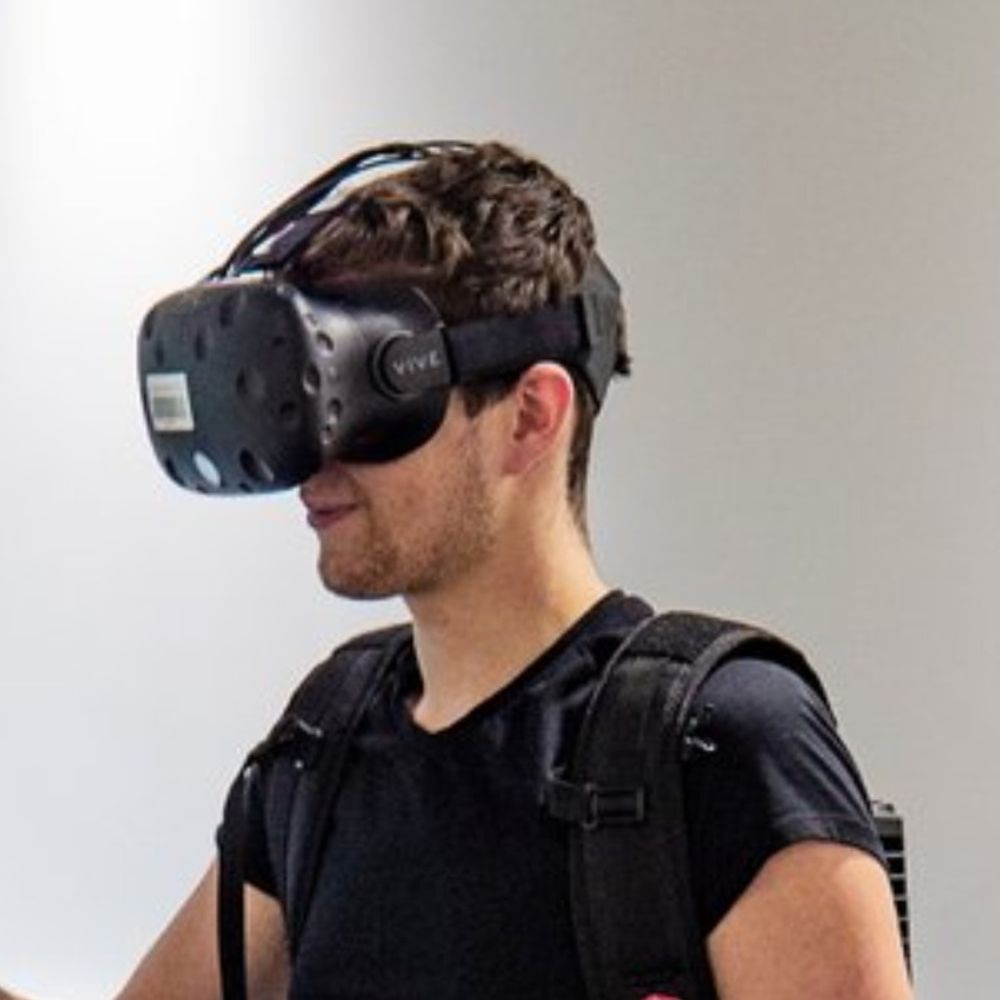
We built an immersive VR orientation task that isolates HD processing.
Participants view a distant landmark, rotate, and must reproduce their facing direction — sometimes after a 20-second delay.
This setup allows us to probe the stability of internal directional estimates.
01.12.2025 10:49 — 👍 1 🔁 0 💬 1 📌 0
3/
That system is the head direction (HD) network — the brain’s internal compass.
Rodent studies suggest aging alters HD representations, but direct human evidence was missing.
So we set out to test HD computations in older vs. younger adults.
01.12.2025 10:49 — 👍 1 🔁 0 💬 1 📌 0
2/
Spatial navigation is one of the first cognitive abilities to decline with age—and often early in conditions like dementia.
But the neural mechanisms behind this decline remain unclear.
Most work has focused on the medial temporal lobe… but one key system has been overlooked.
01.12.2025 10:49 — 👍 1 🔁 0 💬 1 📌 0

Excited to share my first PhD preprint!
“How human aging disrupts the head direction network: evidence from VR experiments and mechanistic models”
We investigated why our sense of direction becomes less stable as we age.
Preprint: www.biorxiv.org/content/10.1...
1/ thread 🧵
01.12.2025 10:49 — 👍 16 🔁 3 💬 1 📌 1
PhD student in the Object Vision Group at CIMeC, University of Trento. Interested in neuroimaging and object perception. He/him 🏳️🌈
https://davidecortinovis-droid.github.io/
Neuroscientist interested in representations of space & memory. Using tools from experimental & theoretical neuroscience as well as machine learning. @UCL
https://barry-lab.com
Proud dad, Professor of Computational Cognitive Neuroscience, author of The Decoding Toolbox, founder of http://things-initiative.org
our lab 👉 https://hebartlab.com
PI of the Research Group Psychology and Neurobiology of Sleep and Memory at the Central Institute of Mental Health in Mannheim.
Neuroscientist and psychologist, ex-pat kiwi slowly reverting to my Scottish roots at UoG. Researching mental map formation in rats and humans. she/her
Postdoctoral Research Associate at Cambridge University | forthcoming MSCA Fellow | PhD in Social and Educational Neuroscience | Interested in how people learn from and with others in real-world interactions | URL: sites.google.com/view/saradefelice/home
Currently working in #Shanghai | PhD from MRC-CBU/Cambridge Uni | Gates Cambridge | interested in neuroscience of memory | you can call me Alex
Associate Professor of psychology and cognitive neuroscience, Université Côte d’Azur. Spatial cognition, Vision, Aging, fMRI, Mobile EEG, VR.
https://univ-cotedazur.fr/annuaire/m-stephen-ramanoel
spatial neuroscience researcher, associate professor at UC Irvine, creator of virtual environments, lover of mazes
faculty.sites.uci.edu/spatialneuro/
PhD student at WolbersLab
Neuroscience
Slowly becoming a neuroscientist.
EiC @elife.bsky.social
Cognitive neuroscientist | Prof @LMU_Muenchen | Memory, Navigation, Sleep, Eye Movements, Thalamus | iEEG, EEG, MEG, DBS | https://www.lmu.de/psy/en/chairs/neuropsychology-and-biological-psychology/cognitive-neuropsychology/
Associate Professor of Neuroscience at UC Santa Barbara. I study neural circuits underlying sensation, decision making, and spatial navigation.
Cognitive and developmental scientist at Temple University
Asst. Prof. at the University of Bonn in Germany. Research focus: neural basis of navigation and memory in humans
Cognitive neuroscientist at UPenn. Interested in scenes, memory, space. Occasionally thinks about other things.
Associate Prof at U Penn. Learning, memory, sleep, neural network modeling...
Prof of Cognitive Neuroscience & Vice Dean at UCL, Fellow of the Royal Inst. of Navigation. I study how we remember, navigate & imagine space
Photo: Our upcoming field research in the Marshall Islands
https://spierslab.wixsite.com/wavesandwayfinding
Passionnate about behavior. In love with the aesthetics of place. I'm studying how the cerebellum impacts our representation of places and can induce spatial disorientation
Spatial navigation • aging and AD • VR
Postdoc at the @Wolberslab 🇩🇪