
A new theme issue of #PhilTransB examines the mechanisms of learning from social interaction. Read articles for free: buff.ly/K8v43YM
06.02.2026 21:30 — 👍 19 🔁 10 💬 0 📌 1
@saradefelice.bsky.social
Postdoctoral Research Associate at Cambridge University | forthcoming MSCA Fellow | PhD in Social and Educational Neuroscience | Interested in how people learn from and with others in real-world interactions | URL: sites.google.com/view/saradefelice/home
A new theme issue of #PhilTransB examines the mechanisms of learning from social interaction. Read articles for free: buff.ly/K8v43YM
06.02.2026 21:30 — 👍 19 🔁 10 💬 0 📌 1
Interesting point. By definition, if the lecture is live, it must be for both parts (lecturer and audience). If one of the two parts is watching the lecture 'offline' (recorded), then there is no liveness. Having the camera off may affect learning for other reasons - see www.cell.com/current-biol...
04.12.2025 10:19 — 👍 0 🔁 0 💬 1 📌 0
This is now out in Cerebral Cortex.
Open Access: academic.oup.com/cercor/artic...
@antoniahamilton.bsky.social @gabriellavigliocco.bsky.social Uzair Hakim @paola182.bsky.social Danny Thompkings @fdi55.bsky.social
Glad you found it interesting!
01.12.2025 18:09 — 👍 0 🔁 0 💬 0 📌 0
Pre-print link: osf.io/preprints/ps...
Thanks for the contribution of the co-authors @antoniahamilton.bsky.social and @sjblakemore.bsky.social
#socialcognition #sociallearning #socialcontingency #learning #teaching #conversationalanalysis #conversation
Overall, our findings point to a simpler explanation:
Learning with others may be effective because the human mind treats live social contexts as special, even when interaction is minimal. Interactivity can help, but it may not be the central ingredient to boost learning.
This matters for online education and AI learning tools.
If contingency is the key driver, then systems may need to create a genuine sense of live presence rather than simply imitating interactive behaviours.
This suggests that the contingent-learning boost we observed in 2021 may not depend on reciprocal dialogue.
Instead, being in a live exchange, with the potential to interact, may already engage contingency-specific processes that support learning, such as attentional arousal and mutual-prediction.


We asked: Do items with more interactivity lead to better learning?
Across different linear mixed-effects models, the results were clear: no detectable relationship. Despite good variability in our metrics, higher interactivity did not predict higher learning.

Brilliant student Stan de Visser annotated the 49 live lessons from De Felice et al. 2021 item-by-item for teacher and learner separately for:
• vocal feedback (“yeah”, "uh-hum", "ok" etc)
• visual feedback (nodding, smiling)
• questions
We computed both incidence-based and time-based metrics.

We preregistered and tested two contrasting hypotheses: is the learning boost due to interactivity, i.e. the back-and-forth between teacher and learner?
Or is the key ingredient simply contingency, i.e. being in a real-time social exchange, that triggers live-specific processes to support learning?
In De Felice et al. 2021 Current Biology, we found a robust effect: live video-call teaching led to better learning than watching a recorded video of the same session.
Same teacher, same explanations, same stimuli, but live social learning improved learning. The next question was why?

In 2021 we reported that live learning outperformed recorded learning. In a new preregistered analysis, my first senior-author paper led by Stan de Visser (pre-print), we find that this benefit does not increase with interactivity. The potential to interact may be enough to boost learning. A thread:
01.12.2025 11:26 — 👍 28 🔁 11 💬 3 📌 1
What happens in the brain as people become less lonely? Intergenerational community programs can reduce loneliness, the underlying mechanisms remain unknown. We collected and analysed 732 🧠-scans to find out!
www.biorxiv.org/content/10.1...
@introspection.bsky.social + @escross.bsky.social


Had the opportunity to present our #fNIRS hyperscanning study @gabriellavigliocco.bsky.social @antoniahamilton.bsky.social @saradefelice.bsky.social at #ICON2025 in the Social And Embodied Language Learning Symposium. Felt small in the huge auditorium but the room was filled w/ inspiring questions!
19.09.2025 16:03 — 👍 15 🔁 4 💬 0 📌 0

Had a great time presenting our #fNIRS study w/ @gabriellavigliocco.bsky.social @antoniahamilton.bsky.social @saradefelice.bsky.social @ #ESCOP2025!🧠 Grateful for the thought-provoking discussions that keep inspiring our work. A fantastic conference ending on a high note in beautiful Peak District ⛰️
06.09.2025 21:59 — 👍 12 🔁 3 💬 0 📌 0
This is such a nice welcome at flux! Thank you for this award at my first Flux Conference Meeting #flux2025 @fluxsociety.bsky.social
06.09.2025 09:23 — 👍 6 🔁 0 💬 0 📌 0Looking forward to what it seems will be an excellent and thought-provoking symposium at #flux2025 @fluxsociety.bsky.social
06.09.2025 09:02 — 👍 2 🔁 0 💬 1 📌 0
🎓 FLUX is proud to spotlight Dr. Sara De Felice.
Her research studies the role of naturalistic social interaction in human learning and model the behavioural and neural dynamics that support this process.
Read the full interview at the link below:
👉 buff.ly/yzDQLA6
I wrongly booked my #flights to @fluxsociety.bsky.social
#flux2025 in #Dublin twice. Tickets are from #Naples to #Dublin and from #Dublin to #London x2 adults + infant + x2 10kg bags. Dates and destinations (and passenger name) can be changed for a fee. Contact me if interested!
Please share!

The British Science Festival - one of Europe’s longest-running science festivals - is happening 10-14 September 2025 in Liverpool! Lots of FREE events for all: britishsciencefestival.org?_gl=1%2Axaa2...
31.07.2025 10:23 — 👍 3 🔁 1 💬 0 📌 0How do our brains and bodies support social learning in real time in the real-world? Check out the preprint by @saradefelice.bsky.social et al. Honoured to have been part of the team!
25.07.2025 18:35 — 👍 11 🔁 4 💬 0 📌 0
A Friday afternoon post to share our new paper (pre-print)! We modelled brain & behaviour & physiology from 27 unconstrained social learning interactions.
Learning emerged from non-linear brain-gaze coupling and asymmetric neural dependencies suggesting mutual prediction. Full thread below ⬇️
This has been an amazing team-effort shared with @fdi55.bsky.social Danny Tompkins Uzair Hakim @gabriellavigliocco.bsky.social @paola182.bsky.social @antoniahamilton.bsky.social
23.07.2025 10:30 — 👍 2 🔁 0 💬 1 📌 0This study contributes to move beyond isolated brain analyses toward multimodal models of learning as an emergent property of real-time, reciprocal interaction at both neural and behavioural levels.
23.07.2025 10:30 — 👍 0 🔁 0 💬 1 📌 0Importantly, these cross-brain effects remained after accounting for gaze, nodding, speech and breathing, addressing common critiques that INS merely reflects shared sensory input or movement. Instead, we provide evidence for INS being a marker of mutual prediction in naturalistic interactions.
23.07.2025 10:30 — 👍 2 🔁 0 💬 1 📌 0We found strong effects of speaking: participants showed greater activity in left SPL during self-speaking. In addition, we found that learner’s left SPL activity predicted teacher’s left PMv activity, suggesting role-dependent coordination in the language network.
23.07.2025 10:30 — 👍 2 🔁 0 💬 1 📌 0This allowed us to examine asymmetric effects of speaking/listening and teaching/learning, going beyond the predominant focus on symmetric analyses of inter-brain coordination in existing research.
23.07.2025 10:30 — 👍 0 🔁 0 💬 1 📌 0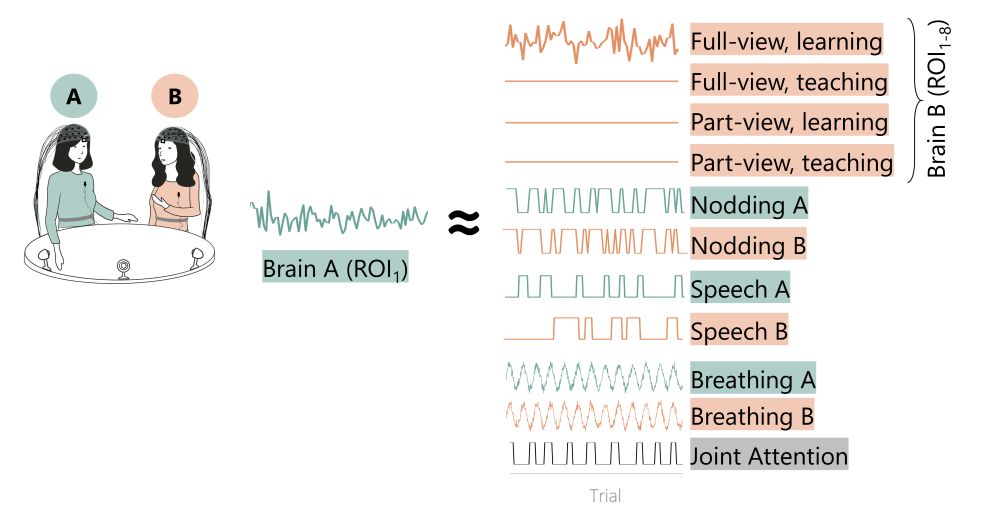
Question 2: Can one person’s brain activity be predicted from their partner’s behaviour and neural signals? Here we used a xGLM to model each individual’s activation as a function of self and partner’s gaze, speech, head-movement and physiology & partner's neural data.
23.07.2025 10:30 — 👍 1 🔁 0 💬 1 📌 0These findings suggest that different social behaviours engage distinct patterns of brain-to-brain coupling that support learning through different cognitive dynamics.
23.07.2025 10:30 — 👍 2 🔁 0 💬 1 📌 0