Intrigued by how microbes spread, evolve, and shape our world, students at the Science Discovery Camp 2025 got a hands-on glimpse into the unseen.
At SCELSE, participants explored the real-world impact of microbial science and how microbial systems influence health and the environment.
SCELSE PI and NTU Assoc Prof Rebecca Case, along with her research team, welcomed the students. Dr Clarence Sim and undergrads from the Case Lab—Lionel Ng, Johnson Lim Jin Hui, Isabella Tiaras Cheng Xue En, and Khoh Yek How—led an open forum on starting their microbial journey, followed by a tour of SCELSE’s research labs and facilities.
They also played Lockdown!, a card game created by SCELSE PI and NUS Assoc Prof Yann Boucher, which simulates pandemic response and global cooperation.
Kudos to NTU College of Science for bringing together curious young scientists and making this event such a success.

Microbes in action! Students at Science Discovery Camp 2025 explored microbial science at SCELSE, toured labs, and played Lockdown!, a pandemic-themed card game. Kudos to NTU College of Science! 📍18–20 Jun 2025 | NTU
🔗 blogs.ntu.edu.sg/science/2025/07/28/science-discovery-camp-2025/
29.07.2025 08:11 — 👍 0 🔁 1 💬 0 📌 0

Thank you Prof Doralyn Dalisay (University of San Agustin, Philippines) for delivering a SCELSE Seminar on “Natural Product Discovery from Philippine Biodiversity: Advancing Therapeutic Leads and Biotechnological Applications.”
Prof Dalisay shared how her team investigates bioactive compounds from marine sediment-derived actinomycetes and ethnobotanically significant plants such as pigeon peas, turmeric, ginger, tawa-tawa, and Philippine honey. Since 2017, their research has yielded prototype products and early-stage technologies in therapeutics, functional foods, and cosmeceuticals, advancing discoveries from the laboratory to the market.
“I was deeply impressed by Prof. Dalisay’s work on discovering new bacteria with antibiotic potential from the Philippine seas, showing how groundbreaking science can emerge from countryside cities like Iloilo. This resonated with me personally, as I also began my scientific journey in a countryside city in Argentina, reminding us that world-class innovation in microbiology is not confined to global hubs, but can thrive wherever curiosity meets dedication.” – Dr Ezequiel Santillan, SCELSE Snr Research Fellow.
📅 Thu, 21 Aug 2025
📍 SBS TR+6 (SBS-01n-26), NTU
Thank you Prof @Doralyn Dalisay for the SCELSE Seminar on “Natural Product Discovery from Philippine Biodiversity”. Her team advances discoveries from lab to market—antibiotics, therapeutics & more—showing innovation can thrive anywhere.
22.08.2025 07:40 — 👍 3 🔁 1 💬 1 📌 0

Don't miss out on the 3rd West Pacific Marine Biology Symposium @ UQ Brisbane, 25–28 Nov.
Reg & abstracts open: tinyurl.com/wpmbs2025
Early-bird regos now extended to 14 Oct, so you can still secure discounted registration rates!
@cnrs.fr
@cnrsbiologie.bsky.social
UQ Centre for Marine Science
30.09.2025 05:35 — 👍 0 🔁 4 💬 0 📌 0
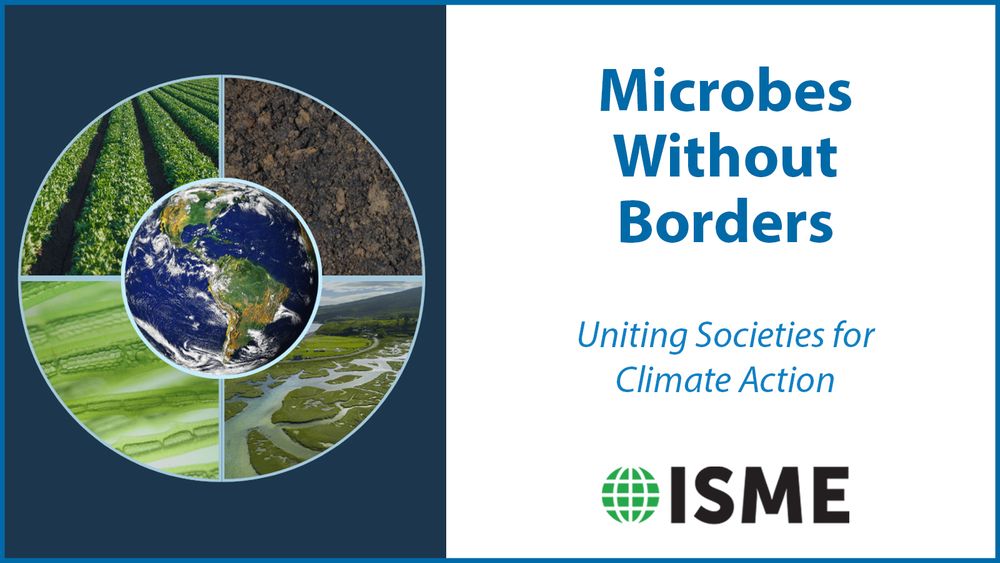
Ten microbiology organizations have come together to develop a global strategy to integrate microbial science into climate solutions. ISME is proud to stand alongside these partners in shaping this roadmap.
Read more: isme-microbes.org/microbes-wit...
#MicrobialEcology #ClimateAction
25.09.2025 12:01 — 👍 14 🔁 5 💬 1 📌 0
Missed SCELSE Open House 2025? Catch the highlights in this 2-min video below. And look out for next year's Open House in Aug 2026! #SCELSE #SCELSEImpact #OpenHouse2025 #Microbiome #Biofilm
18.09.2025 07:26 — 👍 0 🔁 1 💬 0 📌 0

Iron-respiring microbes could have a role in sulfur cycling
A species of bacteria grows when both ferrihydrite and sulfide are present, but not when either is absent.
Nice summary from Songcan & Marc 🙏 on our discovery of a new microbial energy metabolism 🦠 🧫 ⚡ 🔌
Microbial Iron oxide respiration coupled to Sulfide Oxidation (MISO)
@nature.com Research Briefing 😍 doi.org/10.1038/d415...
📰 Original paper www.nature.com/articles/s41...
#microsky #microbiomesky
11.09.2025 08:14 — 👍 27 🔁 14 💬 0 📌 1

Frontiers | The Bacterial Symbiont Phaeobacter inhibens S...
Marine microbes form host-associated biofilm communities ...
The Bacterial Symbiont Phaeobacter inhibens Shapes the Life History of Its Algal Host Emiliania huxleyi - @FrontMarineSci https://ift.tt/2LCV412
29.05.2018 10:06 — 👍 1 🔁 2 💬 0 📌 0

📣 Ready to lead your own lab? NTU Singapore's Nanyang Assistant Professorship offers a 100% paid salary & a S$2.75M start-up package. We're visiting the US this Sept to recruit top talent. Meet us in NYC, Boston & more! #FacultyJobs #TenureTrack
Register HERE: lnkd.in/gSy5qpA7
27.08.2025 03:24 — 👍 10 🔁 21 💬 1 📌 0

Your research future starts at NTU Singapore! We're recruiting for fully-funded PhDs & prestigious Postdoc fellowships. Join our info sessions across the US this Sept to learn more about launching your career at a world-class university. #PhD #PostdocJobs
Register 👇
forms.office.com/r/HYfKgmcAa0
02.09.2025 11:46 — 👍 8 🔁 10 💬 0 📌 1
Globetrotter 🌏 and Algae enthusiast doing Postdoc @Mueller-Cajar lab, NTU Singapore 🇸🇬
PhD Candidate at UC Berkeley studying Bacterial Methylotrophic Metabolism and Interactions
A new home for Australian Centre for Ecogenomics comms. Glad to be here. Posts to come.
As seen on twitter: ace_uq
Follow us for coral reef related news, career postings, academic opportunities and more | We are a network of coral professionals and early career scientists
Professor who studies evolution with a focus on marine ecosystems. We aim to turn science into products of use to society.
PhD candidate | Microbial genomics and evolution | Coral reef benthic microbiome | #Symbiodiniacae | TeamCX | Australian Centre for Ecogenomics @ace-uq.bsky.social | Australia
Senior Scientist of Coastal and Marine Ecology Division at GUIDE. Oceanography and Marine biologist.
Horizon Europe project harnessing the marine microbiome. Grant Agreement 101082304. Additional funding SERI: 22.00384 & UKRI: IFS 10061678; 10055633; 10057167.
Empowering impact makers with mission-critical insights. Together, we advance human progress and build global connections.
We like to look at bacteria do the things they do. Université de Montréal.
Microbiologist at Indiana University. We study the convergence of surface attachment, biofilm formation, genomics and virulence in bacteria.
marine biologist & polar researcher | music, scuba diving & SciComm
PostDoc @SunagawaLab | Bacterial physiology | Phototroph-heterotroph interactions | Coral models
https://micro.biol.ethz.ch/people/person-detail.MzM1Mjk4.TGlzdC8xMDU0LDI3NjU3NTY0MA==.html
We investigate the chemical communication between different organisms - plants, insects and microbes - in Jena, Germany.
Highlights and sharing of the science and research from the Tara Oceans expeditions.
Publication list: https://t.co/TCbLXqT0oE
Prof Lindsay Hall’s research group at University of Birmingham & Quadram Institute. Early life microbiota (we love Bifidobacterium!), and influence of diet, host and pathogens.
The Earth BioGenome Project (EBP), a moonshot for biology, aims to sequence, catalog, and characterize the genomes of all of Earth's eukaryotic biodiversity over a period of ten years.
🌲Keep up with all EBP updates: https://linktr.ee/earthbiogenomeproject
Professor, USC Marine and Environmental Biology, microbe hunter. he/him. Not a bot. thethrashlab.com
Rédacteur multimédia/Multimedia Writer. #océans, #environnement, #musique, #espace, #nouvellestechnologies, #histoire et #archéologie...
Nature Communications is an open access journal publishing high-quality research in all areas of the biological, physical, chemical, clinical, social, and Earth sciences.
www.nature.com/ncomms/