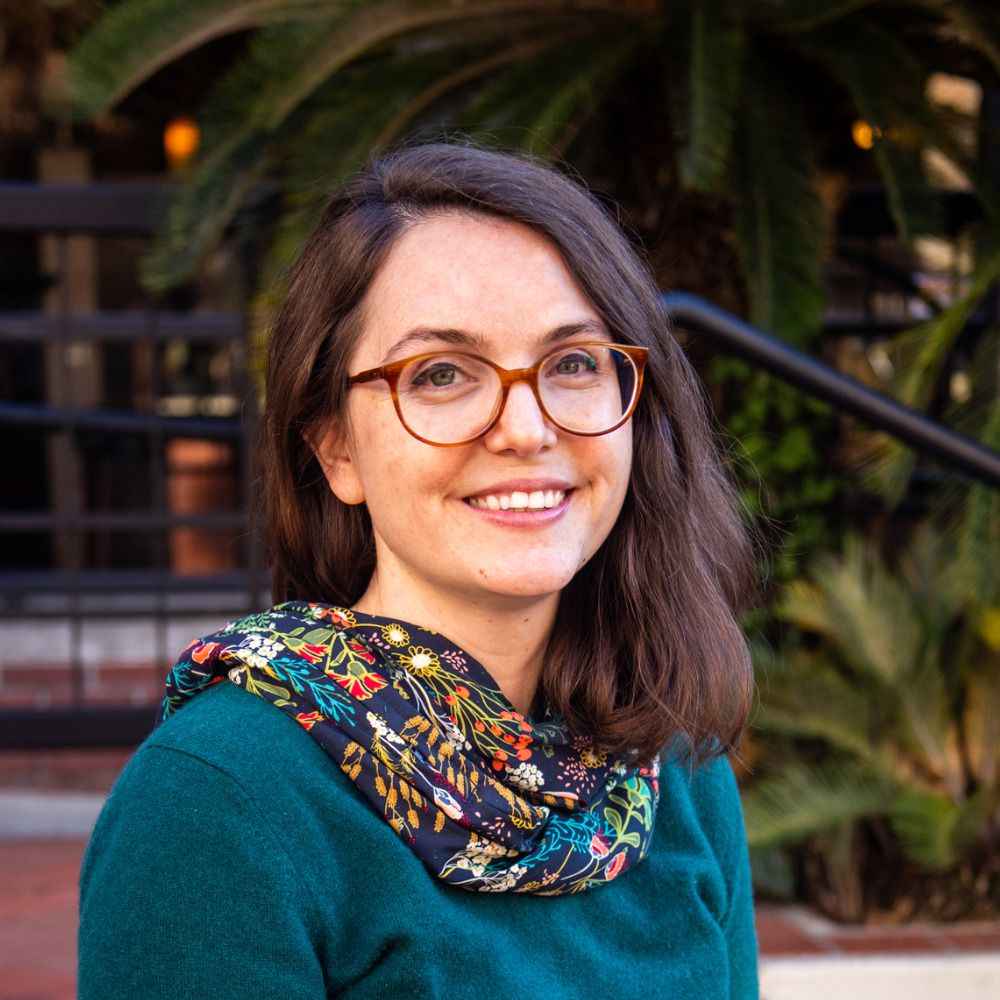
The Mongue lab at a conference last year.
This is the biggest project in my lab so far and wouldn't have been possible without help from lab members and collaborators @tliesenfelt.bsky.social @erincpow.bsky.social @kkbugtime.bsky.social
And my former postdoc adviser @laurarossevo.bsky.social for introducing me to scales. Thank you!!
7/7
17.02.2026 03:55 — 👍 0 🔁 0 💬 0 📌 0
For starters, there's not "one weird trick to ditch your X." There are multiple paths to sex determination turnover.
To read more about it, including what genes were gained or lost and how the genome looks in X chromosome scales, check out our preprint:
www.biorxiv.org/content/10.6...
6/n
17.02.2026 03:55 — 👍 0 🔁 0 💬 1 📌 0

Synteny across loss of X sex determination for paternal genome evolution. Colored bars next to species are chromosomes with individual colored lines tracking gene conservation between species. Where applicable, the X is the leftmost chromosome and highlighted with a dashed box.
The other loss, for PGE, is very different. Here, the X is basically intact across the transition and for several PGE groups. The biggest rearrangement only happens in true mealybugs, Pseudococcidae. In other words, the X chromosome seemed to be supplanted not lost. What does it all mean? 5/n
17.02.2026 03:55 — 👍 0 🔁 0 💬 1 📌 0

Synteny across loss of X sex determination for simultaneous hermaphroditism. Colored bars next to species are chromosomes with individual colored lines tracking gene conservation between species. Where applicable, the X is the leftmost chromosome and highlighted with a dashed box.
Next, we explored genomic changes across transitions. Starting with the hermaphrodites we found that the X fused to one of the 2 massive autosomes and gene order became more shuffled within and between chrs. Weirdly, the decrease in chromosome number precedes the turnover and may help enable it? 4/n
17.02.2026 03:55 — 👍 0 🔁 0 💬 1 📌 0

Maximum likelihood phylogeny of scale insects colored by sex determination system. Tips with a * are newly sequenced draft genomes, those with an illustration are new chromosome level assemblies.
First, we reconstructed a big phylogeny of scale insects based on ~1500 genes. We found X sex determination is ancestral (and some scales still use it!) and there have been
2 independent losses of the X, once in the hermaphrodites and again in the paternal genome eliminating clade. 3/n
17.02.2026 03:55 — 👍 0 🔁 0 💬 1 📌 0
We've known for 50+yrs that these alternative reproductive systems exist, but not really how they relate to the more mundane X sex chromosome system of other Hemiptera. So my lab sequenced 17 species of scale insects, getting five of those to chromosome level to explore. 2/n
17.02.2026 03:55 — 👍 0 🔁 0 💬 1 📌 0

An unknown scale insect from Costa Rica.
I'm back with another weird scale insect repro study. Previously I've talked about the simultaneous hermaphrodite cottony cushion scales and (functional) haplodiploidy paternal genome elimination in mealybugs. But how did these systems evolve? The Mongue lab has some answers! 1/n #genomics
17.02.2026 03:55 — 👍 2 🔁 0 💬 1 📌 0

U.S. government has lost more than 10,000 STEM Ph.D.s since Trump took office
A Science analysis reveals how many were fired, retired, or quit across 14 agencies
The US government lost more than 10,000 STEM PhDs last year, according to an analysis by Science of newly released OPM data, with 11 departures for every hire. And many OPM calls "voluntary" separations were probably pushed. www.science.org/content/arti...
27.01.2026 01:28 — 👍 356 🔁 261 💬 16 📌 33
ICE agents killed a man and are disappearing the witnesses.
24.01.2026 16:50 — 👍 2491 🔁 1233 💬 21 📌 20

This line graph illustrates the percentage change in agency staff levels from the previous year for nine major U.S. federal scientific and health organizations between the fiscal years 2016 and 2025. The agencies tracked include the CDC, Department of Energy, EPA, FDA, NASA, NIH, NIST, NOAA, and NSF. For the majority of the timeline between 2016 and 2023, the agencies show relatively stable fluctuations, generally staying within a range of +5% to -5% change per year. However, there is a dramatic and uniform plummet starting in the 2024–25 period. Every agency depicted shows a sharp downward trajectory, with staffing losses ranging from approximately -15% to over -25%. The Environmental Protection Agency (EPA) shows the most significant decline, dropping to roughly -26%, while the National Institute of Standards and Technology (NIST) shows the least severe but still substantial drop at approximately -15%.
This is the most astonishing graph of what the Trump regime has done to US science. They have destroyed the federal science workforce across the board. The negative impacts on Americans will be felt for generations, and the US might never be the same again.
www.nature.com/immersive/d4...
20.01.2026 22:53 — 👍 14463 🔁 8336 💬 91 📌 767
Character displacement!
19.01.2026 15:53 — 👍 2 🔁 1 💬 0 📌 0
Molecular lab representation: Congratulations to One Battle After Another for all the Golden Globe wins, making it the highest profile movie in which people anxiously wait for the results of a gel electrophoresis run (...even if they skipped the PCR amplification).
12.01.2026 16:31 — 👍 4 🔁 0 💬 0 📌 0
This story is absolutely wild. Did you know that avocados change sex over the course of a day? And that it's controlled by a single ancient balanced polymorphism? This is flat our crazy
25.12.2025 06:33 — 👍 212 🔁 78 💬 5 📌 9
Love some good Caligidae!There's plenty of genomic data from salmon lice that let us do a sex chromosome evolution analysis without having to sequence a single thing. Salmon lice are in the Z chromosome club with birds and butterflies!
doi.org/10.1093/evol...
14.12.2025 13:56 — 👍 7 🔁 1 💬 0 📌 0
Haha well this is our NSF funded project!
And yeah she will mate and lay eggs in the bag, then kind of flop out and die. Neither sex feeds as adults and they live for a couple of days at most at that point!
09.12.2025 21:40 — 👍 1 🔁 0 💬 1 📌 0
Thanks @laurarossevo.bsky.social !!
09.12.2025 18:33 — 👍 0 🔁 0 💬 0 📌 0

Conservation of sperm proteins across Lepidoptera. Proteins in the blue subsets are found in fertilizing sperm, those in red are from non-fertilizing sperm, and those found in both are at the overlap. Orthologous evergreen bagworm sperm proteins come (almost) entirely from the fertilizing and shared subsets.
To explore this, we've done genomics, proteomics, and a bit of cytogenetics on the evergreen bagworm.
The one sperm type looks basically like fertilizing sperm, but with some differences from other lep sperm proteomes, like a lack of proteases to break apart bundled fertilizing sperm.
09.12.2025 13:41 — 👍 4 🔁 0 💬 1 📌 0

A grub-like female and two male evergreen bagworms.
But we're most interested in the adults. In this pic, the grub-like insect is an ADULT female bagworm(!!). The males look like normal moths...extreme sexual dimorphism!!
We're studying how this evolved, but that's another story. Today I want to highlight their sperm biology.
09.12.2025 13:41 — 👍 6 🔁 0 💬 1 📌 0
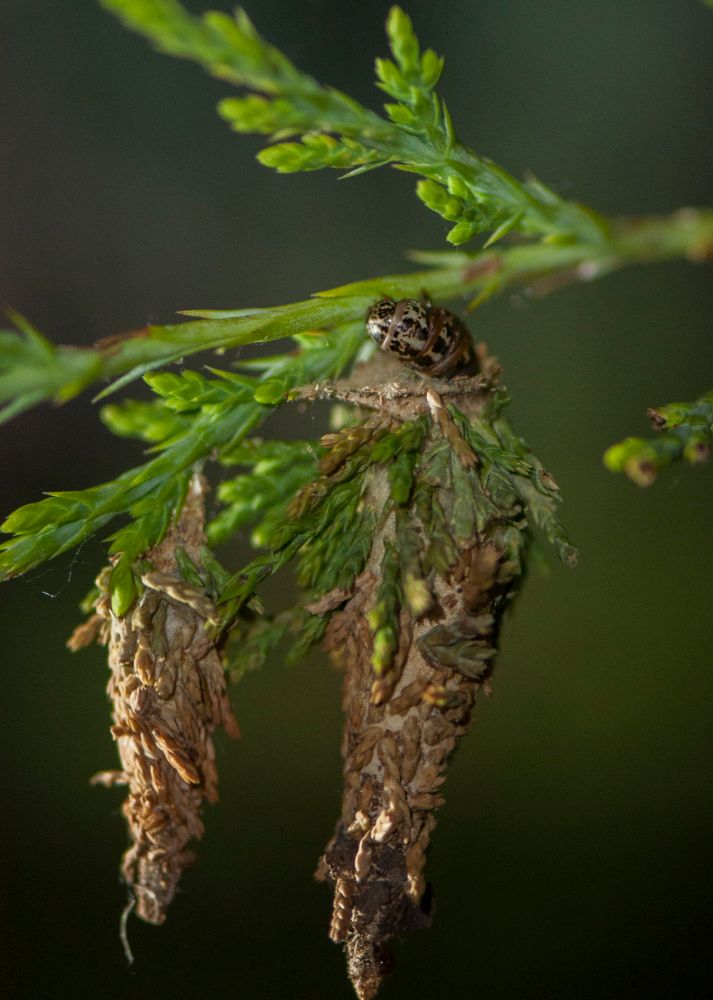
Two evergreen bagworms feeding

One abbot's bagworm hanging out
Pre-print and weird repro thread time!
I've posted here about scale insects a lot, but ~half of my research is on Lepidoptera. My lab is developing bagworm moths (Psychidae) as models for comparative genomics.
You probably know them like you see in the pics below: caterpillars that make cases.
09.12.2025 13:41 — 👍 19 🔁 6 💬 2 📌 1
Congrats, a great milestone!!
24.11.2025 15:03 — 👍 1 🔁 0 💬 0 📌 0
Aha, beat me to it with the classic, good choice!
22.11.2025 15:45 — 👍 2 🔁 0 💬 0 📌 0

A pedantic penguin very much not helping the cause.
This thread needs the Bible...the Perry Bible Fellowship.
22.11.2025 15:44 — 👍 101 🔁 1 💬 1 📌 0

A male Icerya purchasi at rest

A hermaphrodite cottony cushion scale upside down on a leaf.
Talk about a life list critter, I've finally found a male cottony cushion scale insect (pic 1)!!
Male scale insects are rare in general but this species is composed almost entirely of simultaneous hermaphrodites (pic 2)! Rare pure males can occur, but we don't fully know under what conditions.
14.11.2025 20:42 — 👍 21 🔁 3 💬 1 📌 0
Mongue lab members at ESA.
The now traditional Mongue lab and alums photo from #EntSoc25. Crazy how much the lab has grown in two years!
10.11.2025 22:19 — 👍 5 🔁 1 💬 0 📌 0

A Manduca sexta adult specimen, pinned in a drawer at the Harvard Museum of Natural History

A desert landscape. Large Saguaro cacti are in the foreground. Rugged mountains in the background.

A large Datura flower with a moth inside it drinking nectar
I'll be heading to @sacnas.bsky.social #NDiSTEM later this week to shamelessly plug my soon-to-open lab (Fall 2026). If any students are interested in studying the plant-insect interactions of the Sonoran Desert, please get in touch!
28.10.2025 21:21 — 👍 22 🔁 12 💬 1 📌 0
New preprint! We unexpectedly discovered that some Caenorhabditis species delete parts of their somatic genome early in development, which fragments their chromosomes and eliminates key germline genes. Multiple lines of evidence suggest this bizarre process was present in the ancestors of C. elegans
28.10.2025 12:11 — 👍 49 🔁 17 💬 0 📌 0
I can definitely see that!
13.10.2025 21:25 — 👍 0 🔁 0 💬 0 📌 0
the answer to your question is someone thought it would be cheaper to do it that way
“He’s just this guy, ya know”
Former Neuroscientist who traveled along I-75.
focused on biomed fellowships & trainee development.
Husband, dad x 4,🏊♂️ 🚴 🏃♂️🏋️♂️🍺🥃
Opinions my own, Reposts not endorsments
Ph.D student at UF, Entomology, interested in answering questions about evolutionary patterns in insects, with emphasis on microlepidopteran "dark taxa". AKA: I love moths!
Journalist, writer, former member of the Six Heartbeats. Championship-level spades player. ContrabandCamp.com founder. Author of NY Times bestseller: Black AF History: The Unwhitewashed Story of America.
A wiki about cut, unused, and debug content left in video games, as well as things like localization differences and revision changes. https://tcrf.net - Support us on Patreon! https://www.patreon.com/tcrfwiki
I am the host of Behind the Bastards and overlord of podcasts at Cool Zone Media
Guidebook author, TV & radio host, business owner, Lutheran, and NORML Board Member. Fanatically positive and militantly optimistic.
Evolutionary ecologist interested in early-life and parental effects, climate change, infectious diseases. Likes insects, theory and comparative studies.
Leads EVE lab, Bristol UK www.evelab.org
UKRI Future Leaders Fellow, academic mama, from Zimbabwe
Postdoc at OIST, Okinawa 🌊🪸🐠
Insect–microbe mutualism, systematics and the evolution of scale insects
Entomologist specializing in parasitoid wasps and dark taxa. Leiden, Netherlands.
The real jbouie. Columnist for the New York Times Opinion section. Co-host of the Unclear and Present Danger podcast. b-boy-bouiebaisse on TikTok. jbouienyt on Twitch. National program director of the CHUM Group.
Send me your mutual aid requests.
i write the data-driven politics newsletter Strength In Numbers: gelliottmorris.com/subscribe
wrote a book by the same name wwnorton.com/books/Strength-in-Numbers
polling averages at @fiftyplusone.news
formerly @ 538 & The Economist. email, don't DM, me
Asst. Curator of Entomology @nhm.org | evolution, genomes, museums | @cornelluniversity.bsky.social & New College of Florida alumna | she/her. | views are my own.
mbarkdull.github.io
Official account of the World Association of Copepodologists (WAC) | Message/tag us @copepodology for shares | https://www.monoculus.org/
Entomology MS Student at the University of Florida focusing on Insect Genomics
Biostatistician • Associate Prof @ Wake Forest University • former postdoc @ Hopkins Biostat • PhD @ Vandy Biostat • 🎙 Casual Inference • lucymcgowan.com