Google suggests the Congo is the world's largest #peatland. This is wrong!
For details of the world’s largest peatland complexes, & as a ref for anyone wanting to avoid error-ridden AI search tools, I have manually searched the available literature. See Peatpedia for the results: lnkd.in/gTi32rGX
13.12.2025 17:03 — 👍 11 🔁 3 💬 0 📌 0

New in AGU Advances: a community vision for a sustained, actionable greenhouse gas observing system. We highlight how tighter integration of top-down and bottom-up approaches can sharpen attribution and bring carbon information closer to management scales.
doi.org/10.1029/2025...
#GHG #Carbon
13.12.2025 18:24 — 👍 6 🔁 4 💬 0 📌 0
We are indeed!!!
11.12.2025 22:57 — 👍 1 🔁 0 💬 0 📌 0
Our whole @carbonique.bsky.social project team got spoilt by Santa this year 😅
11.12.2025 22:40 — 👍 7 🔁 1 💬 2 📌 0

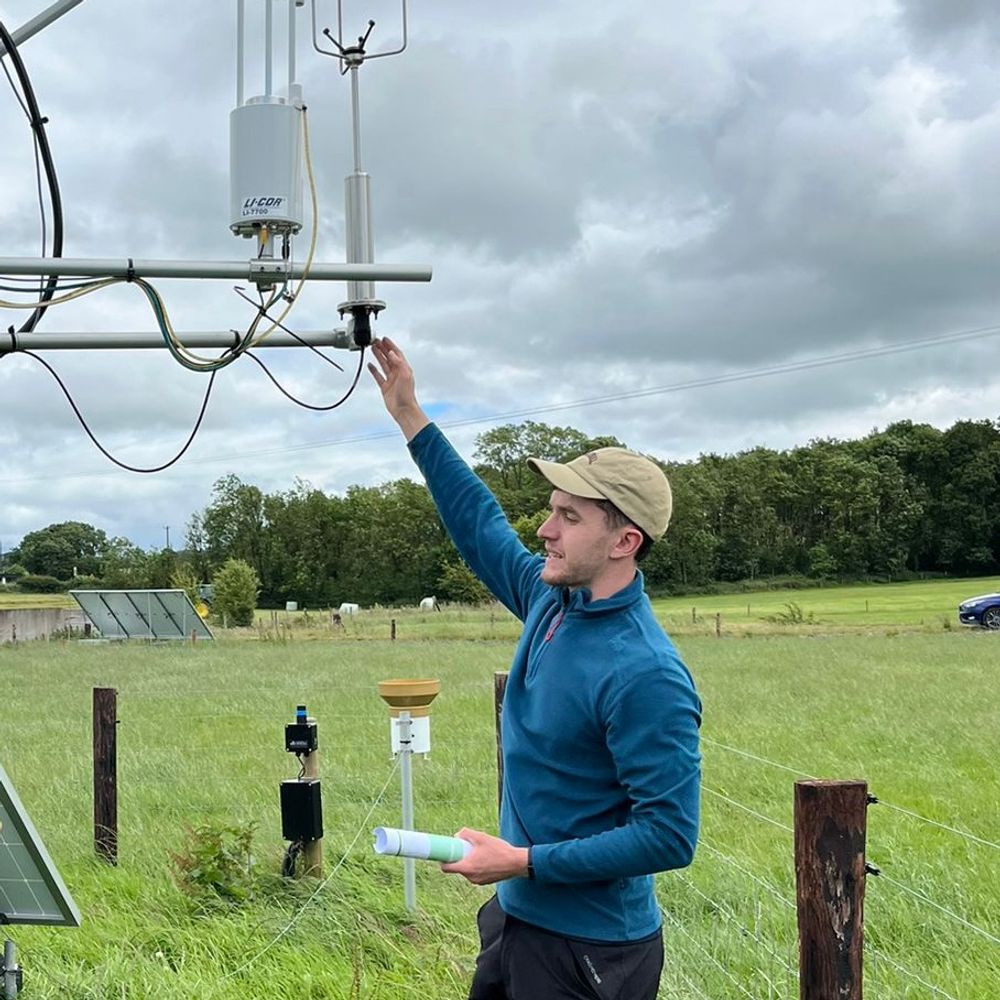
Christmas came early - a shiny new toy!
@li-corenv.bsky.social
11.12.2025 18:02 — 👍 17 🔁 1 💬 1 📌 1

2025 #NobelPeatPrize (Outreach)
Peat Colours!
The “Tracking the Colours of Peatlands” outreach and citizen science initiative explores and communicates peatland science through peat pics.
Congrats @wetlandresilienceresearchgroup.com
The #NobelPeatPrize (McMaster) will be announced Dec 10th.
09.12.2025 04:17 — 👍 26 🔁 6 💬 1 📌 1
This is another flux tower we installed this spring/summer for the @carbonique.bsky.social project. This time the tower was installed on a floating platform in a restored marsh near Baie-du-Febvre.
Thank you to my colleague Léonie @cpaleolab.bsky.social for putting together this video 💚
10.12.2025 16:50 — 👍 6 🔁 3 💬 0 📌 0
What a fun day in the field scouting a new site for our research project 💚
02.12.2025 18:39 — 👍 4 🔁 0 💬 0 📌 0
So excited #PEATcalendar is back for 2026! 🎉
Look at all the animals and critters you can find in a peatland 🐻🐍🦆🦡🕸️
The sea urchin might be a bit surprising? Get a calendar to learn how it ended up in a peatland.
Thanks to everyone who contributed photos for the calendar! #PeatECR #PeatSky
29.11.2025 20:23 — 👍 11 🔁 2 💬 0 📌 0
Woo! #PeatPics got nominated for the Nobel Peat Prize!
27.11.2025 20:52 — 👍 15 🔁 1 💬 0 📌 1
The Conversation article that @avnimalh0tra.bsky.social and I wrote about the PeatPic Project and the power of harnessing people, community science and the importance of research networks is now online too
theconversation.com/harnessing-t...
#Peatlands #PeatColour
14.10.2025 17:18 — 👍 29 🔁 11 💬 0 📌 2


🚨New Paper 🚨
The PeatPic Project: Predicting plot-scale green leaf #phenology across #peatlands
So happy to see this paper online — one of my favourite projects!
We explored how to capture how peatlands change colour using smartphones and community science!
iopscience.iop.org/article/10.1...
13.10.2025 12:29 — 👍 32 🔁 13 💬 2 📌 3
Does anyone have any good resources (or their own examples) for how to make a good scientific poster to share with students.
Please RT!
20.09.2025 17:38 — 👍 2 🔁 6 💬 2 📌 0
Better Posters
A blog to improve poster presentations.
I have the Better Posters (betterposters.blogspot.com) book in my office if you want to have a look at it on Monday.
20.09.2025 18:45 — 👍 0 🔁 0 💬 1 📌 0

#ExcitingNews! Austria has designated Peatlands in Styrian Salzkammergut as its 25th #RamsarSite. The Styrian Salzkammergut is a region in the Alps, between the Totes Gebirge mountain range and the Styrian Dachstein plateau.
@bmimi.gv.at
www.ramsar.org/news/austria...
01.09.2025 07:48 — 👍 15 🔁 4 💬 0 📌 0

Greenhouse Gas Mitigation Potential of Temperate Fen Paludicultures
📄 buff.ly/APdzmb9
11.08.2025 16:59 — 👍 1 🔁 3 💬 0 📌 0
If you’re a ECR and are keen to be part of the peatlands and wetlands community in the UK (and beyond!) - please think about joining our committee and helping us grow!
We have momentum now but we need it to continue!
20.08.2025 12:48 — 👍 10 🔁 8 💬 1 📌 0
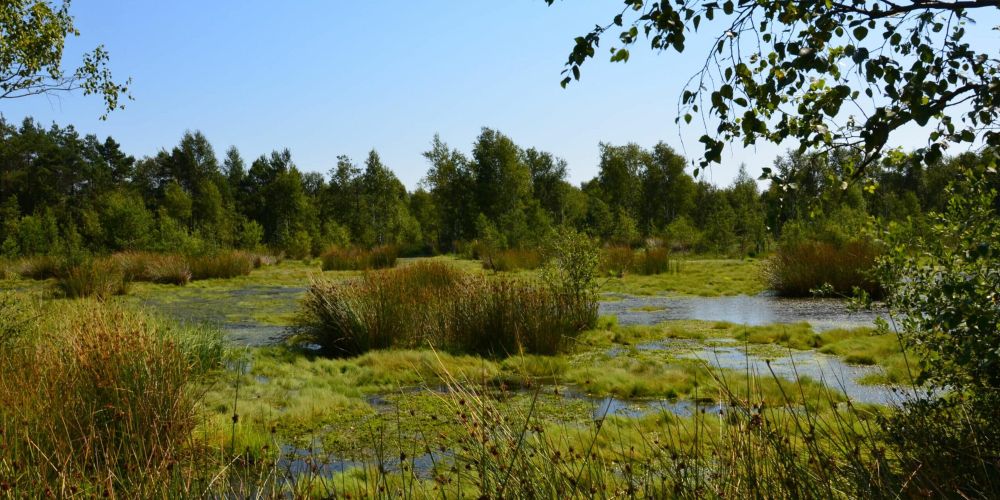
Of Microbes and Mires: What the Diet of Bacteria Has to Do With the Global Climate - ECH
Peatlands are powerful carbon sinks - if we let them stay intact. New research from ECH members shows how wetland farming - magic word: paludiculture - and microbial life can work together to reduce e...
What does the diet of bacteria have to do with the global climate? 💭🌍
Peatlands are powerful carbon sinks – if we let them stay intact. New research from ECH members shows how wetland farming – #paludiculture – and microbial life can work together to reduce #emissions without sacrificing land use. 🦠
01.08.2025 08:33 — 👍 8 🔁 7 💬 1 📌 0
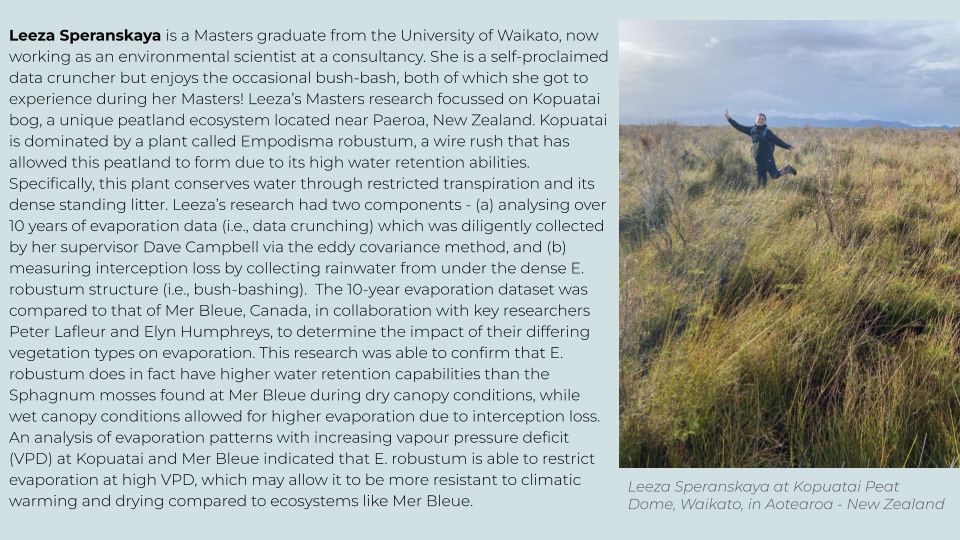
Leeza Speranskaya is a Masters graduate from the University of Waikato, now working as an environmental scientist at a consultancy. She is a self-proclaimed data cruncher but enjoys the occasional bush-bash, both of which she got to experience during her Masters! Leeza’s Masters research focussed on Kopuatai bog, a unique peatland ecosystem located near Paeroa, New Zealand. Kopuatai is dominated by a plant called Empodisma robustum, a wire rush that has allowed this peatland to form due to its high water retention abilities. Specifically, this plant conserves water through restricted transpiration and its dense standing litter. Leeza’s research had two components - (a) analysing over 10 years of evaporation data (i.e., data crunching) which was diligently collected by her supervisor Dave Campbell via the eddy covariance method, and (b) measuring interception loss by collecting rainwater from under the dense E. robustum structure (i.e., bush-bashing). The 10-year evaporation dataset was compared to that of Mer Bleue, Canada, in collaboration with key researchers Peter Lafleur and Elyn Humphreys, to determine the impact of their differing vegetation types on evaporation. This research was able to confirm that E. robustum does in fact have higher water retention capabilities than the Sphagnum mosses found at Mer Bleue during dry canopy conditions, while wet canopy conditions allowed for higher evaporation due to interception loss. An analysis of evaporation patterns with increasing vapour pressure deficit (VPD) at Kopuatai and Mer Bleue indicated that E. robustum is able to restrict evaporation at high VPD, which may allow it to be more resistant to climatic warming and drying compared to ecosystems like Mer Bleue.
PeatECR Bio Series #1 - just in time to introduce our first featured bio in for July 2025 💚
Today we introduce Leeza Speranskaya, a recent MSc graduate, focusing on evaporation dynamics in restiad peat bogs. Connect with Leeza here:
www.linkedin.com/in/leeza-spe...
#PeatECRBioSeries
29.07.2025 23:37 — 👍 13 🔁 5 💬 1 📌 0
PeatECR Bio Series - a monthly spotlight on one researcher/practitioner working in and around wetlands.
If you or someone you know would like to be featured, please email us at peatecr@gmail.com with attention to Rahel Bauerdick, our current coordinator of this series.
Please share far and wide to help us reach more early-career folk around the world!
New Series Alert!💚Welcome to the PeatECR bio series, a monthly spotlight on one early-career researcher/practitioner working in and around wetlands (no discrimination between peatlands and non-peatlands in this case). If you or someone you know would like to be featured, please get in touch with us!
29.07.2025 23:49 — 👍 10 🔁 3 💬 0 📌 0
Wetlands across Canada are indeed great treasures for Canadians and globally. But the push to fast-track 'projects of national interest', incl. critical minerals, puts these important ecosystems at significant risk. A reminder to governments that protecting wetlands is also of national interest.
23.07.2025 20:15 — 👍 8 🔁 1 💬 0 📌 0
In-depth, independent reporting to better understand the world, now on Bluesky. News tips? Share them here: http://nyti.ms/2FVHq9v
PhD Walsh Scholar with Teagasc and Trinity College Dublin. DCU and Maynooth University graduate. Currently working on GHG dynamics in grasslands on organic soils in Ireland.
PhD researcher at University of Plymouth | researching carbon dynamics in wet woodlands | general lover of 🌱🍄 and soil | find me in the 🌊 on my days off
Associate Professor in Plant Biology at Saint Mary's University, Halifax 🇨🇦 | mother, botanist, ecologist, lover of peatlands and other wild things | elliemgoud.com
C'est sympa, ici.
Reporter
Journaliste à Radio-Canada | en mode olympique
Montréal 🖖
👀 linktr.ee/valerieboisclair
✍️ https://ici.radio-canada.ca/profil/24469/valerie-boisclair
Understanding Water and Carbon Cycling across the Pan-American Tropical Peatland Biome | #NSFFunded | #peatsky
PhD student in biogeochemistry working on the impacts of dust and trace elements on ecosystems
Limnology, Biogeochemistry, Hydrometeorology - Water Science and Watershed Management Branch, Government of Manitoba
Assistant Professor University of North Florida | Coastal Resilience, Plant Ecology, Blue Carbon, Climate Change | Views my own | he/him/his
We manufacture the instruments you need to answer questions about plants, the atmosphere, and the environment in general.
www.licor.com
Climate change, environmental monitoring tech, carbon sequestration, climate-smart agriculture, music, outdoor sporting, and cats.
@li-corenv.bsky.social
European research infrastructure providing open & standardised greenhouse gas data for climate action
In those boggy places we measure, define, and change, stop first, and listen💚| PhD candidate at The University of Waikato, Aotearoa - New Zealand | Peatland Restoration Trajectories through the Active-Passive Continuum | In Awe of Soil | She/They
PhD student at the University of Liverpool researching GHG emissions from peatland waterbodies
Official account of the Canadian Geophysical Union, dedicated to promoting and supporting the geosciences in Canada.
The Great Fen project is one of the most exciting habitat restoration projects ever undertaken in Britain. It will create a 3,700 hectare wetland. www.greatfen.org.uk
Lab manager at Geotop (UQAM)
Expert in peatland and wetland studies, carbon cycle and radiochronology
FR/EN