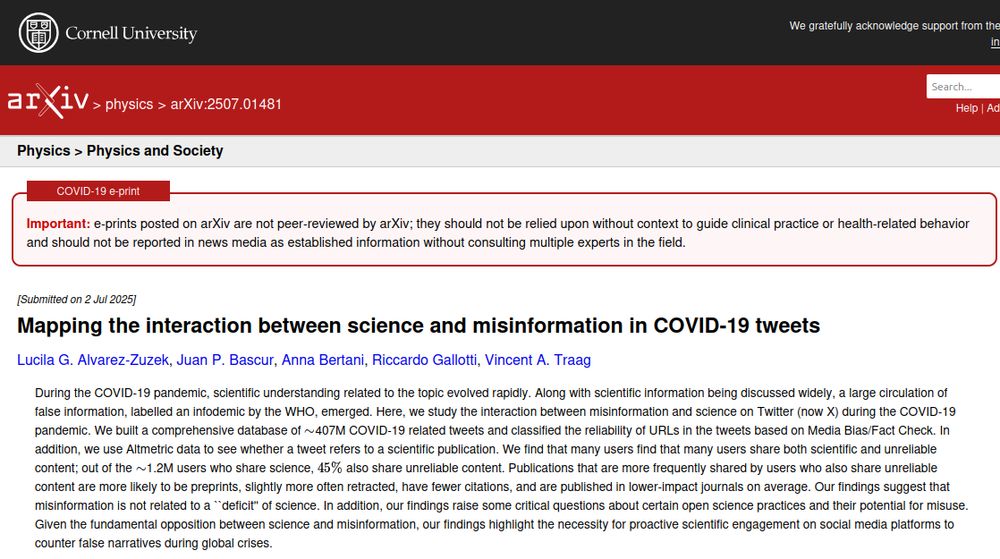
Mapping the interaction between science and misinformation in COVID-19 tweets.
Publication from @luzuzek.bsky.social, Juan Pablo Bascur, @annabertani.bsky.social, @ricgallotti.bsky.social. This project is supported by European Media and Information Fund.
Abstract: During the COVID-19 pandemic, scientific understanding related to the topic evolved rapidly. Along with scientific information being discussed widely, a large circulation of false information, labelled an infodemic by the WHO, emerged. Here, we study the interaction between misinformation and science on Twitter (now X) during the COVID-19 pandemic. We built a comprehensive database of 407M COVID-19 related tweets and classified the reliability of URLs in the tweets based on Media Bias/Fact Check. In addition, we use Altmetric data to see whether a tweet refers to a scientific publication. We find that many users find that many users share both scientific and unreliable content; out of the 1.2M users who share science, also share unreliable content. Publications that are more frequently shared by users who also share unreliable content are more likely to be preprints, slightly more often retracted, have fewer citations, and are published in lower-impact journals on average. Our findings suggest that misinformation is not related to a ``deficit'' of science. In addition, our findings raise some critical questions about certain open science practices and their potential for misuse. Given the fundamental opposition between science and misinformation, our findings highlight the necessity for proactive scientific engagement on social media platforms to counter false narratives during global crises.
New preprint! 🚨
We study the interaction between misinformation and science on Twitter during COVID-19 based on ~407M tweets. Both science and misinformation featured prominently during the pandemic, but the interaction between the two has not been studied on this scale before.
🧵 (1/10)
04.07.2025 10:37 — 👍 102 🔁 40 💬 4 📌 5

Trump administration shuts down federal advisory committee on infection prevention
Trump shuts down #HICPAC, advisory group formed in 1991 to prevent the spread of IDs
www.cidrap.umn.edu/healthcare-a...
Members have expertise in IDs, infection prevention and control, healthcare epidemiology, nursing, public health, and other areas of health and medicine #IDsky #Medsky
08.05.2025 21:26 — 👍 1 🔁 1 💬 0 📌 1

Infectious disease specialists keeping it social on #Bluesky - #IDSky getting some serious use over here!
#MedSky #pedsky #cardiosky #cansky #obgynsky #immunosky #episky #nephsky
08.05.2025 10:28 — 👍 44 🔁 10 💬 4 📌 1
New @thelancet.bsky.social - Treatment options to support the elimination of hepatitis C: an open-label, factorial, randomised controlled non-inferiority trial
www.thelancet.com/journals/lan...
#hepsky #liversky #medsky #idsky
08.05.2025 13:03 — 👍 1 🔁 1 💬 0 📌 0
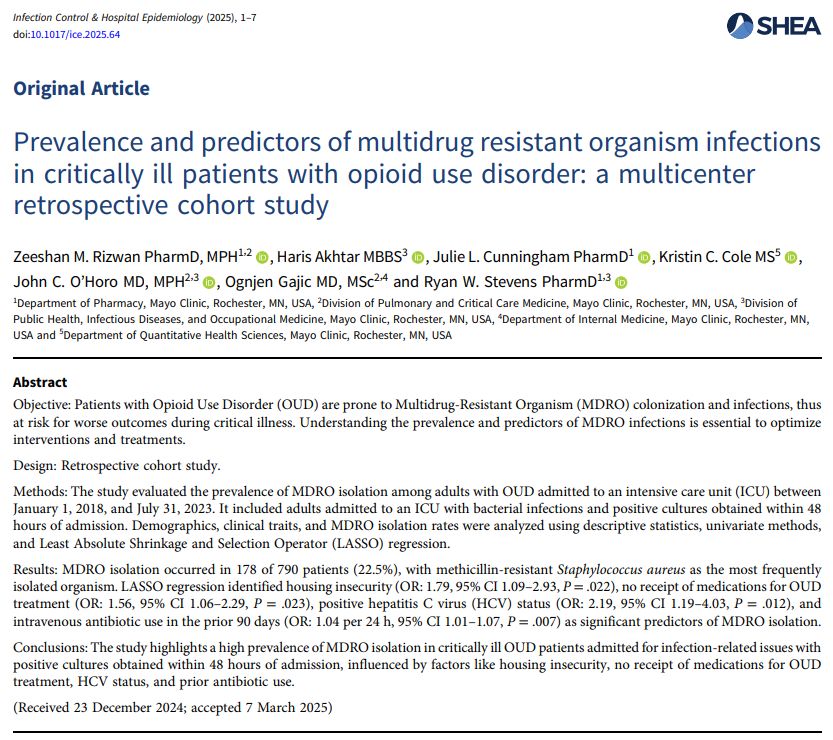
NEW in ICHE:
▶️ Critically ill opioid use disorder (OUD) patients face high MDRO infection rates (22.5%), with MRSA most common
▶️ Key risk factors include housing insecurity, lack of OUD meds, HCV status, and recent IV antibiotic use.
#IDSky
📄: doi.org/10.1017/ice....
08.05.2025 13:40 — 👍 4 🔁 3 💬 1 📌 0
Anyone else calculating the decreased life expectancy we will see in the US in the next decade? #idsky #publichealth
01.05.2025 14:25 — 👍 4 🔁 1 💬 0 📌 0

Could stewardship interventions targeting steroids and PPI prevent HAIs and reduce antibiotic use in hospitals?
This study shows a time- and dose-dependent association between PPI & steroids and the incidence of HAIs: www.journalofhospitalinfection.com/callback?red...
#AMSky #IDsky #IPSky #PharmSky
01.05.2025 14:53 — 👍 6 🔁 2 💬 0 📌 0

Stay tuned for the first @cmicomms.bsky.social & #Breakpoints collaboration episode on Sun, May 4th 6PM US EST/Mon May 5th 12 AM CET. Hosts Angela Huttner & Erin McCreary interview SNAP trial investigators, Steven Tong &Joshua Davis, on PSSA and MSSA domain results shared at 2025 ESCMID Global.
29.04.2025 22:01 — 👍 36 🔁 14 💬 2 📌 0
"An antibiotic with supporting clinical trial data, administered at the right dose, by the right route, at the right time, and for the right duration, along with source control, is preferred."
#IDsky
01.05.2025 17:21 — 👍 5 🔁 1 💬 0 📌 0

Warmer Winters Are Fueling a Surge in Tick-Borne Illnesses
Andrew Lover, MPH, PhD, MS, discusses the shifting landscape of tick-borne illnesses during Tick-borne Disease Awareness Month
Warmer winters are extending tick seasons, spreading Lyme disease to new areas. Dr. Andrew Lover discusses the challenges of tracking tick-borne illnesses and prevention methods. #TickBorneDiseaseAwareness #LymeDisease #IDsky #MEDsky
Listen here: www.contagionlive.com/view/warmer-...
01.05.2025 18:11 — 👍 4 🔁 3 💬 0 📌 1
Don’t forget to register if you haven’t already! 🦠🧫🤓 #IDSky
01.05.2025 22:38 — 👍 2 🔁 2 💬 0 📌 0
 25.09.2025 23:38 — 👍 5 🔁 5 💬 0 📌 0