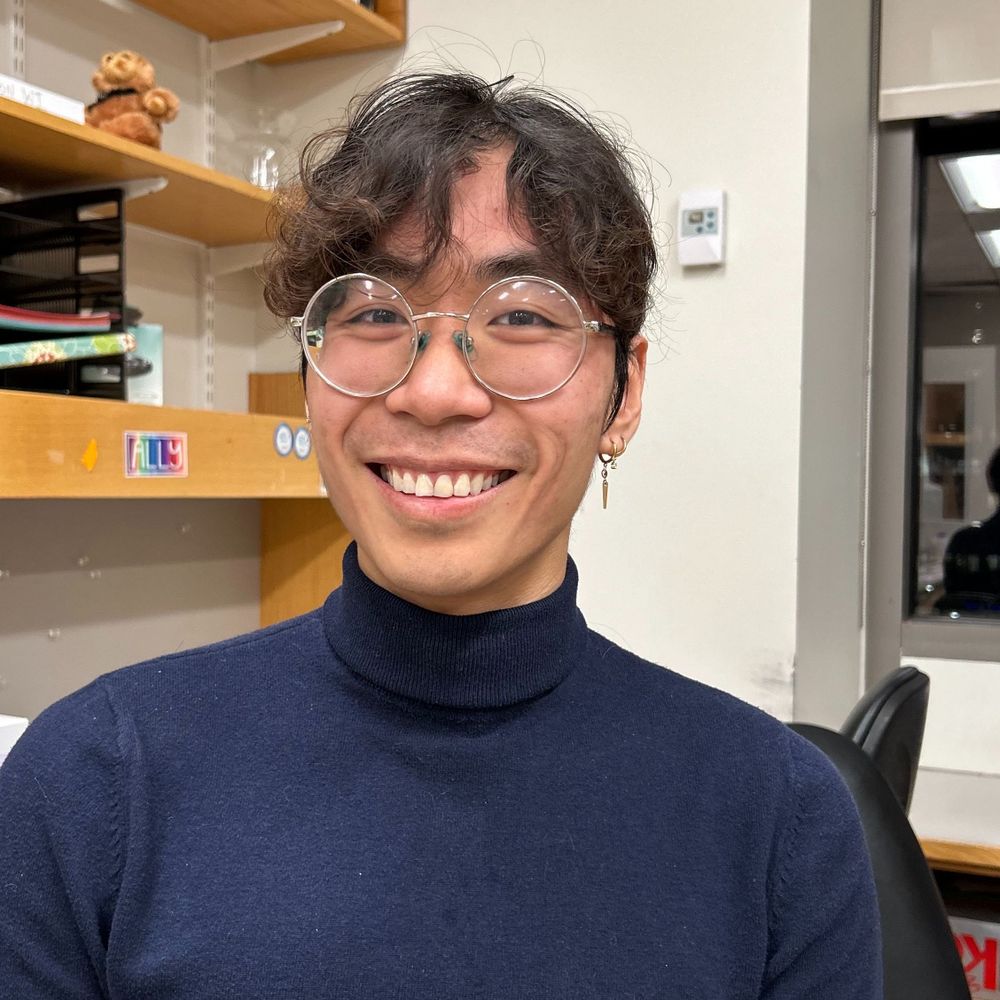
Congratulations to Kate, Hari, and all authors!
11.11.2025 22:39 — 👍 1 🔁 0 💬 0 📌 0
Regulated decay of microRNAs plays a critical role in controlling body size in mammals! Check out our new paper in @genesdev.bsky.social and see thread previously posted with our pre-print 👇 for more info. Congrats to Collette LaVigne, Jaeil Han, and all authors!
genesdev.cshlp.org/cgi/content/...
10.11.2025 17:40 — 👍 19 🔁 8 💬 1 📌 1
Thank you!
21.10.2025 14:37 — 👍 1 🔁 0 💬 0 📌 0
Thank you Davide!
17.10.2025 18:41 — 👍 0 🔁 0 💬 0 📌 0
Thank you Jinfan!
15.10.2025 21:22 — 👍 0 🔁 0 💬 0 📌 0
Thank you!
15.10.2025 14:05 — 👍 1 🔁 0 💬 1 📌 0
Thank you Julius!
15.10.2025 13:58 — 👍 0 🔁 0 💬 0 📌 0
I would also like to thank Claire Lundstrom and He Zhang (not on Bluesky) for their critical contributions to this work.
14.10.2025 22:28 — 👍 0 🔁 0 💬 0 📌 0
Altogether, these findings demonstrate how ‘programmed’ ribosome collisions enable the selective regulation of gene expression and reveal a new mechanism by which the translation machinery senses and responds to stress in order to maintain homeostasis.
14.10.2025 22:28 — 👍 1 🔁 0 💬 1 📌 0
Beyond selenoprotein-encoding transcripts, ribosome collisions occur at defined sites throughout the transcriptome, pointing to broader control of translation by EEF1G-mediated redox sensing.
14.10.2025 22:28 — 👍 1 🔁 0 💬 1 📌 0
Excitingly, Fred identified the elongation factor EEF1G as a key redox sensor that directly slows the rate of translation elongation in response to oxidative stress to decrease ribosome collisions and thereby enhance detoxifying selenoprotein production.
14.10.2025 22:28 — 👍 3 🔁 0 💬 1 📌 0
Using genome-wide CRISPR screens, Fred unexpectedly discovered that the production of selenoproteins is limited by ribosome collisions that occur at inefficiently decoded Sec codons.
14.10.2025 22:28 — 👍 1 🔁 0 💬 1 📌 0
Fred began this study by investigating how cells regulate the incorporation of the non-canonical amino acid selenocysteine (Sec) into polypeptides. Sec is inserted during translation at recoded UGA termination codons and plays a vital role in metazoan redox biology.
14.10.2025 22:28 — 👍 3 🔁 0 💬 1 📌 0

Oxidative stress sensing by the translation elongation machinery promotes production of detoxifying selenoproteins
Selenocysteine, incorporated into polypeptides at recoded termination codons, plays an essential role in redox biology. Using GPX1 and GPX4, selenoenzymes that mitigate oxidative stress, as reporters,...
Colliding ribosomes are potent signals of cellular stress. But do cells use ‘programmed’ ribosome collisions to regulate gene expression? I’m excited to present a new story from my lab led by Frederick Rehfeld(@fred-rehfeld.bsky.social) which revealed that the answer is YES! Read on to find out how👇
14.10.2025 22:28 — 👍 75 🔁 28 💬 1 📌 6
Congratulations @kateodonnell-lab.bsky.social and Shayna!
17.07.2025 21:51 — 👍 3 🔁 0 💬 0 📌 0


#Worm25 Congratulations to Jacob (Ortega) for the Sydney Brenner thesis award!!! Truly a spectacular young scientist! Keep an eye out for him!!
Jacob is a postdoc in Josh Mendell’s lab at UTSW right now.
29.06.2025 03:32 — 👍 71 🔁 9 💬 7 📌 2
Altogether, this study provides a valuable dataset that will facilitate identification of additional mammalian TDMD triggers and establishes the existence of a Plagl1/Lrrc58-mediated TDMD pathway that plays a major role in regulating mammalian body size. /end
02.07.2025 16:17 — 👍 1 🔁 0 💬 0 📌 0
Interestingly, Plagl1 encodes a transcription factor that promotes embryonic growth by transactivating Igf2 expression. This function likely synergizes with the noncoding function of this mRNA in removing the growth suppressing miRNA miR-322 through TDMD.
02.07.2025 16:17 — 👍 1 🔁 0 💬 1 📌 0
We further demonstrate that deletion of the trigger sites in the 3' UTRs of these mRNAs in mice results in miR-322/503-dependent embryonic growth restriction, thereby recapitulating a key aspect of the ZSWIM8-deficiency phenotype.
02.07.2025 16:17 — 👍 0 🔁 0 💬 1 📌 0
But the presumptive triggers that induce TDMD of miR-322/503 have remained elusive until now. We show here that Plagl1 and Lrrc58 are the long-sought trigger RNAs for TDMD of miR-322 and miR-503, respectively.
02.07.2025 16:17 — 👍 0 🔁 0 💬 1 📌 0
miR-322/503 were among the first miRNAs found to have short half-lives (Rissland et al., Mol Cell 2011). Moreover, we showed that a major phenotype in Zswim8 KO mice, embryonic growth restriction, is attributable to upregulation of miR-322/503 (Jones et al., Genes Dev, 2023).
02.07.2025 16:17 — 👍 0 🔁 0 💬 1 📌 0
Here, we applied a method called AGO-CLASH, which enables the detection of bona fide miRNA binding sites across the transcriptome. This revealed the triggers for TDMD of miR-322 and miR-503 in mice. These miRNAs are of particular interest for several reasons.
02.07.2025 16:17 — 👍 0 🔁 0 💬 1 📌 0
Although it is presumed that each of these miRNAs has an associated trigger RNA that activates ZSWIM8-mediated degradation, the identification of TDMD triggers has proven to be a very challenging problem, with only four mammalian trigger RNAs reported to date.
02.07.2025 16:17 — 👍 0 🔁 0 💬 1 📌 0
ZSWIM8 and its orthologs are required for normal development in flies, worms, and mice and, accordingly, many miRNAs are controlled by this mechanism across these species. For example, more than 50 ZSWIM8-regulated miRNAs have been identified in mouse tissues.
02.07.2025 16:17 — 👍 0 🔁 0 💬 1 📌 0
Our lab and the Bartel lab showed that this leads to recruitment of the ZSWIM8 ubiquitin ligase, which ubiquitylates the trigger-bound Argonaute (AGO) protein, resulting in decay of AGO by the proteasome and release and degradation of the associated miRNA.
02.07.2025 16:17 — 👍 0 🔁 0 💬 2 📌 0
In recent years, TDMD has emerged as a major mechanism that is critical for controlling microRNA (miRNA) expression during development in diverse metazoans. TDMD is activated when a miRNA binds to a specialized target RNA, referred to as a ‘trigger RNA’.
02.07.2025 16:17 — 👍 0 🔁 0 💬 1 📌 0
Congratulations Joana! This is fabulous work.
04.04.2025 21:19 — 👍 3 🔁 0 💬 1 📌 0
Special thanks to Tu Dan, He Zhang, Yujing Cheng, Frederick Rehfeld, and Jim Brugarolas for their critical contributions to this work and to @hhmi.org, NIH/NCI, CPRIT, and @thewelchfoundation.bsky.social for their essential and generous support! End/
03.04.2025 16:47 — 👍 3 🔁 0 💬 0 📌 0
Ribosome is life. Posts by grads/postdocs, approved (sometimes) by Rachel Green.
@Johns Hopkins Medical Institute
https://greenlabjhmi.org
PI for a group of scientists interested in #Retina #Photoreceptors #StemCells #GeneEditing #InheritedRetinalDystrophies #Ophthalmology at UT Southwestern Medical Center -Posts are my own
Our team studies #Rloop & #RNA 🧬 with #biochemistry #cryoEM 🔬❄️ #crystallography💎 to understand how they control life! Views from Charles
https://biochem.emory.edu/bou-nader-lab/
Assistant Professor @ UTSW biochemistry/ Ribosome/Single-molecule biophysics/mitochondria
Assistant professor of Biochemistry @CU Boulder. We study Ubiquilins and how dysregulation of the virus-like protein PEG10 contributes to neurodegenerative disease upon UBQLN2 mutation. I'm lucky to lead a great group of scientists in a beautiful place!
Group Leader @Centre de Recherche du CHU de Québec-Université Laval #NewPI
RNA-binding proteins and microRNAs in development and beyond.
We love all things RNA! We from the Eric Miska lab run a monthly seminar series on topics related to RNA biology and chemistry. Sponsored by The RNA Society and Lexogen 🧬
https://www.ericmiskalab.org/cambridge-rna-club/
Scientist in the Department of Molecular Biology at UT Southwestern Medical Center. We investigate mechanisms of tumorigenesis.
https://labs.utsouthwestern.edu/odonnell-lab
Research group in the Biochemistry department @cambiochem.bsky.social at the University of Cambridge exploring the RNA Universe! 🧬✨ https://www.ericmiskalab.org/
Managed by lab members
Organisers of @cambridgerna.bsky.social
Cancer Killer | Engineering RNA medicines to End Cancer | Potentially sarcastic | Honey-badger
Interested in molecular mechanisms of small #ribozymes | #PhD in #Chemistry in the Sigel Lab @ UZH | new to #Cryo-EM | #RNA
Department of Molecular Biology at UT Southwestern. Interested in Genetics, Developmental Biology, Ribosomes, mRNA Translation.
RNA biologist
non-coding RNAs | RNA-protein interactions | gene expression regulation | brain 🧠 & neuroendocrine system
I make Dad jokes on NPR and also write books and other things.
Regulation of and by RNAs
Former @ZavolanLab on X
Assistant Professor & CPRIT Scholar at Baylor College of Medicine | Biophysicist & RNA Aficionado | Mitochondria, Cancer, Translation, RNA Proximity Labeling | http://fazallab.org
Professor of Biochemistry, UT Southwestern
Professor of RNA Biology @University of Vienna, Groupleader @MaxPerutzLabs studying post-transcriptional gene regulation in flies and mammals @viennabiocenter