Very cool study, with interesting insights about theta sequences and learning!
19.09.2025 07:07 — 👍 1 🔁 0 💬 1 📌 0
Congratulations, Dan!! 😁
24.06.2025 21:44 — 👍 1 🔁 0 💬 0 📌 0
This looks like a very cool result! 😀
Can't wait to read in detail.
15.06.2025 23:03 — 👍 3 🔁 0 💬 0 📌 0
Fantastic work on Multi-agent RL from
@dvnxmvlhdf5.bsky.social & @tyrellturing.bsky.social! 🤩
09.06.2025 06:16 — 👍 8 🔁 2 💬 0 📌 0
Re diff implicit biases of architecture: the metrics implemented here (roughly) characterize the eigenspectrum (eigenval distribution) of the representation space. They don't really incorporate the eigenvector information --> hence, "what" features don't matter, only "how" matters.
02.04.2025 03:16 — 👍 0 🔁 0 💬 0 📌 0
Comparing models of different architectures often is tricky because of the different implicit biases of each architecture.
RSA can be helpful to in some cases.
But if you are looking for a metric (number) that tells you which model is better, I have some ideas but they are not implemented here. 😜
02.04.2025 03:14 — 👍 0 🔁 0 💬 1 📌 0
Indeed!
The metrics work best when comparing networks of comparable architectures, though. So, if you are looking to select the best model checkpoint from a pretraining routine or diff hyperparam configurations, and the loss function is not as insightful, these metrics are incredibly helpful. :)
01.04.2025 21:01 — 👍 1 🔁 0 💬 1 📌 0
Also, big shoutout to @quentin-garrido.bsky.social+gang and
@aggieinca.bsky.social+gang for developing Rankme and Lidar, respectively.
Reptrix incorporates these representation quality metrics. 🚀
Let's make it easier to select good SSL/foundation models. 💪
01.04.2025 20:58 — 👍 2 🔁 0 💬 0 📌 0
PS: It was fun to put Reptrix together with @daniebenes.bsky.social, our open-source expert and new addition to the α-Squad comprising of Arnab Mondal, @kumarkagrawal.bsky.social @tyrellturing.bsky.social and I.
[6/6]
01.04.2025 18:24 — 👍 3 🔁 0 💬 0 📌 0
reptrix/CONTRIBUTING.md at main · BARL-SSL/reptrix
Library that provides metrics to assess representation quality - BARL-SSL/reptrix
If you do end up giving Reptrix a try, we would love to hear from you! We also encourage you to contribute to our repo and add example notebooks trying out these metrics for your networks, beyond natural language and vision domains.
github.com/BARL-SSL/rep...
[5/6]
01.04.2025 18:24 — 👍 1 🔁 0 💬 1 📌 0
Metrics for evaluating representation quality:
- α-ReQ: Measures discriminativeness. Lower alpha = better!
- RankMe: Assesses representation capacity. Higher rank = higher capacity!
- LiDAR: Evaluates separability among object manifolds. Higher rank = better separability!
[4/6]
01.04.2025 18:24 — 👍 2 🔁 0 💬 1 📌 0
✨ Key Features of Reptrix:
- 📈 Suite of metrics to assess representation quality: α-ReQ, RankMe, LiDAR, and more!
- 🤝 Seamless PyTorch integration for minimal setup, maximum insights
- 💻 Open Source: Contribute and enhance!
[3/6]
01.04.2025 18:24 — 👍 1 🔁 0 💬 1 📌 0

α-ReQ: Assessing Representation Quality in SSL | Mila
The success of self-supervised learning algorithms has drastically changed the landscape of training deep neural networks. With well-engineered architectures and training objectives, SSL models learn ...
Inspired by conversations after our α-ReQ paper (NeurIPS 2022) and subsequent work, we created Reptrix as an open-source library for assessing representation quality across models of vision, language… and more.
Check out our @mila-quebec.bsky.social blogpost: mila.quebec/en/article/a...
[2/6]
01.04.2025 18:24 — 👍 2 🔁 0 💬 1 📌 0

Are you training self-supervised/foundation models, and worried if they are learning good representations? We got you covered! 💪
🦖Introducing Reptrix, a #Python library to evaluate representation quality metrics for neural nets: github.com/BARL-SSL/rep...
🧵👇[1/6]
#DeepLearning
01.04.2025 18:24 — 👍 27 🔁 9 💬 3 📌 2
Super cool paper!
It formalizes a lot of ideas I have been mulling over the past year, and connects tons of historical ideas neatly.
Definitely worth a read if you are working/interested in mechanistic interp and neural representations.
08.03.2025 06:01 — 👍 2 🔁 0 💬 0 📌 0
I do not have words that can capture how grateful I am to you for your support throughout this journey. 🥹
I joined the lab as a fan of our work (apical dendrites FTW 😉), 5.5 years later I am a fan of you! ⭐
18.02.2025 16:28 — 👍 2 🔁 0 💬 1 📌 0
Thank you so much Rui! :)
I was blessed with great examiners, who made my job easier. 😅
15.02.2025 14:11 — 👍 1 🔁 0 💬 0 📌 0
Thanks Koustuv da for your guidance and wise words throughout! ❤️
15.02.2025 14:10 — 👍 1 🔁 0 💬 0 📌 0
Thanks Yigit!! ❤️
Looking forward to doing exciting things together. :)
15.02.2025 14:09 — 👍 1 🔁 0 💬 0 📌 0
Thanks a lot, Adrien!
You have been an integral part of my grad school journey, thank you so much for your support and encouragement throughout. 🥹
15.02.2025 14:08 — 👍 1 🔁 0 💬 0 📌 0
I have been very fortunate to have the support of close friends & family through my academic journey, as well as the support of my stellar defence committee: Aaron Courville, Adriana Romero-Soriano, @somnirons.bsky.social @apeyrache.bsky.social, David Adelani. 🚀
10.02.2025 12:36 — 👍 3 🔁 0 💬 2 📌 0
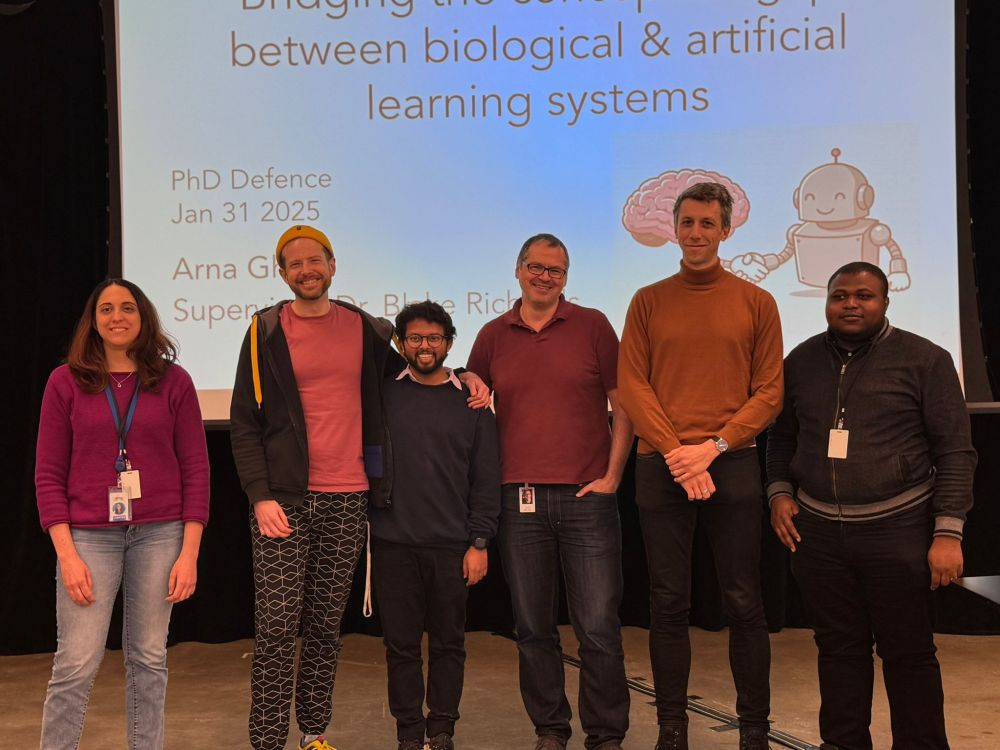
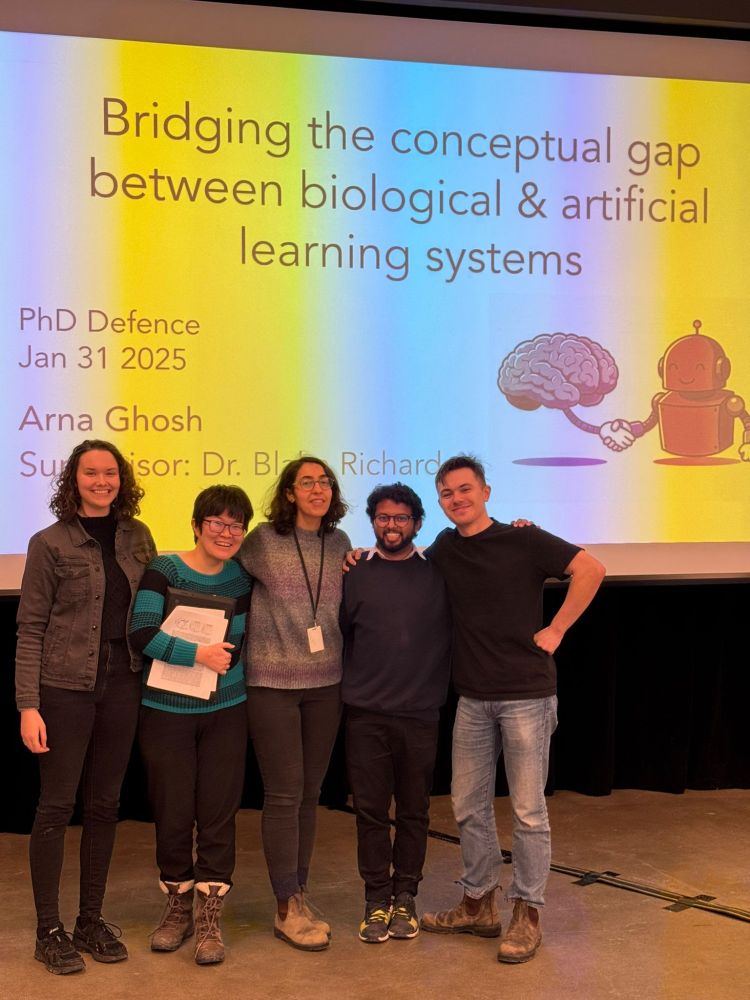
Just over a week since I defended my 🤖+🧠PhD thesis, and the feeling is just sinking in. Extremely grateful to
@tyrellturing.bsky.social for supporting me through this amazing journey! 🙏
Big thanks to all members of the LiNC lab, and colleagues at mcgill University and @mila-quebec.bsky.social. ❤️😁
10.02.2025 12:36 — 👍 30 🔁 3 💬 3 📌 1
Scientist/Senior Scientist – Research Institute, Hospital for Sick Children, University of Toronto – Canadian Association for Neuroscience
Just giving this a boost for those who may not have seen it yet... we have a PI position (molecular and cellular basis of cognition) at The Hospital for Sick Children (Toronto). The position comes with an appointment at Assist/Assoc Prof level at U of T. Share widely!
can-acn.org/scientist-se...
23.01.2025 14:16 — 👍 145 🔁 108 💬 1 📌 3
Hahaha!
Time to bring it good food than lots of food 😜😋
18.12.2024 05:03 — 👍 1 🔁 0 💬 1 📌 0
Come say hi at the noon poster session today in the East hall, poster #2201. 🚀
#NeurIPS2024
13.12.2024 18:47 — 👍 3 🔁 0 💬 0 📌 0
NeurIPS Poster Harnessing small projectors and multiple views for efficient vision pretrainingNeurIPS 2024
🧵 8/8 Interested in the details? Visit our poster! Full paper: neurips.cc/virtual/2024...
Work done by dream team 🤩, consisting of
Kumar K Agrawal, @shagunsodhani.bsky.social, Adam Oberman & @tyrellturing.bsky.social!
#AI #DeepLearning #NeurIPS2024 #SSL
13.12.2024 03:44 — 👍 2 🔁 0 💬 0 📌 0

🧵 7/8 Combining smaller projectors, higher # augmentations, and optimal orthogonalization advances the compute-performance Pareto frontier in SSL: 50% less compute for the same downstream performance or better accuracy at a fixed compute budget. 📈
13.12.2024 03:44 — 👍 1 🔁 0 💬 1 📌 0


🧵 6/8 Multiple augmentations lead to better approximation of the underlying data similarity kernel. More views → better kernel estimation → improved convergence and sample efficiency, matching larger datasets in low-data settings.
4 views 50% data 🤝 2 views 100% data. 📊
13.12.2024 03:44 — 👍 1 🔁 0 💬 1 📌 0
PhD student at Berens lab @hertie-ai.bsky.social @unituebingen.bsky.social | #ELLIS PhD student & associated w IMPRS-IS | ML for science, NeuroAI | ex: @fz-juelich.de KTH IISERP
Neuroscientist studying interactions between cognition, action & timing
Lab website: neuroact.in
Group Leader | NeuroACTLab @NCBS_Bangalore | SCAgingBrain fellow ➡️ faculty | Previously: @Neuro_CF @UCSF @UniofOxford @IiserMohali
Neuroimaging, Cognition, Epilepsy | Montreal Neurological Institute, McGill University
AI Researcher at the Samsung SAIT AI Lab 🐱💻
I build generative models for images, videos, text, tabular data, NN weights, molecules, and now video games!
Neuroscience/AI researcher at the University of Groningen, the Netherlands. Exploring learning and memory using deep learning frameworks and in vivo neurophysiology. Loves spaghetti, rock 'n roll, and lifting heavy things.
Real world neuroscience.
Neuroscience of animal societies and in the wild.
Flying bats, shrinking shrews, running rats.
Computational neuroscientist in the connectionist tradition.
https://ari-benjamin.com
Neuroscientist at KISN at NTNU, Tronheim, Norway
Nobel prize in Medicine or Physiology, 2014 together with Edvard I. Moser and John O’Keefe for the discoveries of cells that constitute a positioning system in the brain
Ph.D. Student Mila / McGill. Machine learning and Neuroscience, Memory and Hippocampus
Neurologist, epilepsy researcher, and PhD candidate @McGill University. Passionate about brain rhythms, neuro-imaging, epilepsy, and making science more inclusive. Mom, scientist, and storyteller.
Neuroengineer | Incoming Assistant Prof #RIT
Neuroengineering - AI - Signal processing - Epilepsy
Alum #Duke - #McGill - #NTU - #NITC
Neurophysiologist working on motor control and neural population dynamics. Assistant Prof. at the Case Western Reserve University School of Medicine.
https://sauerbreilab.org/
Thinking on dopamine heterogeneity
NeuroAI PhD student at @mcgillu.
Prev: @GeorgiaTech @FlatironCCN.
Cognitive computational neuroscientist, diver & traveller
PI at ATR Institute International (Japan)
Researching planning, reasoning, and RL in LLMs. Previously: Google DeepMind, UC Berkeley, MIT. I post about: AI 🤖, flowers 🌷, parenting 👶, public transit 🚆. She/her.
http://www.jesshamrick.com
Neuroscience PhD Candidate at McGill University | Learning, memory, and navigation 🧠 🐁 🔬
Father, husband, scientist
Multiscale Neuroscience
Associate Prof @ Montreal Neurological Institute
work: http://mica-mni.mcgill.ca
pixels: @borismontreal
waves: https://soundcloud.com/heschls
Chief Scientist @ Univ.Ai. We do AI, ML, Bayes and Data. Somerville, MA.
Bringing up the next generation of decision makers @Hult University! Previously ML and Bayes at Harvard.
Otherwise, Cosmology, Climbing and Skiing.
Liberalism is a moral choice.