Many-Two-One
UPDATE
project page: yingtiandt.github.io/dynamic-visi...
04.08.2025 03:27 — 👍 0 🔁 0 💬 0 📌 0
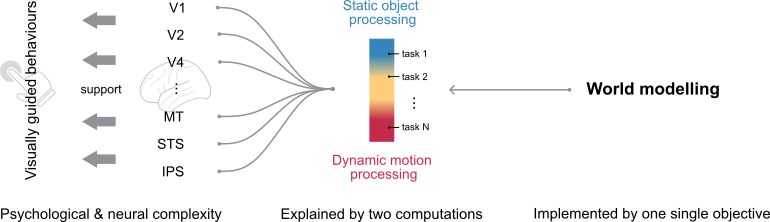
8/🖼️ Big Picture
Optimizing to model world dynamics leads to brain-like representations.
🧠 The visual system isn't a patchwork of modules — it’s a unified system built on shared core principles.
30.07.2025 13:39 — 👍 2 🔁 0 💬 1 📌 0
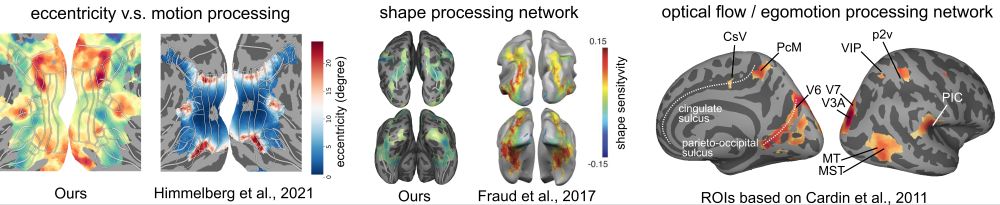
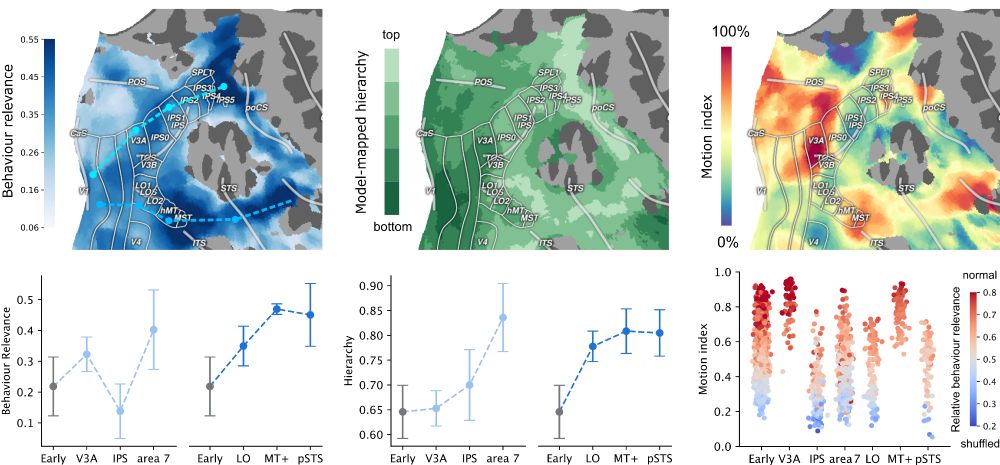
7/🧠 Finding 4
We introduce task-based functional localization.
It:
1. Recovers many prior neuroscience results in a unified way
2. Reveals new structure in action understanding pathways
A novel scalable approach to functional brain mapping.
30.07.2025 13:37 — 👍 1 🔁 0 💬 1 📌 0
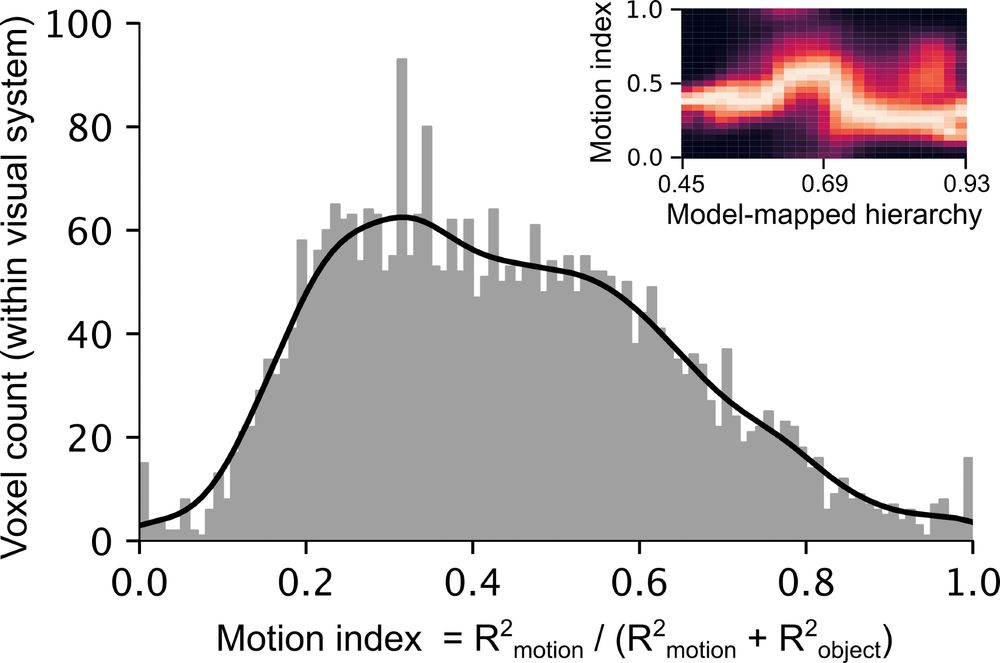
6/🌀 Finding 3
Putting observations together:
• Single-objective models align with all regions and behaviors
• Cortex shows hybrid, smooth representation transitions
💡 A new perspective: the brain may implement a shared feature backbone — reused for diverse tasks, just like a “foundation model”.
30.07.2025 13:37 — 👍 1 🔁 0 💬 1 📌 0
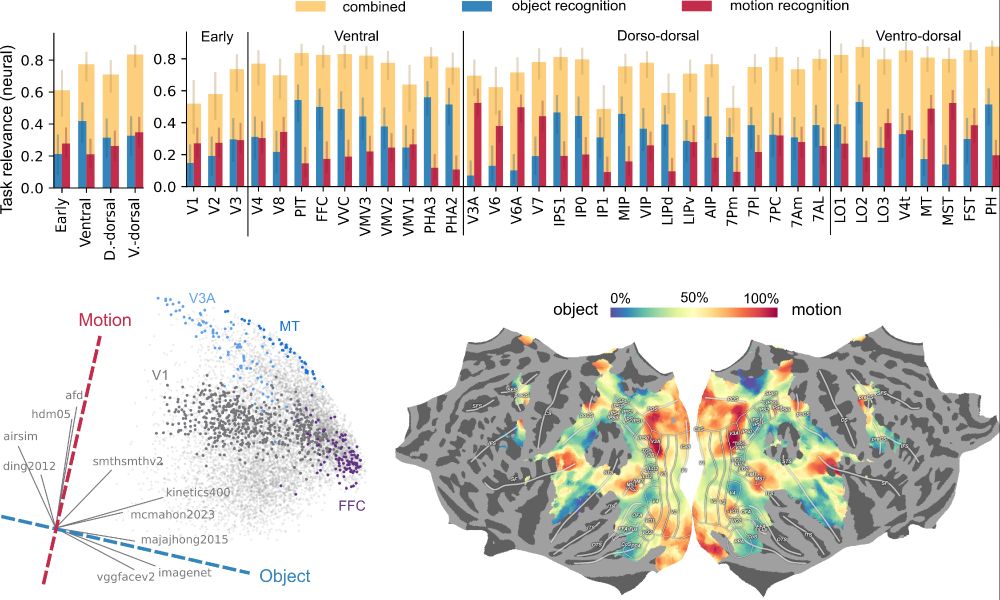
5/🌐 Finding 2.2
These two aren’t isolated — they’re:
• Blended across ventral & dorsal streams
• Smoothly mapped across the cortex
So, the visual system isn’t modular — it’s highly distributed, and the classic stream separation theory appears oversimplified.
30.07.2025 13:36 — 👍 1 🔁 0 💬 1 📌 0
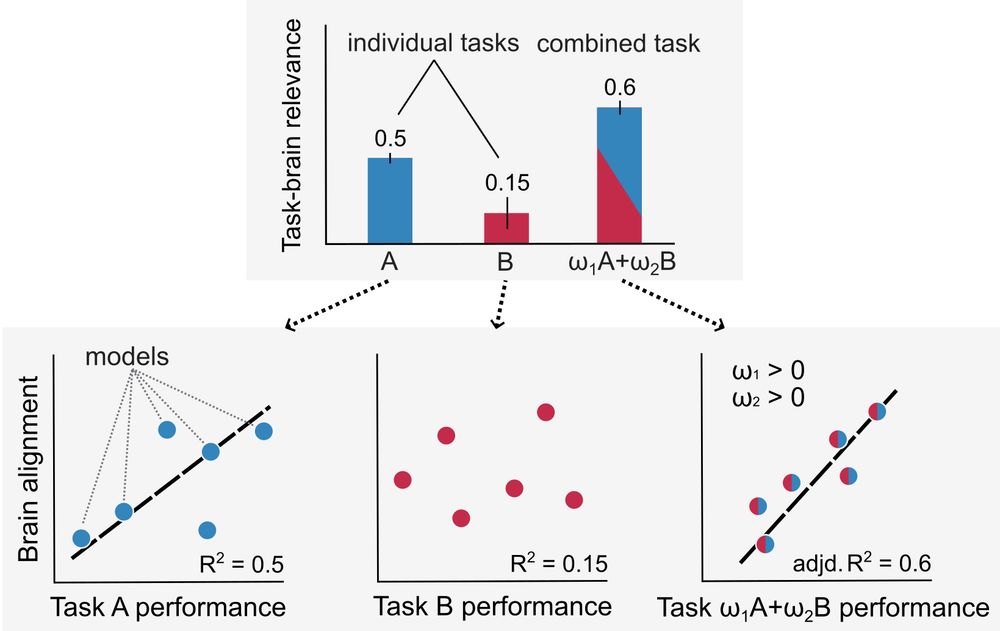
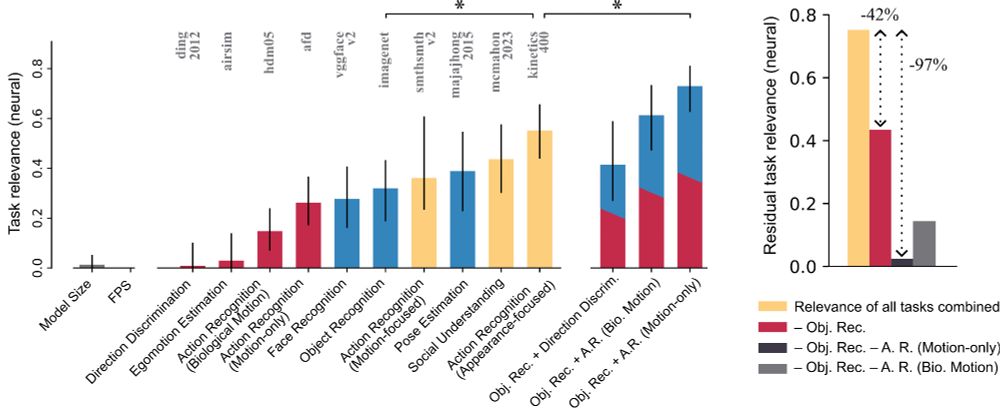
4/🌐 Finding 2.1
So, what does the brain actually compute during dynamic vision?
Across 10 cognitive tasks (e.g., pose, social cues, action), just two suffice to explain brain-like representations:
• Object form
• Appearance-free motion
30.07.2025 13:35 — 👍 2 🔁 0 💬 1 📌 0
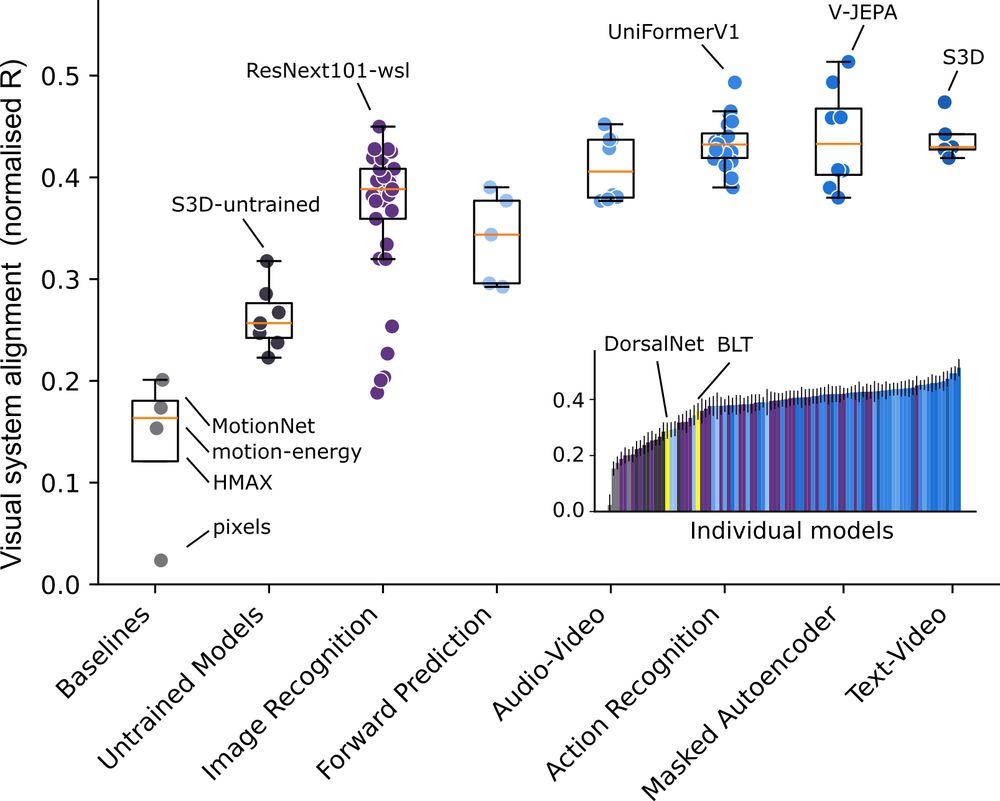
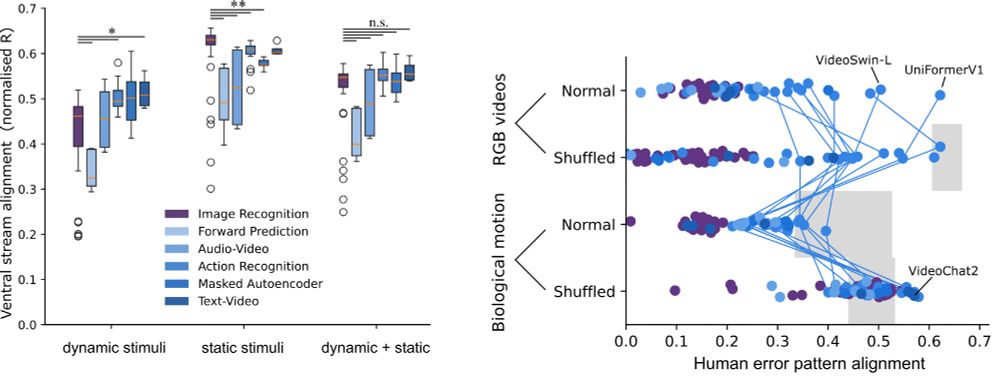
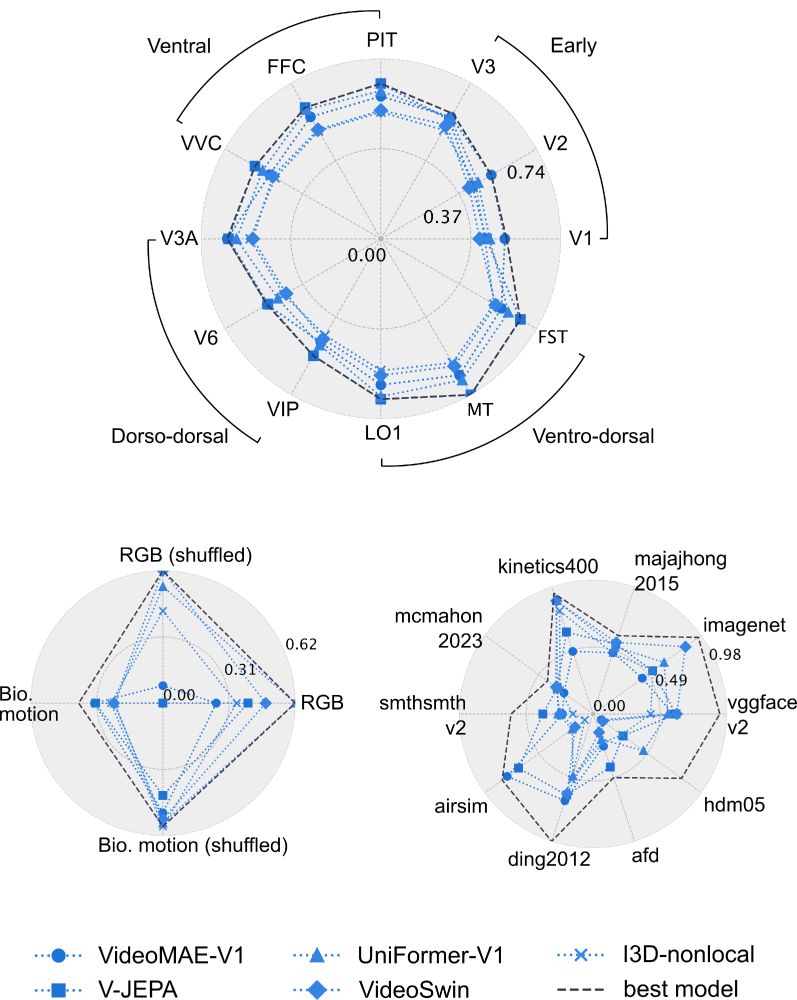
3/📊 Finding 1
✅ Dynamic models > static image models > classic vision models
✅ Across both dorsal & ventral regions
✅ Across neural & behavioral alignment
Best match to brain: V-JEPA.
In general, learning world dynamics give alignment to the whole visual system.
30.07.2025 13:34 — 👍 1 🔁 0 💬 1 📌 0
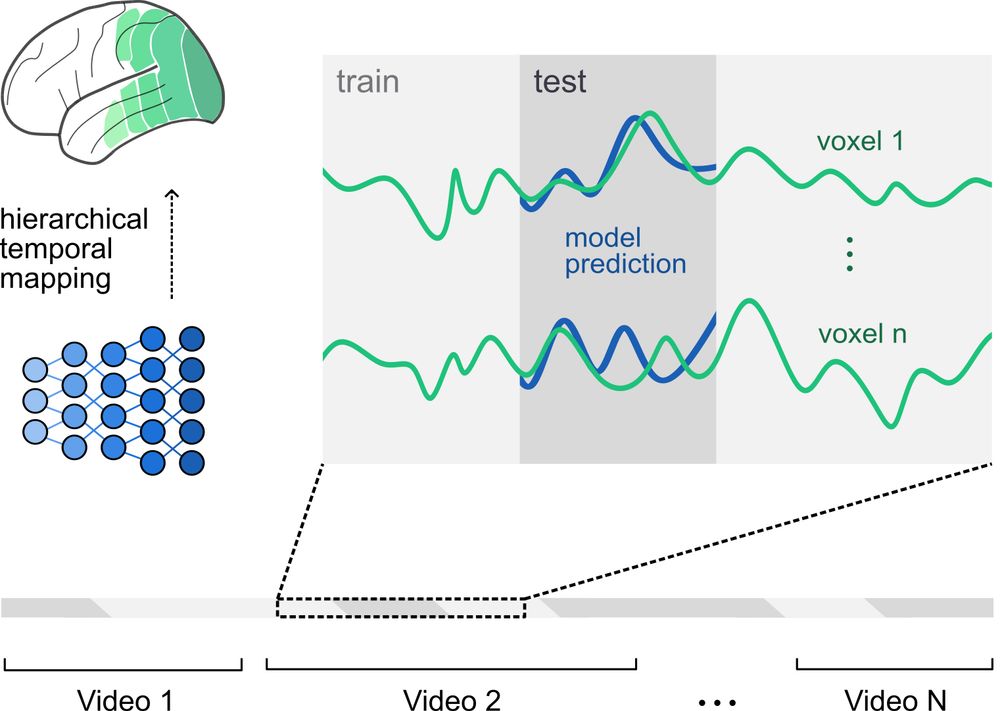
2/🧪 Approach
We benchmarked diverse video models, each with a different pretraining objective.
Then: tested how well they predict human fMRI responses to natural movies.
🧠 ~10,000 voxels, whole visual system.
30.07.2025 13:34 — 👍 1 🔁 0 💬 1 📌 0
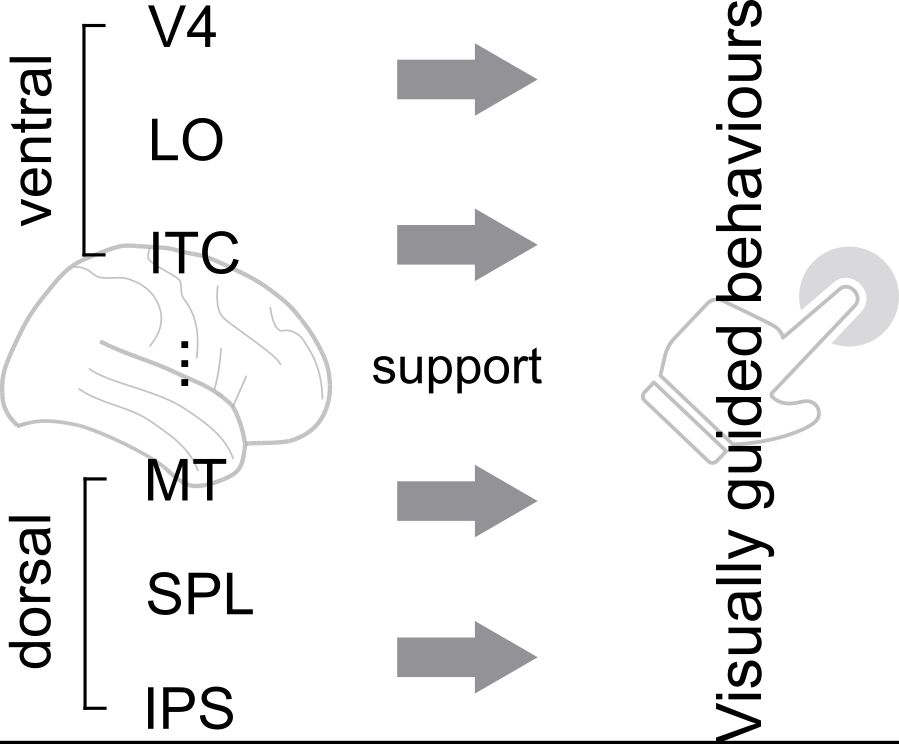
1/🔍 Motivation
The brain is thought to process vision through two streams:
🖼 Ventral — objects, form, identity
🧭 Dorsal — motion, spatial layout, actions
Image models explain ventral well.
But: what about dorsal? Can one model do both?
30.07.2025 13:33 — 👍 2 🔁 0 💬 1 📌 0
🚨 New research: Can the brain's complex visual system — ventral & dorsal processing streams — arise from a single goal?
We study dynamic vision and reveal how object and motion recognition — long thought to be separate — could emerge from the same underlying goal.
30.07.2025 13:32 — 👍 1 🔁 0 💬 1 📌 0
NeuroAI Prof @EPFL 🇨🇭. ML + Neuro 🤖🧠. Brain-Score, CORnet, Vision, Language. Previously: PhD @MIT, ML @Salesforce, Neuro @HarvardMed, & co-founder @Integreat. go.epfl.ch/NeuroAI
Computational Cognitive Scientist 🧠🤖 • NeuroAI, Predictive Coding, RL & Deep Learning, Complex Systems • Postdoc at @siegellab.bsky.social, @unituebingen.bsky.social • Husband & Dad
🎓 https://scholar.google.com/citations?hl=en&user=k5eR8_oAAAAJ
official Bluesky account (check username👆)
Bugs, feature requests, feedback: support@bsky.app