See also the comment by Jessica Belser (@jessbelser.bsky.social): "A pandemic toolbox for clade 2.3.4.4b A(H5N1) influenza virus risk assessment": www.thelancet.com/journals/lan...
16.12.2025 05:54 — 👍 6 🔁 4 💬 0 📌 0
@debbyvanriel.bsky.social
Associate Professor ○ Viroscience ○ Erasmus MC ○ The Netherlands Virology • Influenza • Enterovirus • SARS-CoV-2 • Pathogenesis • neuropathogenesis • Pathology • WomeninSTEM
See also the comment by Jessica Belser (@jessbelser.bsky.social): "A pandemic toolbox for clade 2.3.4.4b A(H5N1) influenza virus risk assessment": www.thelancet.com/journals/lan...
16.12.2025 05:54 — 👍 6 🔁 4 💬 0 📌 0
Replication of clade 2.3.4.4b H5N1 virus, clade 2.1.3.2 H5N1 virus and H3N2 virus in human primary nasal and tracheobronchial respiratory epithelium Replication kinetics of H3N2 , H5N1 , H5N1 Polecat2022 , or H5N1 Bovine2024 in two independent experiments in nasal respiratory epithelium (A, B) and tracheobronchial epithelium (C) cultures with a multiplicity of infection of 0⋅1. Replication kinetics were performed in technical duplicates in three independent experiments and data represented show the mean with 95% CIs. (D) Detection of influenza A virus nucleoprotein by immunohistochemistry in the nasal and tracheobronchial epithelium cultures 24 h after inoculation. Source: Attachment and replication of clade 2.3.4.4b influenza A (H5N1) viruses in human respiratory epithelium: an in-vitro study Bauer, Lisa et al. The Lancet Microbe, Volume 0, Issue 0, 101230
Current H5N1 avian influenza viruses replicate better in human respiratory tissues than a historic one, warranting "the urgency to prevent cross-species transmission to humans by controlling spillover events to mammals and limiting viral spread in farmed mammals." www.thelancet.com/journals/lan...
16.12.2025 05:54 — 👍 53 🔁 36 💬 1 📌 3
Excited to share that our mansucript is finally published! Check it out here:
www.thelancet.com/journals/lan...
Check out the new publication of Viruses like it 🍬🍭!
@lisabauervirus.bsky.social and @debbyvanriel.bsky.social investigated the clade 2.3.4.4b A(H5N1) influenza virus attachment and replication in human respiratory epithelium!
Congratulation to all involved!
And now published! #glycotime "Sialic Acid-Containing Glycolipids Extend the Receptor Repertoire of Enterovirus-D68" fantastic collaboration with @lisabauervirus.bsky.social @debbyvanriel.bsky.social @TheBoonsGroup enjoy 👍https://pubs.acs.org/doi/10.1021/acsinfecdis.5c00063
10.07.2025 07:50 — 👍 5 🔁 2 💬 0 📌 0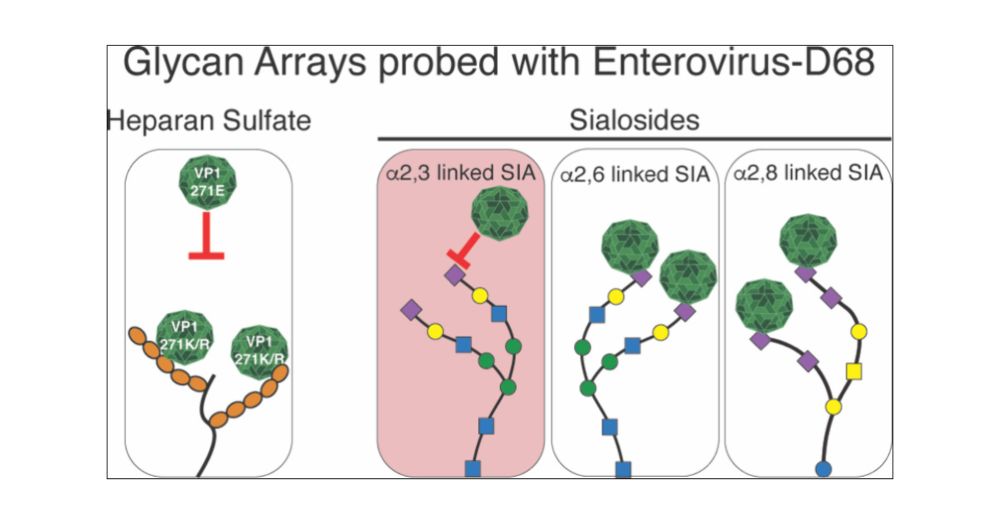
We are happy to share the first publication of our consortium:
pubs.acs.org/doi/10.1021/...
Check out this amazing documentary from our PI @debbyvanriel.bsky.social discussing the potential of a bird flu as the next pandemic!
27.05.2025 13:12 — 👍 4 🔁 2 💬 0 📌 0
The Razor Science Show provides cutting-edge science and technology stories, including the documentary "Bird flu - the next pandemic?". Neil Cairns interviews @drtomfrieden.bsky.social , @jw132.bsky.social, @linekebegeman.bsky.social, and @debbyvanriel.bsky.social.
www.youtube.com/watch?v=F5XK...

This documentary covers the current bird flu situation. Clearly presented, realistic and where necessary with nuance. Interviews by Neil Cairns & team with @linekebegeman.bsky.social, Tom Frieden, @jw132.bsky.social, Jim Paulson and myself.
www.youtube.com/watch?v=F5XK...

Excited to have this story out on bioRxv! #glycotime #lovevirology #H5N1 The receptor binding properties of H5Nx influenza A viruses have evolved to promiscuously bind to avian-type mucin-like O-glycans.
www.biorxiv.org/content/10.1...
We a looking for a Postdoc!
Interested in virology, stem-cell derived models, glycans?
Apply before 29th of October!
@thijskuiken.bsky.social @lisabauervirus.bsky.social @marionkoopmans.bsky.social @rpdevrieslab.bsky.social
www.werkenbijerasmusmc.nl/en/vacancy/1...
One more week to apply!
👇🏼👇🏼👇🏼👇🏼
Looking for a PhD position? Interested in viruses, stem cell-derived models and/or glycans? Ready to work in a multidisciplinary teams other amazing scientists?
Apply now 👇
www.werkenbijerasmusmc.nl/en/vacancy/1...
#Viruseslikeitsweet is online! We are a consortium of the department of Viroscience @erasmusmc.bsky.social and the department of Chemical Biology & Drug discovery @utrechtuniversity.bsky.social
Follow our progress here or via our Linked-In account: NWO-XL Consortium Viruses like it Sweet
@marionkoopmans.bsky.social @lisabauervirus.bsky.social @thijskuiken.bsky.social @linekebegeman.bsky.social @rpdevrieslab.bsky.social @viruseslikeitsweet.bsky.social
09.04.2025 06:52 — 👍 3 🔁 1 💬 0 📌 0
Looking for a PhD position? Interested in viruses, stem cell-derived models and/or glycans? Ready to work in a multidisciplinary teams other amazing scientists?
Apply now 👇
www.werkenbijerasmusmc.nl/en/vacancy/1...
Feline Benavides has been the driving force behind this work! Thanks to @lisabauervirus.bsky.social, @thijskuiken.bsky.social, Lonneke, Edwin, Peter, Rory and Katy.
@marionkoopmans.bsky.social
Altogether, we show that a mild SARS-CoV-2 infection triggers subtle (but insidious?) changes in the brains of ferrets in the acute and post-acute phase of the infection. It is time that we start developing methods to study the functional consequences of these changes!
08.04.2025 09:18 — 👍 2 🔁 0 💬 1 📌 0Decreased astrocyte activation has not been reported before, but activation has been shown in hamsters (PMID: 35388072). Alzheimer type II astrocytes have been detected in the brain of a COVID-19 patient with an meningoencephalitis (PMID: 33937731).
08.04.2025 09:18 — 👍 2 🔁 0 💬 1 📌 0Increased microglial activation has been detected in patients and experimentally inoculated hamsters and mice (with severe disease). Microglia help maintaining brain homeostasis, synapse formation, neuronal proliferation, etc.. Dysregulation can impact learning and memory.
08.04.2025 09:17 — 👍 2 🔁 0 💬 1 📌 0What does this mean? Even though we did not find strong evidence for neuroinvasion (high ct values, no virus antigen in brain) we did detect microglial activations, a decrease in astrocytic activation and an increase of Alzheimer type II astrocytes in parts of the brain.
08.04.2025 09:17 — 👍 1 🔁 0 💬 1 📌 0
In the white matter of the cerebral cortex and the CA1 region of the hippocampus there was a decrease in the GFAP+ surface area (decrease of astrocyte actication). In the hippocampus this was associated with an increase of IBA1+ surface area.
08.04.2025 09:17 — 👍 1 🔁 0 💬 1 📌 0
In the olfactory bulb there was no evidence for an increase of microglia compared to mock inoculated ferrets, although the surface area of IBA1+ cells was increased (suggestive for microglial activation). There was no increase of astrocytes.
08.04.2025 09:16 — 👍 1 🔁 0 💬 1 📌 0
In the brain we did not detect histological changes associated with inflammation, gliosis or necrosis. However, we did detect an increase of Alzheimer type II astrocytes in the pons and cerebellum at 7 and 21 dpi compared to mock inoculated ferrets.
08.04.2025 09:16 — 👍 1 🔁 0 💬 1 📌 0
From intranasally inoculated ferrets, noses and brains were collected 7 and 21 days post inoculation (dpi). Virus antigen was detected sporadically in the nose at 7 dpi in respiratory and olfactory mucosa. In the brain we only detected viral RNA at 7 dpi, with high ct values.
08.04.2025 09:15 — 👍 1 🔁 0 💬 1 📌 0
Online now!
Neuroinvasive and neurovirulent potential of SARS-CoV-2 in the acute and post-acute phase of intranasally inoculated ferrets.
Here we reveal subtle changes in the brain of SARS-CoV-2 infection in ferrets, which developed only MILD disease.
dx.plos.org/10.1371/jour...
1/n
Are you (or anyone you know) ambitious, interested in the pathogenesis of arboviruses and ready for Rotterdam? If yes, check out this vacancy for an assistant professor position 👇.
More opportunities to join Viroscience will follow soon, so stay tuned 😀

The UK’s Chief Veterinary Officer has confirmed a case of highly pathogenic avian influenza (H5N1) in a single sheep in Yorkshire following repeat positive milk testing.
To my knowledge, this is the first time the virus has been detected in sheep.
www.gov.uk/government/n...

In normal times, I'd have written about this #MMWR report about some of the kids who've died from #flu this year having had a severe neurological condition called influenza-associated encephalopathy or encephalitis. Glad to see @cidrap.bsky.social did write! www.cidrap.umn.edu/influenza-ge...
28.02.2025 02:30 — 👍 397 🔁 145 💬 4 📌 11
📣 New #ESWIAirborne: #hMPV - the (not so) new kid on the block. Learn about the story behind #humanmetapneumovirus and how it was first discovered, featuring: Albert Osterhaus, Bernadette van den Hoogen & Ann Falsey!
#ESWIEducationHub
shorturl.at/yszOv