Biological insights into schizophrenia from ancestrally diverse populations
Nature - Genome-wide association studies incorporating data for populations of African ancestry provide an expanded view of the genetic basis of schizophrenia, which has previously been studied...
Now out in @nature.com: Biological insights into schizophrenia from ancestrally diverse populations.
@sinaibrain.bsky.social @sinaigenetics.bsky.social cs.bsky.social @timbigdeli.bsky.social #CDNeurogenomics #MountSinaiPsych #MillionVeteranProgram and many collaborators
Read: rdcu.be/eZ7he
21.01.2026 18:58 — 👍 33 🔁 13 💬 0 📌 0

ADHD is on the rise, but why?
The more we learn, the less we seem to understand this condition.
Rates of ADHD have been rising quickly over the past few decades, for reasons that are not entirely clear — a mystery that underscores how much we still have to learn about the condition.
go.nature.com/49TQWG5
22.01.2026 15:25 — 👍 19 🔁 7 💬 3 📌 1
I’m very happy to share the latest from my lab published in @Nature
Hippocampal neurons that initially encode reward shift their tuning over the course of days to precede or predict reward.
Full text here:
rdcu.be/eY5nh
14.01.2026 21:32 — 👍 104 🔁 32 💬 2 📌 2
All theory is wrong until verified by data. Greatly indebted to @mhyaghoubi.bsky.social, @markbrandonlab.bsky.social, @douglasresearch.bsky.social for finding the hippocampus encoding reward prediction! Grateful to my advisor @cpehlevan.bsky.social, @kempnerinstitute.bsky.social.
#RL #hippocampus
19.01.2026 09:32 — 👍 30 🔁 9 💬 0 📌 1
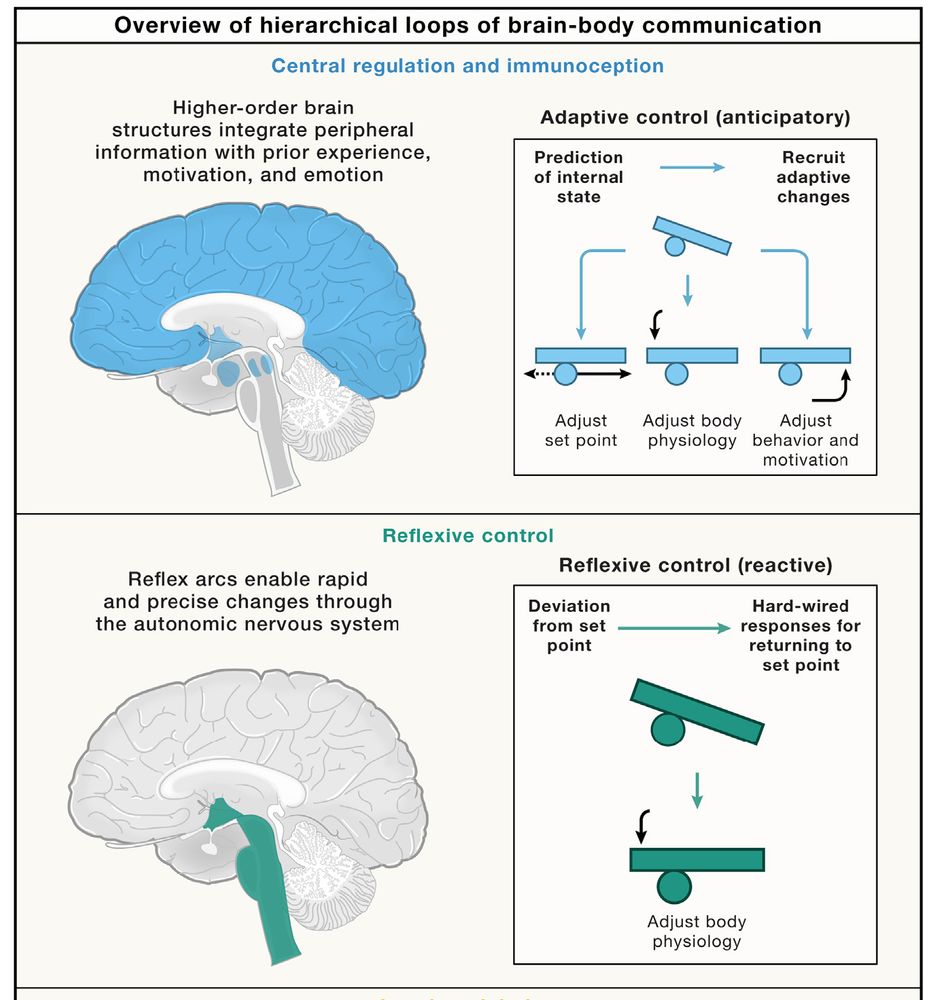
𝗕𝗿𝗮𝗶𝗻-𝗯𝗼𝗱𝘆 𝗽𝗵𝘆𝘀𝗶𝗼𝗹𝗼𝗴𝘆:
𝗟𝗼𝗰𝗮𝗹, 𝗿𝗲𝗳𝗹𝗲𝘅, 𝗮𝗻𝗱 𝗰𝗲𝗻𝘁𝗿𝗮𝗹 𝗰𝗼𝗺𝗺𝘂𝗻𝗶𝗰𝗮𝘁𝗶𝗼𝗻
Excellent review paper about reactive and anticipatory processes.
#neuroskyence
doi.org/10.1016/j.ce...
07.09.2025 17:45 — 👍 67 🔁 19 💬 0 📌 3
I am extremely grateful to be awarded the National University of Singapore (NUS) Development Grant, and to be a Young NUS Fellow! Look forward to collaborating with the Yong Loo Lin School of Medicine on exciting projects. This is my first grant and hopefully many more to come! #NUS #NeuroAI
27.08.2025 14:31 — 👍 8 🔁 1 💬 1 📌 0
Theoretical neuroscience has room to grow
Nature Reviews Neuroscience - The goal of theoretical neuroscience is to uncover principles of neural computation through careful design and interpretation of mathematical models. Here, I examine...
I wrote a Comment on neurotheory, and now you can read it!
Some thoughts on where neurotheory has and has not taken root within the neuroscience community, how it has shaped those subfields, and where we theorists might look next for fresh adventures.
www.nature.com/articles/s41...
20.08.2025 16:09 — 👍 151 🔁 52 💬 8 📌 3
🧵 New paper! We studied depression symptoms and goal-directed decisions under uncertainty
@shiyiliang.bsky.social, with @evanrussek.bsky.social & @robbrutledge.bsky.social
Surprisingly, we found that apathy–anhedonia was linked to enhanced goal-directed behavior. www.biorxiv.org/content/10.1...
20.08.2025 12:25 — 👍 45 🔁 10 💬 4 📌 1
Not just for AI but these theories can improve our understanding of biological networks too!
19.08.2025 19:04 — 👍 7 🔁 1 💬 0 📌 0
On the left is a rabbit. On the right is an elephant. But guess what: They’re the *same image*, rotated 90°!
In @currentbiology.bsky.social, @chazfirestone.bsky.social & I show how these images—known as “visual anagrams”—can help solve a longstanding problem in cognitive science. bit.ly/45BVnCZ
19.08.2025 16:32 — 👍 353 🔁 106 💬 19 📌 30
trying this with GPT-5 and charting new frontiers in gaslighting
19.08.2025 13:08 — 👍 221 🔁 55 💬 6 📌 9

Connectivity structure and dynamics of nonlinear recurrent neural networks
Studies of the dynamics of nonlinear recurrent neural networks often assume independent and identically distributed couplings, but large-scale connectomics data indicate that biological neural circuit...
Wanted to share a new version (much cleaner!) of a preprint on how connectivity structure shapes collective dynamics in nonlinear RNNs. Neural circuits have highly non-iid connectivity (e.g., rapidly decaying singular values, structured singular-vector overlaps), unlike classical random RNN models.
19.08.2025 15:42 — 👍 40 🔁 9 💬 1 📌 0
Poster Presentation
3. We present TeDFA-δ, a bio. plaus. deep spiking RL model that leverages temporal integration and weak learning rules to outperform standard MLPs+BP for policy learning, highlighting the importance of neural dynamics over credit assignment for effective control:
2025.ccneuro.org/poster/?id=S...
13.08.2025 15:28 — 👍 4 🔁 0 💬 0 📌 0
Poster Presentation
2. We developed a bio. plaus. computational model of the dentate gyrus that shows how both impaired synaptic plasticity and increased neurogenesis—modulated by Cbln4-Neo1 complex—disrupt behavioral pattern separation:
2025.ccneuro.org/poster/?id=P...
13.08.2025 15:25 — 👍 3 🔁 0 💬 1 📌 0
Poster Presentation
1. We developed a RNN-based meta-RL framework that models schizophrenia-like decision-making deficits. We see a positive correlation between the number of dynamical attractor states and suboptimal behavior:
2025.ccneuro.org/poster/?id=4...
13.08.2025 15:23 — 👍 3 🔁 1 💬 1 📌 1
1 proceeding and 2 extended abstracts at Cognitive Computational Neuroscience (CCN) Conference 2025! Short summaries and links are in the thread. Look forward to the discussions! #CCN25
13.08.2025 15:17 — 👍 6 🔁 0 💬 1 📌 0
![What do representations tell us about a system? Image of a mouse with a scope showing a vector of activity patterns, and a neural network with a vector of unit activity patterns
Common analyses of neural representations: Encoding models (relating activity to task features) drawing of an arrow from a trace saying [on_____on____] to a neuron and spike train. Comparing models via neural predictivity: comparing two neural networks by their R^2 to mouse brain activity. RSA: assessing brain-brain or model-brain correspondence using representational dissimilarity matrices](https://cdn.bsky.app/img/feed_thumbnail/plain/did:plc:e6ewzleebkdi2y2bxhjxoknt/bafkreiav2io2ska33o4kizf57co5bboqyyfdpnozo2gxsicrfr5l7qzjcq@jpeg)
What do representations tell us about a system? Image of a mouse with a scope showing a vector of activity patterns, and a neural network with a vector of unit activity patterns
Common analyses of neural representations: Encoding models (relating activity to task features) drawing of an arrow from a trace saying [on_____on____] to a neuron and spike train. Comparing models via neural predictivity: comparing two neural networks by their R^2 to mouse brain activity. RSA: assessing brain-brain or model-brain correspondence using representational dissimilarity matrices
In neuroscience, we often try to understand systems by analyzing their representations — using tools like regression or RSA. But are these analyses biased towards discovering a subset of what a system represents? If you're interested in this question, check out our new commentary! Thread:
05.08.2025 14:36 — 👍 169 🔁 53 💬 5 📌 0
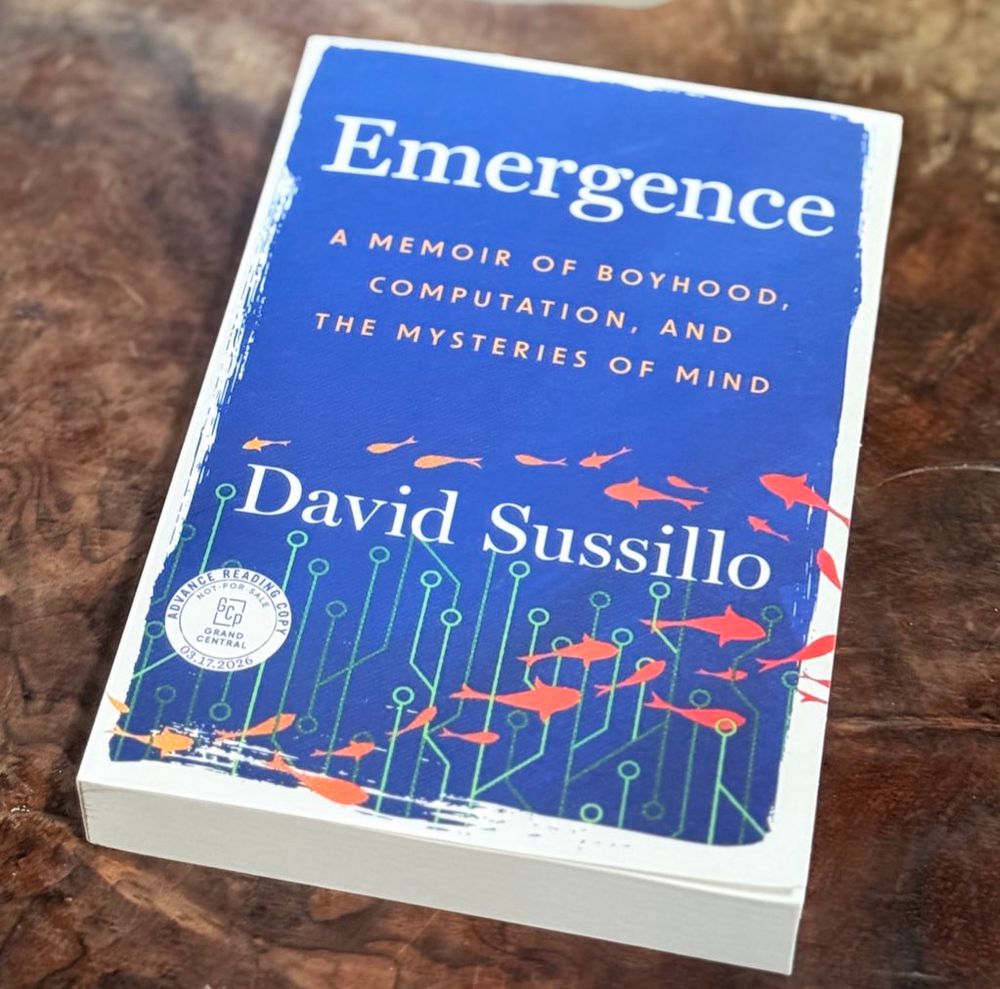
Coming March 17, 2026!
Just got my advance copy of Emergence — a memoir about growing up in group homes and somehow ending up in neuroscience and AI. It’s personal, it’s scientific, and it’s been a wild thing to write. Grateful and excited to share it soon.
04.08.2025 16:21 — 👍 184 🔁 37 💬 8 📌 0
How can we test theories in neuroscience? Take a variable predicted to be important by the theory. It could fail to be observed because it's represented in some nonlinear, even distributed way. Or it could be observed but not be causal because the network is a reservoir. How can we deal with this?
11.07.2025 08:13 — 👍 58 🔁 8 💬 11 📌 0
This summer my lab's journal club somewhat unintentionally ended up reading papers on a theme of "more naturalistic computational neuroscience". I figured I'd share the list of papers here 🧵:
23.07.2025 14:59 — 👍 108 🔁 29 💬 2 📌 2
ICML Poster A Model of Place Field Reorganization During Reward MaximizationICML 2025
First #ICML2025 conference proceeding (icml.cc/virtual/2025...)! We (@frostedblakess.bsky.social, @jzv.bsky.social, @cpehlevan.bsky.social) developed a simple model to better understand state representation learning dynamics in both artificial and biological intelligent systems!
12.07.2025 20:28 — 👍 4 🔁 1 💬 0 📌 0
State representation learning in the hippocampus?
28.04.2025 10:39 — 👍 5 🔁 0 💬 0 📌 0
I'm heading back to Singapore for ICLR25! Hit me up for discussions or where to find good food!
#neuroai #home
23.04.2025 19:00 — 👍 1 🔁 0 💬 0 📌 0

Interestingly, we found no significant difference in under and over-updating behavior in Schizophrenia patient data (Nassar et al. 2021). Instead, analyzing the behavior using the delta area metric showed a significant difference, suggesting the utility of model-guided human-behavior data analysis.
27.03.2025 17:12 — 👍 1 🔁 0 💬 0 📌 0

We used a fixed point finder algorithm and found that suboptimal agents (lower delta area value) exhibited smaller number of unstable fixed points compared to more optimal agents. The number of stable fixed points remained consistent across the delta area metric.
27.03.2025 17:10 — 👍 1 🔁 0 💬 1 📌 0

Besides the (1) reward discount factor, we explored (2) prediction error scaling, (3) probability of disrupting RNN dynamics, (4) rollout buffer length. Each hyperparameter differently influenced the suboptimal decision making behavior, which we termed as delta area.
27.03.2025 17:08 — 👍 1 🔁 0 💬 1 📌 0

Agents have to learn 2 solutions to predict changes in target location (change-point) and ignore outliers (oddballs). Decreasing the reward discount factor caused agents to under-update and over-update in each conditions respectively, replicating the maladaptive behavior seen in patients.
27.03.2025 17:04 — 👍 1 🔁 0 💬 1 📌 0
Learning, memory and systems neuroscience
Interested in cognition and artificial intelligence. Research Scientist at Google DeepMind. Previously cognitive science at Stanford. Posts are mine.
lampinen.github.io
Associate Prof of Psychology. I study how you remember (episodic memory), but am also interested in other areas of science (astronomy, geology, astrophysics, paleobiology, ecology, meteorology, etc) and other things too (architecture, birds, transit, etc).
Comp Neuro, ML, Dynamical Systems 🧠🤖PhD student at Harvard & Kempner Institute. Prev at McGill, Mila, EPFL.
💻: https://ann-huang-0.github.io
Prof of Cognitive Neuroscience & Vice Dean at UCL, Fellow of the Royal Inst. of Navigation. I study how we remember, navigate & imagine space
Photo: Our upcoming field research in the Marshall Islands
https://spierslab.wixsite.com/wavesandwayfinding
Computational neuroscientist and computer science professor
Western Washington University
Applied mathematics PhD
Fan of Nature
https://glomerul.us
Postdoc in Uchida Lab, Harvard (dopamine, learning, circuit computation) | PhD in Giocomo lab, Stanford (grid cells, path integration, navigation) | NIH NIDA K99/R00 | Bridging theory and biology of animal learning and decision making
phd student @ uc irvine cog sci w/ Megan Peters.
🧠 structure learning, metacognition, perception, comp cog neuro.
https://www.rochellekaper.com/
she/her
Professor for Cognitive Modeling at the Institute for Cognitive Science in Osnabrück, Germany. Previously at Oxford & ETH Zurich.
Neuroscientist in Oslo. Former Editor. Mucking about with Voltage Imaging and patching. Aiming for a mix of fun, science, and funny science. Trying to be kind. He/him. https://dorst-lab.org/
Computational neuroscientist.
Senior Lecturer at Ulster University in the Great City of Derry, Northern Ireland.
"not articulate enough"
https://odonnellgroup.github.io
Assistant professor at the Haifa University, interested in how Humans smell, breathe, remember and recall their world.
Neuroscience PhD Candidate at McGill University | Learning, memory, and navigation 🧠 🐁 🔬
Researcher in computational neuroscience and neuromorphic computing || http://wchapmaniv.com ||
Neuroscience PhD candidate at Columbia University | UC Berkeley alum | Studying RL mechanisms for vocal learning (+ fan of animals 🐋🦇🦜🦋🦑 🦎🦕)
MD | Network Neuroscience, EEG/MEG, oscillations, traveling waves, neuroAI | PhD candidate at University of Helsinki 🇫🇮 | Previously AES postdoctoral fellow at UW-Madison 🇺🇸 | https://felipebpaiva.github.io/
Biophysics PhD student with Jan Drugowitsch at Harvard Univ. (he/him) | theoretical neuroscience | spatial navigation under uncertainty
See https://tenuretracker.info/ for the most complete & worldwide overview of open postdoc, tenure track, (junior) professor, and lecturer positions.
Visit the site to search for specific positions and subscribe to email notifications