
Online Studies
Psychological Science requires that authors who use samples from online data collection include a statement in the Method section explicitly addressing their approach to preventing and detecting automated or AI-generated responses.
Rationale
As large language models and other generative AI tools become more accessible, the risk of data contamination by non-human respondents has increased dramatically in research. Psychological science (and the social sciences generally) is particularly susceptible to this issue given its growing reliance on online data collection. Preventing automated responses during data collection and detecting them afterward often involve methodological trade-offs. For instance, technical barriers that aim to prevent LLM use (e.g., blocking copy-pasting functionalities) may eliminate behavioral indicators needed for detection (e.g., pasting rather than typing). This policy aims to enhance transparency and reproducibility of reported results by requiring authors to articulate their approach across both prevention and detection dimensions, enabling readers and reviewers to assess the likelihood of reported data being influenced by automated responses.
Scope
This policy applies to any submission with at least one study that includes data collected online without direct human supervision (e.g., via crowdsourcing platforms, student participants who complete the study online, online recruitment ads, or remote survey distribution tools).
Required Reporting
Authors must include in the Methods section either:
A statement confirming that procedures were in place to prevent and/or detect and exclude automated or AI-generated responses, including a description of those procedures (e.g., explicit participant instructions against LLM use, disabled copy–paste functionality, CAPTCHA use, IP filtering, consistency checks, attention checks, adversarial prompting) as well as the types of automated responses that these procedures are suitable …
Maybe of interest: The submission guidelines of Psychological Science now demand an explicit statement on measures taken to reduce the risk of AI-generated responses for all online studies!
www.psychologicalscience.org/publications...
25.02.2026 12:08 —
👍 124
🔁 53
💬 1
📌 0
Redirecting
Delighted to share my first paper of 2026 "Interoception and allostatic load after stroke: A scoping review". Available now, open access: doi.org/10.1016/j.ne...
20.01.2026 02:25 —
👍 5
🔁 4
💬 1
📌 0
Our paper on interoceptive rhythms and perception now is published in NeuroImage 🚀📄
@alexgalvezpol.bsky.social already shared a fantastic breakdown of our main findings in the thread below👇🏽
🔗Full OA article: doi.org/10.1016/j.ne...
#Interoception #Perception #Neuroscience #ActiveSensing
06.01.2026 11:34 —
👍 8
🔁 1
💬 0
📌 1

NEPTUNE project logo with affiliations & funders
New job alert 💫 We’re hiring a 3-year postdoc for the NEPTUNE project to study the causal mechanisms of paranoia and social learning.
Work with us on experimental psychopharmacology (THC), social cognition, and psychosis 🧑🔬
Apply here: lnkd.in/gQqnNvjR](my.corehr.com/pls/kclrecru...)
Please RT :)
18.12.2025 08:27 —
👍 11
🔁 14
💬 1
📌 0

A figure showing that non-invasive transcutaneous vagus nerve stimulation (tVNS) modulates Pavlovian bias in a state-dependent manner. A milkshake vs. water load reduces hunger and these changes are associated with the effects of tVNS on Pavlovian bias.
Last preprint 🎶(of the year).
If vagus nerve stimulation alters motivation by amplifying internal signals, then bodily states should matter. Using milkshake vs. water loads, we show that tVNS-induced changes in Pavlovian bias are dependent on hunger. #neuroskyence 🩺
www.biorxiv.org/content/10.6...
17.12.2025 07:24 —
👍 42
🔁 15
💬 1
📌 0
It is hugely fun & we are very lucky to do science for the sake of science. But it is amazing to see work we and many others I admire have done turn into public awareness thanks to excellent science writing.
(see also www.nytimes.com/2025/11/25/s...)
17.12.2025 09:25 —
👍 37
🔁 8
💬 1
📌 0
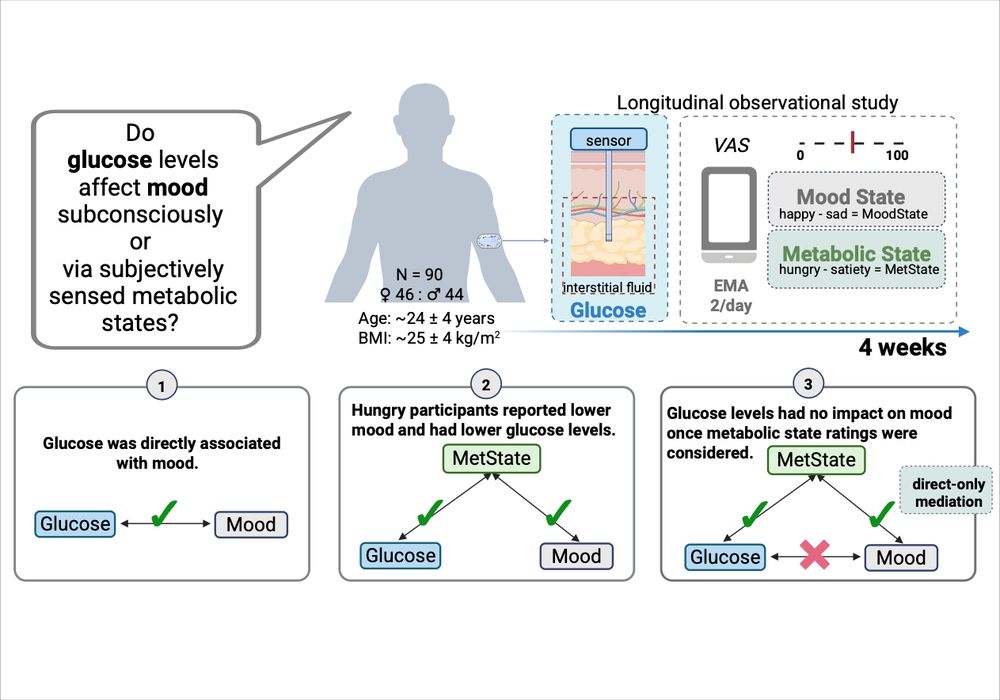
A graphical abstract showing the research question and the operationalization of the study.
Out now in @ebiomedicine.bsky.social 🚨.
Hunger often affects our mood, but is this a conscious or a subconscious process? Using continuous glucose monitoring, we show that differences in mood are driven by hunger ratings, not just glucose. #neuroskyence 🩺
www.thelancet.com/journals/EBI...
08.12.2025 13:32 —
👍 68
🔁 21
💬 1
📌 1
Out now in Translational Psychiatry! www.nature.com/articles/s41...
28.11.2025 14:53 —
👍 42
🔁 20
💬 0
📌 1


Very excited to introduce InteroMap, a new bodily mapping tool designed to measure how we subjectively experience our bodily sensations, what we call interoceptive phenomenology 🧵👇
18.11.2025 22:06 —
👍 32
🔁 14
💬 2
📌 2
What is the most profitable industry in the world, this side of the law? Not oil, not IT, not pharma.
It's *scientific publishing*.
We call this the Drain of Scientific Publishing.
Paper: arxiv.org/abs/2511.04820
Background: doi.org/10.1162/qss_...
Thread @markhanson.fediscience.org.ap.brid.gy 👇
12.11.2025 10:31 —
👍 336
🔁 238
💬 8
📌 17
How to get PhD funding in the UK
It is that time of year again. The leaves are turning golden, red, and orange (or just brown), the nights are drawing in, and there is a chi...
It's that time of year when many start thinking about applying for PhDs. If you're applying for a UK PhD position, here is a blog post I wrote a while back that might be helpful
#cognition #psychscisky #neuroskyence #psychjobs
06.10.2025 18:03 —
👍 29
🔁 12
💬 2
📌 1

Even after recovery, relapse is heartbreakingly common in anorexia nervosa. Could the answer lie in the gut’s hidden signals? 🧵
22.09.2025 20:13 —
👍 34
🔁 15
💬 3
📌 3

🚨Do you want to join our online seminars?
Next month we have this amazing seminar with Anna and Noa!
Register to join, it’s free 🤓
#somatosensation
#interoception
#sensory
#body
#science
#neuroscience
docs.google.com/forms/d/e/1F...
16.09.2025 10:27 —
👍 9
🔁 4
💬 0
📌 4

"I feel full with shame": A qualitative perspective on gastric interoceptive sensibility
“Am I hungry? Did I overeat at lunch?” Gastric interoception - the sensing, interpretation, and regulation of signals from the gastrointestinal system…
New qualitative paper! A foray into gastric interception. @lucysta02475610.bsky.social ran a LOT of focus groups, across groups with eating disorders, gastric disorders and neither, to understand how people experience the sensations from their GI system. www.sciencedirect.com/science/arti...
13.09.2025 07:03 —
👍 32
🔁 13
💬 0
📌 2

Stomach–brain synchronisation is associated with poorer mental health
In common parlance, ‘being in touch with your body’ is often used positively. However,
in a recent study, Banellis, Rebollo, and colleagues show that better stomach–brain
synchronisation is actually a...
In this @cp-trendsneuro.bsky.social Spotlight, I describe how a recent paper by @leahbanellis.bsky.social, @brainandstomach.bsky.social, et al. opens new avenues in interoception research, including those focussed on the subjective interpretation of internal signals: www.cell.com/trends/neuro...
09.09.2025 11:32 —
👍 23
🔁 8
💬 1
📌 3
Frontiers | The adamant adherence to a prior belief: the case of anosognosia in anorexia nervosa
Anorexia Nervosa (AN) is a complex psychiatric disorder marked by restrictive eating and distorted body image. Often, individuals with AN show a persistent d...
🧠 New publication out!
👁️🗨️ 🫀 In this perspective, we draw parallels with anosognosia
for hemiplegia, commonly seen in acute stroke patients, in the attempt to explain anosognosia for the illness in anorexia nervosa, based on recent
computational accounts
www.frontiersin.org/journals/neu...
05.09.2025 15:35 —
👍 3
🔁 1
💬 1
📌 0

On Prolific, "we estimate that about 34% of online study participants use LLMs to answer open-ended questions atleast some of the time..."
Seems like a very timely paper for behavioural scientists using online samples: osf.io/preprints/so... ;
We really need more papers on this issue
29.08.2025 09:46 —
👍 194
🔁 80
💬 4
📌 7
A roller coaster of a thread for any interoceptive researchers ⬇️
28.08.2025 09:41 —
👍 7
🔁 0
💬 1
📌 0
Wow, this is the kind of evidence we need to move ahead in the field. I'll go out on a limb here: I guess it is more about the gut than cardiac and respiratory domains. Huge effort by @leahbanellis.bsky.social @micahgallen.com and the entire team 👏
27.08.2025 15:36 —
👍 27
🔁 6
💬 2
📌 0
the tldr of my thread is that, interoceptive sensing at rest has no relationship to mental health symptoms, and we think this is likely because we need to measure interoception during and after arousal, close in time to symptoms, with ecological measures.
28.08.2025 07:01 —
👍 25
🔁 5
💬 1
📌 0
The latest from our lab @the-ecg.bsky.social: interoceptive sensing at rest is *not* related to mental health symptoms 🤔 Read our study here 👇
28.08.2025 08:37 —
👍 6
🔁 4
💬 0
📌 0
This leads me to our final point. Interoceptive accuracy is not the construct for emotion or mental health. We think that interoceptive narratives and beliefs, and how interoceptive sensastions change during acute stress and arousal, is so much more important.
27.08.2025 16:47 —
👍 19
🔁 2
💬 2
📌 0
Academia may not give you job security, flexibility, or wealth, but it will let you unexpectedly connect to eduroam in foreign cities
20.08.2025 16:58 —
👍 1005
🔁 165
💬 30
📌 21

Research opportunity! Email or click the link for more info: www.canva.com/design/DAGmM...
Please share thank you!
#eatingdisorders #EDAwareness #emotions #ResearchStudy #ParticipateInResearch #PsychologyResearch #NHSresearch #UKresearch #students
@jrefox.bsky.social
@livuniresearch.bsky.social
08.08.2025 16:22 —
👍 2
🔁 2
💬 0
📌 0


