The Reinforcement Learning workshop at U Mannheim was a lot of fun and highly recommended if you are looking for an engaging exchange of ideas, thanks to the organizers: Leif Döring, @theo-vincent.bsky.social, @claireve.bsky.social, and Simon Weißmann! www.wim.uni-mannheim.de/doering/conf...
08.02.2026 19:13 — 👍 11 🔁 2 💬 0 📌 0
To model the perceptual process, it is first necessary to model quantitatively how the action of pouring changes the liquid level. The physics of liquids is not trivial. This work allows simulating the liquid's behaviors in pouring, a requirement for then considering perception.
18.12.2025 17:08 — 👍 1 🔁 0 💬 0 📌 0

Want to model and simulate human behavior in tasks when interacting with liquids? Check out our work Niteesh Midlagajn & Constantin Rothkopf, Learning Particle Dynamics Subject to Rigid Body Manipulations Using Graph Neural Networks, presented at @logconference.bsky.social
18.12.2025 14:32 — 👍 1 🔁 0 💬 1 📌 0

Are you looking for a PhD in machine learning? 🧠
ELIZA is hiring a Doctoral Researcher at TU Darmstadt!
Apply by Jan 5: www.career.tu-darmstadt.de/tu-darmstadt...
ℹ️ Learn more about ELIZA: eliza.school
@tuda.bsky.social, @cs-tudarmstadt.bsky.social, @ellis.eu, @daadworldwide.bsky.social
#AI
11.12.2025 10:39 — 👍 4 🔁 2 💬 1 📌 1
🚀🎓We have exciting opportunities at the PhD and Postdoc level, including in the new Simons Collaboration on Ecological Neuroscience, a 10-year initiative spanning a powerful international network of labs working across species and disciplines - please reach out if interested
bsky.app/profile/simo...
11.12.2025 12:20 — 👍 16 🔁 11 💬 0 📌 0

Matthias Schultheis is presenting our latest work on understanding the behavior of bounded agents in more naturalistic tasks at #NeurIPS2025: What do you know? Bayesian knowledge inference for navigating agents with Jana-Sophie Schönfeld and Heinz Koeppl
neurips.cc/virtual/2025...
04.12.2025 12:28 — 👍 5 🔁 0 💬 0 📌 0

Tobias Niehues @tobnie.bsky.social is presenting our work with @dominikstrb.bsky.social 'Amortized Bayesian decision-making for inferring decision-making parameters from behavior' at the Amortized ProbML Workshop and the @ellis.eu UnConference. Please come by our poster!
04.12.2025 11:06 — 👍 18 🔁 3 💬 0 📌 0

🚀 Join @tuda.bsky.social and @hessianai.bsky.social as Professor for Ethical & Safe AI to advance the algorithmic foundations of ethical and safe AI and to shape “Reasonable AI."
Apply now and make an impact where AI meets society.
👉 buff.ly/bIvq7Mb
08.11.2025 14:29 — 👍 8 🔁 6 💬 0 📌 2

🗞️TIP: ProLOEWE👱🏼🧑🏼🦰 with Kristian Kersting+Constantin @c-rothkopf.bsky.social, who bring together modern #AI + #cognitivescience➡️@tuda.bsky.social within LOEWE-WhiteBox. Who, together with their team, have succeeded in obtaining 2 clusters of #excellence with #RAI + #TAM ➡️ proloewe.de/en/proloewe-...
04.11.2025 14:13 — 👍 19 🔁 9 💬 0 📌 1

Looking forward to meeting you #ECVP2025 Mainz this week, including collaborative work with @tobnie.bsky.social @dominikstrb.bsky.social @ookenfooken.bsky.social @fatatai.bsky.social @tsawallis.bsky.social @mamassian.bsky.social @guidomaiello.bsky.social @mariaeckstein.bsky.social and many others
25.08.2025 11:58 — 👍 16 🔁 5 💬 0 📌 1

Upper left sketch shows the problem description the paper tackles, which is the decision-making problem that the subject needs to solve versus the inverse problem about the behavioral parameters that the researcher wants to infer. Bottom left sketch shows probabilistic graphical model of the behavior as formalized in our framework. Right panel shows the results of the paper. From top to bottom it shows example data, results of the model comparison, inferred cost functions and inferred prior beliefs of the subject. Five tasks are organized in columns by which cost function described subjects' behavior in the respective task best. We found three different cost functions, None of which are quadratic.
I'm presenting our work "Revisiting Cost Functions in Sensorimotor Decision-Making" at #CCN2025!
Stop by our poster (@dominikstrb.bsky.social, @c-rothkopf.bsky.social) and learn more about how to rethink common modeling assumptions.
📅 When: Friday, August 15, 2pm–5pm
📍 Where: De Brug, Poster C1
13.08.2025 11:52 — 👍 10 🔁 2 💬 0 📌 0

Happy to announce that I am presenting a poster today at #CogSci25: Physical reasoning during motor learning aids people at transferring mass, but not motor control mappings.
This is joint work with Dominik Ürüm, @mariaeckstein.bsky.social and @c-rothkopf.bsky.social
Find out more at P3-T-192!
02.08.2025 16:21 — 👍 7 🔁 3 💬 0 📌 0
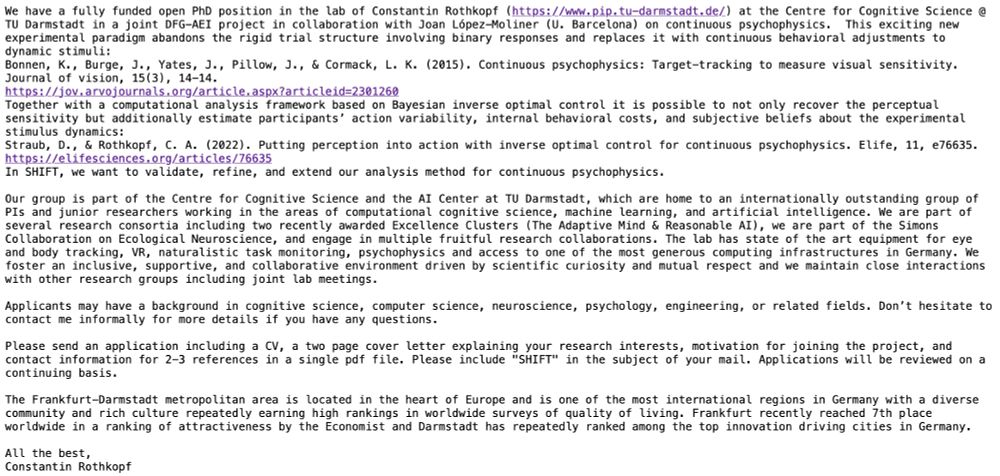
We have an open PhD position in an exciting @dfg.de - @ageinves.bsky.social project to further develop continuous psychophysics in collaboration with Joan-Lopez Moliner.
08.07.2025 10:12 — 👍 7 🔁 4 💬 0 📌 0
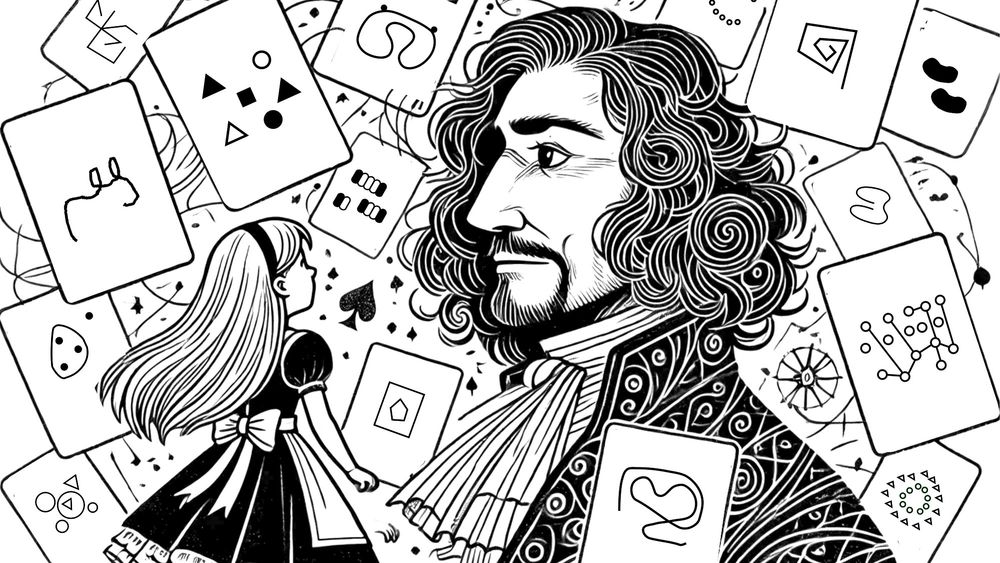
Excited to share that our paper got accepted at #ICML2025!! 🎉
We challenge Vision-Language Models like OpenAI’s o1 with Bongard problems, classic visual reasoning challenges and uncover surprising shortcomings.
Check out the paper: arxiv.org/abs/2410.19546
& read more below 👇
02.05.2025 07:47 — 👍 25 🔁 10 💬 1 📌 1

College of Liberal Arts | The University of Texas at Austin
Liberal Arts at UT offers over 40 majors and many top-ranked graduate programs in the social sciences and humanities taught by 750 faculty.
Happy to contribute to the Natural Environments Tasks and Intelligence (NETI) workshop at UT Austin with a talk on "Computational elements of goal-directed sensorimotor behavior". You can follow the live-stream at the workshop's website liberalarts.utexas.edu/cps/neti-wor...
25.04.2025 20:09 — 👍 5 🔁 0 💬 0 📌 0
Very excited to be part of the Simons collaboration on ecological neuroscience @simonsfoundation.org together with this fantastic team! Theory-driven investigation of where representations for perception, cognition, and action in ecological tasks come from. POMDPs FTW. Stay tuned for job openings...
25.04.2025 15:56 — 👍 24 🔁 7 💬 1 📌 0
If you wanna find out how to overcome Gaussian distribution and quadratic cost assumptions in Bayesian decision-making models AND how to perform inference over their parameters, swing by our poster at #ICLR2025 in Singapore!
📅 When: Friday, April 25, 10am–12:30pm
📍 Where: Halls 3 + 2B, Poster #61
23.04.2025 14:07 — 👍 7 🔁 1 💬 0 📌 1
More work still to appear ...
17.04.2025 13:37 — 👍 0 🔁 0 💬 0 📌 0

How to infer an individual’s knowledge about the dynamics of an environment? Approximate BAMDP planning model for uncertainty over transitions & efficient replanning, as well as an approximate knowledge inference method given the behavior of an agent based on the planning model and Gibbs sampling
17.04.2025 13:37 — 👍 2 🔁 0 💬 1 📌 0
Straub∗, D., Schultheis∗, M., Koeppl, H., & Rothkopf, C. A. (2023). Probabilistic inverse optimal control for non-linear partially observable systems disentangles perceptual uncertainty and behavioral costs. NeurIPS.
17.04.2025 13:37 — 👍 2 🔁 0 💬 1 📌 0
Schultheis∗, M., Straub∗, D., & Rothkopf, C. A. (2021). Inverse Optimal Control Adapted to the Noise Characteristics of the Human Sensorimotor System. NeurIPS.
17.04.2025 13:37 — 👍 0 🔁 0 💬 1 📌 0
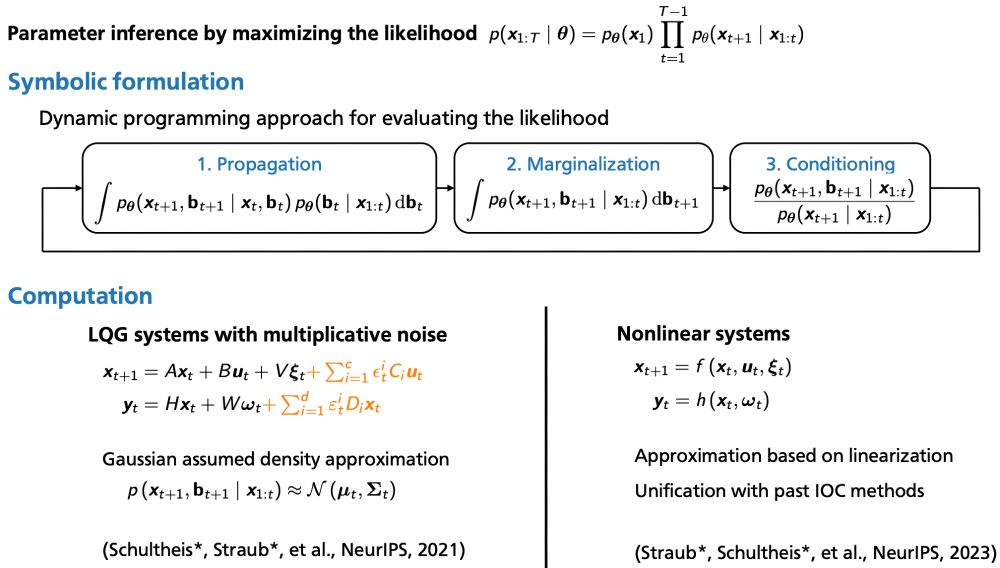
How to infer model parameters in sensorimotor control tasks? Dynamics may be stochastic and non-linear, the agent’s beliefs and controls may be unobserved, and beyond costs we may want to infer perceptual noises, beliefs, dynamics, and control-- this includes partial observations and unknown plant
17.04.2025 13:37 — 👍 0 🔁 0 💬 1 📌 0
M. Schultheis, C.A. Rothkopf, H. Koeppl (2022). Reinforcement learning with non-exponential discounting. NeurIPS.
17.04.2025 13:37 — 👍 0 🔁 0 💬 1 📌 0

We developed a theory of continuous-time model-based reinforcement learning generalized to arbitrary discount functions. This formulation covers non-exponential random termination times and includes solving the inverse problem of learning the discount function from decision data
17.04.2025 13:37 — 👍 0 🔁 0 💬 1 📌 0
How to model and estimate non-exponential time preferences? Commonly in reinforcement learning, rewards are discounted over time using an exponential function to model time preference. In contrast, in economics and psychology, it has been shown that humans often adopt a hyperbolic discounting scheme
17.04.2025 13:37 — 👍 0 🔁 0 💬 1 📌 0
Matthias was co-advised together with Heinz Koeppl.
17.04.2025 13:37 — 👍 0 🔁 0 💬 1 📌 0
Intelligent Autonomous Systems Group @TUDarmstadt working on Robot Learning, the intersection of robotics and machine learning.
Led by Prof. Jan Peters
https://www.ias.informatik.tu-darmstadt.de
Professor at UT Nuremberg, Germany
I’m 🇫🇷 and I work on RL and lifelong learning. Mostly posting on ML related topics.
PhD student at @dfki | @ias-tudarmstadt.bsky.social, working on RL 🤖 Previously master student at MVA @ENS_ParisSaclay | ENPC 🎓
Researcher in robotics and machine learning (Reinforcement Learning). Maintainer of Stable-Baselines (SB3).
https://araffin.github.io/
Neuroscientist (PhD) exploring how the primate 🧠 learns and decides, while exploiting the consumption of 🍕 and 🥯
All posts made in a personal capacity and do not reflect the views of my employer.
Lab website: www.fullcolorbrain.com
SYR/GNV/DC/PDX/ATL
PI Computational Cognitive Science (BoCoCo) lab in Edinburgh 🏴
https://zhaobn.github.io
she/her | 👩🏻🔬 PhD candidate @EPFL🇨🇭| Computational Neuroscience 🧠🤖 | 🔍 Exploring vision, motor control & neural representations ✨
🌐 celiabenquet.netlify.app
Postdoc @ Princeton AI Lab
Natural and Artificial Minds
Prev: PhD @ Brown, MIT FutureTech
Website: https://annatsv.github.io/
Professor, Northwestern University
Computational neuroscience | Neural manifolds
Vision & Motion. Stability & Plasticity.
Professor at University of Bonn.
www.troselab.de
Reverse engineering the brain
Assistant Professor / Faculty Fellow @nyudatascience.bsky.social studying cognition in mind & brain with neural nets, Bayes, and other tools (eringrant.github.io).
elsewhere: sigmoid.social/@eringrant, twitter.com/ermgrant @ermgrant
Prof. of Biological Psychology and director of the Berlin Mobile Brain/Body Imaging Labs (BeMoBIL) at TU Berlin.
Keen interest in the neural foundations of natural cognition in actively behaving humans.
Spatial navigation; Neurorbanism/NeuroArchitecture
neuroscientist studying vision at Univ of Oregon
nielllab.uoregon.edu
Team leader (tenured) at RIKEN AIP. Opinions my own. https://emtiyaz.github.io
🌉 bridged from https://mastodon.social/@emtiyaz on the fediverse by https://fed.brid.gy/
Assistant Professor for Computational Modelling of Behaviour @unimarburg.bsky.social | Collective decision-making and cultural evolution | https://www.uni-marburg.de/en/fb04/team-deffner/deffner
I study how people solve big problems with small brains. Starting at Dartmouth in 2026—I'm recruiting!
https://fredcallaway.com
Neuro + AI Research Scientist at DeepMind; Affiliate Professor at Columbia Center for Theoretical Neuroscience.
Likes studying learning+memory, hippocampi, and other things brains have and do, too.
she/her.
Computational cognitive scientist interested in learning and decision-making in human and machiches
Research director of the Human Reinforcement Learning team
Ecole Normale Supérieure (ENS)
Institut National de la Santé et Recherche Médicale (INSERM)