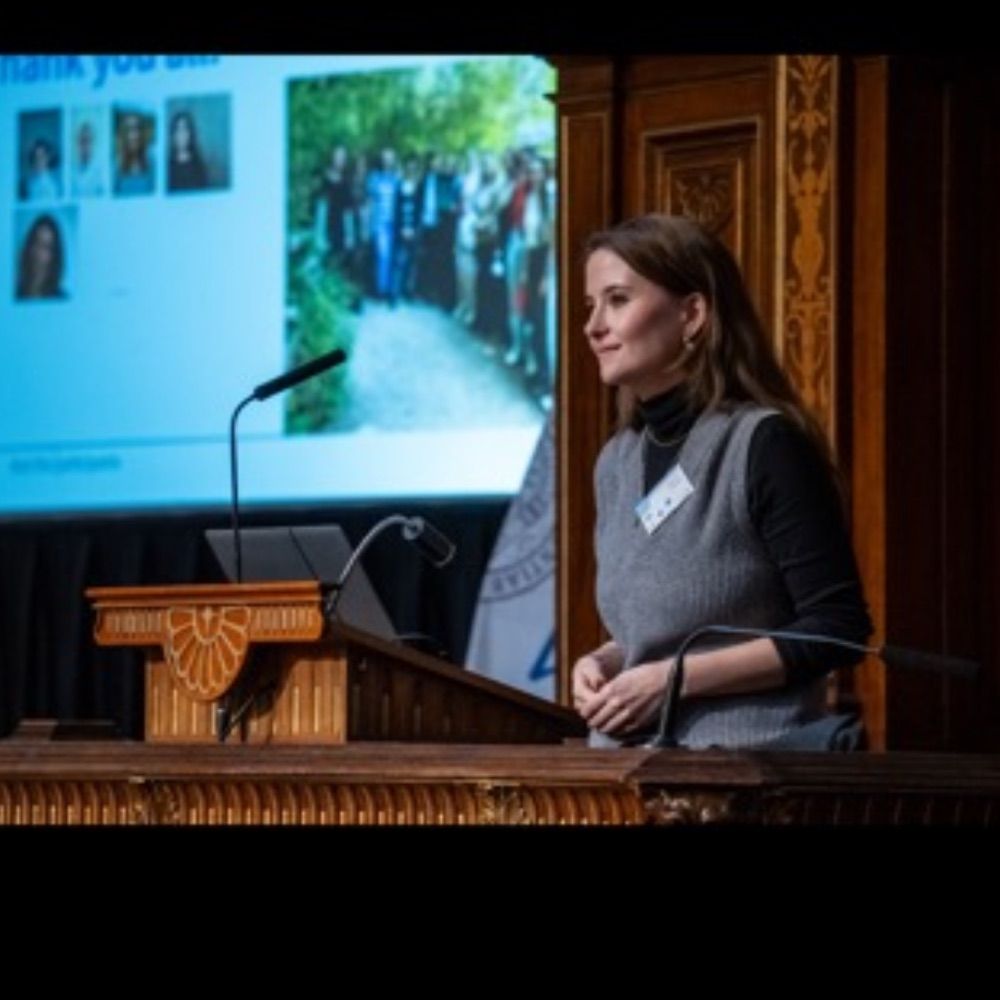
This study was an amazing collaborative experience. I'm really really grateful to all the wonderful people who contributed and made this happen.
It's the closest I have ever come to finding something like a "universal" in human cognition.
09.02.2026 12:32 — 👍 39 🔁 20 💬 6 📌 0

Mean life satisfaction in the survey years 2010, 2015 and 2023, separately for female and male gender.
In general, girls have lower scores but in 2023, they are drifting even further down

The city of Leipzig in Germany conducts large-scale school surveys of adolescents in secondary education schools. Following the regular surveys in 2010 and 2015, the 2020 survey had to be rescheduled to 2023 due to the COVID-19 pandemic. In this latest survey wave, the gender gap in general life satisfaction has significantly grown. While in 2010 and 2015 girls were somewhat less satisfied than boys (0.26 to 0.33 SD), in 2023 this gender gap had doubled (with girls 0.57 SD less satisfied). Why? Here, we probe various explanations, aiming to provide a template for researchers who are asking reverse causal questions (“What caused this?”). First, we find that the widening of the gender gap is much more pronounced among students with a migration background. This could plausibly be explained by a shift in the composition of the underlying population, with a strong increase of Syrian students, and a relative decrease of Vietnamese ones. Second, among students without a migration background, part of the increasing gender gap could potentially be attributed to survey mode: In 2023, for the first time, the survey was conducted on tablets—and unexpectedly, girls (but not boys) reported significantly lower satisfaction when surveyed on tablet rather than on paper. Third, beyond these two patterns, we still find significantly widening gender gaps in satisfaction with leisure time activities and relationships to friends. Thus, there may be a substantive increase in the gender gap in satisfaction in those two domains that is not readily attributable to changes in population and survey mode.
New preprint 🥳
The city of Leipzig conducts large-scale surveys of adolescents. In 2023, the gender gap in life satisfaction has significantly widened, with girls declining more steeply than boys. What's up with that?>
(work with @rmcelreath.bsky.social and @gregork.bsky.social)
29.01.2026 14:57 — 👍 129 🔁 33 💬 7 📌 4

"Intuitions of mathematical curves in young children's drawings"
In this new paper from the lab, Lorenzo Ciccione, Marie Lubineau, Theo Morfoisse and I show that 5 and 6 year olds already possess intuitions of linearity, curvature, period and compositionality.
www.sciencedirect.com/science/arti...
01.11.2025 13:51 — 👍 39 🔁 11 💬 0 📌 1

Applications open for the new #PhD program “Embracing Transformation” @leuphana.bsky.social (36 positions)
Research how societies respond to change – whether in climate, democracy, work, or digital culture.
Fin me in "Psychology of Transformation"
More info: www.leuphana.de/transformation-phd
31.07.2025 15:20 — 👍 4 🔁 6 💬 0 📌 2