bsky.app/profile/grf....
29.01.2026 17:55 — 👍 0 🔁 0 💬 0 📌 0
A pleasure to chat with Matt Galloway in The Current, earlier this morniing, about our recently published paper on spider monkeys' collective intelligence www.cbc.ca/listen/live-...
29.01.2026 17:53 — 👍 1 🔁 0 💬 1 📌 0
npj Complex.: Uncovering complementary information sharing in spider monkey collective foraging using higher-order spatial networks
https://www.nature.com/articles/s44260-025-00060-0
26.01.2026 14:30 — 👍 2 🔁 2 💬 0 📌 0
YouTube video by Global Research Centre for Diverse Intelligences
Uncovering complementary information sharing in spider monkey collective foraging
🐒🧠 New paper in npj Complexity: complementary information sharing in fission-fusion dynamics.
Video explainer: youtu.be/PIAhcLWqsO8?...
Full paper (open access): doi.org/10.1038/s442...
Higher-order spatial networks enable distributed foraging knowledge in heterogeneous environments.
👇
09.01.2026 19:09 — 👍 8 🔁 5 💬 1 📌 2
Fission-fusion dynamics implies distributed information processing analogous to that occurring in "liquid brains."
Collective intelligence through complementary knowledge sharing! 🧠✨
Collaborators:Ross S. Walker, @mattjsilk.bsky.social, Denis Boyer and @sandrateles-esmag.bsky.social
09.01.2026 19:09 — 👍 2 🔁 0 💬 0 📌 0
Maximal simplicial degree centrality shows sigmoidal scaling with simplex size: intermediate-sized simplices (4-6 individuals) are most central to the network.
Centrality is independent of age, sex, or immigration status → knowledge asymmetry driven by mobility, not individual traits.
09.01.2026 19:09 — 👍 0 🔁 0 💬 1 📌 0
These holes persist across multiple filtration values, indicating robust complementarity.
Even when including less redundant interactions, spatial overlaps don't form trivial structures - unique knowledge pockets remain across various subset sizes.
09.01.2026 19:09 — 👍 0 🔁 0 💬 1 📌 0

Persistence barcodes for the simplicial complexes in each season, including the simplices of individual core ranges formed by decreasingly redundant interactions.
We constructed filtered simplicial complexes using α as a filtration parameter (scaled by deviation from w*).
Persistent homology reveals topological holes, which we interpret as structural signatures of complementary information distribution 🕸️
09.01.2026 19:09 — 👍 0 🔁 0 💬 1 📌 0

Scaling relationship between the number of individual core ranges and its intersection/union ratio, w. Each dot corresponds to a particular set of a given number of individuals. The solid black line corresponds to the scaling relationship.
We found that in some cases, the observed w values closely follow the predicted convex decreasing function of set size n.
Smaller sets (2-6 individuals) show higher variance, suggesting this range is most dynamic for knowledge complementarity.
09.01.2026 19:09 — 👍 0 🔁 0 💬 1 📌 0

Conceptual illustration of the degree of redundancy and uniqueness shown by four hypothetical overlapping individual core ranges.
We derived an optimal intersection/union ratio (w*) that maximizes information transfer between n individuals:
w* = 1/(n+1)
This balances redundant overlap (coincidence opportunities) with unique knowledge (areas known exclusively by subsets).
09.01.2026 19:09 — 👍 0 🔁 0 💬 1 📌 0

Two sets of overlapping core ranges showing both redundant and unique areas
We estimated individual core ranges (60% utilization distributions) from 6 years of location data in Yucatan, Mexico.
We assumed that these core ranges represent an individual's spatial knowledge for a given season, while partial overlaps create opportunities for information transfer.
09.01.2026 19:09 — 👍 0 🔁 0 💬 1 📌 0
Spider monkeys (Ateles geoffroyi) exhibit high fission-fusion dynamics - individuals form subgroups that join and split frequently.
We asked whether distributed spatial knowledge across individuals enabled collective processing of foraging information beyond individual capacity.
09.01.2026 19:09 — 👍 0 🔁 0 💬 1 📌 0
YouTube video by Global Research Centre for Diverse Intelligences
Uncovering complementary information sharing in spider monkey collective foraging
🐒🧠 New paper in npj Complexity: complementary information sharing in fission-fusion dynamics.
Video explainer: youtu.be/PIAhcLWqsO8?...
Full paper (open access): doi.org/10.1038/s442...
Higher-order spatial networks enable distributed foraging knowledge in heterogeneous environments.
👇
09.01.2026 19:09 — 👍 8 🔁 5 💬 1 📌 2
Thrilled to see this paper out, two years after starting our collaboration at @divintelligence.bsky.social
30.12.2025 19:58 — 👍 9 🔁 3 💬 0 📌 0

Jane Goodall with the rest of participants at the Animal Social Complexity and Intelligence conference, Chicago, 2000
Always uniquely funny and inspiring. Here at one of the first conferences I attended as a grad student, the Animal Social Complexity and Intelligence conference in Chicago, in 2000. Thank you Jane Goodall.
01.10.2025 19:04 — 👍 2 🔁 0 💬 0 📌 0
bsky.app/profile/grf....
04.06.2025 18:14 — 👍 0 🔁 0 💬 0 📌 0
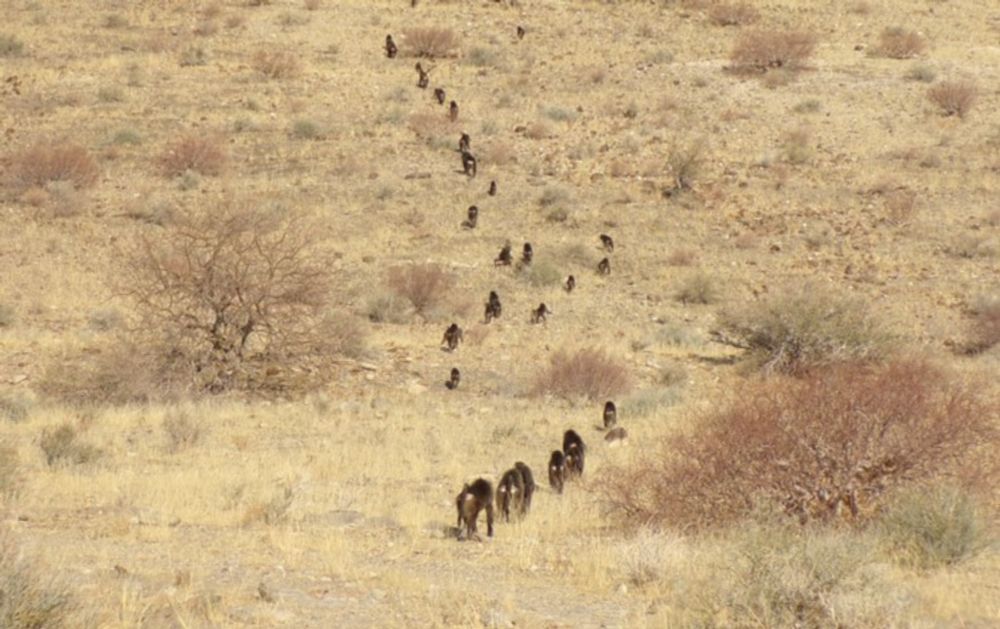
Baboons walk in line for friendship, not survival, new study finds
Researchers at Swansea University have discovered that baboons walk in lines, not for safety or strategy, but simply to stay close to their friends.
New paper in @behavecol.bsky.social (link: academic.oup.com/beheco/advan...)
led by PhD student @marcofele.bsky.social using hard-won data from our amazing baboon team. Our @swanseauni.bsky.social press release:
www.swansea.ac.uk/press-office...
We introduce the idea of a "social spandrel".....
03.06.2025 17:55 — 👍 38 🔁 19 💬 3 📌 1
5/5
combined knowledge has complementarity: each individual fills in parts of the puzzle that others miss. We argue that the ever-changing structure of these groups helps them collectively adapt and make the most of their shared knowledge in unpredictable environments.
🐒 🧩 🐒 = 🧠
05.05.2025 12:19 — 👍 1 🔁 0 💬 0 📌 0
4/5
to share key information, but also enough unique knowledge to cover more ground. To model these interactions, we used a mathematical approach (simplicial complexes) that captures how multiple animals exchange information at once. This revealed 'gaps' in different dimensions—meaning the group’s…
05.05.2025 12:19 — 👍 0 🔁 0 💬 1 📌 0
3/5
track changes in their environment better than any individual could on its own. We studied how much individual animals' core ranges overlap, treating these overlaps as a way to measure shared vs. unique knowledge of food sources. Some range combinations strike a balance: they have enough overlap
05.05.2025 12:19 — 👍 0 🔁 0 💬 1 📌 0
2/5
Groups can often process information together more effectively than any single member could alone. In species with fission-fusion dynamics—where animals frequently split up and reunite (like dolphins or chimpanzees)—sharing different bits of knowledge about food locations helps the whole group…
05.05.2025 12:19 — 👍 0 🔁 0 💬 1 📌 0
Preprint: The causal role of synergy in collective problem solving. Great collaboration with DISI fellows @ketikagarg.bsky.social @culturologies.co, Zara Anwarzai and Hannah Dromiack
23.04.2025 18:40 — 👍 4 🔁 2 💬 0 📌 0
Group identity without social interactions? | Behavioral and Brain Sciences | Cambridge Core
Group identity without social interactions? - Volume 48
With colleagues from our social complexity seminar, we joined the debate in BBS on "What is a society" by M. Moffett. We argue that a society can emerge from social interaction patterns without the need for establishing an a priori limit on who actually belongs to it doi.org/10.1017/S014...
09.04.2025 10:35 — 👍 1 🔁 1 💬 0 📌 0
“Everything is political, especially the things that people tell you are not political. Those are the most political of all”
05.03.2025 10:02 — 👍 3 🔁 0 💬 0 📌 0
Official account of the University of Konstanz. Successful in the German Excellence Initiative and Excellence Strategy — since 2007.
Website: https://www.uni-konstanz.de
Impressum: https://www.uni-konstanz.de/impressum
Science X provides daily science news on research developments, technological breakthroughs and the latest science innovations.
Phys. org: https://phys.org/
Medical Xpress: https://medicalxpress.com/
Tech Xplore: https://techxplore.com/
Cosmologist, pilot, author, connoisseur of cosmic catastrophes. TEDFellow, CIFAR Azrieli Global Scholar. Domain verified through my personal astrokatie.com website. She/her. Dr.
Personal account; not speaking for employer or anyone else.
Professor at ICTA-UAB and Visiting Senior Fellow at LSE • Author of THE DIVIDE and LESS IS MORE • Global inequality, political economy and ecological economics
Assistant Professor for Computational Modelling of Behaviour @unimarburg.bsky.social | Collective decision-making and cultural evolution | https://www.uni-marburg.de/en/fb04/team-deffner/deffner
The GRCDI aims to develop a ground-breaking framework that paves the way to the development of empirically tractable big ideas that cut across disciplines and set the research agenda for the coming years.
Phil of tech/science, cultural/tech evo, distributed cognition, and interdisciplinary integration. Associate professor at UM6P-FGSES.
https://mcharbonneau.com/
Cognitive Biology Professsor, Comparative Cognition Researcher, Head of the Goffin Lab, Messerli Research institute, @VetmeduniVienna
Prof of Neurogenetics & Genomics @St Andrews and Bonn; interested in cognition, neurodevelopment, dyslexia and handedness. Co-Chair of the @sldnetwork.bsky.social. Made in Italy.
https://neurogenetics.st-andrews.ac.uk/
Studies social identity, group/crowd behaviour, social influence and leadership. Senior lecturer at University of St Andrews Business School. Organsises live music at BigRockNewport.
Reader in Phys & Astro @ Univ St Andrews – Co-Director, Centre for Exoplanet Science (StA-CES) – Past President of NoRCEL – Alumnus of the Global Young Academy (GYA)
teaching faculty @ UPenn
Ph.D. in Cognitive Science from UC Irvine w/Megan Peters
science writer (words in Scientific American, Science News, Nat Geo and other outlets)
studied phil + neuro + psych @ UChicago - she/they
norabradford.com
PhD candidate in Animal Behaviour at the University of Portsmouth
NSF SBE Postdoctoral Fellow at Harvard and UMich • Incoming Professor at TCNJ • Interdisciplinary researcher studying what kids think about AI • Science Communicator • R Stats nerd • Passionate about Pedagogy • FirstGen 🏳️🌈
#ComplexNetworks · #ComplexSystems · #Cities
Associate Professor @ Network Science Institute, Northeastern University London.
Behavioural Ecologist, studying communication and group coordination
Primatologist, Assistant Professor and PI of the Great Ape Behaviour Lab at UVic Anthropology in BC, Canada
www.ammiekkalan.com
Myrmecologist | Accidental bioacoustician | Behavioural ecologist | PhD student @ Umeå university |
Don't let pfp fool you I'm a parrot fan too :]
Ant drawing by Hélène Bézin--Chaingy
Used to study at Sorbonne Nord @leec-uspn.bsky.social
Check here for updates on the EFP 2026 conference, to be held in Montpellier, France, 29th June- 3rd July 2026.
Official website: https://www.alphavisa.com/efp/2026/index.php