I wrote a short expository note about a beautiful result of Carmosino, Gao, Impagliazzo, Mihajlin,
Paturi, and Schneider for certifying NO instances of 3-SUM in roughly n^{3/2} time, beating the fastest known, roughly n^2-time deterministic algorithm: home.cs.colorado.edu/~hbennett/no.... 1/
23.01.2026 16:36 — 👍 21 🔁 3 💬 2 📌 0
I think what I'm proposing just achieves the best of all worlds here? You can write f(n) <= g(n) + O(h(n)) and maintain the flexibility of big-O notation while achieving the clarity of an inequality rather than a "one-way equality."
18.01.2026 05:33 — 👍 0 🔁 0 💬 0 📌 0
But, Knuth prefers big-O because it's cumbersome to use << to write, e.g., f(n) = g(n) + O(h(n)). One would have to write f(n) - g(n) << h(n), which would be annoying in more complicated settings if one wants to write something like f(n) = g(n) + h_1(n) = g(n) + O(h_2(n)) or something.
18.01.2026 05:33 — 👍 0 🔁 0 💬 1 📌 0
He then says that the notation f(n) << g(n) (or similar) has the huge benefit that it is clear and doesn't yield the weird "one-way equalities" that one gets from f(n) = O(g(n)).
18.01.2026 05:18 — 👍 0 🔁 0 💬 1 📌 0
Thanks for the link!
It looks like Knuth says that they're best thought of as sets, but we should still write equalities and not set inclusion because that's what people are used to.
18.01.2026 05:18 — 👍 1 🔁 0 💬 1 📌 0
Much butter, and also much better :).
18.01.2026 05:11 — 👍 0 🔁 0 💬 0 📌 0
I feel like that's technically incorrect, but not in a way that is likely to be misunderstood. So, it's much butter than saying "if m is O(n^2)" to mean "if m >= C n^2", which is both incorrect and likely to be misunderstood.
18.01.2026 05:03 — 👍 0 🔁 0 💬 2 📌 0
I know that this is not an original idea. It seems that many authors use this notation already, at least in some contexts. I have not seen anyone advocate for its widespread adoption, so I thought I would.
07.01.2026 18:41 — 👍 1 🔁 0 💬 0 📌 0
A more subtle example is something like f(n) = n^2 + O(n). This sometimes means f(n) <= n^2 + O(n), but it often means |f(n) - n^2| <= O(n). Note that using inequalities here again removes this ambiguity.
07.01.2026 18:38 — 👍 0 🔁 0 💬 1 📌 0
This sometimes removes ambiguity. E.g., f(n) = poly(n) is ambiguous. This can mean that f(n) is upper bounded by a polynomial in n, that it's lower bounded, or both. I think one should write f(n) <= poly(n), f(n) >= poly(n), and f(n) = poly(n) to distinguish these cases.
07.01.2026 18:38 — 👍 0 🔁 0 💬 1 📌 0
For more complicated expressions like f(n) <= 1/(1-O(1/x)) or whatever, the inequality is useful to help the reader know whether an upper bound or a lower bound is implied by the notation.
07.01.2026 18:38 — 👍 2 🔁 0 💬 1 📌 0
I think this notation makes it much clearer what we mean. It also solves the annoying problem that something like "f(n) = O(n^2)" is an abuse of the equals sign, which pedants (like me) often complain about.
07.01.2026 18:38 — 👍 0 🔁 0 💬 1 📌 0
A simple and modest proposal for improving asymptotic notation | Solipsist's Log
I wrote up a little blog post proposing a slightly different way to write asymptotic notation. www.solipsistslog.com/a-simple-and...
In short, I think asymptotic notation should usually be written with an INequality. E.g., f(n) <= O(n^2), f(n) < o(log n), f(n) > 2^{-o(n)}, f(n) >= n^{-O(1)}, etc.
07.01.2026 18:32 — 👍 13 🔁 5 💬 4 📌 0
On brand!
02.01.2026 01:34 — 👍 2 🔁 0 💬 0 📌 0

To kick off 2026, here's a quick thread on a few mountain ascents from 2025, starting at home in Boulder, Colorado with Mount Sanitas (6,798') at night. 1/4
01.01.2026 20:14 — 👍 10 🔁 1 💬 2 📌 0
This isn't exactly what you want, but the composition series seems closely related.
12.12.2025 04:33 — 👍 0 🔁 0 💬 1 📌 0
Let me finish with a fun technical tool: We show an AM protocol that *upper* bounds the image size of a circuit C. This is kind of dual to the celebrated Goldwasser-Sipster protocol, which gives an AM protocol that *lower* bounds this (or any NP set). This seems likely to have other applications!
09.12.2025 00:40 — 👍 1 🔁 0 💬 0 📌 0
Avoid could be such a problem itself. However, our work doesn't rule out a reduction from a hard decision problem that lies in AM ∩ co-AM---even a well-studied problem like, say, factoring.
09.12.2025 00:40 — 👍 0 🔁 0 💬 1 📌 0
A key subtlety here is the distinction between search and decision. As a trippy example, there exist search problems A such that (1) every *decision* problem that reduces to A is efficiently solvable; but (2) A itself is not efficiently solvable. (It's a fun exercise to come up with such a problem.)
09.12.2025 00:40 — 👍 0 🔁 0 💬 1 📌 0
For example, this immediately implies that the (co-NP-complete) problem of verifying solutions to Avoid does *not* reduce to Avoid unless PH collapses, which is just trippy! (Lots of things about Avoid are quite trippy!)
09.12.2025 00:40 — 👍 0 🔁 0 💬 1 📌 0
We show that this is unlikely. For example, we show that NP-hardness of Avoid would collapse the polynomial hierarchy (to AM). More generally, we show that any decision problem that reduces to Avoid is in AM ∩ co-AM. (This works even for adaptive, randomized reductions.)
09.12.2025 00:40 — 👍 1 🔁 0 💬 1 📌 0
Basically, Korten showed that an algorithm would allow us to derandomize *many* randomized constructions.
However, this left open the question of whether we simply reduce a well-studied presumed hard problem to it to show that Avoid is hard. Ideally, we'd like to show NP-hardness.
09.12.2025 00:40 — 👍 0 🔁 0 💬 1 📌 0
Avoid is not only weird, but also important. E.g., Korten and Jeřábek showed that it is in FP^{NP} if and only if E^{NP} requires 2^{\Omega(n)}-size circuits!! And, Korten showed that an algorithm for Avoid would yield nearly optimal two-source extractors, rigid matrices, hard truth tables, etc.
09.12.2025 00:40 — 👍 0 🔁 0 💬 1 📌 0
I find this problem to be endlessly fascinating because of how weird it is.
For example, Avoid is clearly hard in some sense, since just *verifying* a solution is coNP-complete. On the other hand, Avoid is clearly easy in some sense, since a random string is a solution with probability 1/2.
09.12.2025 00:40 — 👍 0 🔁 0 💬 1 📌 0
The input to Avoid is a circuit C : {0,1}^n -> {0,1}^{n+1}. Since C is expanding, there must be some string (in fact, many strings) y \in {0,1}^{n+1} that are not in the image of C. The goal is to find such a y that is not in the image.
09.12.2025 00:40 — 👍 0 🔁 0 💬 1 📌 0
We study the range-avoidance problem (Avoid), which was introduced by Kleinberg, Korten, Mitropolsky, and Papadimitriou in 2021. This problem gained a ton of attention after Korten showed that it has deep connections to derandomization and circuit lower bounds.
09.12.2025 00:40 — 👍 1 🔁 0 💬 1 📌 0
ECCC - TR25-210
New paper with Surendra Ghentiyala (my wonderful PhD student) and Zeyong Li (a PhD student at NUS) eccc.weizmann.ac.il/report/2025/... .
I'm super excited about this paper!
09.12.2025 00:40 — 👍 7 🔁 1 💬 1 📌 0
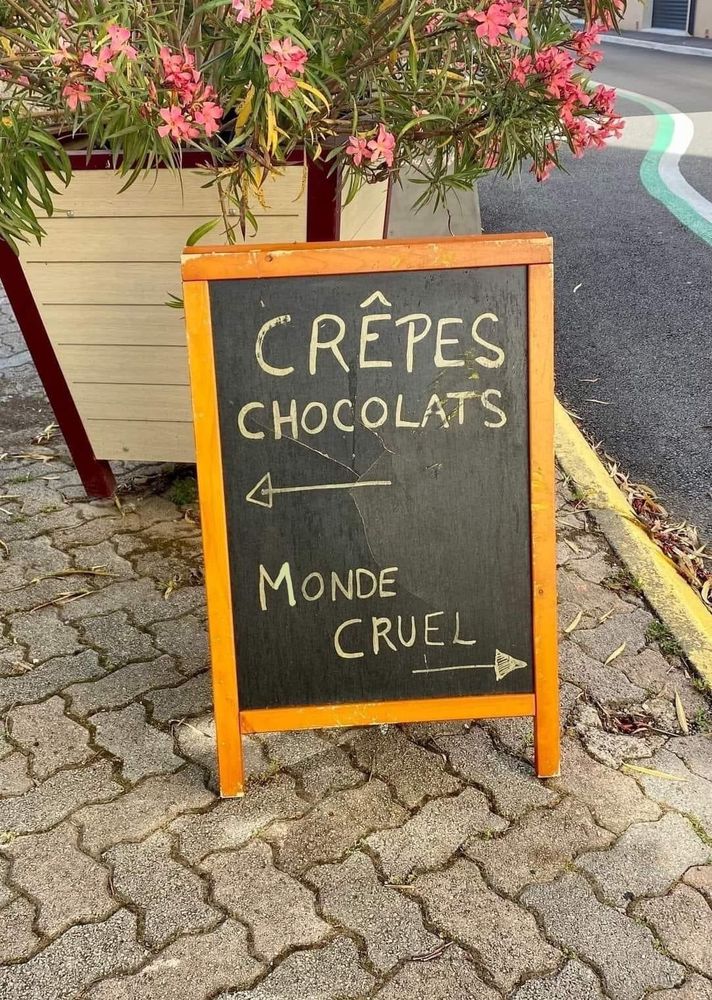
French sign saying (in French) "Crepes and chocolates", left arrow. "Cruel world", right arrow. Harvested from the webs, no idea of attribution.
27.07.2025 08:10 — 👍 4391 🔁 1202 💬 36 📌 59
Sarah Huckabee Sanders was once politely asked to leave a restaurant and it generated 100x as much handwringing from the media as this will
31.05.2025 19:45 — 👍 10190 🔁 3065 💬 181 📌 41
Kimbrel's receipt of this honor is well-deserved! To celebrate, I'll discuss the matrix multiplication verification problem and his improvement with R.K. Sinha [KS93] to Freivalds' algorithm [Fre79].
More improvements are ongoing work, joint with @huckbennett.bsky.social and @noahsd.bsky.social!
01.06.2025 12:17 — 👍 5 🔁 2 💬 1 📌 0
Fighting every day to deliver a city that working New Yorkers can actually afford. Mayor of New York City.
M.S. Computer Science @Stanford. Interested in machine learning privacy, AI security, diffusion models, cryptography, AI for environment, healthcare, education
🌱 poonpura.github.io
PhD Student in the Stanford CS Theory group, studying computational social choice.
https://web.stanford.edu/~pras1712/
Postdoc on high troughput bioinformatics @ KIT Karlsruhe;
IMO, ICPC, Xoogler, Rust, road-cycling, hiking, wild camping, photography
Quantum Learning Theory PhD student @ University of Edinburgh
https://chirag-w.github.io/
Assistant Professor in Computer Science at Boston University. I work on quantum computation and cryptography.
Researcher in Cryptography (symmetric-key, white-box, post-quantum, etc.)
https://affine.group
PhD Student at UMD studying Cryptography
website: sasha.place
Formerly at Meta/Cornell
Unofficial bot tracking the IACR Cryptology ePrint Archive (eprint.iacr.org). Maintained by @str4d.xyz.
Currently only posts about new papers. Author names are linkified to Bluesky accounts (cryptography.social); contact maintainer for inclusion/removal.
Computer Science -- Data Structures and Algorithms (cs.DS)
source: https://export.arxiv.org/rss/cs.DS
maintainer: @tmaehara.bsky.social
https://sites.google.com/view/yihan/
☯️🌈🌊 I ❤️ Psych/Sociology, Philosophy, ZR & Unreal Cinematography, Cosmology, Writing & SciFi, but Comedy is Life! Also follow AI & S/W Dev stuff.
Quantum Complexity Theory | Researching how hard the universe lets computation be.
Professor of Computer Science, Oxford University. Research interest in Algorithmic Game Theory, also Computational Complexity.
Also interested in good urbanism & cartoons
https://www.cs.ox.ac.uk/people/paul.goldberg/index1.html
Lecturer @sydney.edu.au @sydneycompsci.bsky.social
Previously Post Doc at @NttResearch, CMU @CyLab. PhD from @UniFAU. Cryptography, Fairness, Blockchain, Cryptocurrency
Webpage: http://aravinda-thyagarajan.com
MIT postdoc, incoming UIUC CS prof
katedonahue.me
Assistant Professor at NYU Courant Institute School | Postdoc at MIT | PhD at CMU | Theoretical Computer Science | Quantum Information
[bridged from https://theory.report/ on the web: https://fed.brid.gy/web/theory.report ]