It has become received wisdom in Brussels and Washington that there is a new “euro-sclerosis”: that the EU economy is lagging the US
This view is wrong
A little primer on the measurement of productivity – and why reports of the economic death of Europe are greatly exaggerated🧵
12.12.2025 12:32 — 👍 1163 🔁 605 💬 25 📌 90

🔬 How has psychology contributed to achieving the 🇺🇳 SDGs?
Our new preprint maps 230,000 psychology articles to the SDGs using our text2sdg R package (www.text2sdg.io) and analyzes historical trends in topics, national and gendered contributions, and citation patterns.
🔗 arxiv.org/abs/2512.08628
10.12.2025 08:34 — 👍 10 🔁 7 💬 0 📌 0
Does “feeling right”—that is, experiencing regulatory fit—lead us to act more in line with our moral preferences?
With @schildchristoph.bsky.social and @stepf.bsky.social, we conducted a series of the first large-scale, independent close replications in the field of regulatory fit.
05.12.2025 15:33 — 👍 9 🔁 6 💬 1 📌 1

1/ Does growing up poor always lead to political apathy?
Very happy to share my first paper published (open access) in @electoralstudies.bsky.social, where I show that parents' influence mitigates the poverty gap in participation, while economic mobility does not.
🔗 shorturl.at/p5Bac
04.12.2025 10:54 — 👍 84 🔁 39 💬 3 📌 1

Today, social media platforms hold the sole power to study the effects of feed-ranking algorithms. We developed a platform-independent method that reranks participants’ feeds in real time and used this method to conduct a preregistered 10-day field experiment with 1256 participants on X during the 2024 US presidential campaign. Our experiment used a large language model to rerank posts that expressed antidemocratic attitudes and partisan animosity (AAPA). Decreasing or increasing AAPA exposure shifted out-party partisan animosity by more than 2 points on a 100-point feeling thermometer, with no detectable differences across party lines, providing causal evidence that exposure to AAPA content alters affective polarization. This work establishes a method to study feed algorithms without requiring platform cooperation, enabling independent evaluation of ranking interventions in naturalistic settings.
New paper in Science:
In a platform-independent field experiment, we show that reranking content expressing antidemocratic attitudes and partisan animosity in social media feeds alters affective polarization.
🧵
01.12.2025 07:59 — 👍 153 🔁 67 💬 4 📌 3

Four three-year postdoctoral positions in the project Slow-Motion Democracy - Vacancy at Aarhus University
Vacancy at Department of Political Science, Aarhus University
Four (!) three-year postdoc positions available at @au.dk: international.au.dk/about/profil...
Join an incredible team & help understand the psychological & political implications of the clash between high-speed society & slow-speed democracy.
Please share! @tboeggild.bsky.social can help with Qs
06.11.2025 14:14 — 👍 30 🔁 35 💬 0 📌 1
It's ok, all holders of these securities need to do is buy an over-the-counter credit derivative to hedge their default risk, then securitize and tranche those derivative contracts and sell the resulting income streams. Assuming the top tranches get AAA credit ratings, what could possibly go wrong?
31.10.2025 04:02 — 👍 25 🔁 7 💬 4 📌 2

Published today: One of the biggest #science #communication studies to date. We asked 71,922 people in 68 countries how they #engage with information about #science and combined the data with several country-level factors: journals.sagepub.com/doi/10.1177/... #OpenAccess
21.10.2025 12:26 — 👍 157 🔁 83 💬 4 📌 11
This #SPSP preconference 1st happened in January of 2016 when the area was 'emerging'. It's more arrived than emerging these days. I will talk about how to approach inequality scholarship (be it central or peripheral to your research question) from a functional perspective: rdcu.be/eBHv8
14.10.2025 14:23 — 👍 12 🔁 4 💬 0 📌 0
Looking forward to finally meeting in person, Andrei! 😀
14.10.2025 12:36 — 👍 2 🔁 0 💬 1 📌 0
Interested in how social psychology can illuminate socioeconomic inequality? Come join us for the preconference on economic inequality and social class at SPSP!
14.10.2025 12:36 — 👍 2 🔁 0 💬 0 📌 0

Senior Economist Molly Broome:
"Wealth gaps in Britain are now so large that a typical full-time employee saving all their earnings across their entire working life would still not be able to reach the top of the wealth ladder. These gaps are doubly concerning as wealth mobility in Britain is low – people that start life wealthy tend to stay wealthy, and vice versa.
Rising house prices and changes in the value of pension promises account for most of the growth in wealth gaps since the early 2010s, rather than any active behaviour on the part of individuals, such as buying homes or acquiring new assets.
Soaring wealth and an acute need for more revenue has prompted fresh talk of wealth taxes ahead of the Budget next month. But with property and pensions now representing 80 per cent of the growing bulk of household wealth, we need to be honest that higher wealth taxes are likely to fall on pensioners, Southern homeowners or their families, rather than just being paid by the super-rich."
🚨 New research published today
'Before the fall' looks at what has happened to the distribution of household wealth in Britain and the impact on families.
Read it here 👉 buff.ly/Ya8kInK
08.10.2025 07:52 — 👍 15 🔁 12 💬 0 📌 6

Fattige børn får dårligere mad, får sjældnere børstet tænder og får mindre opbakning fra læreren
Danmark | Sektionen med Politikens undersøgende journalistik og seneste nyt indenfor politik, ret, sundhed, uddannelse, forbrug, økonomi og aktuelle temaer
Økonom og lektor ved CBS Birthe Larsen:
»Vi ved, at det påvirker børn negativt hele livet at vokse op i fattigdom, og at de har svært ved at kravle op igennem indkomstlagene. Den her undersøgelse giver et bud på, hvorfor det er så svært«, siger hun.
Læs denne artikel!:
politiken.dk/del/gUv3kYAE...
30.09.2025 06:10 — 👍 45 🔁 11 💬 0 📌 2

New Capitalism in America, Part III - LSE Inequalities
Why is capital so concentrated and why do so few have it? Under the "new" capitalism, why do 85% of the world’s population remain capital-income destitute?
“What has happened is not that capital income trickled down, but that labour income ‘trickled up’” – @brankomilan.bsky.social on how income from capital remains a privilege of the few in our latest blog post #LSEInequalitiesBlog
Read the post here: buff.ly/BEs46q0
17.09.2025 10:58 — 👍 6 🔁 4 💬 0 📌 0

A line graph titled "A comparison of World Bank estimates of extreme poverty" illustrates the global number of people living in extreme poverty.
Two distinct lines are present: one in dark brown representing the previous estimates using a poverty line of $2.15 per day measured in 2017 prices, and another in blue for the latest estimates utilizing a new poverty line of $3 per day measured in 2021 prices. The brown line trends downward, starting around 2 billion in 1990 and reaching 692 million in 2024. The blue line, starting slightly higher at roughly 2.3 billion, shows a similar decline, reaching 817 million in 2024. The difference between the lines — 125 million — indicates the increase in the estimated number of people living in extreme poverty due to the new measurement criteria.
The note at the bottom indicates that data has been adjusted for inflation and differences in living costs using international dollars from 2017 and 2021. The data source is the World Bank (2025)
The latest World Bank data counts 125 million more people as living in extreme poverty — but the world has not gotten poorer.
12.09.2025 12:25 — 👍 33 🔁 12 💬 3 📌 0

Antisocial Economics
What is wealth? How come so many of us haven’t got any? How does wealth inequality make poverty worse? In the UK and other rich economies, wealth inequality and poverty are at incredibly high…
Episode five of Antisocial Economics is out now!
@wealtherty.bsky.social talks to Professor Adrian Sinfield about the hidden world of tax expenditures, and why we know so little about a huge government expenditure that benefits higher income earners the most.
27.08.2025 11:32 — 👍 7 🔁 4 💬 0 📌 0

Just published in @jpube.bsky.social:
"Old money: Campaign finance and gerontocracy in the United States"
By @adambonica.bsky.social & @jakemgrumbach.bsky.social
www.sciencedirect.com/science/arti...
#econsky #publiceconomics
25.08.2025 13:18 — 👍 34 🔁 12 💬 2 📌 0
On my way to #ISPP2025 in Prague!
Very excited for our symposium on Saturday at 3:10PM arranged by @fransolmar.bsky.social:
“Unpacking support for redistribution: Psychological mechanisms and interventions”
Feel free to reach out if you want to meet up for a coffee and chat!
02.07.2025 11:19 — 👍 0 🔁 0 💬 0 📌 0
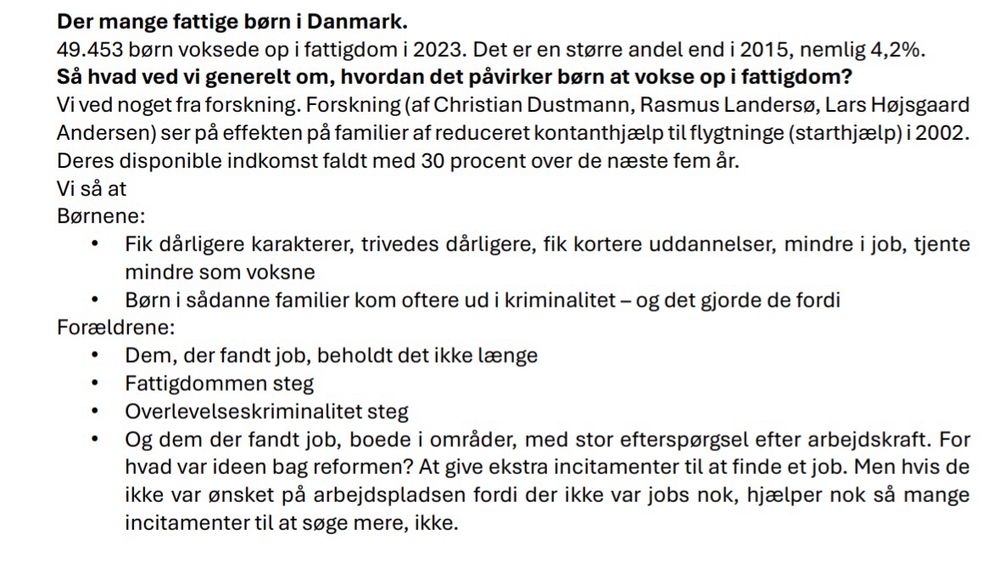
I dag træder et nyt kontanthjælpssystem i kraft.
Forskning viser at Kontanthjælpsreformen i 2002 med nettofald i indkomst for de fattigste på 30% (starthjælp) betød mere fattigdom, børn der trivedes dårligere, fik dårligere karakterer, kortere uddannelse, mindre i job, lavere indkomst som voksne.
01.07.2025 08:52 — 👍 101 🔁 31 💬 5 📌 4
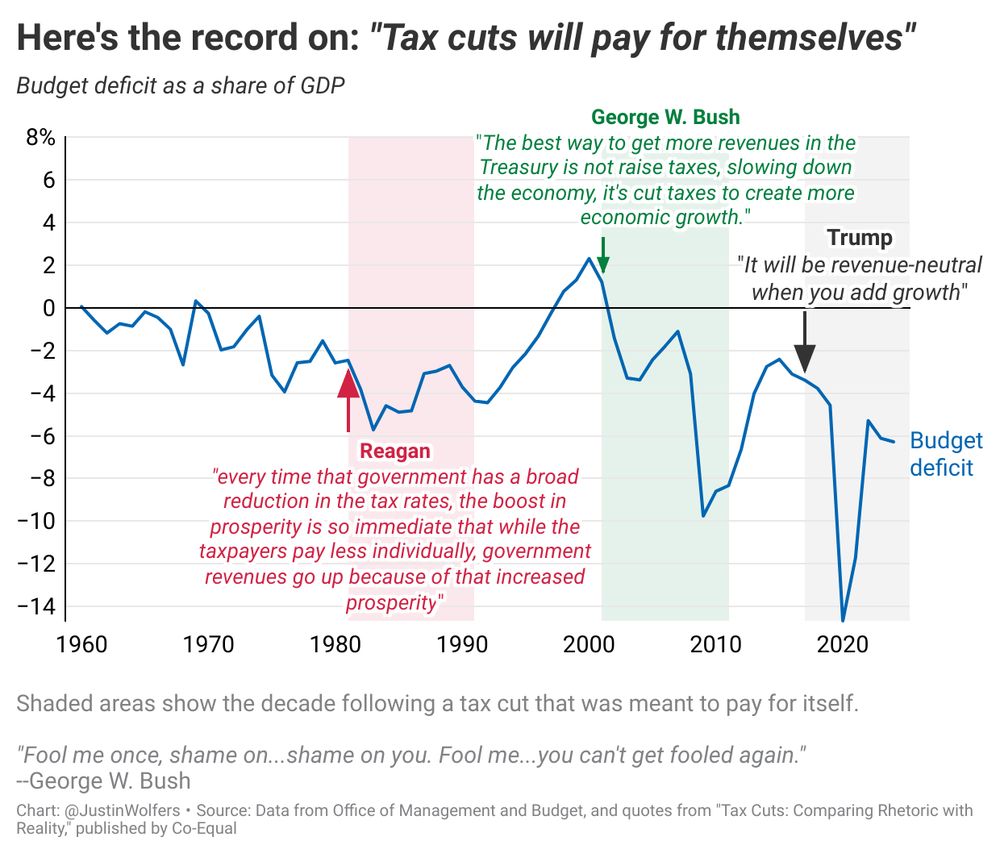
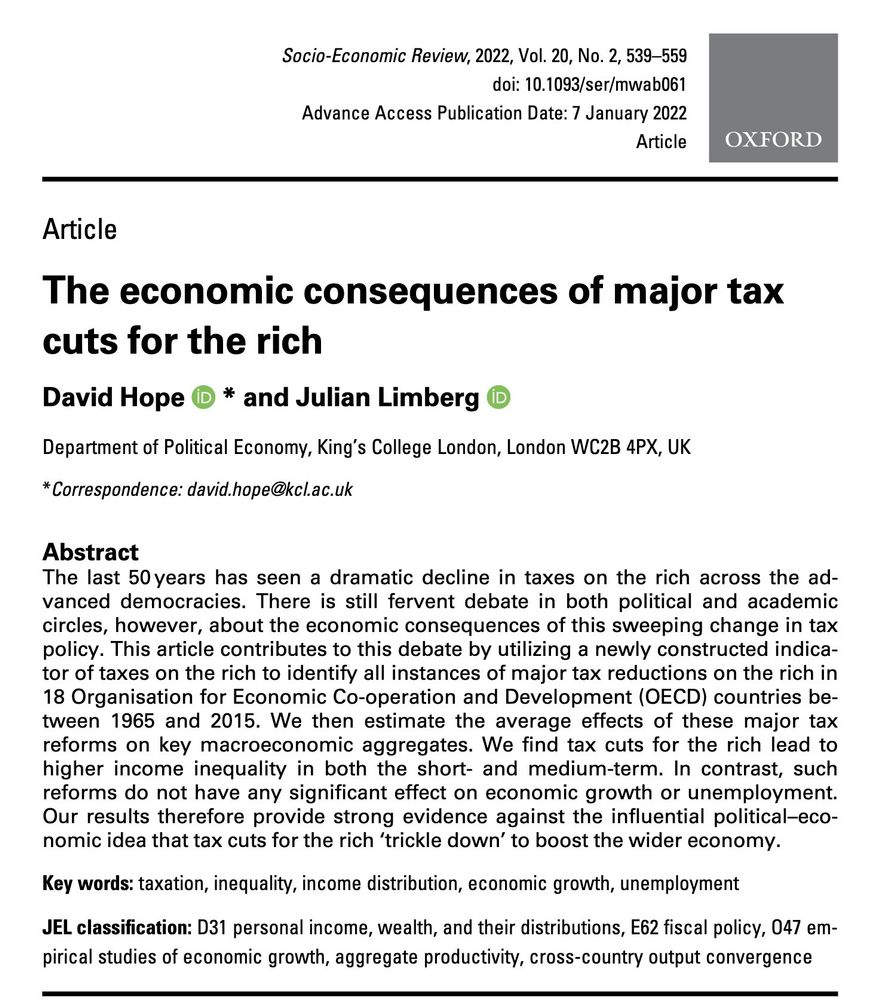
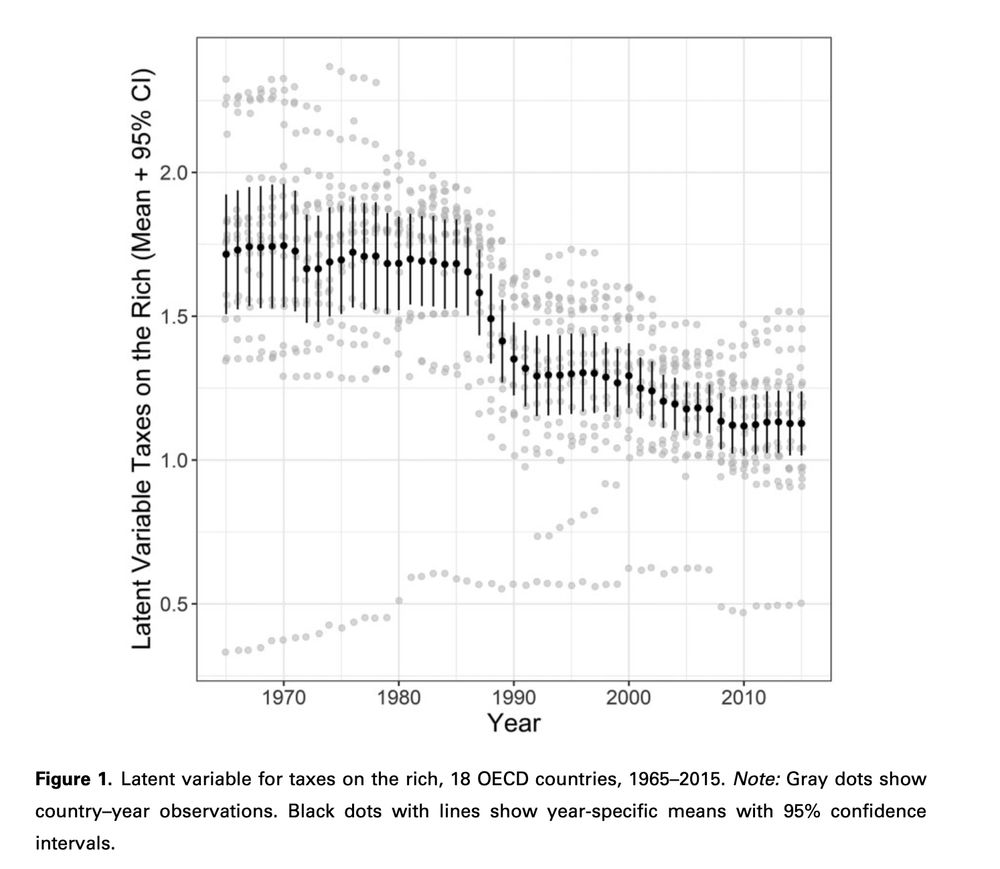
You’ve seen this movie before: Maybe Reagan guessed, Bush hoped, and Trump tried—but tax cuts never paid for themselves. Given the mountain of evidence, claiming once again that "tax cuts will pay for themselves" is no longer ideologically motivated optimism.
It's a lie.
27.06.2025 00:37 — 👍 3360 🔁 1359 💬 94 📌 88
Trickle up economics
01.07.2025 10:46 — 👍 247 🔁 76 💬 6 📌 2
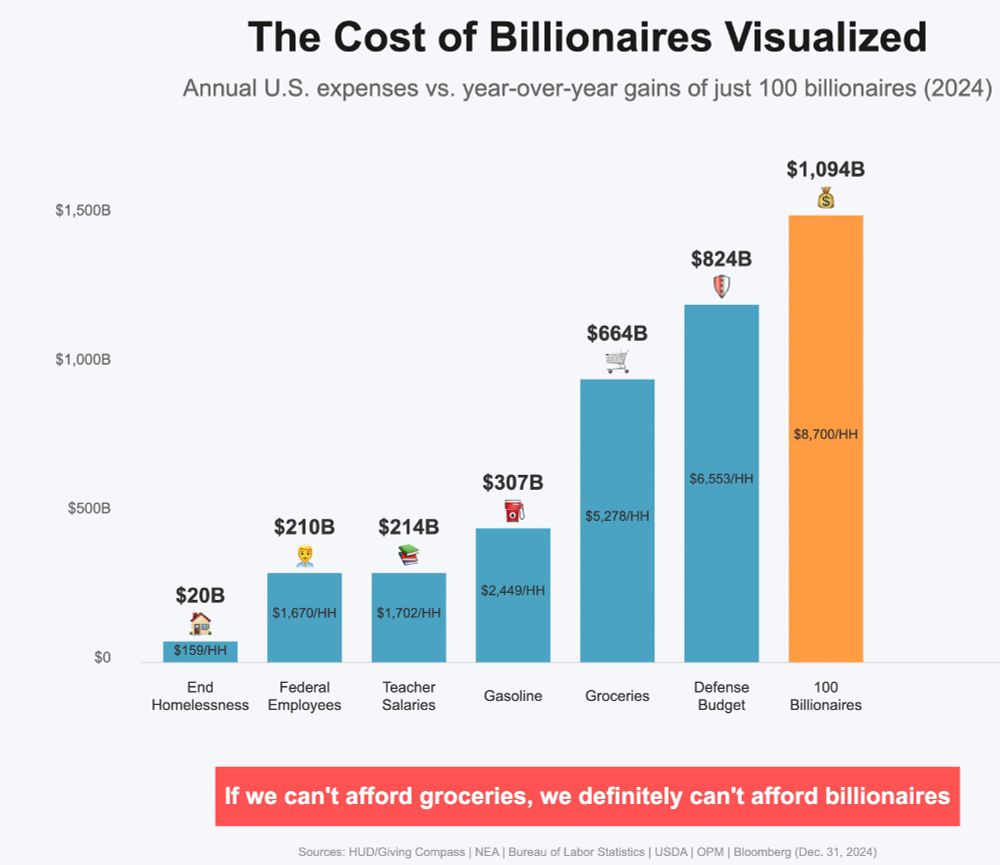
A bar chart titled “The Cost of Billionaires Visualized” compares major U.S. expenses to the 2024 year-over-year wealth gains of just 100 billionaires. Bars represent spending or gains in billions of dollars and are labeled with household-level (HH) equivalents. Categories shown include:
• Ending homelessness: $20B ($159 per household)
• Federal employees: $210B ($1,670/HH)
• Teacher salaries: $214B ($1,702/HH)
• Gasoline: $307B ($2,449/HH)
• Groceries: $664B ($5,278/HH)
• Defense budget: $824B ($6,553/HH)
• 100 billionaires: $1,094B ($8,700/HH)
A red banner at the bottom reads: “If we can’t afford groceries, we definitely can’t afford billionaires.”
Sources listed include HUD, NEA, BLS, USDA, OPM, and Bloomberg (Dec. 31, 2024).
If you took the $1.1 trillion earned by just 100 billionaires last year and mailed every household a check, it'd be $8,700 each.
The thing is most billionaires don't actually pay taxes anymore. What the GOP bill is really doing is selling off public lands and cutting Medicare to pay off oligarchs.
20.06.2025 05:33 — 👍 1331 🔁 585 💬 36 📌 21
Okay this is getting ridiculous.
In addition to the ongoing problems with the UK’s Labour Force Survey, the Wealth and Assets Survey (key source for measuring wealth inequality) has now also had its accreditation revoked due to falling response rates.
osr.statisticsauthority.gov.uk/news/osr-sus...
14.06.2025 09:42 — 👍 131 🔁 40 💬 9 📌 6
Fellow European researchers, if at all in your power, try to get your school to consider late applicants who were admitted to US programs.
Hearing from many cases of admitted to top US schools who last minute realize they won't be allowed in the country.
13.06.2025 09:15 — 👍 18 🔁 6 💬 1 📌 0

“I Netflix-serien ‘Reservatet’ ses ekstrem rigdom - næsten eksotisk for Danmark. Men eksistensen af en superrig dansk elite er mere virkelig end nogensinde.”
25 reformer har medvirket til øget ulighed: Socialdemokratiet stemt for 12, DF/Konservative for 21, Venstre for 23
www.mm.dk/velfaerd/art...
02.06.2025 14:52 — 👍 106 🔁 24 💬 2 📌 6

NSF slashes number of ‘rotators’ and well-paid managers as part of restructuring
Smaller future budgets will require fewer people, NSF official tells staff
1. After getting some further insight into changes at NSF (thanks to those who reached out), I deleted a previous post where I tried to make sense of Cheatham's memo as reported in the Science story below.
10.05.2025 01:58 — 👍 318 🔁 157 💬 7 📌 21
‼️If you haven't seen the call already, this is your reminder‼️
3-year postdoc in computational social science at Aarhus University to study societal norms about political power 🫅
I'll be @comptext.bsky.social in Vienna (April 24-26) if you want to meet up and hear more about the position ☕🗣️
09.04.2025 07:35 — 👍 36 🔁 35 💬 1 📌 0
I (try to) advance knowledge on the politics of dictatorships, political elites, comparative politics, and 💵🏠 as Associate Professor at University of Oslo. I also collect loads of data on governments: https://bit.ly/whogov.
https://emilhvitfeldt.com/
making modeling easier in #rstats with tidymodels at @posit.co
writing about feature engineering (https://feaz-book.com/) and Slidecrafting. He/Him
I'm an associate director at the Pew Research Center in Washington, DC. Follow us: @pewresearch.org. Learn more: https://www.pewresearch.org/
Postdoc @ Uni Siegen, Political Economy | Interested in all political sociology and political economy | before: Unis Duisburg, Oxford & Mannheim + Politics
Associate Professor, Deparment of Psychology, Aarhus University
Interested in personality, dishonesty and all things antisocial
Enthusiastic about transparency and open science ☀️
Psychologist focused on identity, time, and well-being | Ph.D student at Service Research Center | Part-time soldier in Swedish Armed Forces | Writer | Amateur pianist | Micro-philanthrope
Use Bluesky mainly to follow topics and gather information.
Jonathan Wolff,
Political Philosopher.
Fellow British Academy
Emeritus Professor Blavatnik School of Government, Oxford
Wolfson College
President The Royal Institute of Philosophy
THFC supporter in 'what's the Premier League?' mode.
#academic
Assistant professor of Political Science at the University of California, Irvine | researching and teaching IPE, financial politics, global inequality | fan of plants, birds, snacks, sci-fi, quilting | she/her
Journalist. Quattrone Center journalism fellow.
Author: Rise of the Warrior Cop.
Co-author: The Cadaver King and the Country Dentist.
New podcast: Collateral Damage
Substack: radleybalko.substack.com
Signal: radleybalko.52
Science journalist at Weekendavisen
phd student https://janpfander.github.io/
University Assistant (Praedoc) & PhD student @univienna
Social & Economic Psychology Group
Conflict and cooperation
President of Signal, Chief Advisor to AI Now Institute
Official Bluesky account of the General Meeting of the European Association of Social Psychology that will take place in Strasbourg in 2026.
Currently a visiting researcher at @bennettoxford.bsky.social. Normally at Uni of Bern.
Meta-scientist building tools to help other scientists. NLP, simulation, & LLMs.
Creator and developer of RegCheck (https://regcheck.app).
1/4 of @error.reviews.
🇮🇪
Social Psychology PhD candidate at Northwestern University, alum of University of Michigan (she/her) :-) interested in inequality, power, unions, and societal injustice
Professor of moral psychology and cognitive science @ Franklin & Marshall College. Dad, vegan, secular humanist, tree-hugger. www.joshuarottman.com
@Utrecht University (the Netherlands), Kids in Context - studies social development and how inequality impacts children