Microvascular hypoxia and inflammation in chronic pain syndromes
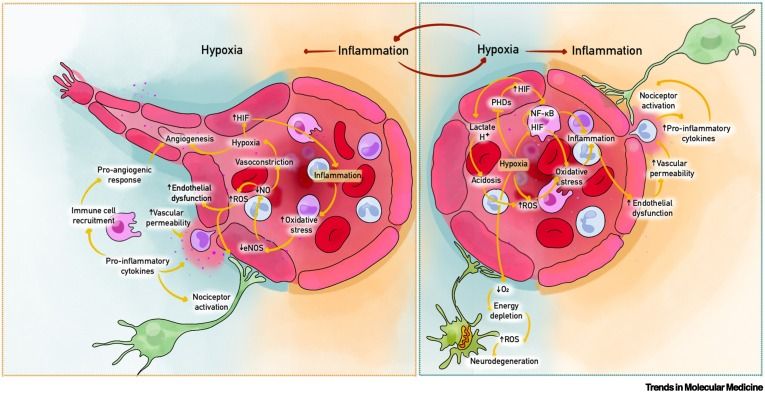
In this opinion, we propose that compromised microvascular perfusion and inflammation are fundamental drivers of chronic pain syndromes, with many of these conditions sharing a common etiology involving suboptimal blood flow and inflammatory cascades. This hypothesis links capillary constriction, hypoxia, inflammation, and nociceptor activation into a unified framework for understanding pain mechanisms. For each example syndrome, we explore specific nuances, molecular mechanisms, and therapeutic opportunities, focusing on the interplay between hypoxia and inflammation. Current treatments often emphasize anti-angiogenic or broad-spectrum approaches, which may neglect the microvascular and hypoxic origins. We review studies investigating microvascular hypoperfusion and inflammation in pain and suggest that targeted therapies addressing vascular deficits and inflammatory responses could better disrupt the hypoxiaβinflammation cycle, offering novel avenues for treatment.
ICYMI: ONLINE NOW: Microvascular hypoxia and inflammation in chronic pain syndromes
10.12.2025 02:13 β π 1 π 0 π¬ 0 π 0
Microvascular hypoxia and inflammation in chronic pain syndromes
In this opinion, we propose that compromised microvascular perfusion and inflammation are fundamental drivers of chronic pain syndromes, with many of these conditions sharing a common etiology involving suboptimal blood flow and inflammatory cascades. This hypothesis links capillary constriction, hypoxia, inflammation, and nociceptor activation into a unified framework for understanding pain mechanisms. For each example syndrome, we explore specific nuances, molecular mechanisms, and therapeutic opportunities, focusing on the interplay between hypoxia and inflammation. Current treatments often emphasize anti-angiogenic or broad-spectrum approaches, which may neglect the microvascular and hypoxic origins. We review studies investigating microvascular hypoperfusion and inflammation in pain and suggest that targeted therapies addressing vascular deficits and inflammatory responses could better disrupt the hypoxiaβinflammation cycle, offering novel avenues for treatment.
ONLINE NOW: Microvascular hypoxia and inflammation in chronic pain syndromes
08.12.2025 20:12 β π 0 π 0 π¬ 0 π 0
The overlooked uterine factor: unlocking endometrium potential in premature ovarian insufficiency
To date, research on premature ovarian insufficiency (POI) primarily centers on ovarian dysfunction and systemic hormonal imbalances, with limited attention given to associated endometrial alterations. Given the critical role of the endometrium in reproductive function and its potential contribution to POI-related infertility, in this review, we bridge the knowledge gap regarding endometrial aspects of POI. We discuss the physiology and pathophysiology alterations in the POI endometrium, the multilevel endometrial changes spanning histological architecture, molecular signatures, and functional capacity, and clinical ramifications for fertility potential. In addition, we critically evaluate both established and novel therapeutic interventions targeting these endometrial abnormalities, paying particular attention to their potential to restore reproductive function.
ICYMI: ONLINE NOW: The overlooked uterine factor: unlocking endometrium potential in premature ovarian insufficiency
07.12.2025 18:53 β π 0 π 0 π¬ 0 π 0
The overlooked uterine factor: unlocking endometrium potential in premature ovarian insufficiency
To date, research on premature ovarian insufficiency (POI) primarily centers on ovarian dysfunction and systemic hormonal imbalances, with limited attention given to associated endometrial alterations. Given the critical role of the endometrium in reproductive function and its potential contribution to POI-related infertility, in this review, we bridge the knowledge gap regarding endometrial aspects of POI. We discuss the physiology and pathophysiology alterations in the POI endometrium, the multilevel endometrial changes spanning histological architecture, molecular signatures, and functional capacity, and clinical ramifications for fertility potential. In addition, we critically evaluate both established and novel therapeutic interventions targeting these endometrial abnormalities, paying particular attention to their potential to restore reproductive function.
ONLINE NOW: The overlooked uterine factor: unlocking endometrium potential in premature ovarian insufficiency
06.12.2025 12:52 β π 1 π 0 π¬ 0 π 0
Neuroendocrine timekeepers: changes in normal and premature aging
The hypothalamus is a central regulator of circadian rhythms, metabolism, and endocrine function, integrating internal and external cues to maintain physiological homeostasis. Aging impairs hypothalamic function, leading to metabolic changes, sleep disturbances, and a higher risk of age-related disease. Laminopathies β rare genetic disorders marked by premature aging β exhibit profound neuroendocrine and circadian rhythm dysfunction, offering insights into mechanisms of hypothalamic aging. The complex interplay between the hypothalamus, circadian rhythms, and systemic aging highlights the critical role of neuroendocrine crosstalk in the regulation of health span and life span. This review summarizes emerging molecular and physiological insights into hypothalamic aging and circadian misalignment, and highlights potential interventions, such as chronotherapy and caloric restriction, that may alleviate hypothalamic alterations and promote healthy aging.
ICYMI: ONLINE NOW: Neuroendocrine timekeepers: changes in normal and premature aging
02.12.2025 18:55 β π 1 π 0 π¬ 0 π 0
Neuroendocrine timekeepers: changes in normal and premature aging
The hypothalamus is a central regulator of circadian rhythms, metabolism, and endocrine function, integrating internal and external cues to maintain physiological homeostasis. Aging impairs hypothalamic function, leading to metabolic changes, sleep disturbances, and a higher risk of age-related disease. Laminopathies β rare genetic disorders marked by premature aging β exhibit profound neuroendocrine and circadian rhythm dysfunction, offering insights into mechanisms of hypothalamic aging. The complex interplay between the hypothalamus, circadian rhythms, and systemic aging highlights the critical role of neuroendocrine crosstalk in the regulation of health span and life span. This review summarizes emerging molecular and physiological insights into hypothalamic aging and circadian misalignment, and highlights potential interventions, such as chronotherapy and caloric restriction, that may alleviate hypothalamic alterations and promote healthy aging.
ONLINE NOW: Neuroendocrine timekeepers: changes in normal and premature aging
01.12.2025 12:53 β π 0 π 0 π¬ 0 π 0
The November issue of Trends in Molecular Medicine is now online! www.cell.com/trends/molec...
Special thanks to all the authors and reviewers for their contribution!
I am happy to receive your feedback and ideas for topics so please get in touch!
06.11.2025 15:57 β π 1 π 0 π¬ 0 π 0
Precision medicine for sodium channelopathy-related autism and epilepsy
Precision medicines for monogenic brain disorders are rapidly advancing. Voltage-gated sodium channel (VGSC) genes are the leading monogenic cause of severe epilepsy and profound autism spectrum disorder, most (ASD) notably SCN1A, SCN2A, SCN3A, and SCN8A. Recent advances in animal and human induced pluripotent stem cell (hiPSC) disease models provide a powerful platform for advancing precision medicines. Thanks to the genomic revolution, many gene therapies are in preclinical studies and clinical trials for VGSC-related diseases, including viral vector gene replacement, clustered regularly interspaced short palindromic repeats (CRISPR) base editing, prime editing, and genetic modulation strategies including antisense oligonucleotides, engineered tRNAs, and CRISPR activation/interference (CRISPRa/i). This review highlights the latest advances in disease modeling and next-generation therapeutic development to advance precision medicine for VGSC-related brain disorders.
ICYMI: ONLINE NOW: Precision medicine for sodium channelopathy-related autism and epilepsy
29.10.2025 20:06 β π 0 π 0 π¬ 0 π 0
Precision medicine for sodium channelopathy-related autism and epilepsy
Precision medicines for monogenic brain disorders are rapidly advancing. Voltage-gated sodium channel (VGSC) genes are the leading monogenic cause of severe epilepsy and profound autism spectrum disorder, most (ASD) notably SCN1A, SCN2A, SCN3A, and SCN8A. Recent advances in animal and human induced pluripotent stem cell (hiPSC) disease models provide a powerful platform for advancing precision medicines. Thanks to the genomic revolution, many gene therapies are in preclinical studies and clinical trials for VGSC-related diseases, including viral vector gene replacement, clustered regularly interspaced short palindromic repeats (CRISPR) base editing, prime editing, and genetic modulation strategies including antisense oligonucleotides, engineered tRNAs, and CRISPR activation/interference (CRISPRa/i). This review highlights the latest advances in disease modeling and next-generation therapeutic development to advance precision medicine for VGSC-related brain disorders.
ONLINE NOW: Precision medicine for sodium channelopathy-related autism and epilepsy
28.10.2025 14:04 β π 0 π 0 π¬ 0 π 0
Scientific content aggregator with custom content feeds. Science news, jobs, events and more. Sign up at https://www.scientific.today.
Professor I
Trying to speak my mind about the relevance of molecular processes in physiology and nutrition I
Reviews Editor in Eur J Appl Physiol |
https://nikolaidis.weebly.com/
Assistant Scientist at the University Health Network and Assistant Professor at the University of Toronto.
Esophageal Adenocarcinoma and Lung Transplant Bioinformatics/Genomics
PhD/Postdoc (RNA/liver disease/therapeutics)
- Former clinical/translational Editor @NatComms
- Current Deputy Editor/EiC @AdvPortfolio
RCLCF Clinical Research Fellow & Medical Oncology Registrar | CRUK National Biomarker Centre & The Christie NHS Foundation Trust
https://www.researchgate.net/profile/Roya-Behrouzi
Laboratory of Cell Biology and Biophysics. Investigates the molecular mechanisms of life processes in human health and disease.
www.aydinlab.org
Associate Professor, University of Copenhagen
PI, the Novo Nordisk CO2 Research Center
The ABTA provides resources to support the needs of brain tumor patients & caregivers and funds critical research in the pursuit of discovering breakthroughs.
Signal Transduction and Targeted Therapy (STTT) | A Nature Portfolio journal | Impact Factor 52.7 | Q1 in Biochemistry, Cell Biology & Molecular Medicine | Open Access
Visit: https://www.nature.com/sigtrans/
The goal of our lab is to identify unique signatures of different brain diseases. A signature is a specific and complex combination of biomarkers that reflect a biological state.
T cell responses, formation of immunological memory. Tumor immunology and infection.
Group Leader at the European Institute of Oncology, Milan, Italy
Postdoc at University of Turku chasing RNAs π©βπ¬π§¬π»
Postdoctoral fellow @mdanderson
RNA biology | Regulatory genomics | still figuring it out.
Skeptic to the point i doubt myself.
Transylvanian living in Houston π·π΄π€ π΄πΌ
Semper vestigans | All things mitochondria
https://biochem.unl.edu/oleh-khalimonchuk-lab/
Assistant Professor at the University of Utah
Department of Nutrition & Integrative Physiology
Nora Eccles Harrison Cardiovascular Research & Training Institute
Diabetes & Metabolism Research Center
Postdoc in @jthompsonlab.bsky.social at the University of Calgary. (www.jenniferthompsonlab.com)
Researching metabolism, adipose tissue, estrogen signaling, women's health, and obesity. Did my PhD here: www.lynnlab.com
Department of Molecular Genetics of Ageing, Max Planck Institute for Biology of Ageing
https://www.age.mpg.de/antebi/research
Assistant Professor, Neurology & Neuroscience | Physician-Scientist
Director, BRAVE2 Neuroscience Research Lab
Kennedy Krieger Institute | Johns Hopkins Medicine
Genomics & Bioinformatics Scientist at the University of Edinburgh | Head of Edinburgh Genomics | #Omics #NGS #LongReads π§ͺ𧬠π₯οΈ
Opinions my own. He/Him
LinkedIn: https://www.linkedin.com/in/javiersantoyolopez/