The discovery of the first kinetochore proteins (CENP-A, CENP-B, CENP-C) was reported by Bill Earnshaw and Naomi Rothfield in 1985 in Chromosoma. Forty years later, Chromosoma/Chromosome Research has published a special issue (most articles are open access)
link.springer.com/collections/...
Human acrocentric chromosome short arm de novo mutation and recombination https://www.biorxiv.org/content/10.64898/2025.12.16.694519v1
Thanks, Kaia! I hope all is well with you!
Hats off to our two co-first authors, Shenghan Gao and
@koisland.bsky.social for leading the work, and many thanks to our collaborators, Shu-Cheng Chuang, Mark Loftus, PingHsun Hsieh, Miriam Konkel, Mario Ventura, and others, for making this work possible!
Our work reveals an "arms race" between centromeric sequences and proteins, with frequent mutations within the site of the kinetochore that lead to changes in genetic and epigenetic landscapes and, ultimately, rapid evolution of these critically important regions.
Finally, comparison with 6,230 centromeres assembled by the HPRC and a 4-generation pedigree (8,340 centromeres total) reveals that centromeres vary in mutation rate by >50-fold. Surprisingly, the kinetochore site is often the most rapidly mutating region in the centromere.
Additionally, we show that some centromeres have evidence of introgression from archaic hominins, with Neanderthal and Denisovan DNA enriched in a subset of centromeres from chromosomes 10 and 21.
We find that the location of the kinetochore depends on the underlying sequence and structure of the centromere, with some chromosomes having a single kinetochore location and others having multiple, distinct locations that stratify by haplotype structure.

Absolutely thrilled to share the latest work from my lab focused on the variation and evolution of human centromeres among global populations! We assembled 2,110 human centromeres, identifying 226 new major haplotypes and 1,870 α-satellite HOR variants. www.biorxiv.org/content/10.6...
It's exciting to see the continuing legacy of T2T sequencing methods being discussed on @scifri.bsky.social ! 🧬
Complete genomes are helping us understand more and more about genetic function and diversity in areas of our DNA that were unreadable just a few years ago.
This was both fun and terrifying to tape! Awesome to talk with @glennislogsdon.bsky.social and @aphillippy.bsky.social about our sequencing data / paper, the improvements to large-scale sequencing projects, and what this means for our understanding of our DNA!

Complete genomes alert! @glennislogsdon.bsky.social, @christinebeck.bsky.social, and I were on @scifri.bsky.social today talking about "Complex genetic variation in nearly complete human genomes"
📄 www.nature.com/articles/s41...
📻 www.sciencefriday.com/segments/65-...

Telomere-to-telomere DNA sequencing is set to transform the field of human genetics in coming years. For a flavour of what's coming, see this exciting work on nearly complete genomes of 65 individuals from diverse populations, out today in @nature.com by @glennislogsdon.bsky.social & colleagues. 👇🧬🧪

🚨New preprint out!
🧬Short reads can now decode centromeres.
🌍We reveal population-scale centromere haplogroups and their links to disease.
biorxiv.org/content/10.1... (1/n)

We updated our preprint describing chr21 centromere genetics/epigenetics in families with Down syndrome and general population! We found transgenerational methylation changes in a subset of families and that centromere size asymmetry is exclusive to T21! www.biorxiv.org/content/10.1...

Congratulations to @glennislogsdon.bsky.social (@penngenetics.bsky.social/ @pennepigenetics.bsky.social) on being named a 2025 Searle Scholar! tinyurl.com/ma4sp577
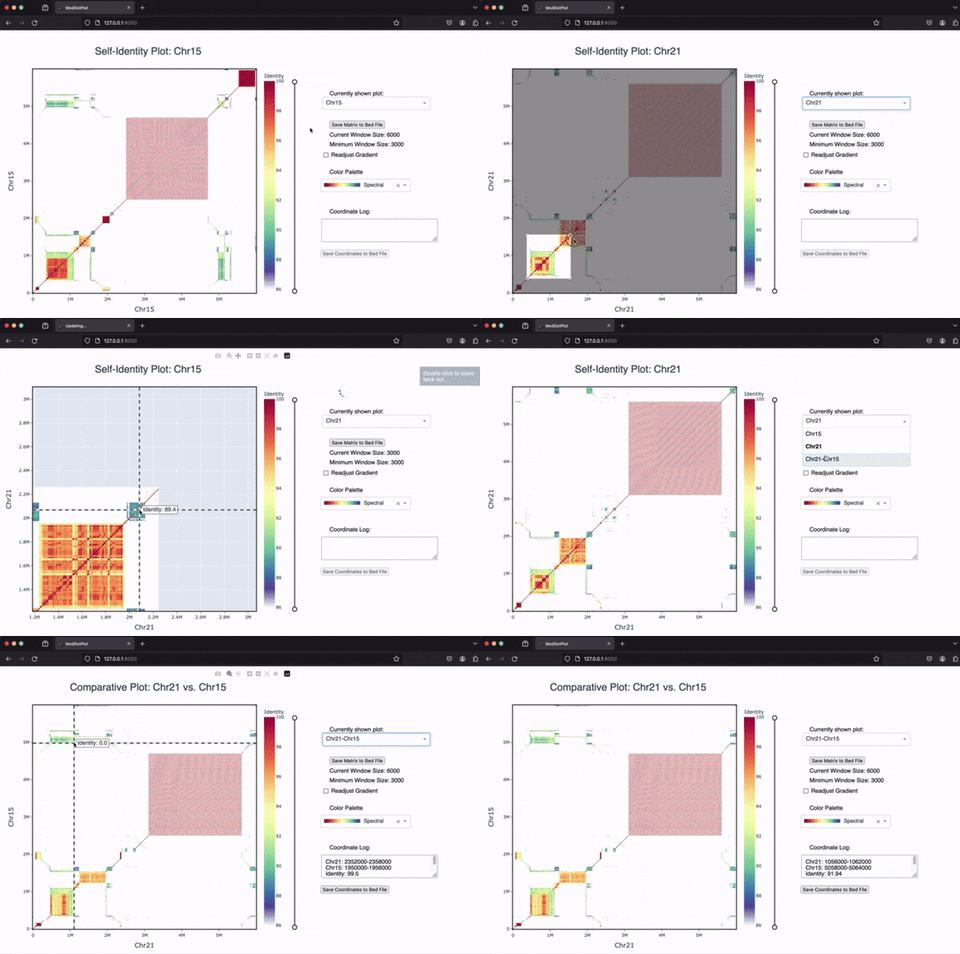
ModDotPlot preprint is now out! Winner of best poster at RECOMB 2023, it can generate either static or interactive dotplots in minutes using hierarchical modimizers. With @alexsweeten.bsky.social and @mikeschatz.bsky.social
Preprint: www.biorxiv.org/content/10.1...
Code: github.com/marbl/ModDot...

Out in Nature from @glennislogsdon.bsky.social. Amazing work on human centromeres and their evolution!
www.nature.com/articles/s41...
We demonstrate a single-platform solution for complete T2T genomes on the ONT PromethION: Duplex + Ultra-long + Pore-C, aka "TNT" 🧨 Expecting rapid improvements in the coming year. Congrats @sergek.bsky.social @zbao.bsky.social @awngs.bsky.social @awngs.bsky.social @khmiga.bsky.social et al.!
Thank you for the warm welcome, @nucleosomepolice.bsky.social! So excited to be on this platform with amazing and inspiring scientists like yourself!
